ARCHIVED RESEARCH PROJECT
f1r high-resolution calibration and review
How does f1r extract from the native Yale TIFF compared with the earlier PDF-derived run?
FINDINGS AND REVIEW IMAGES488 accessible result rows from 488 authoritative meaningful result rows in the declared scope. Review cards are separate.
All rows from the stated saved result sets are accessible; detailed machine arrays remain in the linked source files.
The preserved report and review images below contain the surviving human-review material; no separate historical item count was recorded.
This curated view is separate from the complete meaningful results listed above.
Archived research project · completed 2026-09-25
ARCHIVED RESEARCH PROJECT
How does f1r extract from the native Yale TIFF compared with the earlier PDF-derived run?
FINDINGS AND REVIEW IMAGESFINDINGS FROM THE COMPLETED STUDY · public presentation of [preserved evidence reference]
Ready for human review. Provenance and reproducibility validated; segmentation and classification accuracy remain unvalidated.
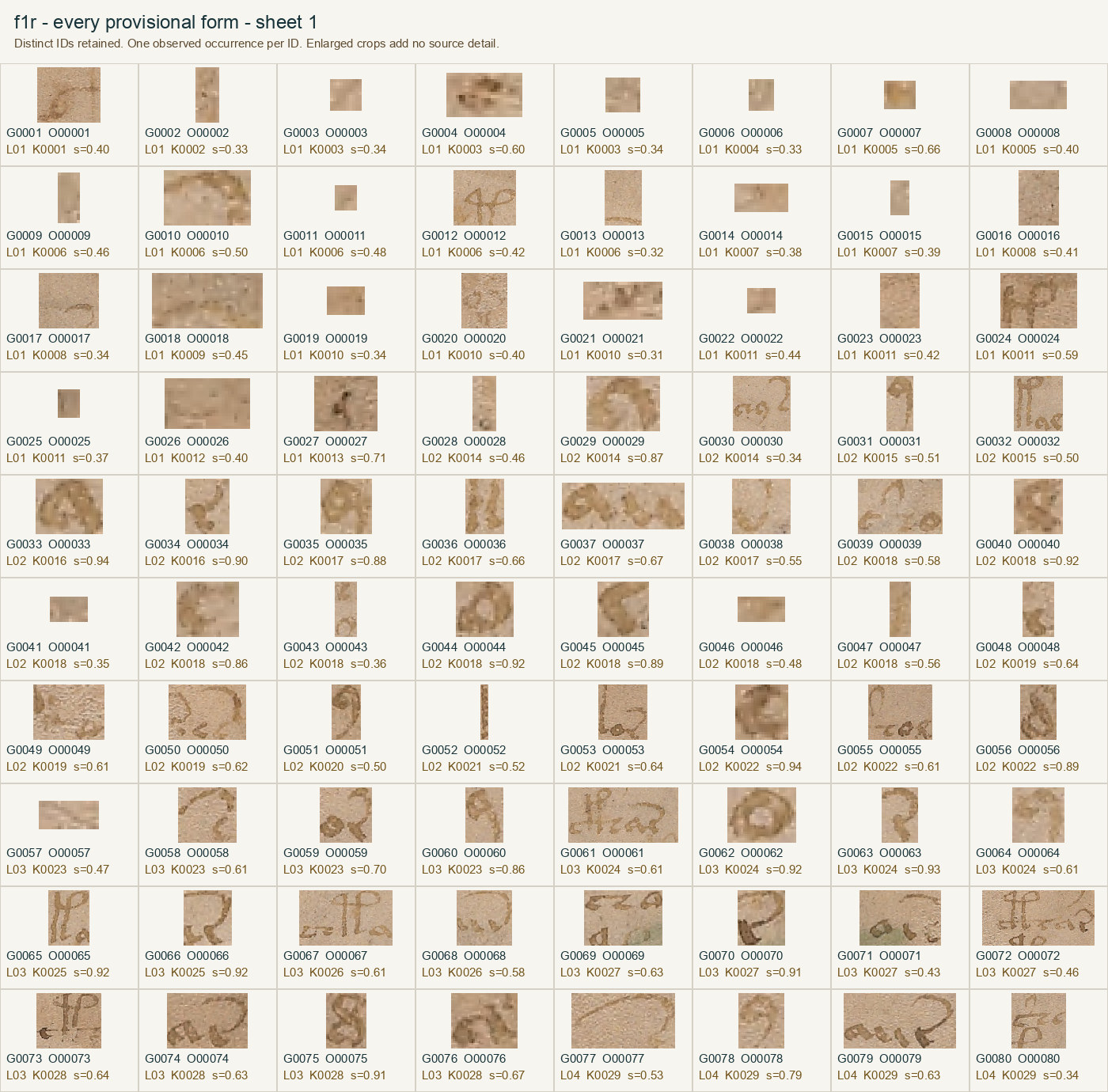
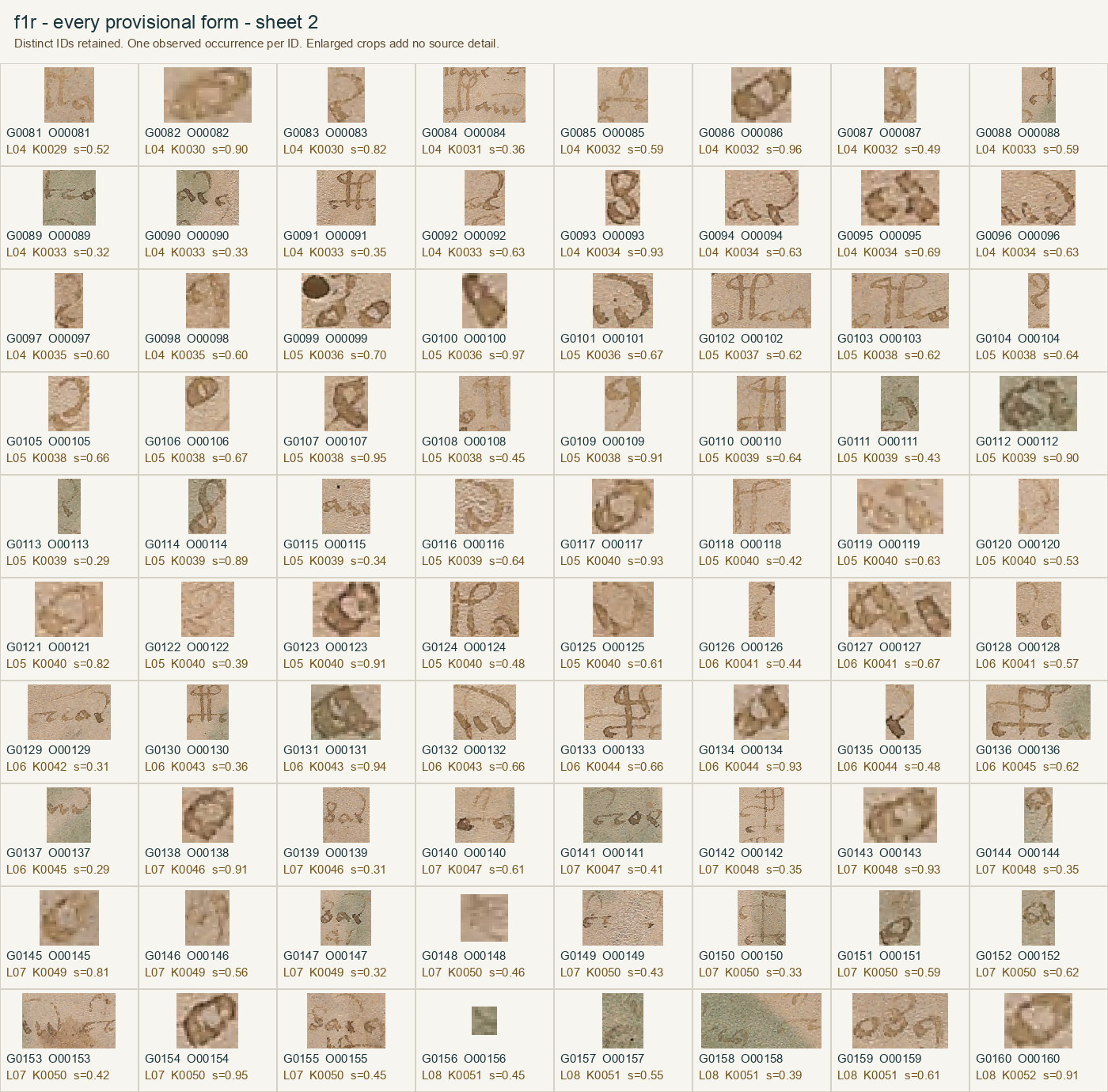
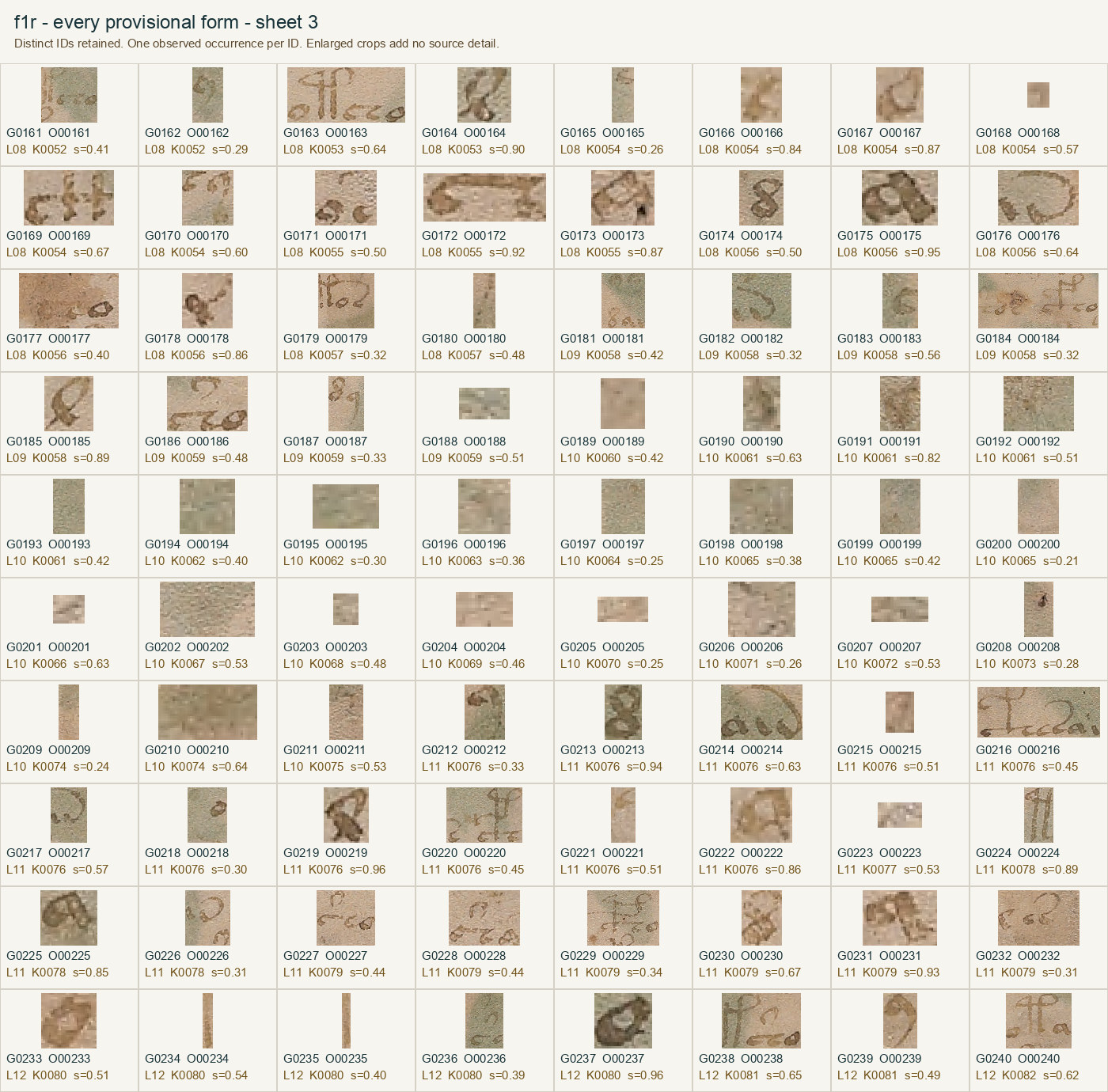
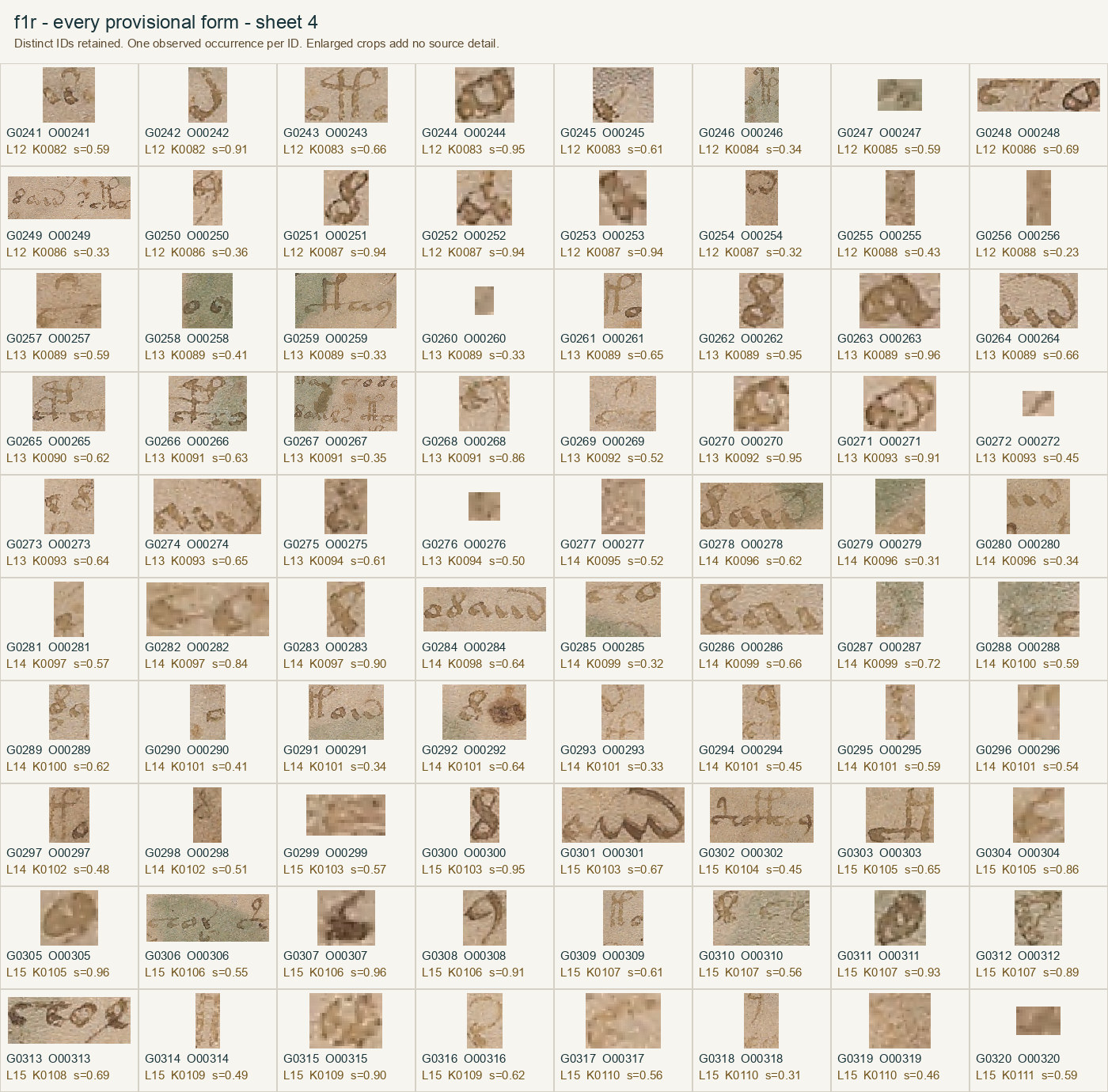
Open the offline review browser. Use v003 ↔ v004, then Changed interpretation proposals, Clearer source evidence, or a structural filter. Search v003:O00479 to inspect the previously difficult R2 example. Each pair includes old pixels, the same field in the TIFF, wider context, and links to independent native proposals, their components, alternatives and candidate relatives.
The authoritative source is f001r.tif, registered under yale_original_tiffs_v001: 2972 × 3766, versus 1184 × 1500 in v003. This provides 2.510× the sampling in each direction and 6.302× as many pixels. Native loops, stroke edges, narrow spaces and surface texture are visibly better resolved. The original TIFF is retained byte-for-byte; the PNG and all materialized crops preserve its decoded RGB values without extraction-time resampling, sharpening or contrast adjustment. No meaningful physical manuscript DPI is inferred from a file tag; extraction uses native pixels.
TIFF SHA-256: f78493ff8b753b998b16d28962f3d43a7383bc667c5a87b7931125e6b184d41b.
Fresh provisional block, decoration, right-edge and R-region annotations were made on a native-coordinate TIFF grid. The extraction ran without access to old observation, line, cluster, crop or review records and was frozen before registration. A file-read audit enforces that boundary. The old numeric rules supplied the physical-scale conversion; old segmentation did not supply the new boundaries. .
The threshold/segmentation algorithm and neutral-ID policy are unchanged. Pixel lengths scale by x=2.510135135 and y=2.510666667; areas by their product. For example, bridge gap 1→2.510135 px, cluster gap 8→20.081081 px, line-peak distance 24→60.256 px, minimum area 4→25.208450 px². Intensity thresholds 6/8/10, primary threshold 8, contrast floor 14, uncertainty rules, normalized shape space and identity rules are unchanged. Array bounds and crop padding require documented integer rounding. , .
These are conservative assistant evidence assessments, awaiting human approval. A does not certify alphabet membership; C/D do not apply a split or merge.
| Assessment | Old observations |
|---|---|
| A — Confirmed visual observation | 20 |
| B — Same probable form, clearer | 171 |
| C — Likely needs splitting | 2 |
| D — Likely needs merging with neighbor | 2 |
| E — Previously invisible distinction established | 0 |
| F — Remains ambiguous | 281 |
| G — Old boundary likely incorrect | 12 |
| H — Registration uncertain | 0 |
191 observations are confirmed or clearer (A+B). The 2 split candidates concern cross-line spatial contamination, not letter counts. The 2 merge candidates are the two faint stem fragments O00044/O00045, retained independently. Twelve other old boundaries likely include neighboring-line strokes or truncate structures. No previously invisible structural distinction was established strongly enough for E; this is not evidence that none exists. All 488 old observations remain available, and no identity change was applied.
The first assessment mistakenly included neighboring curved mark O00046 in a merge proposal. A closer coordinate-labeled context check excluded it. The initial assessment remains intact, with an explicit superseding event in . O00046 remains F. No human decisions were migrated.
| Measurement | v003 | v004 |
|---|---|---|
| Line proposals | 24 | 27 |
| Visual clusters | 164 | 189 |
| Provisional visual IDs | 488 | 601 |
| Raw threshold connected components | 40,597 | 208,907 |
| Components routed to whole forms | 1,747 | 1,950 |
| Residual components retained | 38,850 | 206,957 |
| Unselected partition hypotheses | 271 | 304 |
| Alternative partition children | 1,054 | 1,101 |
| Low-confidence segmentation | 196 | 232 |
| Threshold-sensitive observations | 41 | 73 |
| Possible compounds | 264 | 276 |
| Neighbor-dependent observations | 344 | 384 |
| Uncertain line assignments | 168 | 185 |
| Repeated-stroke candidates | 270 | 300 |
| Tall-structure candidates | 215 | 220 |
| Horizontal-structure candidates | 121 | 116 |
| Uncertain cluster boundaries | 154 | 134 |
All 601 IDs are provisional singleton observations, not 601 glyph classes. Whole forms and all connected components are retained together. Component decomposition consists of exact threshold membership, skeleton/loop/junction measurements and unselected cut alternatives; semantic stroke ownership remains unresolved. Classification confidence stays unassessed at 0; segmentation scores are unchanged, uncalibrated heuristics.
The 27 line proposals include extra peaks L01 (P1), L10 (P3) and L27 (P4) that require review. This is not a finding of 27 actual text lines. Extra peaks can route the tops and bodies of tall structures separately. The rise to 208,907 threshold components is largely fine texture and faint-mark fragmentation, not newly identified writing. All 206,957 residual components remain inspectable and traceable.
Post-freeze controls enlarged only the old image and ran the same v004 regions and scaled rules: linear interpolation produced 24 lines / 579 whole-form proposals; Lanczos produced 25 / 584, versus native TIFF 27 / 601. Thus the increase from 488 proposals cannot be attributed entirely to genuine new source information. Threshold discretization, interpolation and independent annotation placement also matter. These controls never fed back into extraction. .
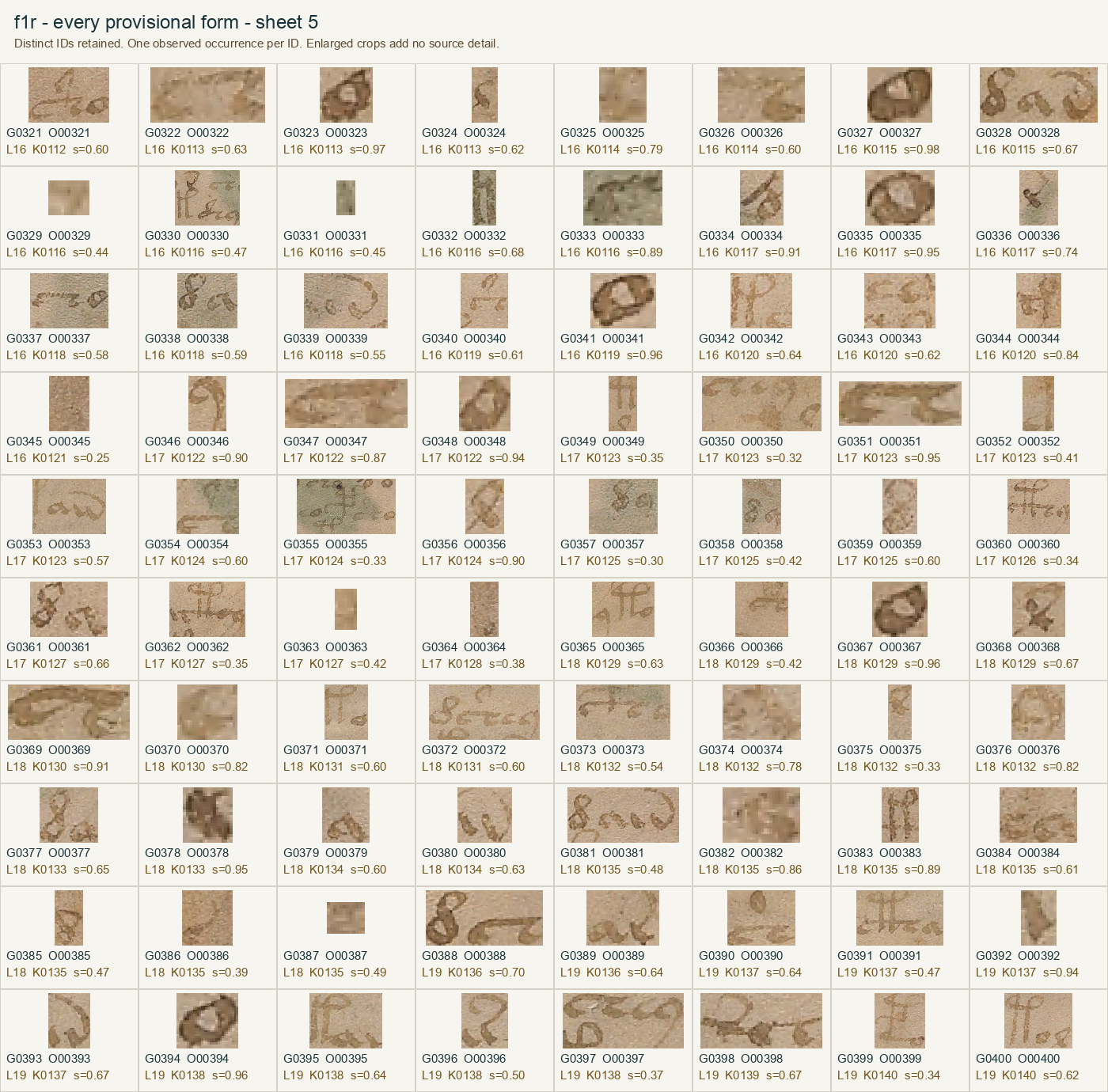
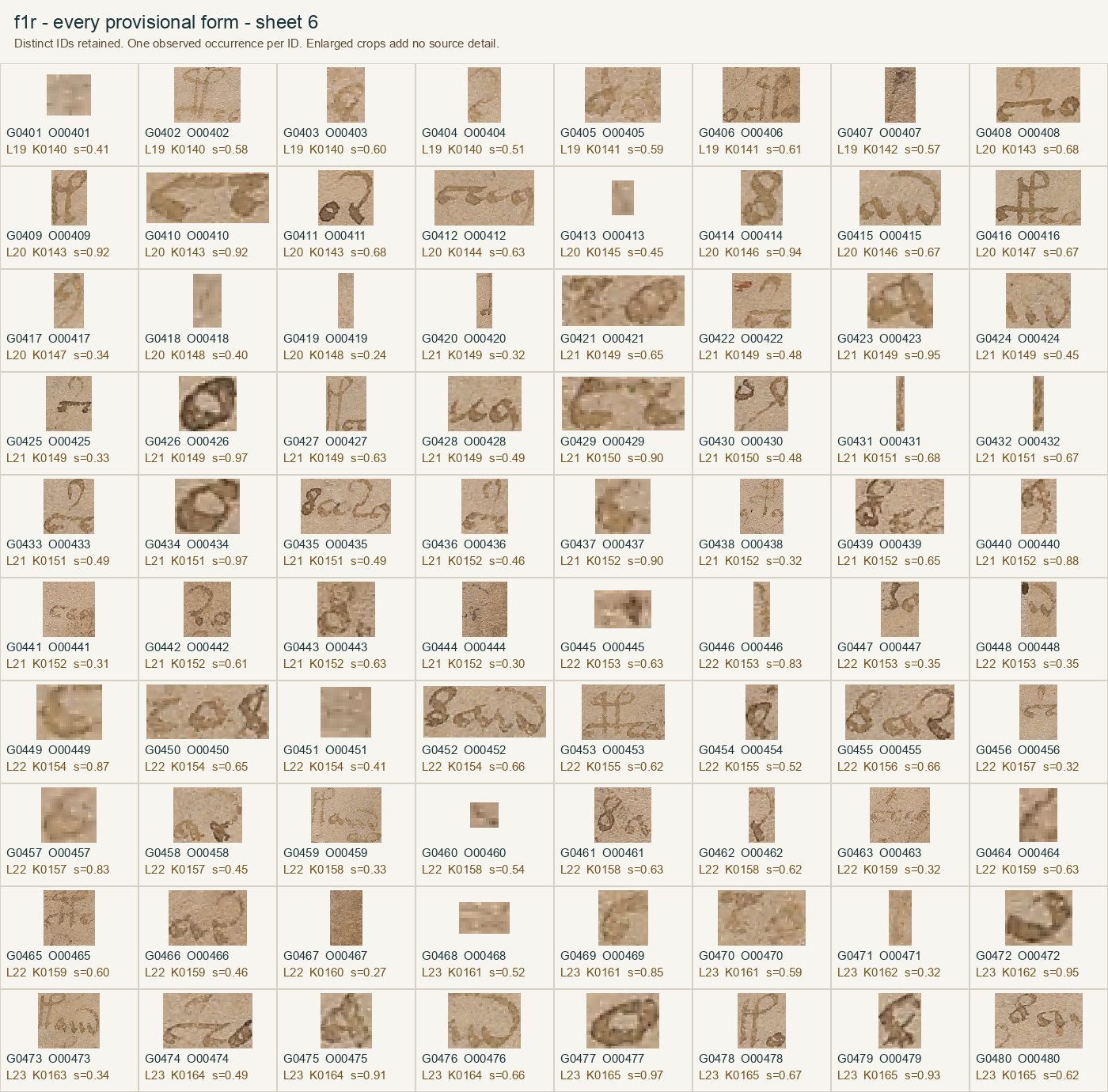
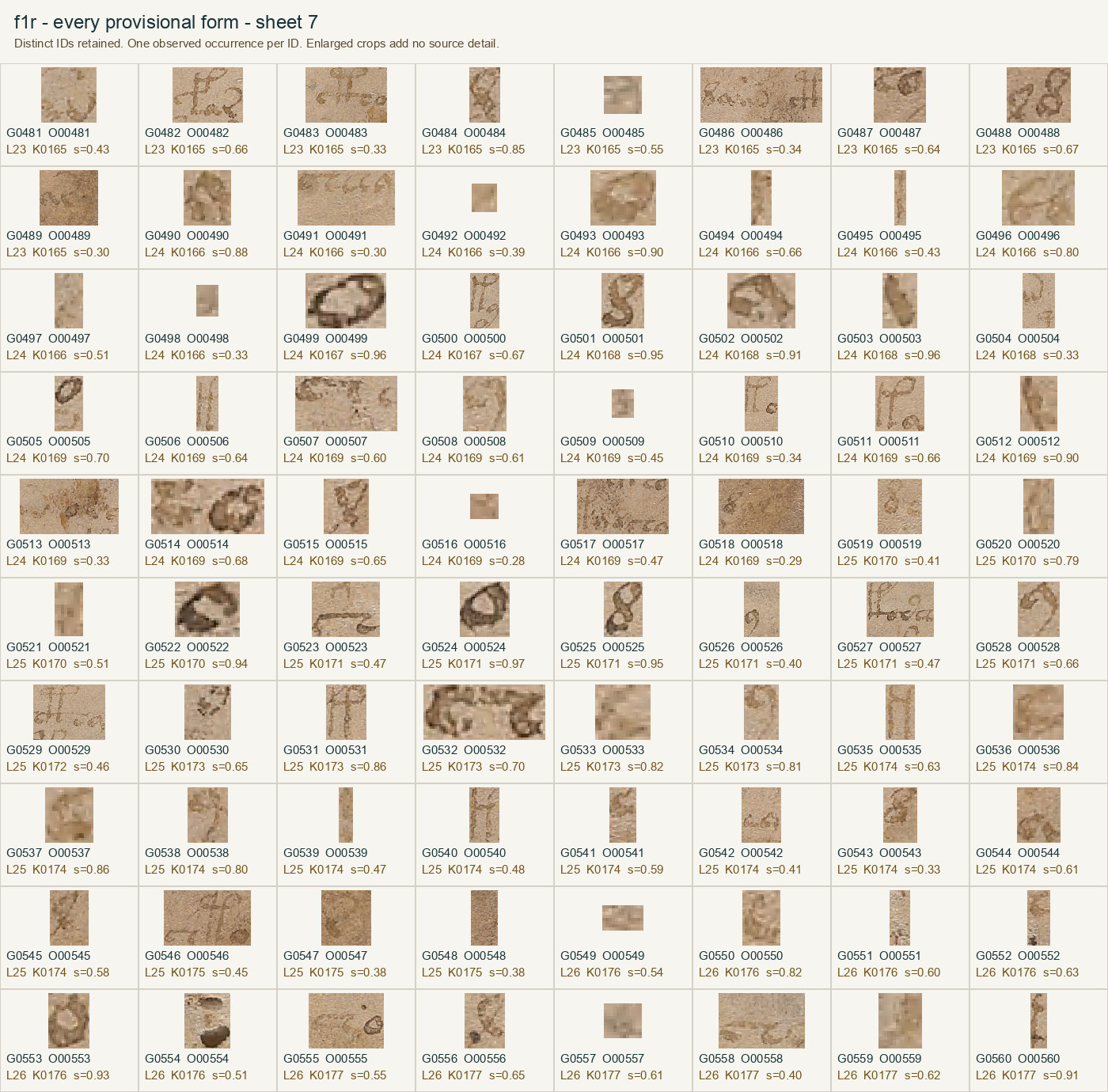
Automatic correspondence triage finds 83 old fields with multiple new proposals, 75 sharing a new proposal, 51 with boundary/routing differences and 21 without assigned-ink correspondence; 258 have simple one-to-one geometric matches. Those are not accepted split/merge counts. Seventy-four new proposals lack an old assigned-ink match; they are not 74 new glyph types.
Minims/repeated strokes: candidate count 270→300 and several partitions change materially at the proposal level. O00081/O00114 show clearer separated dark strokes and intervening texture, but neither a validated minim count nor a unique whole-form partition follows. Repeated-stroke counts remain measurements, not syllable or letter claims.
Tall/gallows and double stems: 215→220 candidates masks substantial routing changes. Inspect O00044/O00045, O00056, O00179, O00248 and O00479 for stem ends, loops and shared crossbars. O00049/O00446 also expose cross-line contamination. Left/right loop differences are clearer and remain distinct observations; no new class is inferred from them. In R2, O00479 remains F despite its sharper stems and loop outlines.
Hooks, benches, compounds and tiny marks: the browser includes focused subsets for curved terminals, horizontal structures, connected/separate strokes, and tiny modifier- or punctuation-like marks. O00333 is a visible isolated dark mark in both sources but is not routed to a new whole form. It remains available in the exact source field and residual layer; calling it punctuation, a modifier, damage or noise would exceed the evidence. No new structural distinction is claimed solely from extra mask loops or components.
Resolved versus unresolved: twenty isolated visual occurrences and their overall crop extents agree; another 171 have clearer probable form evidence. Source alignment and preservation are established. Glyph identity, intentional versus incidental connections, faint ink versus showthrough/texture, compound boundaries, minim counts and linguistic spacing remain unresolved. Finer pixels improve inspection without supplying those missing interpretations.
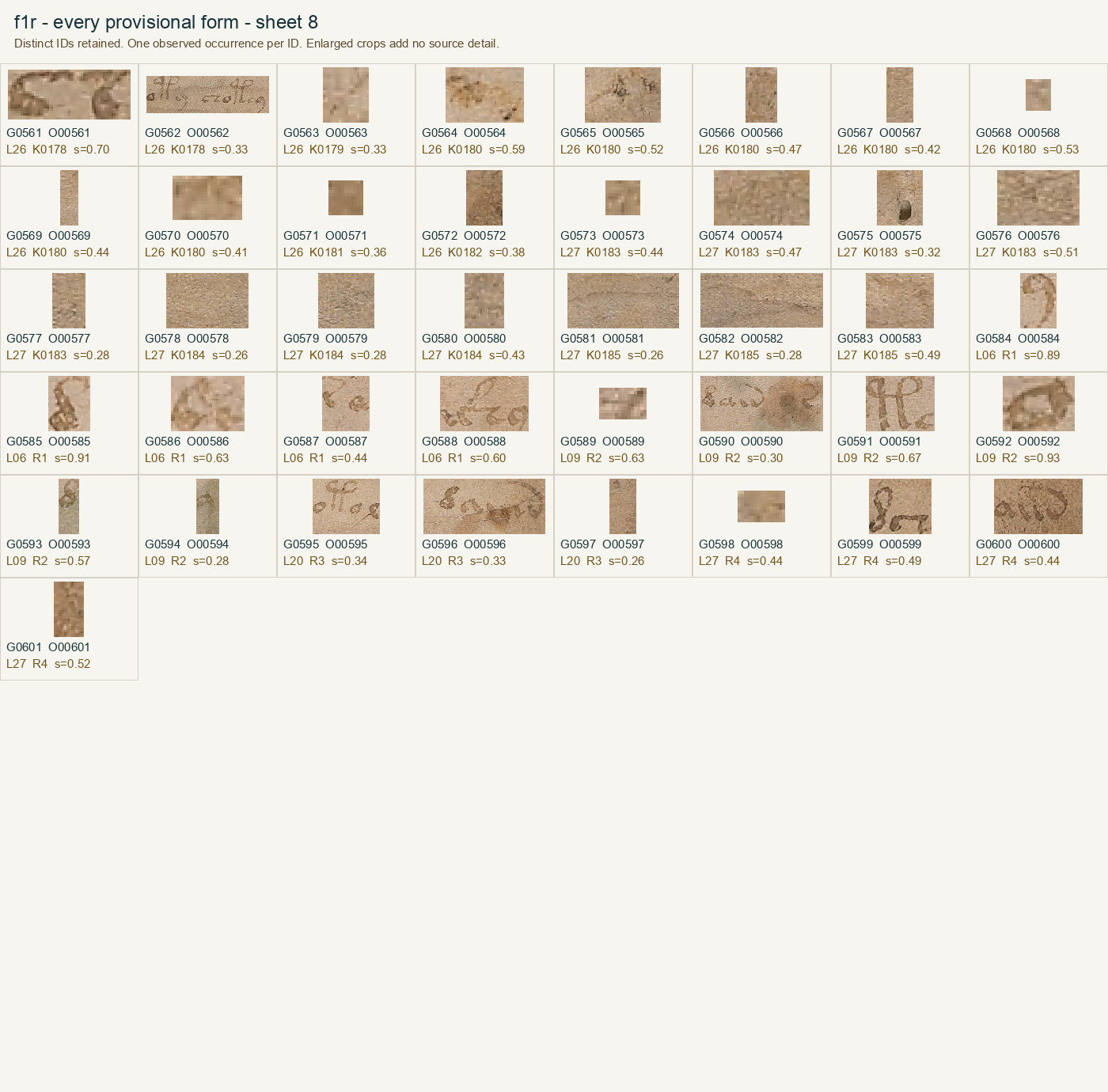
All four groups remain separate layout objects with no assigned meaning. The native terminal strips preserve the surrounding blank space; the overall detached arrangement is visually unchanged. Proposal segmentation changes inside R1–R3.
| Object | Proposal count | Fresh native annotation box | Algorithmic gap, native px | Provisional line |
|---|---|---|---|---|
| R1 | 3 → 5 | [2035, 840, 2395, 930] | 341 | L06 |
| R2 | 4 → 6 | [1835, 1200, 2325, 1320] | 509 | L09 |
| R3 | 4 → 3 | [1945, 2240, 2395, 2360] | 443 | L20 |
| R4 | 4 → 4 | [1975, 2970, 2260, 3070] | 450 | L27 |
These exact numerical gaps are annotation-edge minus routed main-line edge, not definitive ink-to-ink distances. They depend on uncertain line membership. R4 is attached to extra peak L27, while the visible body writing is nearer L26; its gap must not be interpreted as a physical layout change. R3's ROI extends 10 px below its block ROI, and component centroids can route strokes whose boxes extend outside a region. Both are explicit review issues; frozen regions were not retrospectively tuned. The allow direct blank-space inspection.
Embedded from the preserved project files (display copies; originals remain in the project folder).