ARCHIVED RESEARCH PROJECT · completed 2026-09-28 · Starting from f016r, does the double-loop / S-like form recur as one visual family across the manuscript? · Back to Home
PROJECT SUMMARY
QuestionStarting from f016r, does the double-loop / S-like form recur as one visual family across the manuscript?
MethodThe target was defined from the native f016r TIFF (Yale 1006104; 2658 × 3758 pixels), first viewing the whole surface and writing region, then its neutral-extraction candidates. Seeds retain independent candidate IDs and boxes. They describe paired lobes, open caps/opposed bends,…
Important numbers3,451 detected candidate
Finding and conclusionThe paired-lobe core looks like a reusable combining element: it recurs beside other forms, within geometric groups and as initial or terminal material beside similar short bases. It does not look exclusively like a standalone separator or a universally fixed ending. That is a structural…
LimitsThe f016r observation leads to a recurring paired-lobe core within a broader visual family, rather than a defensible single identity for every lookalike. Many examples have a compact central junction and two vertically separated enclosures. Open opposed bends, upright-sided executions, single-lobe forms and regions containing neighboring marks require separate treatment. The pixels do not establish pen order, an accepted unit count or meaning.
MeaningThe f016r observation leads to a recurring paired-lobe core within a broader visual family, rather than a defensible single identity for every lookalike. Many examples have a compact central junction and two vertically separated enclosures. Open opposed bends, upright-sided executions, single-lobe forms and regions containing neighboring marks require separate treatment. The pixels do not establish pen order, an accepted unit count or meaning.
9 source-linked cards. Display images are embedded; original TIFFs and scientific records remain authoritative in the project folder.
44 native-pixel views in nine descriptive panels, starting from f016r. Inspect paired lobes, open bends, nearby marks, uncertain boundaries and similar larger constructions. These are visual observations, not accepted identities or meanings.
D01 · 1 of 9Origin on f016r
The f016r observation
Neutral source-pixel observation
The same folio contains paired enclosed lobes, a closed lower lobe with an open or filled cap, upright-sided forms, a nearby mark, and an opposed open bend. These descriptions may overlap. The final example (local 516) was visibly present but missed by the fixed retrieval.
A narrow waist between vertically stacked lobes recurs in Herbal, astronomical, bathing, pharmaceutical and recipe/text contexts. The foldout example retains Yale’s partial-view designation; no panel identity is invented.
Open opposed curves are visually distinguishable from clearly enclosed lobes. An open or filled cap can also reflect ink loss, thresholding or a different execution. Do not merge these with closed forms solely on resemblance.
These crops may prompt a B-like visual description. They overlap the paired-lobe family; the current evidence does not establish a separate unit or mutually exclusive class.
A paired form beside a hooked or descending element recurs. Pixel separation and ownership vary. The retrieval region sometimes includes two nearby visible forms; it does not prove an attachment.
Multiple substantial components in a normalized mask usually arise from a neighboring mark; faint central breaks can split the paired construction too. These examples do not demonstrate that every paired form consists of two repeated independent units.
One round enclosure and one upper-loop construction are comparators, excluded from the target count. A resemblance of parts does not establish the same construction or an incomplete paired form.
Faint or filled crops leave closure unresolved. The final two broad-search examples are a texture patch and a diagonal stroke, excluded on visual inspection. They make the limits of automated retrieval visible.
Similar short bases, with and without the paired form
Geometric comparison leads
Each adjacent pair compares a short base accompanied by the target with a visually similar base lacking that detected target. Order is left-to-right geometry, not assumed reading order. These are leads for optional initial/terminal material; they do not establish identical strings, insertion/deletion, word boundaries or meaning.
f113rRecipe / textPair 1: With paired form.yale-1006270-CS00538 / yale-1006270-CS00544 / yale-1006270-CS00537Yale 1006270 · bbox 256,1180,419,1234f113vRecipe / textPair 1: Similar base without that detected form.yale-1006271-CS01183 / yale-1006271-CS01187Yale 1006271 · bbox 519,2709,657,2757f056rHerbalPair 2: With paired form.yale-1006184-CS00714 / yale-1006184-CS00721 / yale-1006184-CS00730Yale 1006184 · bbox 716,1332,844,1385f043rHerbalPair 2: Similar base without that detected form.yale-1006158-CS00203 / yale-1006158-CS00204Yale 1006158 · bbox 460,434,521,458f104vRecipe / textPair 3: With paired form.yale-1006257-CS00725 / yale-1006257-CS00734 / yale-1006257-CS00724Yale 1006257 · bbox 1564,1981,1690,2021f107rRecipe / textPair 3: Similar base without that detected form.yale-1006262-CS01009 / yale-1006262-CS01001Yale 1006262 · bbox 841,2743,937,2787
The f016r observation leads to a recurring paired-lobe core within a broader visual family, rather than a defensible single identity for every lookalike. Many examples have a compact central junction and two vertically separated enclosures. Open opposed bends, upright-sided executions, single-lobe forms and regions containing neighboring marks require separate treatment. The pixels do not establish pen order, an accepted unit count or meaning.
The 44-view review has nine panels, including eight native f016r examples, several manuscript sections, component alternatives, ambiguous/failed matches, and three larger-construction pairs. Each view has a lossless native crop, wider native context, canonical filename, Yale identity and coordinates. The same review is embedded in the single outer START HERE.html. Display categories are observations by Codex, not human-approved segmentation or identities.
Definition, search and freeze
The target was defined from the native f016r TIFF (Yale 1006104; 2658 × 3758 pixels), first viewing the whole surface and writing region, then its neutral-extraction candidates. Seeds retain independent candidate IDs and boxes. They describe paired lobes, open caps/opposed bends, upright-sided lobes, attached/nearby material, and single-lobe comparators. The latter are excluded from target counts.
All 213 Yale sources were searched through the existing 496,071-region visual index. Fixed screening retained 80,197 sufficiently dark, form-scale regions: mask area ≥130 pixels, height 24–160, width 10–240, darkness ≥25, and threshold-support fraction ≥0.45. Retrieval used 32 × 32 aspect-preserving support, DCT similarity, aspect/area penalties and support intersection-over-union ≥0.38. Scores ≥0.88 are called strong; ≥0.82 form the broad set. These thresholds select similar extracted regions, not an alphabet, calibrated probabilities or every occurrence embedded inside a larger region.
The shape retrieval, three spacing analyses, topology measurements, neighbor clusters, base-comparison leads, code snapshots and audit notes were hashed in before current section/proposed-hand labels were joined. No transcription, EVA, language theory or decipherment was used. The analyst had prior project and handwriting-study knowledge; this is algorithmic label isolation, not a claim of an independently blinded replication. No medieval abbreviation comparison was undertaken in this study.
1. How common?
Observation
Result
What it counts
f016r strong retrieval
21
Extracted target-family regions
f016r broad retrieval
22
Includes the opposed open-bend comparator
f016r inspected family examples
At least 23
The broad examples plus a clear missed paired form, feature local index 516
Manuscript strong retrieval
1,176
Target-family regions on 190 Yale manuscript image surfaces
Manuscript broad retrieval
2,455
Includes uncertain and false matches
Single-lobe strong comparators
186
Excluded from both target totals
All nine unnumbered binding/cover/flyleaf views yielded zero strong targets. The remaining 204 manuscript surfaces include partial/combined foldout scans: 190 surfaces is not 190 independent folios. Different scans can contain the same ink. Counts were not deduplicated across overlapping partial views because panel ownership is unspecified in some Yale labels.
A fixed random audit of 72 strong matches showed plausible paired constructions, with closure and ink-quality uncertainty; it did not measure recall. The 48-example broad audit included at least two definite failures: texture and a diagonal stroke. f016r's visibly missed local-516 example independently demonstrates incomplete recall. Long combinations, tiny writing, faint ink and curved diagrams are especially liable to be missed. An exact manuscript frequency is not established. The family is nevertheless widespread and repeatedly visible on f016r.
2–4. Forms, closures and component alternatives
Review family
Defensible observation
Remaining distinction
Closed paired lobes
Vertically stacked enclosures with a narrow junction recur
Whole-form identity and stroke order unknown
Open caps / opposed bends
Some have an enclosed lower lobe and open/filled cap; others are fully opposed open curves
Faint closure, execution variant and a different construction can resemble one another
Upright-sided lobes
A relatively straight side beside lobes can produce a B-like visual impression
Overlaps closed/open families; not an established separate identity
Extended / attached / nearby
A hook, descending trace or neighboring enclosure accompanies the paired form
Candidate ownership and physical attachment vary
Possible two-component regions
Some masks split the construction or include separate neighboring marks
Connectivity does not establish two repeated units
Single-lobe relatives
One enclosure or upper-loop construction shares part of the geometry
Kept as comparators rather than counted as paired forms
Ambiguous cases
Pale/filled junctions, texture and incomplete boundaries remain
Preserved rather than forced into a class
The strong set's best-seed neighborhoods, not mutually exclusive identities, are 1,065 paired-lobe, 53 upright-sided, 29 open-cap/opposed-bend and 29 attached/nearby matches. Unequal seed coverage and contrast affect these totals. In particular, the open-cap neighborhood mixes visibly closed, filled and truly open examples; its count is not the true frequency of open forms.
For a topology check, cavities smaller than eight normalized pixels were ignored. 958/1,176 strong regions (81.5%) retained at least two vertically separated substantial cavities. Exact cavity totals were: zero 9; one 206; two 928; three 32; four 1. Extra cavities can come from a neighboring mark or texture. This is normalized-mask topology, with native examples supplied for inspection, not a reliable inventory of pen loops.
Only 14 strong regions had multiple substantial normalized components. Native inspection of that set mostly shows the paired form plus a neighboring mark; faint breaks can also split the paired construction. Consequently it does not demonstrate two repeated independent lobes. Many native closed examples look like one interconnected paired construction, with unequal upper/lower geometry and a shared central trace. That favors a compact whole-form description over automatically counting two identical repetitions. It still cannot tell whether the scribe made one stroke, several strokes or a composite unit. Connected ink and a linguistic/written unit are different questions.
5. Position in surrounding structures
“Beginning/middle/end” here refers to left-to-right geometric proximity, not accepted reading order, words or linguistic boundaries. A separate screen retained 98,881 smaller writing-like regions for neighbors (area ≥70; height 12–160; width 6–240; darkness ≥25; threshold-support ≥0.35). Neighbors require at least 45% vertical overlap and compatible height alignment. A gap divided by the mean candidate height determines whether neighboring material remains in the same provisional group.
Maximum gap / height
Beginning
Middle
End
Isolated
0.25
562
235
198
181
0.40
448
392
240
96
0.60
351
531
238
56
The target occurs in all four situations. “Mostly initial” versus “mostly internal” changes with the spacing rule. There is therefore no robust exclusive positional role, and these counts do not establish enrichment relative to all forms. Curved/rotated writing and material inside unsplit larger candidates remain underrepresented.
6. Immediate visible neighbors
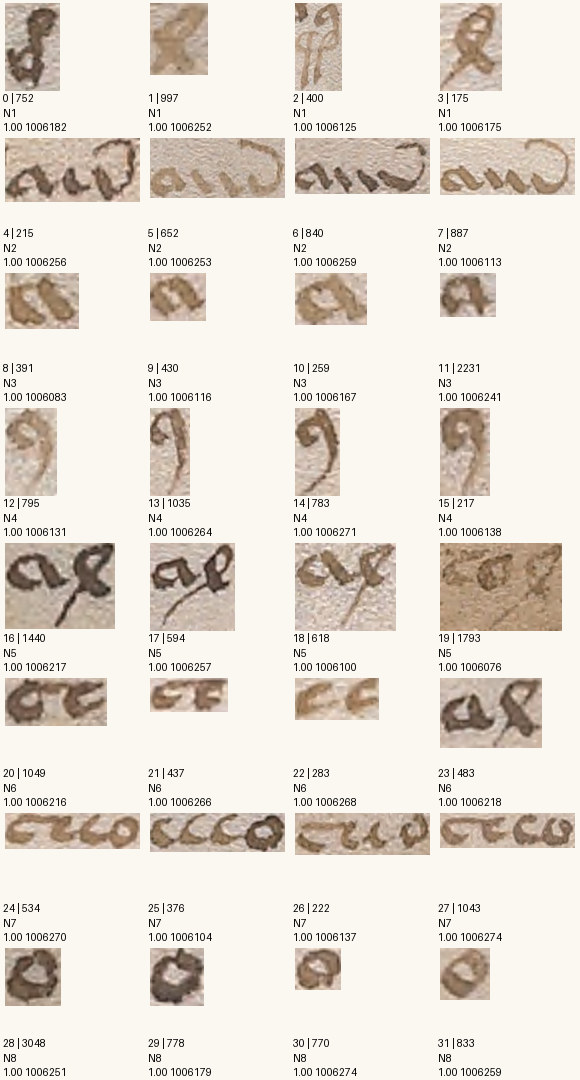
The neighbor contact sheet shows four representatives of each of eight deterministic geometry clusters, N1–N8. These retain candidate boundaries, so a neighbor can contain several visible forms. At the 0.60 gap rule, 769 left neighbors and 882 right neighbors were recorded; “before/after” means left/right only.
The leading left clusters were N1 (190; mixed upright/looped constructions), N8 (167; compact rounded enclosures), and N7 (108; longer low horizontal combinations). The leading right clusters were N3 (161; compact short-stroke/arched pieces), N2 (148; wider short-stroke runs with curved ends), and N4 (144; upper-loop/descending-curve constructions). N1 in particular is heterogeneous. These are useful recurring visual contexts, not assigned neighbor identities or a transcription. Full counts and representatives are in .
7–8. Sections and proposed hands, revealed after the freeze
Only archived image-locus metadata, section tags and proposed Davis hand relationships were joined. No annotated form or transcription table was used. The archive is derivative metadata and the proposed hands are hypotheses. Multiple or missing assignments remain unknown. Yale's combined/partial labels are preserved; no unspecified panel identity is supplied.
Archived section
Yale views
Strong targets
Per 1,000 screened geometric regions
Paired / upright / open-neighborhood / nearby
Herbal
117
672
20.58
609 / 33 / 17 / 13
Astronomical/zodiac (Astro)
12
10
1.31
9 / 1 / 0 / 0
Bathing/biological (Balneology)
20
101
7.47
89 / 2 / 2 / 8
Pharmaceutical (Pharma)
11
46
10.77
38 / 2 / 4 / 2
Recipe/text (Stars)
22
208
10.29
195 / 9 / 2 / 2
Mixed/unknown, including unnumbered views
31
139
6.76
125 / 8 / 4 / 2
This is a retrieval-density comparison, not true glyph frequencies. Different scale, layout, ink and segmentation can cause section differences. Astro's low result particularly cannot establish visual absence in diagrams. The unknown bucket includes complex foldouts; it is not a new section.
Strong candidates occur in each proposed hand group: 1 = 644, 2 = 203, 3 = 204, 4 = 10, 5 = 37, unknown = 78. These uneven totals do not demonstrate writer preferences.
Prediction used 1,015 labeled strong occurrences, grouped into 88 complete-folio holdouts. Recto/verso and explicitly related combined/partial views were kept in the same fold. Five fixed folds, equal weight per folio group, and darkness/height covariates limit pseudoreplication and some acquisition confounds. Two outcomes were tested: substantial paired cavities and the upright-sided best-seed neighborhood. Smaller log loss is better.
Predictor set (plus darkness/height)
Paired cavities
Upright-sided neighborhood
Quality only
0.4910
0.2035
Section
0.4833
0.1965
Proposed hand
0.4948
0.2044
Local context
0.5088
0.2167
Section + context
0.5025
0.2079
Section + context + hand
0.5026
0.2104
Section-only predictions were modestly better than hand-only, but folio-bootstrap intervals for their differences included zero: paired cavities +0.0115 [−0.0078, +0.0312]; upright-sided +0.0079 [−0.0046, +0.0239]. Adding hand to section/context did not improve mean held-out performance; its intervals also included zero. The Herbal-only check (672 occurrences, 61 folio groups) likewise showed no clear additional hand benefit.
The study does not establish that context/section is a stronger determinant than writer. Section has the better exploratory point estimates; local context alone does not. Section/hand confounding, few unusual variants and topology's sensitivity to ink prevent a stronger claim. This f016r-defined study is not a replacement for previous differently anchored handwriting experiments.
9. Similar larger constructions with/without the form
The frozen search found 29 short-base comparison leads from 1,416 queries against 25,733 eligible base pairs. Review panel D09 displays three inspected pairs:
f113r / f113v: similar low horizontal construction and rounded end, with an additional terminal paired form in one example.
f056r / f043r: a similar short-stroke run, with an initial paired form in one example.
f104v / f107r: a similar enclosure/short-stroke/curved-end base, with an initial paired form in one example.
The base descriptors were matched separately, with constituent cosine ≥0.86, aspect-log differences ≤0.35 and combined score ≥0.92. The paired form itself was not used to make the bases similar. Native contexts show that adjacent material and execution still differ. These are recurring construction leads, not proven identical underlying strings or historical additions/deletions. An undetected target may also remain outside the matched base.
What does it look like functionally?
The paired-lobe core looks like a reusable combining element: it recurs beside other forms, within geometric groups and as initial or terminal material beside similar short bases. It does not look exclusively like a standalone separator or a universally fixed ending. That is a structural appearance, with no assigned meaning or linguistic category.
The safest unit conclusion is a family of related appearances containing a recurring compact paired construction. The evidence supports that recurring construction more strongly than either “every lookalike is one identical unit” or “every example is two repeated units.” Stroke count, component ownership, and the relation of the open forms remain ambiguous.
Review images
Embedded from the preserved project files (display copies; originals remain in the project folder).