ARCHIVED RESEARCH PROJECT · completed 2026-09-28 · Do Voynich gallows/bench constructions share real construction principles with a German/Central-European scribal tradition, or were earlier matches generic looped handwriting? · Back to Home
PROJECT SUMMARY
QuestionDo Voynich gallows/bench constructions share real construction principles with a German/Central-European scribal tradition, or were earlier matches generic looped handwriting?
MethodThe corpus was fixed by metadata rules, with no image viewed before selection ([deterministic method], plan in catalogue/selection_plan.txt). It was drawn from catalogue harvests of 839 Heidelberg Cod. Pal. germ. manifests and 2,020 Penn OPenn TEI records: - SEED: the…
Limits- One analyst coded everything, with no second rater. The coding was partially blind (script visible), and two seed pages were recognised. - The corpus has one densest-text window per page and one page per manuscript (seeds excepted). Controls are small (16), especially Iberia and the Low…
90 accessible result rows from 90 authoritative meaningful result rows in the declared scope. Review cards are separate.
All rows from the stated saved result sets are accessible; detailed machine arrays remain in the linked source files.
REVIEW NEEDED
6 preserved review panels are available below.
This curated view is separate from the complete meaningful results listed above.
Voynich gallows/bench vs German cursiva (v001)
Question: do Voynich’s tall paired “gallows” and low “bench” constructions share real construction principles with a German / Central-European scribal tradition, or were the earlier matches generic looped handwriting? No language or translation theory was used.
Answer
Only partly. There is one real shared principle, but not a scribal ancestry.
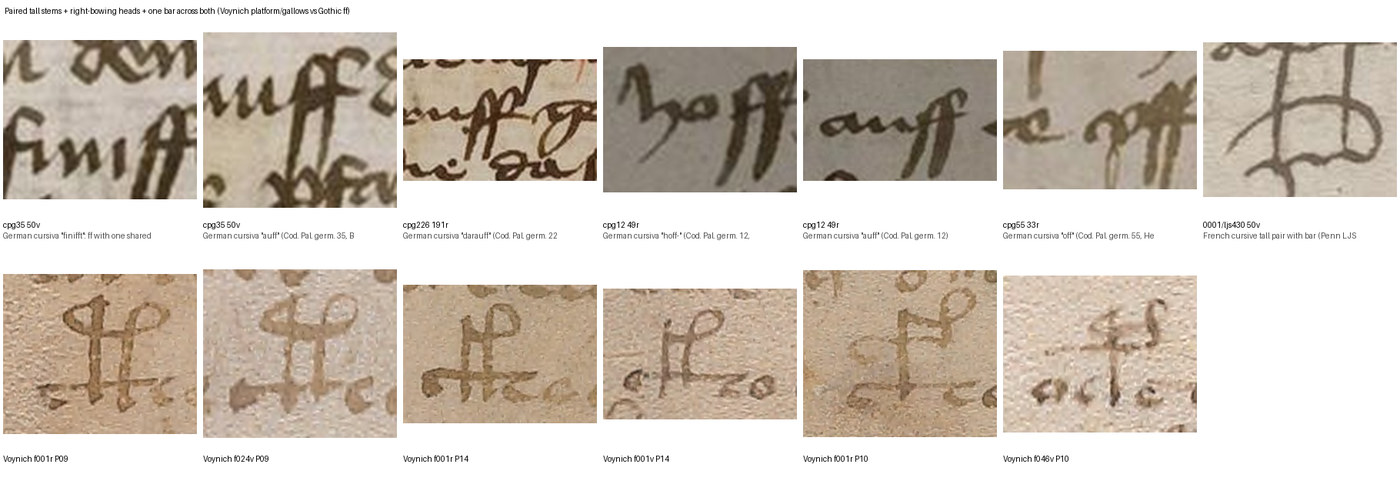
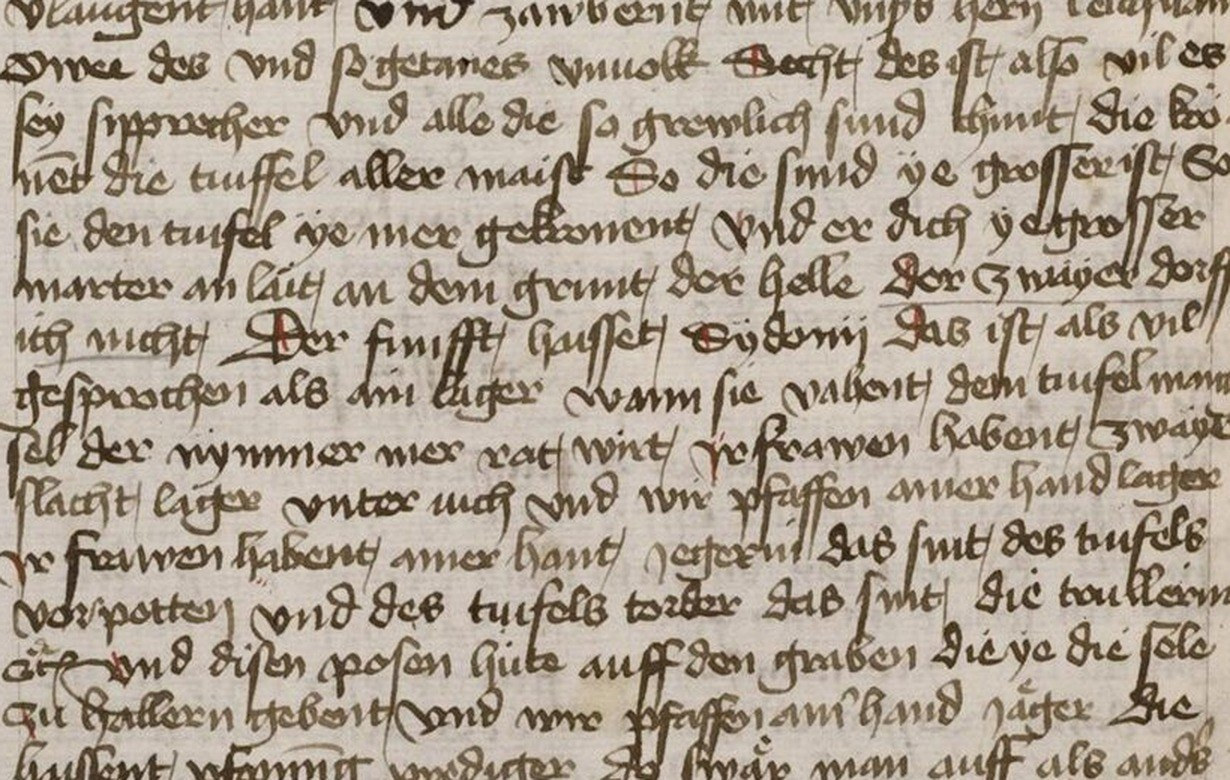
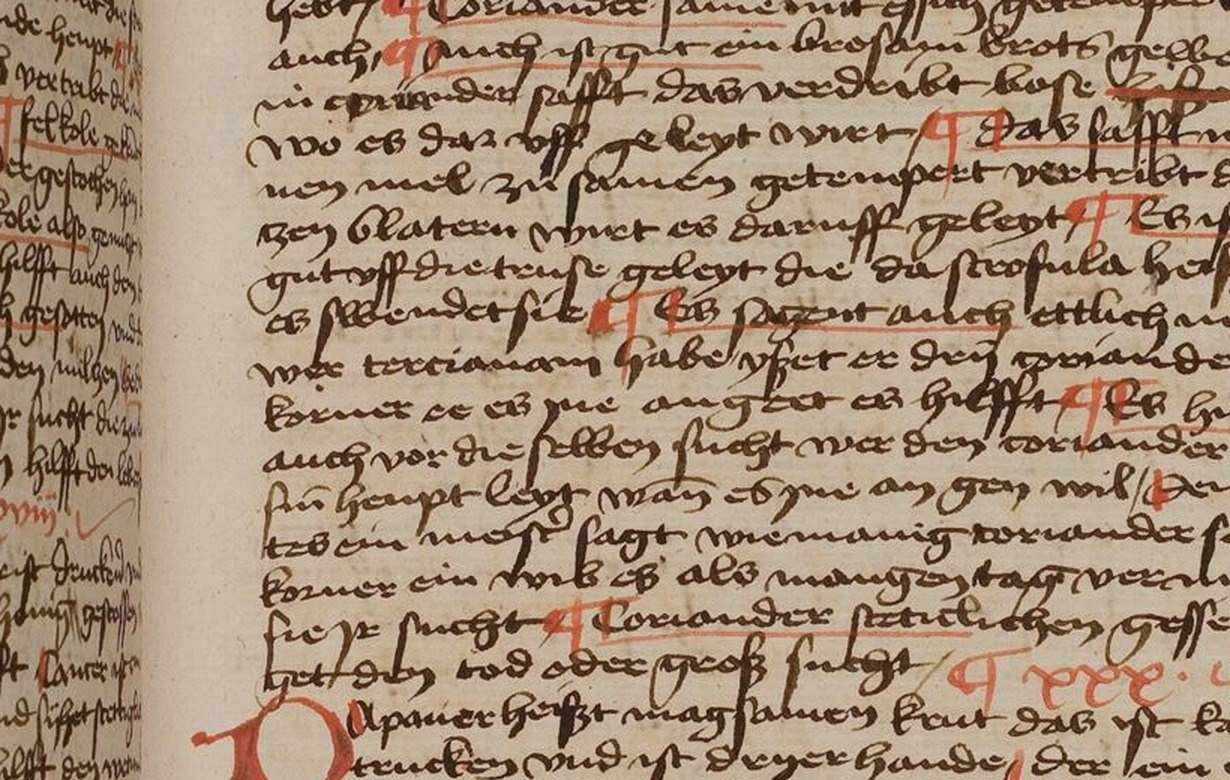
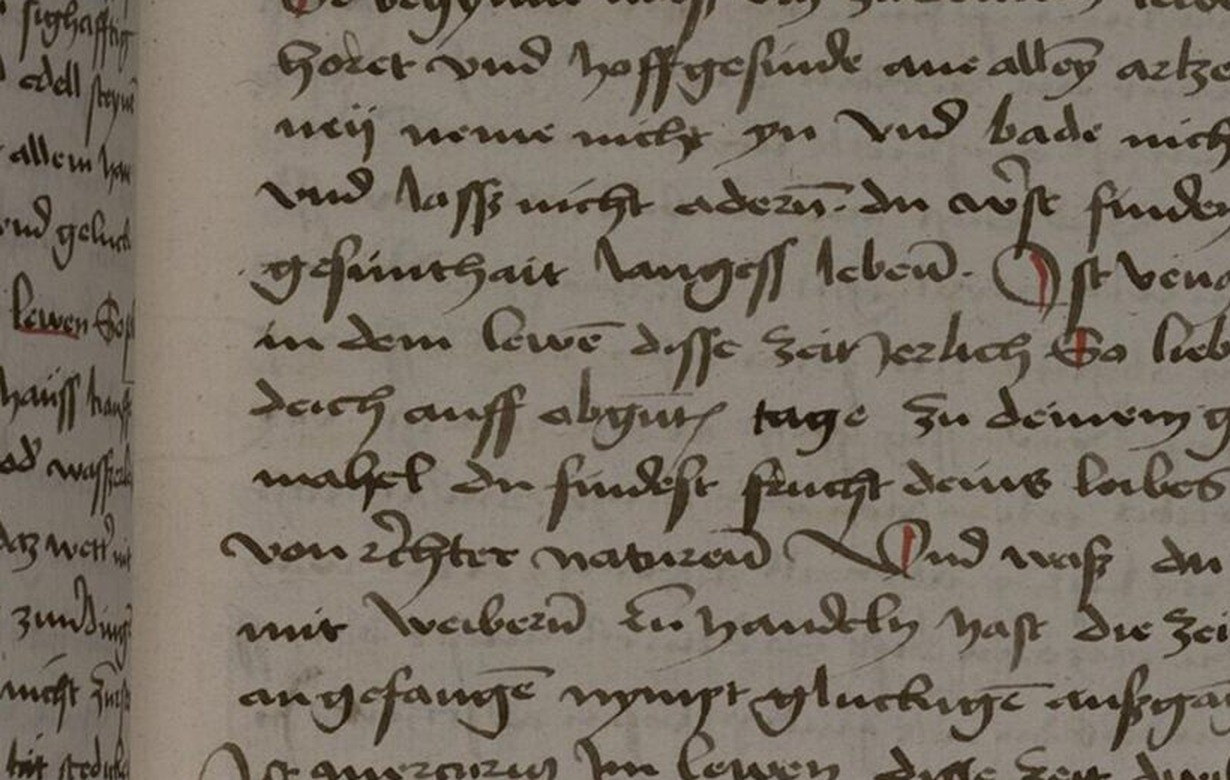
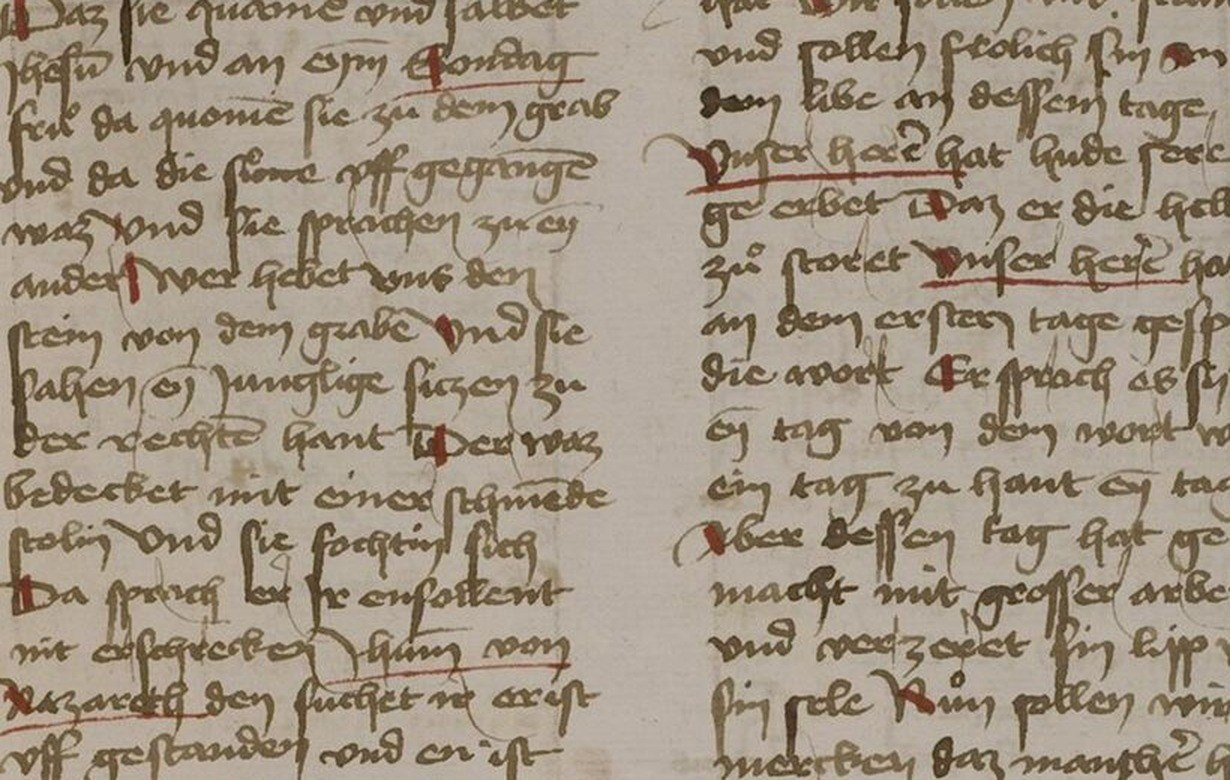
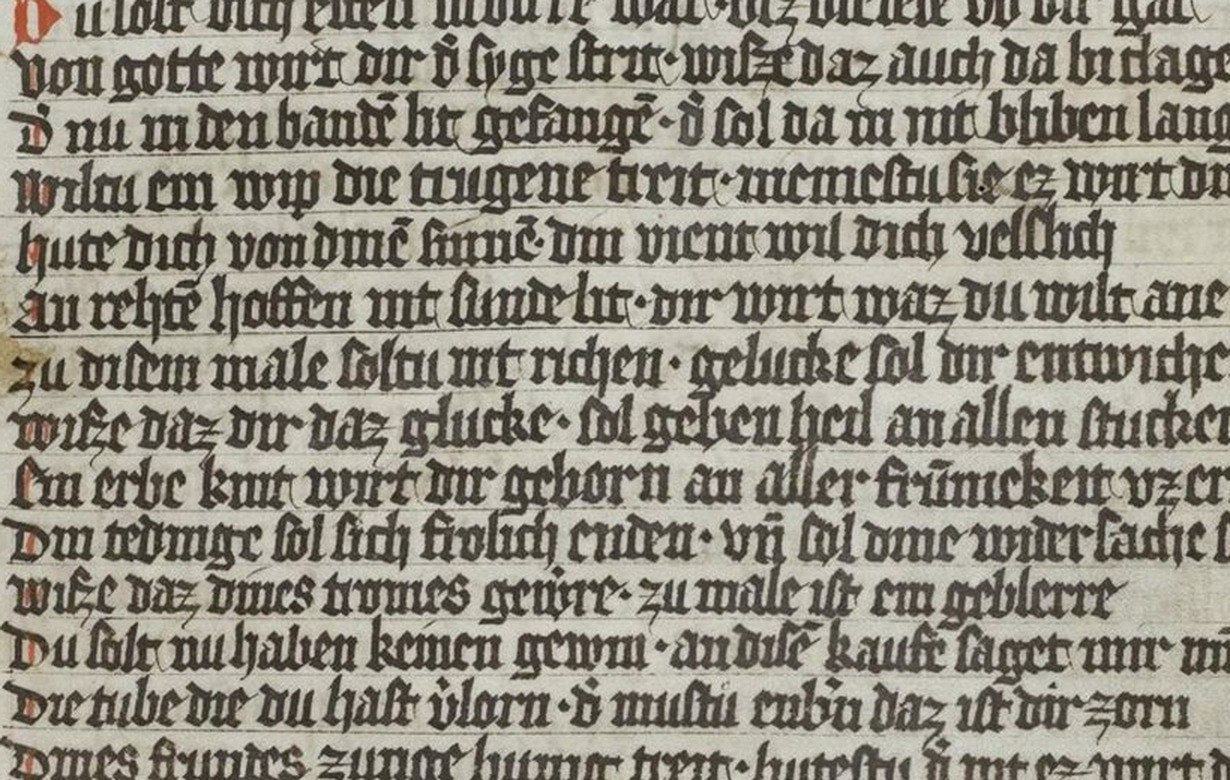
The Gothic ff ligature, and to a lesser extent long-s pairs, write two tall stems as one unit with a single crossbar at x-height and heads bowing to the right. That combination was significantly more common in Central-European pages than in western and southern controls: 33% of 21 non-seed panels vs 6% of 16 control panels (one-sided permutation p = 0.0496; the shared bar alone p = 0.028). It is densest in German-language cursiva and bastarda, 1425–1475, and appears in every German region sampled. It also appears in one late French cursive, so it is not exclusively German.
However, the construction rules that make Voynich gallows distinctive do not occur together in any panel:
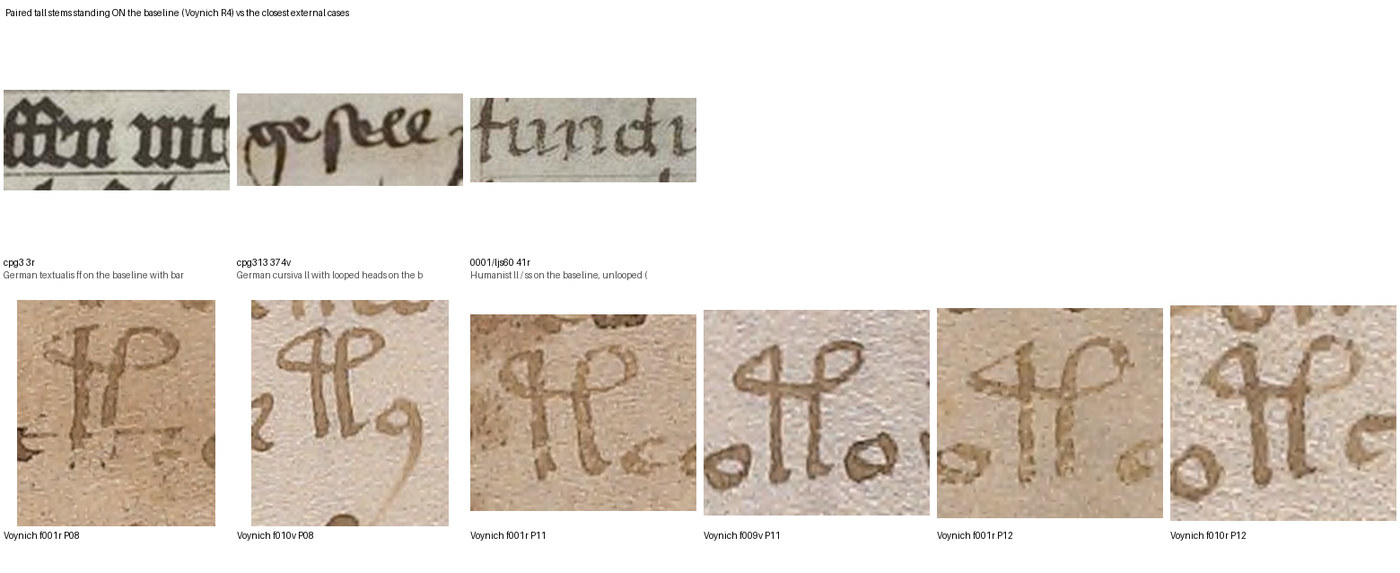
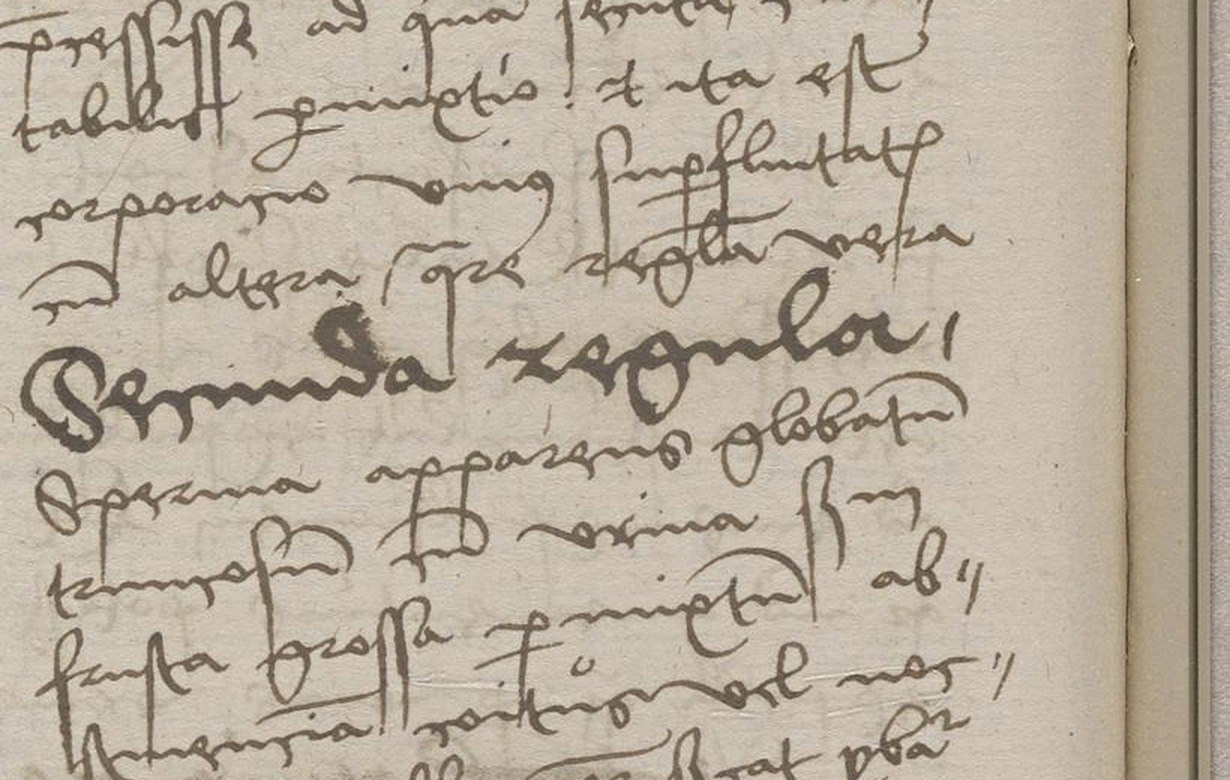
paired stems standing on the baseline with a right loop and a shared bar: 0 of 43 panels;
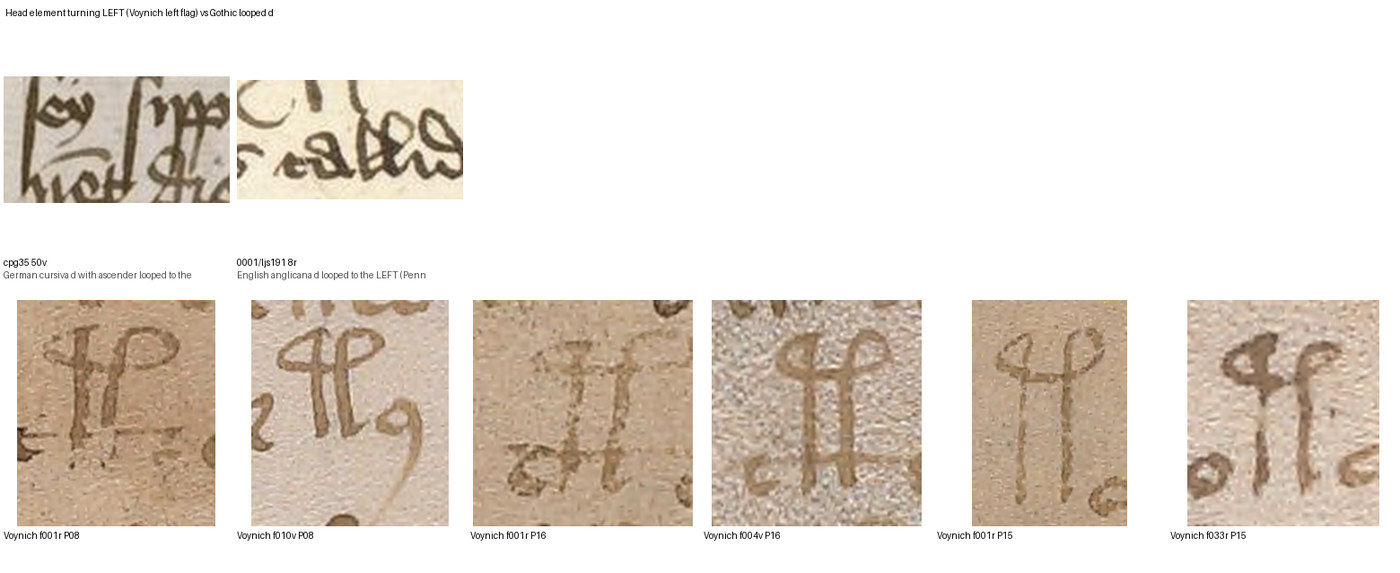
a head turning left on the left stem, while the right stem carries a large closed loop;
the bench bar resting on short c-curves: 0 of 43 panels.
In German cursiva the ff stems descend below the line and the leftward loop belongs to a different letter (d). The German forms are ordinary letters (double f, as in the German spellings auff, hoff, darauff; long-s pairs; looped d/b/h/l), not abbreviations. Their frequency partly reflects German spelling, with its many doubled consonants: the same scribal region writing Latin shows the feature less often.
Verdict: COMPONENT-LEVEL ANALOGUE, not evidence of Central-European scribal ancestry.
1. Voynich constructions (frozen before comparison)
Frozen 2026-09-28 23:03 EDT, before any comparison panel for this study was coded. Before this freeze the analyst had already seen four German audit crops (A24, A27, A45, A81) during the medical comparison and a glance at German ff/tt forms at the start of this study; the freeze is therefore not fully blind.
R1_paired_stems: Two separate parallel tall stems written side by side as one construction (pen lifts between them; not a loop-joined ligature).
R2_left_head_flag: The LEFT stem carries a small head element at its top that turns or loops to the LEFT (flag/closed small loop).
R3_right_loop: A large loop springs from the top of the RIGHT stem (or bridges both tops), rises above the stems, bows to the RIGHT and returns down toward mid-height on the right; may be open or closed.
R4_baseline_stems: Both stems end at the baseline: no descender below the line and no baseline entry/exit hairline joining neighbours.
R5_shared_low_bar: One horizontal bar at about x-height crosses BOTH tall stems (and may extend beyond them).
R6_bar_joins_c_curves: The low bar joins the tops of short c-like curves beside the stems (bench/platform), so tall and short elements form one construction.
R7_isolation: The tall construction is not linked to preceding/following letters by cursive joining strokes other than the R5/R6 bar.
Top: Central-European ff with one shared bar (plus one French control). Bottom: Voynich platform gallows. Shared: two stems plus one bar and right-bowing heads. Different: German stems descend, heads both bow right, no left flag, no bench curves.Top: the only external paired stems standing on the baseline (German textualis ff, German cursiva ll, humanist ll/ss); none combine a baseline pair with loops AND a shared bar. Bottom: Voynich paired gallows on the baseline.Top: Gothic leftward loops occur on the letter d, a separate letter. Bottom: the Voynich left flag sits on the LEFT stem of the same paired construction.
Voynich rule
Found in German cursiva?
What the German form actually is
R1 two parallel tall stems as one unit
YES, as ordinary letter pairs
ff, ſſ (long-s pairs), st, ll: two letters written side by side. Common in every Gothic hand and humanist ll/ss; not distinctive.
R2 left-turning head on the LEFT stem
NO (different letter)
The Gothic leftward loop belongs to the letter d (and some b/h/l loops), not to the left member of a paired construction. In ff and ſſ both heads bow to the right.
R3 large right-bowing loop over the pair
PARTIAL
f and long-s heads arch right and sometimes return downward; in cursiva they can be open loops. The Voynich loop is larger, closed or near-closed, and comes back down to mid-height.
R4 stems stand on the baseline
NO in cursiva
Cursiva/bastarda f and long s descend well below the line; the paired stems never stood on the baseline in any panel with R3+R5. Only textualis/humanist ll, ſſ or ff stand on the line, and those have no loops.
R5 one bar at x-height across both stems
YES (German ff)
The f crossbar is drawn once through both stems of ff (and often continues into a following t: fft). This is the one genuinely shared construction principle.
R6 bar joins short c-like curves (bench)
NO
Not seen in any of 43 judgeable panels. The nearest case is the ff bar running on into t or e, not a bar resting on two c-curves.
R7 pen-lifted isolation
NO in cursiva
Gothic cursiva joins the pair to neighbours with hairlines; Voynich gallows stand isolated apart from the bench bar.
3. Distribution (sealed, partially blind coding of 46 panels)
44 dated manuscripts, c.1375–1500, chosen by fixed metadata rules:
4 Heidelberg seed manuscripts (6 pages);
16 German-language Cod. Pal. germ., one per region × quarter-century;
8 Penn codices from Germany, Austria and Bohemia, mostly Latin;
16 Latin-script controls from Italy, France, England, the Low Countries and Iberia.
Panels were coded under shuffled codes before the key was opened. 3 panels could not be judged. The seeds were chosen for resemblance, so they are shown but excluded from tests.
Group
panels
R1 paired tall stems
R2 left-turning head
R3 right-bowing loop
R5 one bar across both stems
R6 bar joins short c-curves (bench)
R1+R3+R5 in panel
paired stems ON baseline (R4)
R4+R3+R5 together
SEED
6
1.00
1.00
1.00
1.00
0.00
1.00
0.00
0.00
DE
15
0.93
0.87
0.87
0.47
0.00
0.40
0.33
0.00
CE-PENN
6
0.50
1.00
0.83
0.17
0.00
0.17
0.00
0.00
CTRL
16
0.75
0.81
0.69
0.06
0.00
0.06
0.31
0.00
Central Europe (all)
27
0.85
0.93
0.89
0.52
0.00
0.48
0.18
0.00
By region
Region
panels
R1 paired tall stems
R2 left-turning head
R3 right-bowing loop
R5 one bar across both stems
R6 bar joins short c-curves (bench)
R1+R3+R5 in panel
paired stems ON baseline (R4)
R4+R3+R5 together
Austria
1
0.00
1.00
1.00
0.00
0.00
0.00
0.00
0.00
East (Bavaria/Austria)
4
0.75
0.75
0.75
0.25
0.00
0.25
0.50
0.00
England
3
0.33
0.67
0.67
0.00
0.00
0.00
0.00
0.00
France
4
1.00
1.00
1.00
0.25
0.00
0.25
0.25
0.00
Germany
5
0.60
1.00
0.80
0.20
0.00
0.20
0.00
0.00
Heidelberg seeds
6
1.00
1.00
1.00
1.00
0.00
1.00
0.00
0.00
Iberia
1
1.00
1.00
0.00
0.00
0.00
0.00
1.00
0.00
Italy
6
0.67
0.67
0.67
0.00
0.00
0.00
0.33
0.00
Low Countries
2
1.00
1.00
0.50
0.00
0.00
0.00
0.50
0.00
Middle/North (Palatinate, Franconia, Rhine)
3
1.00
0.67
0.67
0.67
0.00
0.33
0.33
0.00
Swabia
4
1.00
1.00
1.00
0.50
0.00
0.50
0.25
0.00
Upper Rhine/Alsace/Swiss
4
1.00
1.00
1.00
0.50
0.00
0.50
0.25
0.00
Central Europe (non-seed) by period
Period
panels
R1 paired tall stems
R2 left-turning head
R3 right-bowing loop
R5 one bar across both stems
R6 bar joins short c-curves (bench)
R1+R3+R5 in panel
paired stems ON baseline (R4)
R4+R3+R5 together
P1 1375-1424
5
0.80
0.80
0.60
0.20
0.00
0.00
0.60
0.00
P2 1425-1449
5
0.80
0.80
0.80
0.40
0.00
0.40
0.20
0.00
P3 1450-1474
6
1.00
1.00
1.00
0.67
0.00
0.67
0.00
0.00
P4 1475-1500
5
0.60
1.00
1.00
0.20
0.00
0.20
0.20
0.00
Central Europe (non-seed) vs controls, one-sided permutation
A dated hand with baseline-standing paired stems carrying a left flag, a large right loop and a shared low bar that also rests on c-curves. The next test would be a targeted search of Central-European technical hands (cipher keys, alchemical/astronomical notation, notarial signs) rather than book cursiva.
No language, translation, EVA-value or decipherment theory was used. Extraction and all prior results are unchanged.
Question
The medical comparison (v001) found the strongest external analogues of Voynich gallows/bench shapes in German cursiva. This study asks whether that reflects shared construction principles or just generic looped handwriting.
1. Voynich constructions (frozen first)
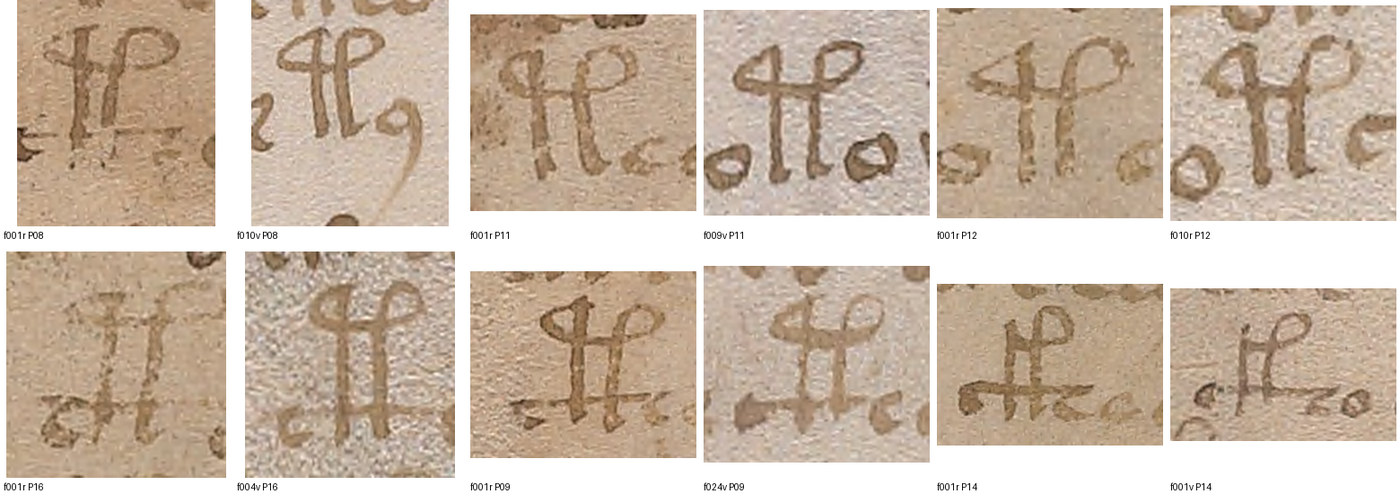
Freeze. Construction rules were written from native Yale crops of the frozen v001 exemplars of pattern cards P08–P16. They were sealed at 2026-09-28 23:03 EDT, before any comparison panel was coded:
file: voynich_construction_rules.json
sha256: 2bcd8ae7…6889
Families.
Paired-stem gallows: P08, P11, P12, P16.
Single-stem looped forms: P15.
Platform/bench: P09, P10, P14.
Rules.
R1: two separate parallel tall stems (2.5–3.5 x-heights) written as one unit.
R2: a small head on the left stem turns or loops left.
R3: a large loop springs from the right stem, bows right above the stems and returns to mid-height.
R4: both stems stand on the baseline, with no descender.
R5: one bar at about x-height crosses both stems.
R6: that bar also joins the tops of short c-like curves (the bench).
R7: the unit is isolated, not cursively joined to its neighbours.
Exposure limit. Before the freeze, the analyst had already seen four German crops (A24, A27, A45, A81), so the freeze is not fully blind.
2. Comparison corpus
The corpus was fixed by metadata rules, with no image viewed before selection ([deterministic method], plan in catalogue/selection_plan.txt). It was drawn from catalogue harvests of 839 Heidelberg Cod. Pal. germ. manifests and 2,020 Penn OPenn TEI records:
SEED: the four named Heidelberg manuscripts, on their exact pages. Cod. Pal. germ. 35 f.50v; 329 f.18r; 226 ff.191r and 107r; 140 ff.54v and 99r.
DE: 16 German-language Cod. Pal. germ. manuscripts. One per region × quarter-century, 1375–1500. The regions are East (Bavaria/Austria), Swabia, Upper Rhine/Alsace/Switzerland, and Middle/North (Palatinate, Franconia, Rhine).
CE-PENN: 8 Penn codices written in Germany, Austria or Bohemia, mostly Latin.
CTRL: 16 Latin-script controls from Italy (6), France (4), England (3), the Low Countries (2) and Iberia (1).
The 46 densest-text panels were coded under shuffled codes before the key was opened (audit/). The ratings were sealed with sha256 9f128dd0…579c.
Three panels could not be judged: a numeral table, a blank ruled page and a lone flourish.
One field, "paired stems on baseline", was added during coding and applied to all panels.
Two seed pages were recognised during coding.
Seeds were chosen for resemblance, so they are excluded from tests.
4. Results
Group
panels
R1
R3
R5 shared bar
R1+R3+R5
paired stems on baseline
R4+R3+R5
R6 bench
Seeds
6
1.00
1.00
1.00
1.00
0
0
0
German-language (DE)
15
0.93
0.87
0.47
0.40
0.33
0
0
Central-European Latin (CE-PENN)
6
0.50
0.83
0.17
0.17
0
0
0
Controls
16
0.75
0.69
0.06
0.06
0.31
0
0
Central Europe vs controls (non-seed, 21 vs 16 panels, one-sided permutation):
Feature
Central Europe
Controls
p
Shared bar across two tall stems (R5)
higher
lower
0.028
R1+R3+R5 together in a panel
33%
6%
0.050
Paired stems, left head, right loop, baseline, bench (each separately)
not higher
—
0.20–1.0
Distribution.
Region: the shared-bar pairing appears in every sampled German region: Swabia 0.5, Upper Rhine 0.5, Middle/North 0.33–0.67, East 0.25.
Period: it peaks 1450–74 (0.67). It is absent in 1375–1424 non-seed panels and falls to 0.2 in 1475–1500.
Script: it is strongest in German bastarda (0.71) and cursiva (0.47). It is absent in textualis and in Italian, English and humanist hands.
Outside Germany: one French cursive of c.1500 (Penn LJS 430) also shows it.
5. What the German forms are
ff with one crossbar. Two ordinary letters f written together, with the crossbar drawn once through both stems. It often continues into a following t, as in finifft and hilfft. This is a standard Gothic ligature, frequent in German because Early New High German spelling doubles f (auff, hoff, darauff).
Long-s pairs (ſſ, ſt). Ordinary letters.
Looped ascenders (b, h, k, l) and left-looped d. Ordinary cursiva letter-forms: Gothic cursiva has looped ascenders and f/long-s descenders (Ad fontes, Univ. Zürich, "Bastarda and Gothic cursives").
None are abbreviations. Latin abbreviation signs in these hands (9-shaped -us, superscripts) are a separate system.
Why the German-language excess. The same region writing Latin shows the ff bar less often (0.17 vs 0.47), so part of the effect is orthographic frequency, not a unique scribal construction.
6. Construction match
Voynich rule
In German cursiva?
R1 paired stems
Yes, as ordinary letter pairs (generic across hands)
R2 left head on the left stem
No. The leftward loop belongs to a different letter (d); ff/ſſ heads both bow right.
R3 right loop
Partial. The heads arch right; the Voynich loop is larger, closed and returns down.
R4 stems on the baseline
No in cursiva/bastarda: f and ſ descend. Only unlooped textualis/humanist pairs stand on the line.
R5 one bar across both stems
Yes. This is the one genuinely shared principle.
R6 bar on c-curves (bench)
No, in 0 of 43 panels. The nearest is the ff bar running into t.
R7 isolation
No. Cursiva joins neighbours with hairlines.
Co-occurrence. Up to three Voynich rules (R1+R3+R5) co-occur in one German construction, the ff ligature. The combination that makes Voynich gallows distinctive never occurs in any panel. That combination is baseline stems + left flag + right loop + shared bar, with or without the bench.
7. Prior scholarship
Painter & Bowern, "Examining the history of Voynich glyphs using phylogenetic methods" (CEUR-WS vol. 3313). They could not code the gallows or bench glyphs against Latin scripts. They found that Voynich glyphs "do not clearly cluster within any single tradition".
voynich.nu (R. Zandbergen) notes that gallows are "not typically found in medieval manuscripts, also not as abbreviation signs".
This study neither contradicts nor extends either claim beyond the construction level.
8. Answer
Does the evidence support a Central-European/German scribal ancestry for these Voynich constructions?
No, not as ancestry. It shows a component-level analogue.
One real construction principle is shared: a single bar through two tall stems whose heads bow right. It is concentrated in German-language Gothic cursiva and bastarda, c.1425–1475, across all German regions sampled, and is rarer in Latin-script controls (p ≈ 0.03–0.05; small samples).
In German hands this is simply the ff ligature of ordinary spelling.
The distinctive Voynich construction rules are absent in every sampled tradition: baseline-standing stems, a left flag on the left stem, the closed right loop, pen-lifted isolation and the bench bar on c-curves.
The earlier match was therefore more than generic looped handwriting, but less than a shared letter-form.
Next test, if pursued: search dated Central-European technical and secret hands for the full rule set, such as cipher keys, alchemical/astronomical sign lists and notarial signets, rather than book cursiva.
Limits
One analyst coded everything, with no second rater. The coding was partially blind (script visible), and two seed pages were recognised.
The corpus has one densest-text window per page and one page per manuscript (seeds excepted). Controls are small (16), especially Iberia and the Low Countries.
Comparison crops in the review were chosen after unblinding as illustrations.
Web images were used at the 1800 px policy.
The permutation tests are descriptive and not corrected across the eight features.