ARCHIVED RESEARCH PROJECT · completed 2026-09-28 · What is the unusual 9/6/3-like sign text in the 1394 manuscript LJS 456, and is its resemblance to Voynich meaningful? · Back to Home
PROJECT SUMMARY
QuestionWhat is the unusual 9/6/3-like sign text in the 1394 manuscript LJS 456, and is its resemblance to Voynich meaningful?
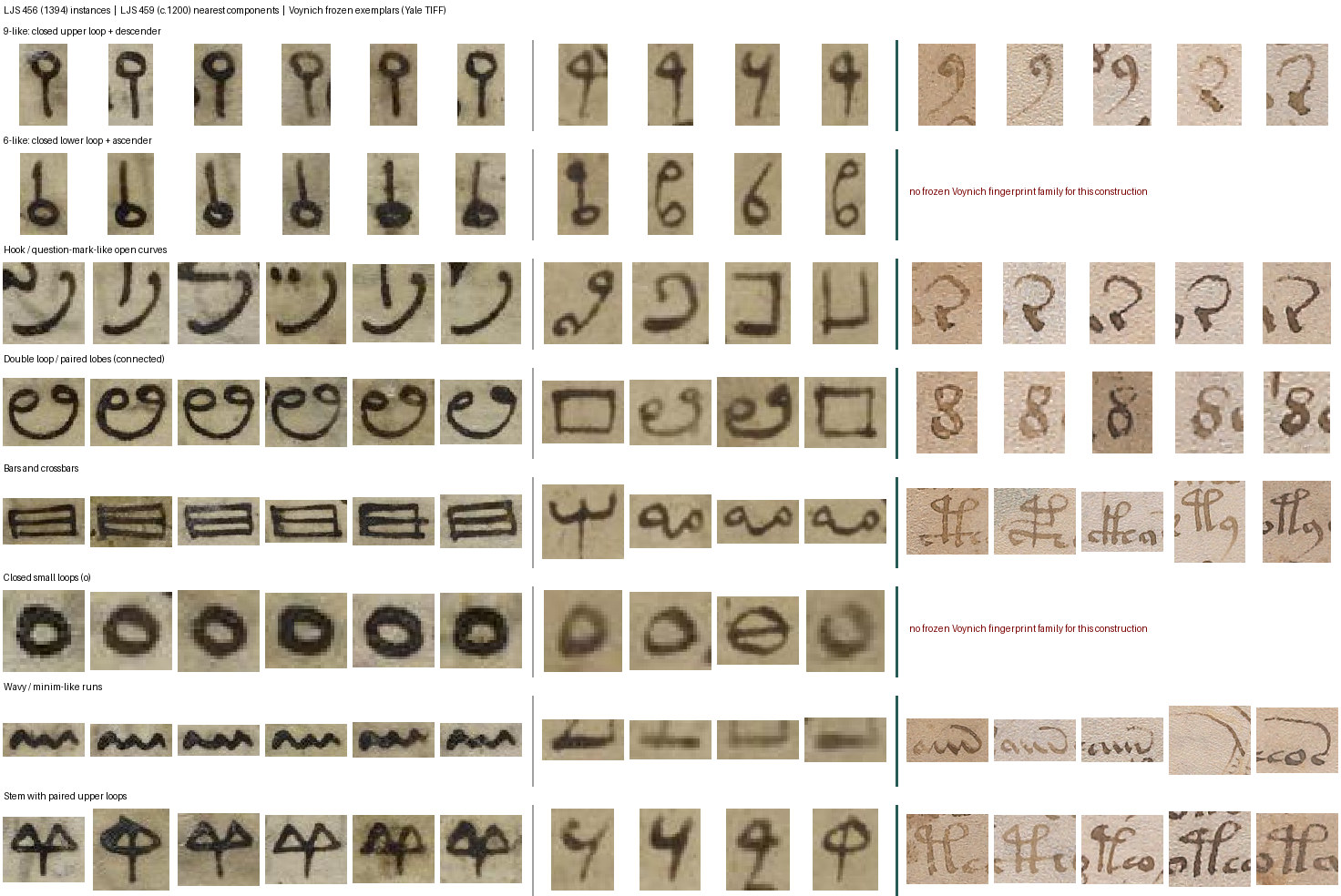
MethodCurated whole-form comparison. See curated_constructions.png. Each row compares LJS 456 inventory members, the nearest LJS 459 components and frozen Voynich exemplars from the named pattern cards. Grades were assigned by the analyst after viewing:
Important numbers17 primary fixed xheight · 1,327 scored strict hit · primary_fixed_xheight · 17 sensitivity v001 auto xheight · 1,243 scored strict hit · sensitivity_v001_auto_xheight
Finding and conclusion- 1394 notation: likely identification. It is a secret/magical alphabet of the Arabic Sirr al-asrār tradition, used for the section on properties of stones. The same repertoire appears in an independent c.1200 Mosul copy. The specific alphabet is not named in the scholarship reached, and…
Limits- One analyst chose the construction rows and the grades, with no second rater. - Region boxes were drawn by eye before scoring and checked against overlays. - Web JPEGs (1800 px height) were used, not master TIFFs. - Permutation p-values ignore line/page clustering and are descriptive…
MeaningVerdict: likely identification. It is a secret (magical) alphabet transmitted with the Arabic Sirr al-asrār, used in LJS 456 to write out the section on stones. The precise alphabet name, its sign-to-letter key and its origin are unresolved. It was not deciphered, since that was out of scope.
2,604 accessible result rows from 2,604 authoritative meaningful result rows in the declared scope. Review cards are separate.
All rows from the stated saved result sets are accessible; detailed machine arrays remain in the linked source files.
REVIEW NEEDED
7 preserved review panels are available below.
This curated view is separate from the complete meaningful results listed above.
LJS 456 secret script vs Voynich (v001)
Follow-up to the medical-manuscript comparison (panel A72). Images are original library pixels (public domain, Penn OPenn) and Yale Voynich TIFF crops. Groupings and grades are visual aids, not sign identities or readings.
Answer
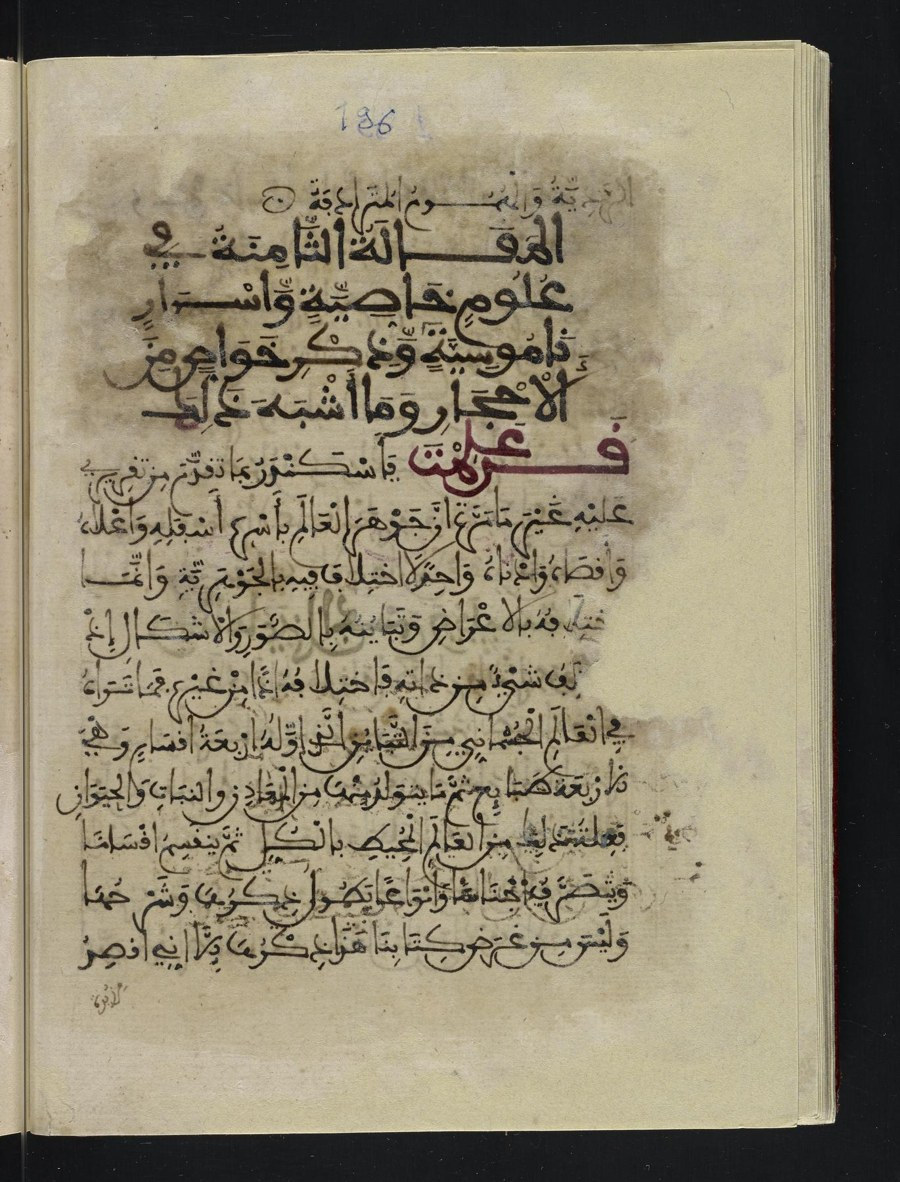
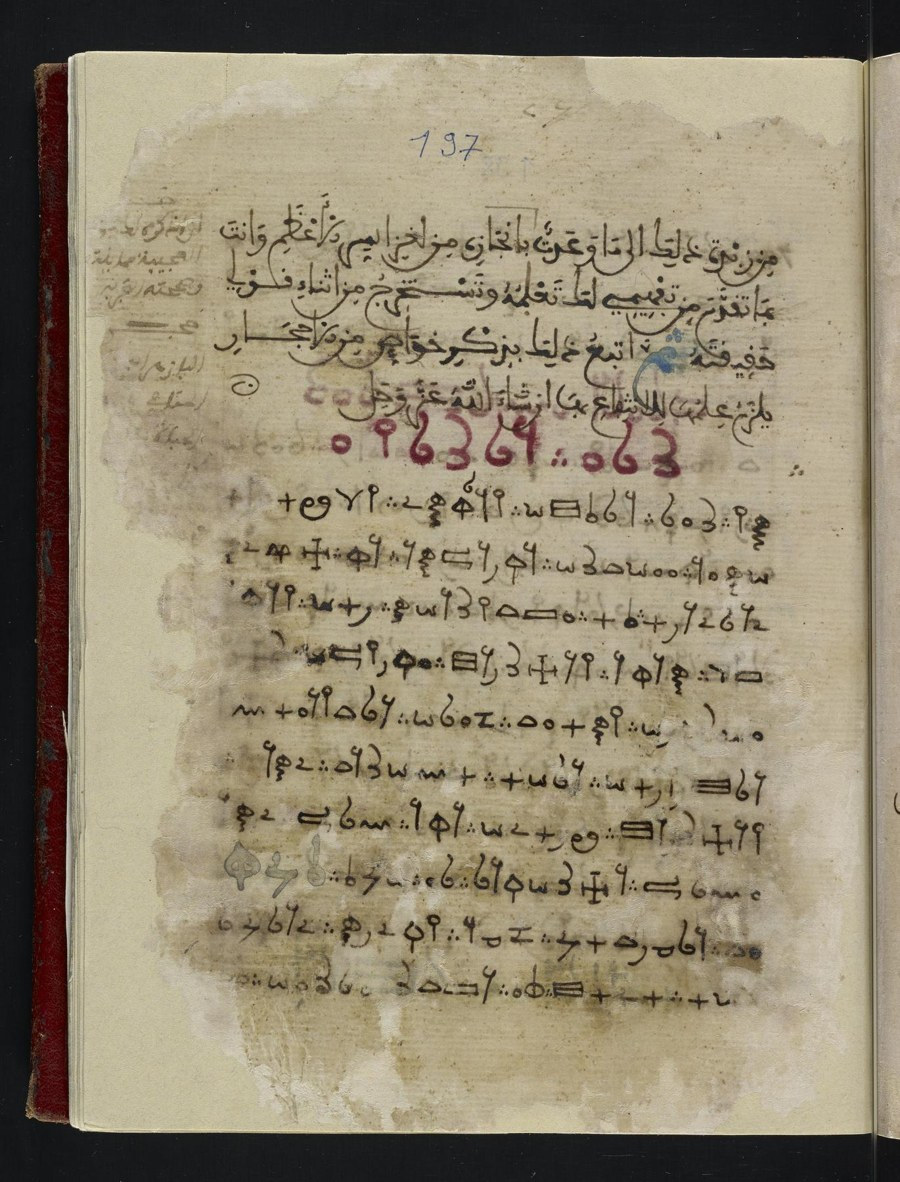
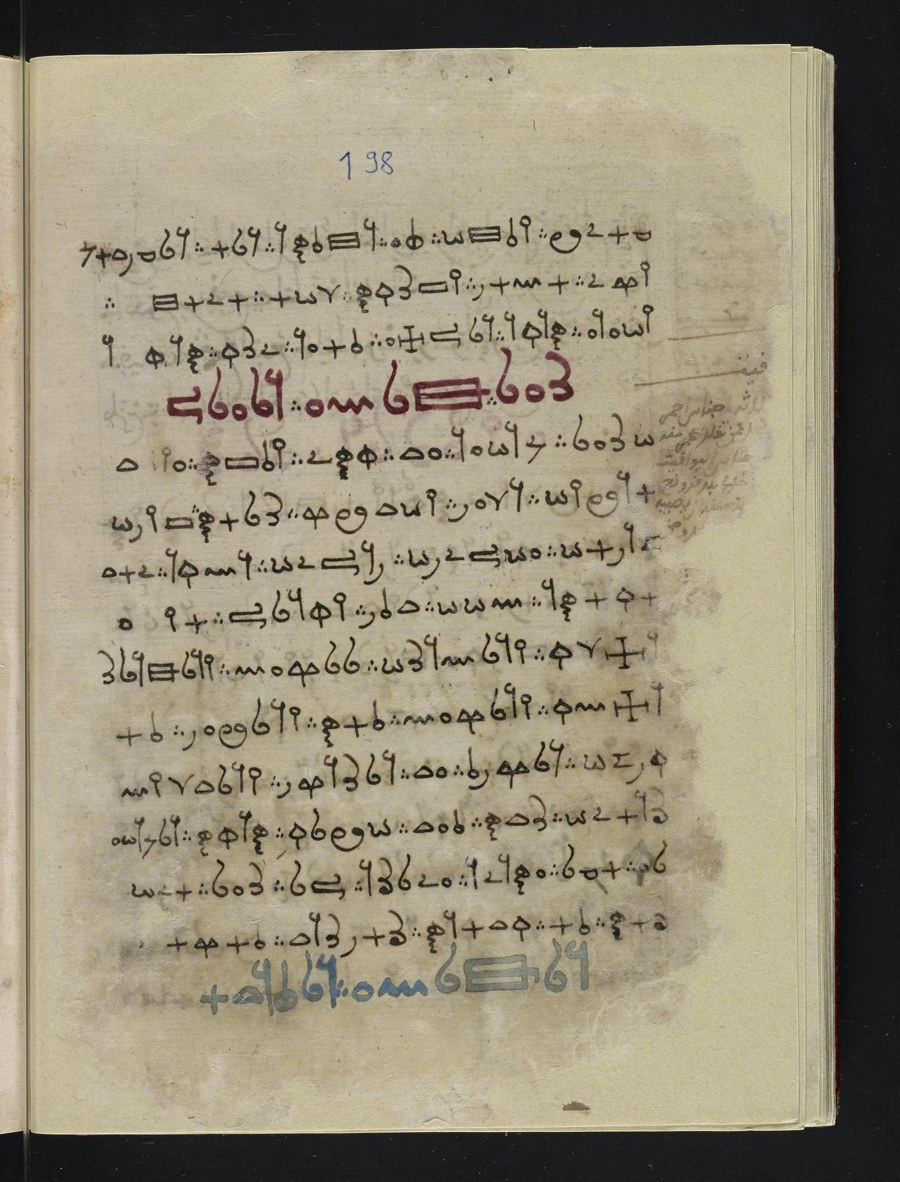
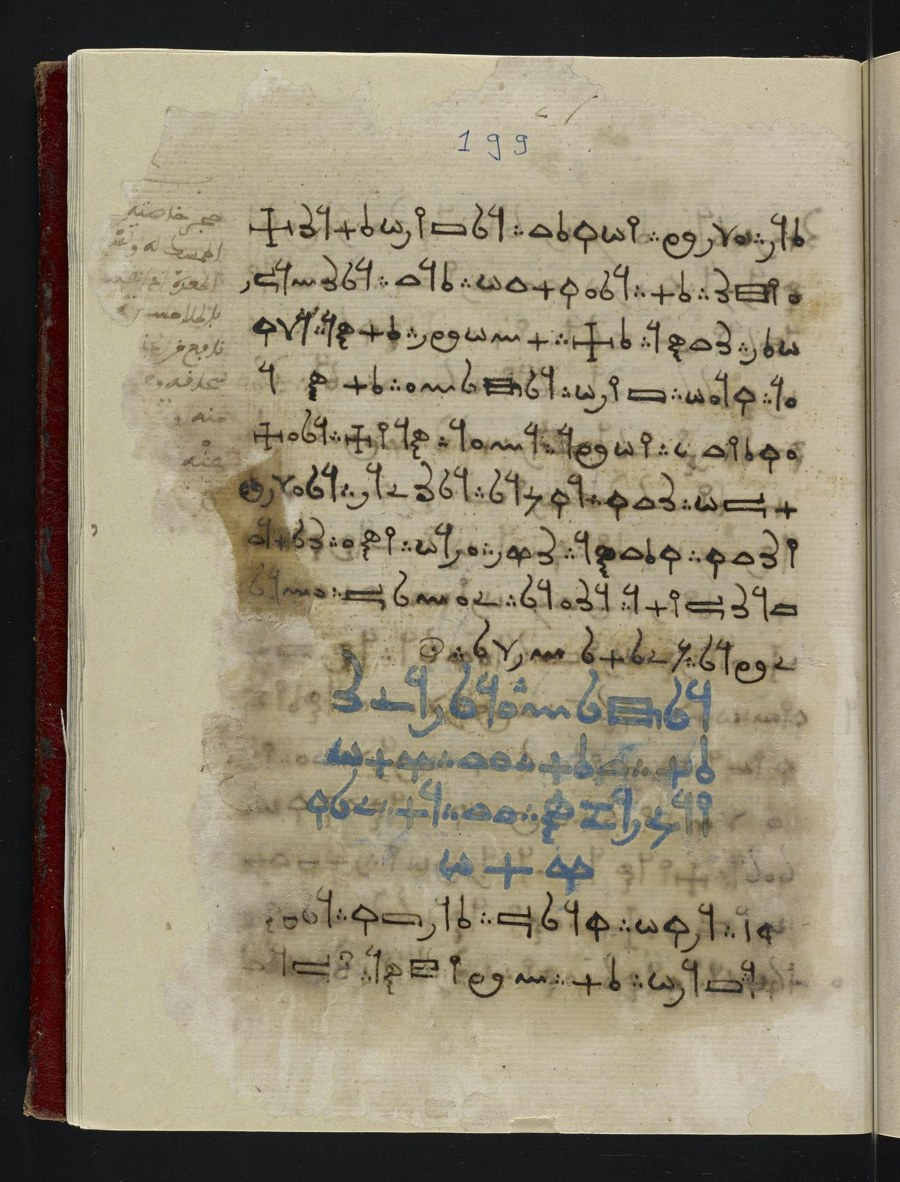
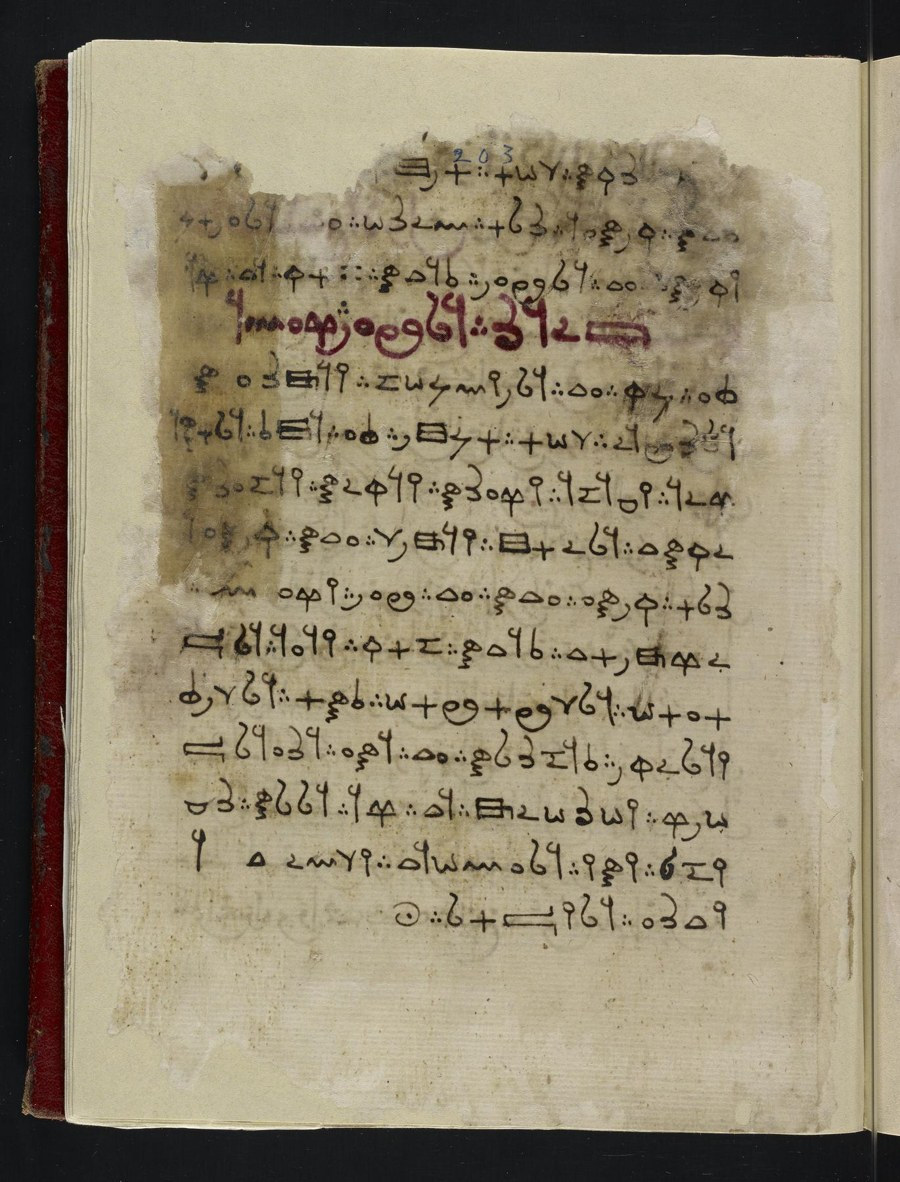
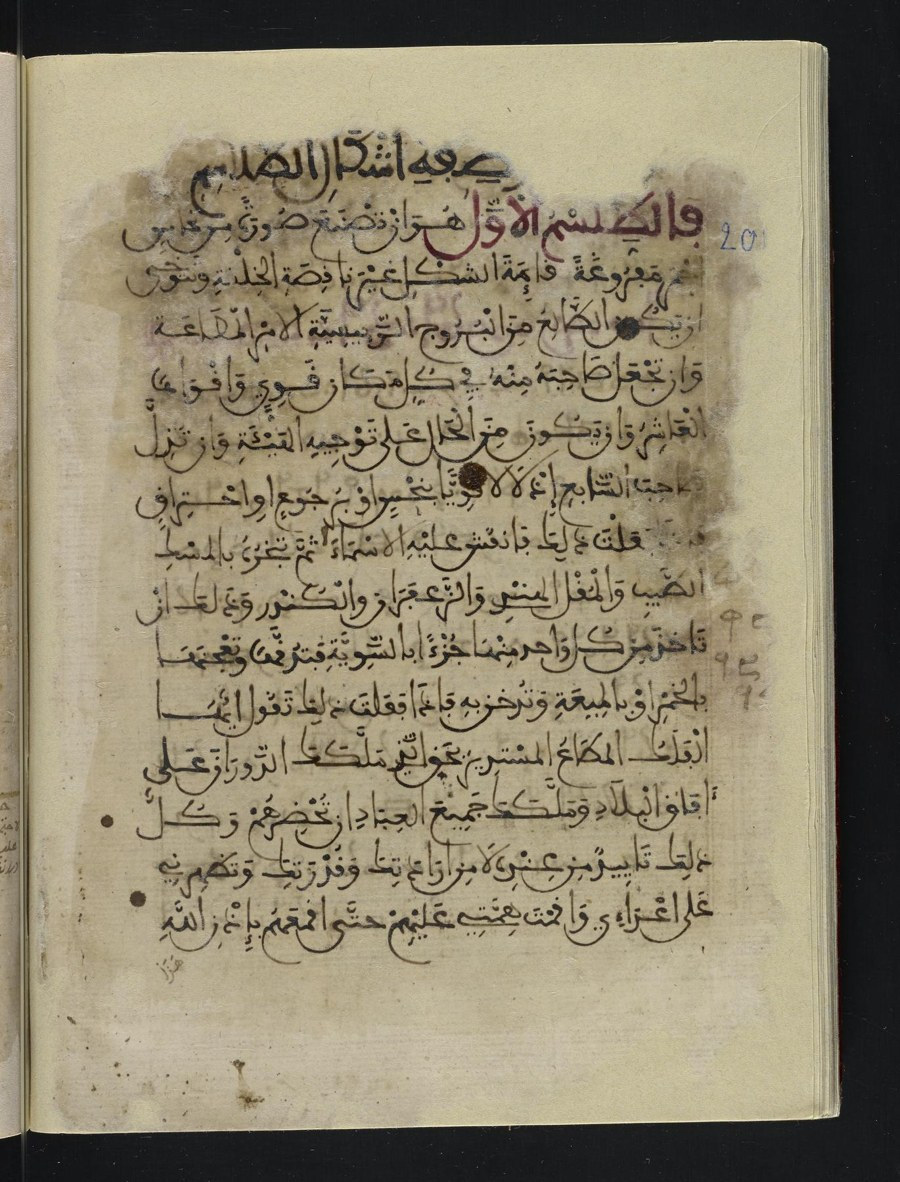
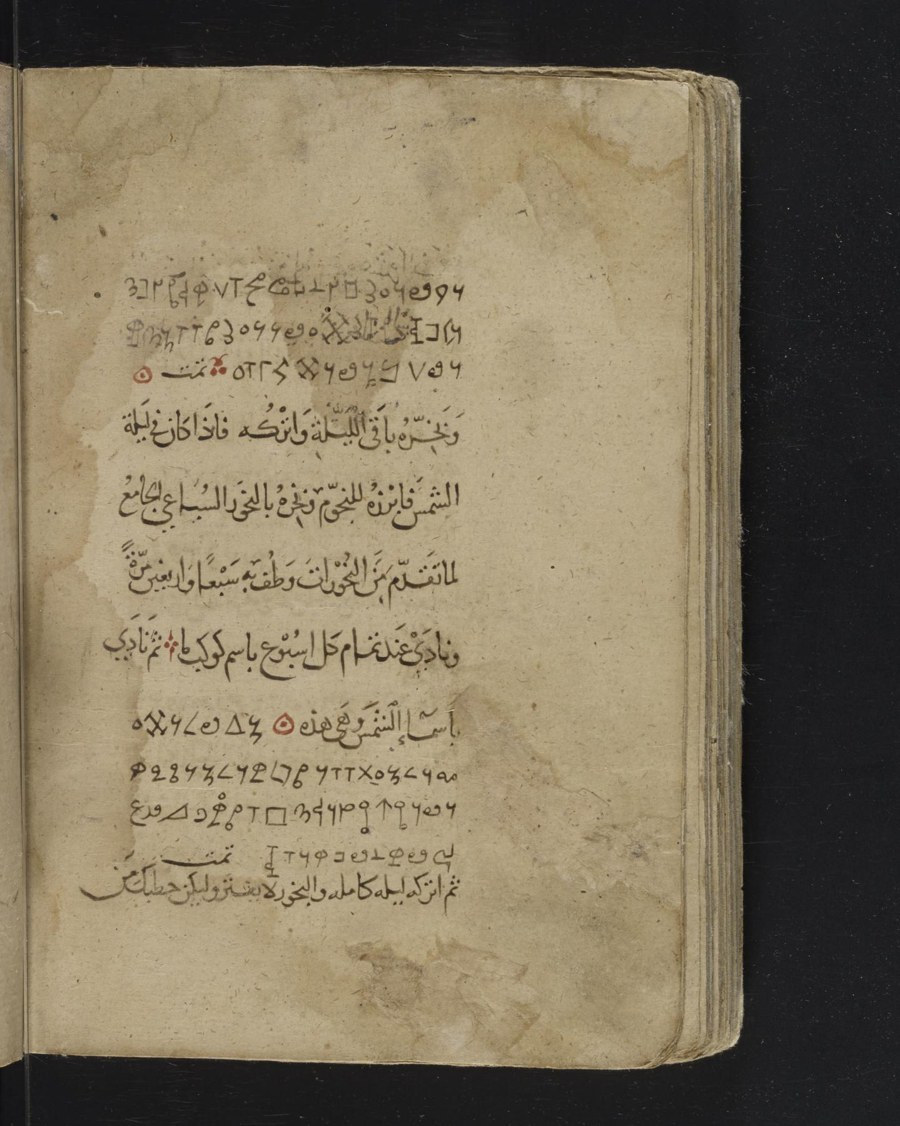
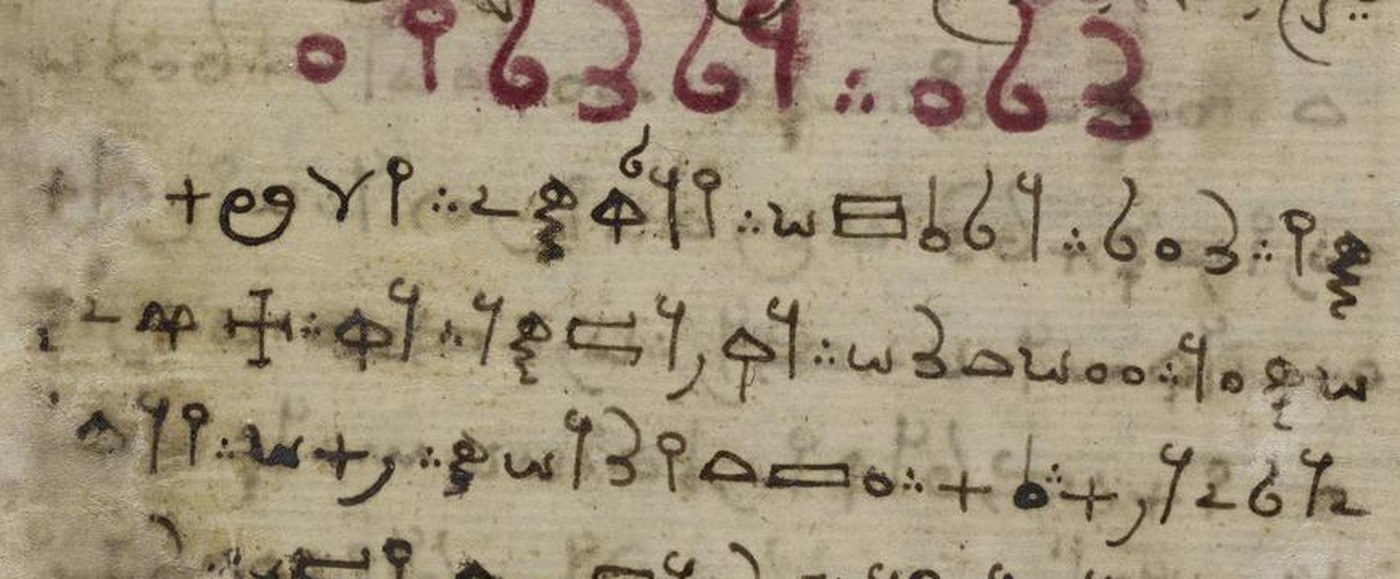
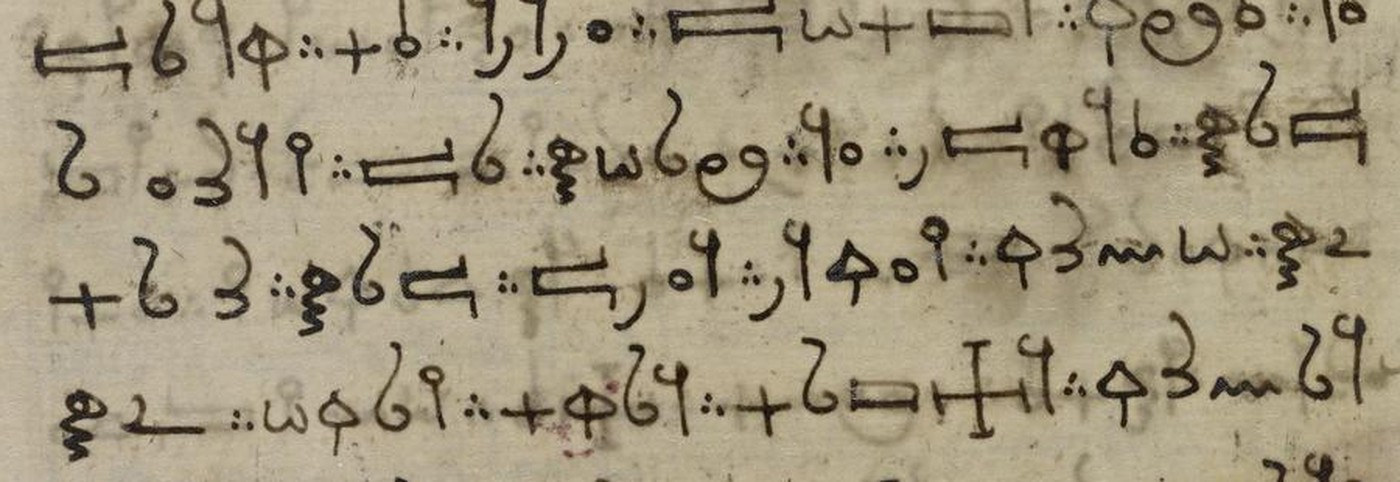
1394 notation: likely identification. This is not a German manuscript and not an isolated sign row. It is Penn LJS 456, Kitāb al-Siyāsah fī tadbīr al-riyāsah (the Arabic pseudo-Aristotelian Sirr al-asrār / Secretum secretorum). The copy was completed AH 797 (1394), perhaps in Andalusia, in Maghribi script. The signs are a secret alphabet filling about seven pages (pp.197–203, =29–35). They start directly after the heading of the eighth maqāla, on occult properties, “nomic secrets” and the properties of stones, and end just before “description of the shapes of the talismans”. The block shows triple-dot word separators, red and blue sign headings that repeat a sequence, a circled-dot end mark and later Arabic marginal notes. That is enciphered running text, not a numeral table. The same core repertoire (9, 6, 3, o, barred box, triangle, ω) appears in an independent Sirr al-asrār copy, LJS 459 (Mosul, c.1193–1211). There it writes “the names of the Sun” in a planetary ritual. I found no published identification of this specific alphabet.
Voynich relationship: GENERIC RESEMBLANCE. Only a 9-shape and plain rings are shared. Voynich’s distinctive gallows and bench constructions are absent from the script. The script’s own distinctive signs (barred boxes, triangles, “6”, +, triple-dot separators) are absent from the Voynich fingerprint forms. The matched pixel test found no higher resemblance than the same scribe’s ordinary Arabic.
1. Manuscript context (whole pages)
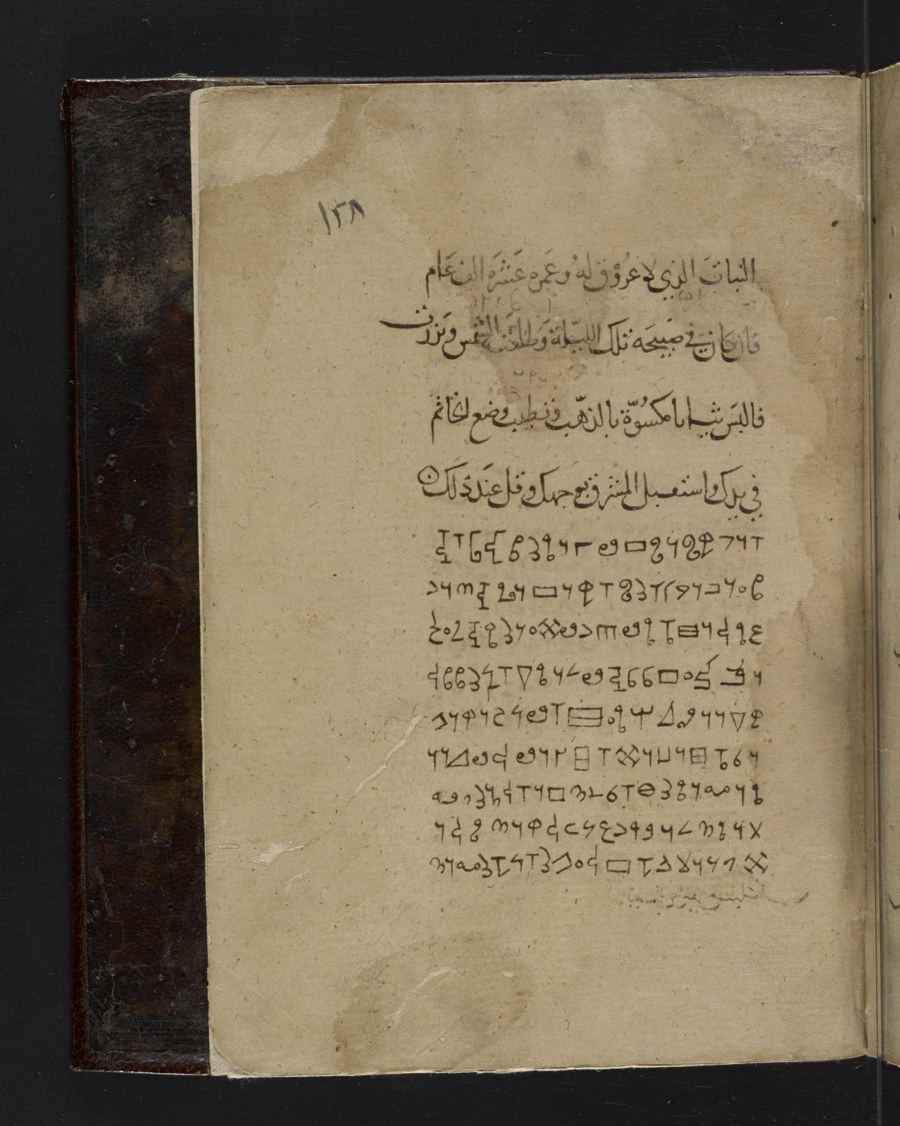
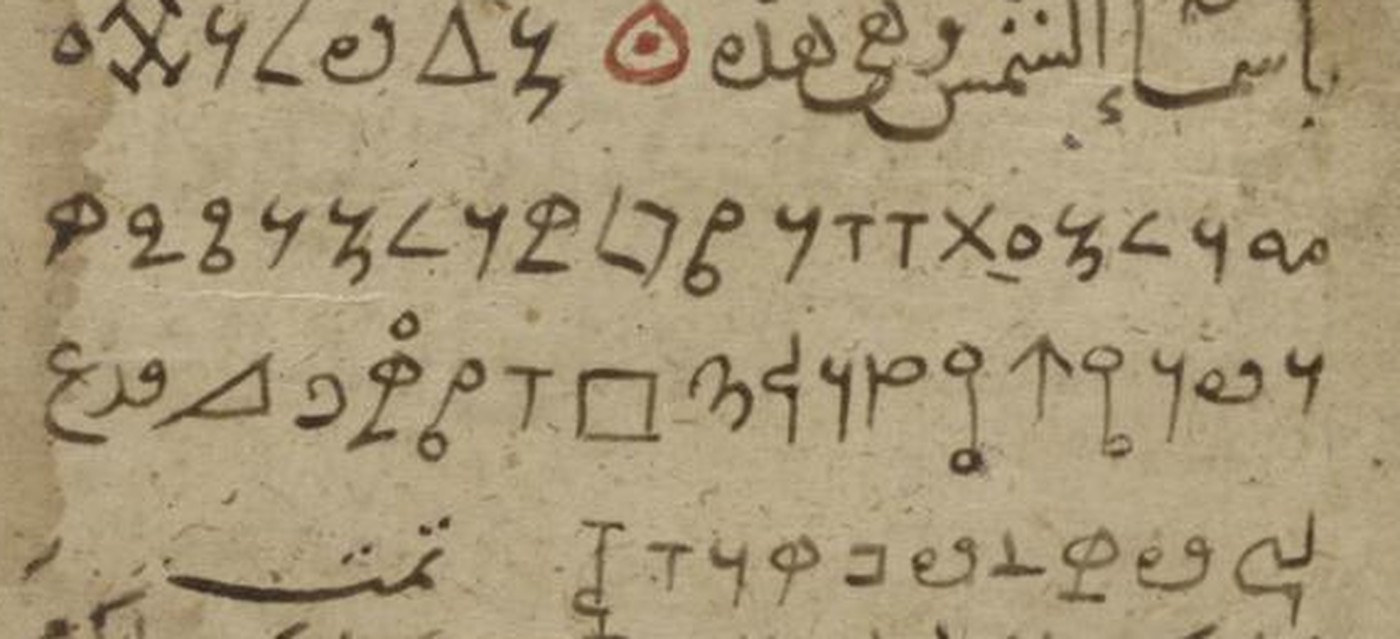
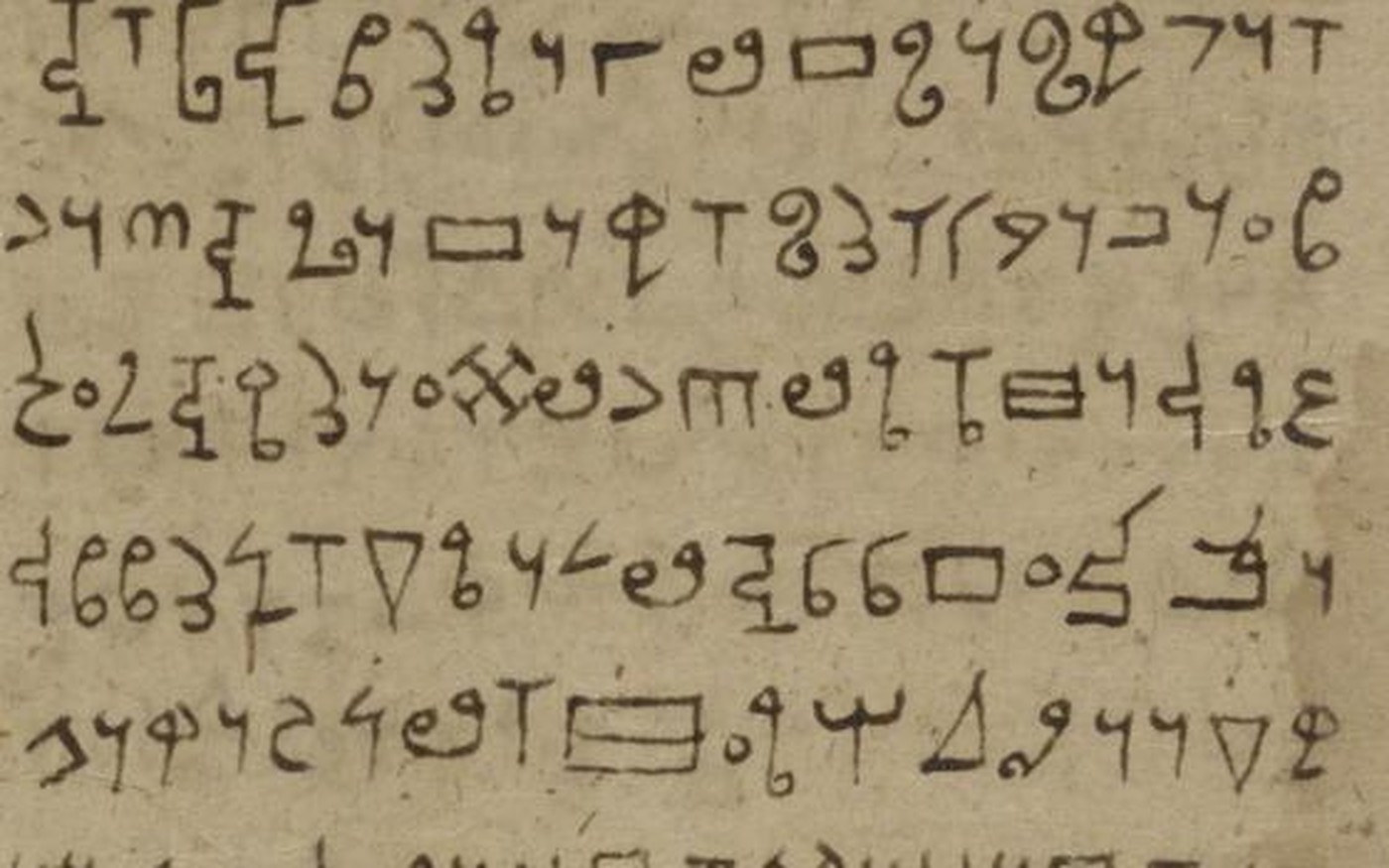
LJS 456 p.196 =28 — Heading of the eighth maqala (occult properties, "nomic" secrets, properties of stones); Arabic prose.LJS 456 p.197 =29 — Arabic introduction ends; red sign heading; secret-script prose begins with triple-dot separators.LJS 456 p.198 =30 — Script continues; red and blue sign headings sharing a repeated sign sequence; later Arabic marginal note.LJS 456 p.199 =31 — Script with a blue multi-line sign heading; Arabic marginal note at left.LJS 456 p.203 =35 — Last script page, red heading, ends with a circled-dot end mark.LJS 456 p.204 =36 — Arabic resumes: "description of the shapes of the talismans - first part".LJS 459 f.127v — Independent witness (Mosul, c.1193-1211): same sign repertoire used for "the names of the Sun", closed with Arabic tammat.LJS 459 f.128r — Independent witness: nine lines of the same repertoire after Arabic ritual instructions (no word separators).
2. Sign lines, enlarged
LJS 456 p.197: red heading and first script linesLJS 456 p.198: red sign headingLJS 456 p.198: blue sign heading (repeats part of the red heading sequence)LJS 456 p.202: running script, lines 1-4LJS 459 f.127v: names of the Sun (script lines)LJS 459 f.128r: script lines 1-5
3. Individual signs: deterministic inventory of LJS 456
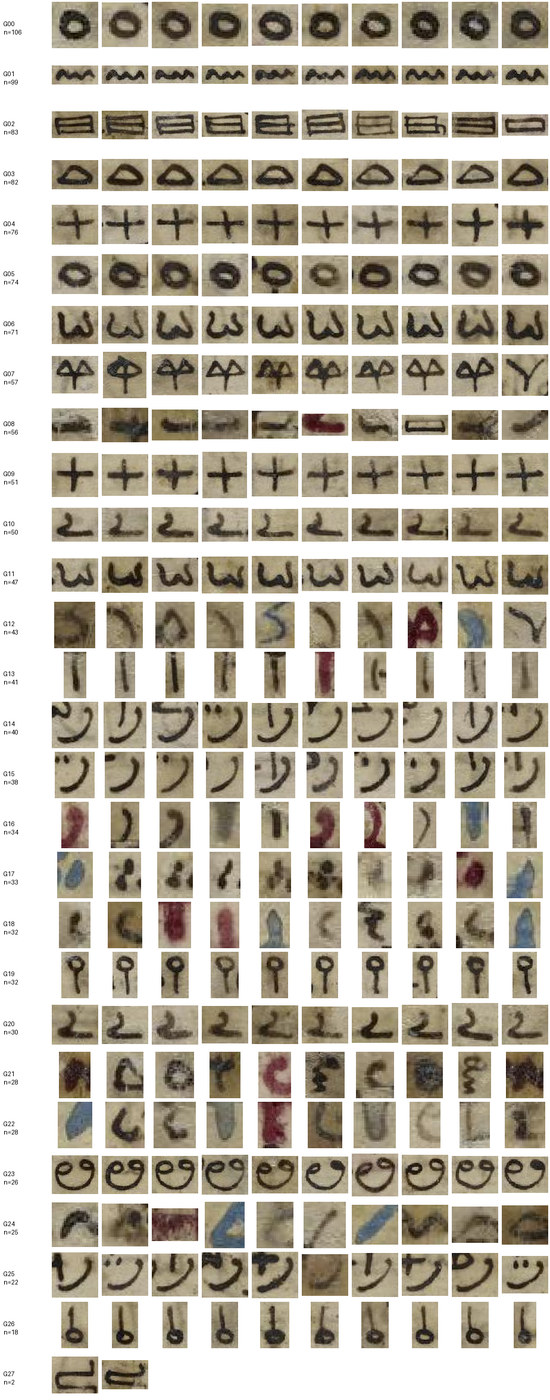
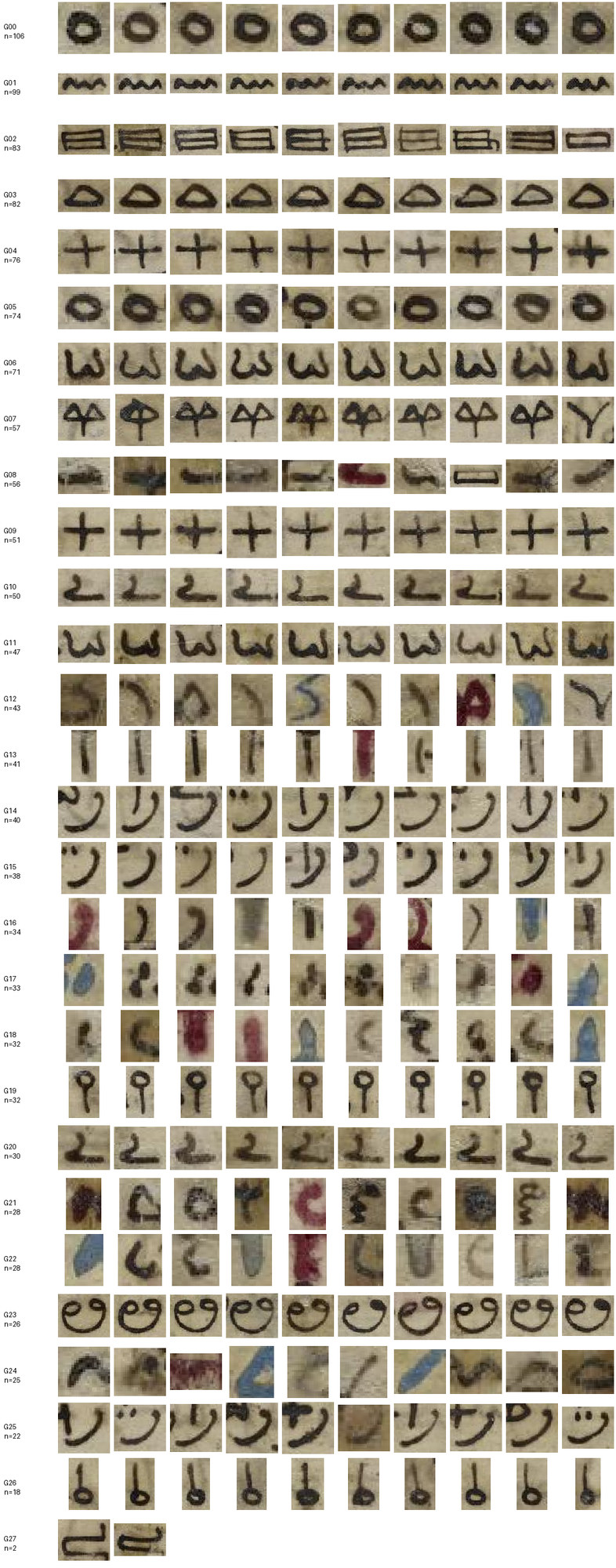
1324 connected components from the seven script pages. Separator dots and specks are removed. Components are grouped by the project shape descriptor (k-means, fixed seed); each row shows the ten members closest to the group centre. Some rows (colour headings, faint marks) are mixed. Signs joined into one component, such as 6+9, appear as one unit.
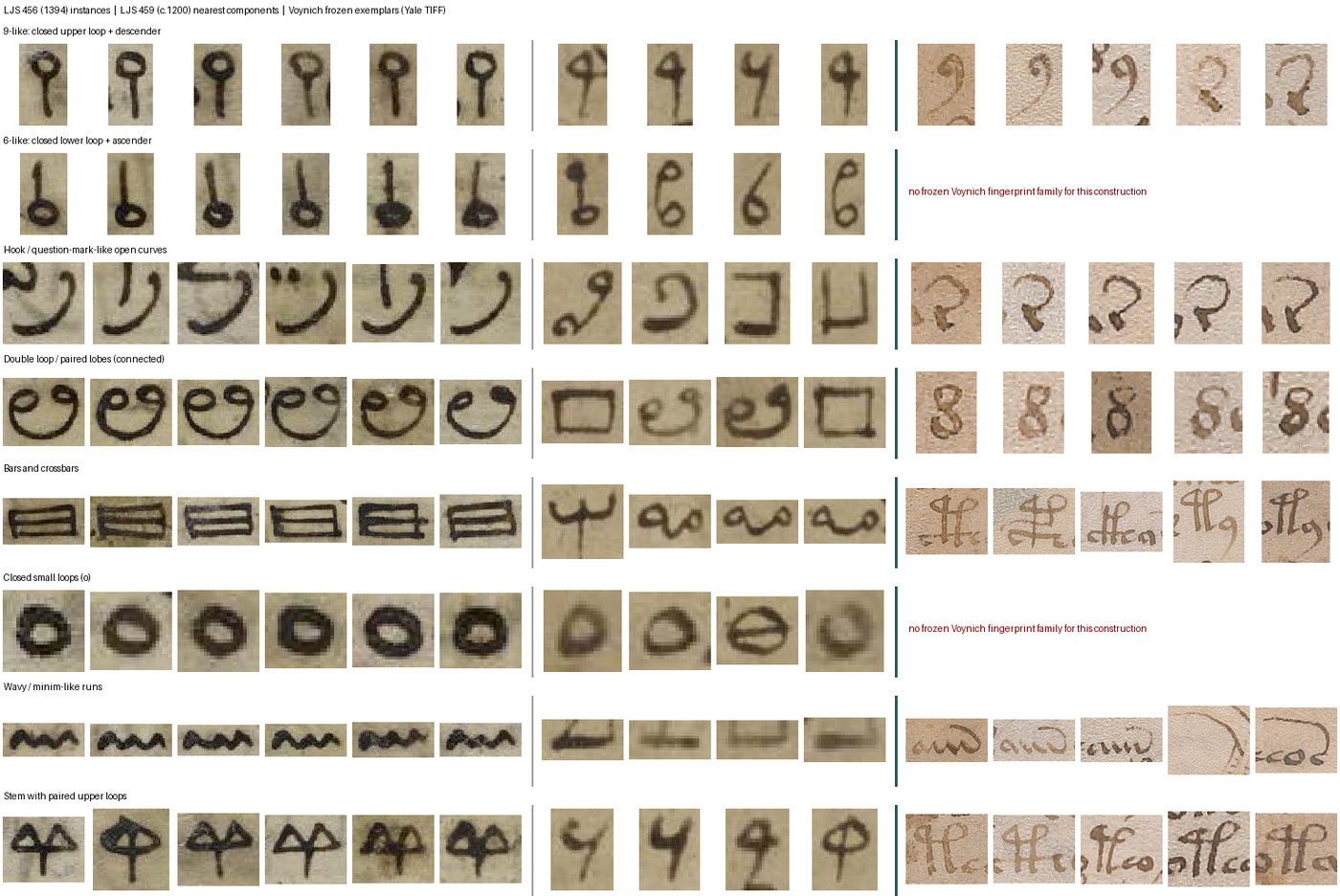
Left: LJS 456 inventory members. Middle: the four LJS 459 components nearest to the same group centre (independent witness). Right: frozen Voynich exemplars from the named pattern cards.
Construction-by-construction comparison
Construction
Grade
Why
9-like: closed upper loop + descender
COMPONENT-LEVEL RESEMBLANCE
LJS 456 running-text form is a closed ring on a straight vertical stem (lollipop); the red heading 9s curve more. Voynich 9-forms have a curved, often open, left-returning tail. The shared shape is also the ordinary Western Arabic (ghubar) and Latin numeral 9, so it carries little weight on its own.
6-like: closed lower loop + ascender
NO MEANINGFUL MATCH
Frequent and distinctive in both Sirr al-asrar witnesses; no Voynich fingerprint construction corresponds.
Hook / question-mark-like open curves
GENERIC MEDIEVAL STROKE
LJS 456 hooks open downward-left like Arabic ra/zay (some dotted); the Voynich hook is a question-mark curve with a short foot.
Double loop / paired lobes
COMPONENT-LEVEL RESEMBLANCE
LJS 456 joins two loops side by side on a baseline; the Voynich double-loop stacks two lobes vertically (8-like).
Bars / crossbars
NO MEANINGFUL MATCH
LJS 456 bars are closed rectangles with internal bars and a free cross (+); Voynich crossbars join tall stems (gallows/bench). The distinctive Voynich stem-and-crossbar architecture is absent.
Loops (o)
GENERIC MEDIEVAL STROKE
Plain small rings in both; universal.
Wavy / minim-like runs
GENERIC MEDIEVAL STROKE
LJS 456 has one continuous wavy sign; Voynich minim runs are separate short strokes with variable joins and terminals.
Stem with paired upper loops
COMPONENT-LEVEL RESEMBLANCE
LJS 456 has a single stem under two small triangles/loops; Voynich gallows are paired stems with a loop and crossbar.
Dot groups
NO MEANINGFUL MATCH
LJS 456 uses triple-dot groups as regular word separators; Voynich fingerprint forms include no comparable separator system.
Connected combinations
NO MEANINGFUL MATCH
LJS 456 signs are written as discrete units between separators (occasional 6+9 joins); Voynich connected compounds join loops, minims and terminals into long contours.
No construction was graded STRONG WHOLE-FORM MATCH or PLAUSIBLE SCRIBAL VARIANT. Distinctive constructions do not co-occur across the two systems.
5. Matched retrieval test (frozen v001 pipeline)
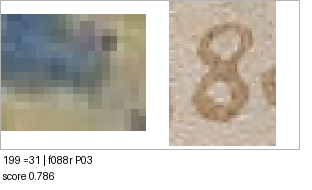
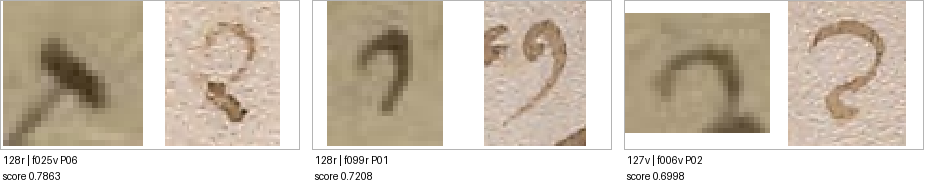
Per-unit rates of frozen Voynich family retrieval for secret-script regions vs the same scribe’s ordinary Arabic. Each manuscript is scaled by one x-height measured on its own Arabic. The v001 automatic estimate doubled on dot-heavy script pages; that run is kept as a sensitivity check in retrieval.json. The script is lower than same-scribe Arabic for gallows, bench and compounds. The lenient 9/hook rate is modestly higher in LJS 456 and does not hold at the strict threshold. Top-scoring pairs are mostly dots and bar fragments (strips below), so these rates measure a coarse descriptor, not whole-form similarity.
Region set
units
double loop
9/hook
gallows/tall
bench/crossbar
minim runs
arch/modifier
connected compounds
LJS 456 cipher
3842
0.003
0.166
0.050
0.089
0.145
0.043
0.055
LJS 456 arabic
3950
0.003
0.137
0.087
0.246
0.091
0.048
0.107
LJS 459 cipher
359
0.000
0.120
0.156
0.070
0.042
0.053
0.033
LJS 459 arabic
366
0.003
0.085
0.115
0.117
0.169
0.038
0.046
Voynich reference folios (v001)
27095
0.007
0.210
0.130
0.182
0.104
0.049
0.115
One-sided permutation p (script higher than same-scribe Arabic; descriptive)
double loop
9/hook
gallows/tall
bench/crossbar
minim runs
arch/modifier
connected compounds
LJS 456 lenient
0.630
0.001
1.000
1.000
0.000
0.836
1.000
LJS 456 strict
0.939
0.657
1.000
1.000
0.000
0.721
1.000
LJS 459 lenient
1.000
0.074
0.071
0.991
1.000
0.213
0.864
LJS 459 strict
1.000
0.062
0.851
0.887
0.988
1.000
0.928
Top strict retrieval pairs, LJS 456, double loop (left script, right Voynich)Top strict retrieval pairs, LJS 456, 9/hook (left script, right Voynich)Top strict retrieval pairs, LJS 456, gallows/tall (left script, right Voynich)Top strict retrieval pairs, LJS 456, bench/crossbar (left script, right Voynich)Top strict retrieval pairs, LJS 459, 9/hook (left script, right Voynich)Top strict retrieval pairs, LJS 459, gallows/tall (left script, right Voynich)Top strict retrieval pairs, LJS 459, bench/crossbar (left script, right Voynich)
6. Preserved leads (not investigated here)
9-like form ↔ scholastic Latin abbreviation. Penn LJS 56, Logica parva, Padua?, 1420, ff. 27v and 37r (audit A75, A59); Penn LJS 457, Loyca parva, Perugia, 1475, f. 62r (A18); Penn LJS 484, veterinary recipes, Ferrara?, 1450–75, f. 23r (A56).
LJS 456 sign notation vs Voynich — focused follow-up (v001)
Date: 2026-09-28 (America/New_York). Scope: one manuscript lead from the medical-manuscript comparison (audit panel A72). This is not a general survey. Review:[preserved evidence reference]. Evidence:[preserved evidence reference] (). No Voynich reading, EVA value, language hypothesis or medical-decipherment theory was used.
Correction to the lead as stated
The lead was described as "the 1394 German non-medical manuscript sign row". It is neither German nor a single row. The 1394 manuscript is Arabic (Maghribi script). The "row" seen in panel A72 is the first line of a secret-script block that runs about seven pages.
1. Identification
Item
Finding
Title
Kitāb al-Siyāsah fī tadbīr al-riyāsah (cataloguer's title). This is the Arabic pseudo-Aristotelian Sirr al-asrār / Secretum secretorum, a letter from "Aristotle" to Alexander on statecraft, astrology, magic and medicine.
Shelfmark / holder
LJS 456, Kislak Center for Special Collections, Rare Books and Manuscripts, University of Pennsylvania (OPenn; TEI sha256 ec0f57ad…aaa1c, identical to the v001 corpus record)
Date / place
Copy completed AH 797 (1394), colophon f. 22r; "perhaps produced in Andalusia" (catalogue). 22 leaves.
Language / script
Arabic, Maghribi hand, red/blue rubrics
Where the signs are
Penn image labels 197 =29 (lower half) through 203 =35, i.e. ff. 15r–18r of the 22-leaf codex (the pencilled numbers 197–203 are an older pagination). Script regions total about 95 lines.
Surrounding text
p.196: heading al-maqāla al-thāmina fī ʿulūm khāṣṣiyya wa-asrār nāmūsiyya wa-dhikr khawāṣṣ min al-aḥjār wa-mā ashbaha dhālika, "the eighth treatise, on sciences of occult properties and 'nomic' secrets, and on the properties of stones and the like". p.197: the Arabic introduction ends with the author promising to "follow with mention of properties of stones" (analyst reading, uncertain in places). Then comes the sign text. p.204: Arabic resumes with ṣifat ashkāl al-ṭalāsim … al-qism al-awwal, "description of the shapes of the talismans … first part".
Occurrence
Repeated, not isolated. It is continuous running text on 7 pages, never elsewhere in the codex (all 44 text pages inspected).
Form of the system (from the pages themselves). The text runs right to left in lines like the Arabic. Word-like groups are separated by triple-dot marks (∴). Red and blue sign headings recur, and at least one sign sequence repeats between a red and a blue heading on p.198. The block closes with a circled-dot end mark. Later Arabic marginal notes stand beside the script on pp.198–200 and 202; they may be readers' glosses, but they are not read here. The repertoire has roughly 25–30 frequent sign types: 9-like, 6-like and 3-like signs, rings, barred boxes (⊟), triangles, +, a cross with bars, ω-shapes, a wavy sign, a stem with two small loops, hooks resembling Arabic rāʾ/zāy, and a few joined pairs. See the 28-group inventory of 1,324 components.
Classification against the requested options:
Not numerals or a numeral table. It is prose-length text with word separators and rubricated headings, and it has too many sign types.
Not shorthand or scribal abbreviation. It does not abbreviate the surrounding Arabic; it replaces it.
Not bookkeeping, mathematical or musical notation. There is no tabular or staff structure.
Not astronomical symbols. The planetary signs are absent.
Best described as a cipher, i.e. a secret alphabet (occult "qalam"). It replaces the Arabic text of the stones/talismans section. Some sign shapes (9, 6, 3, 0) coincide with Western Arabic (ghubār) numeral forms. Whether numerals were deliberately borrowed is not established.
Scholarship. Library catalogues and web-accessible literature identify no named alphabet. Penn's catalogue for LJS 459 says only that its text "breaks off during a discussion of magical alphabets". Scholarship does place magical alphabets and talisman lore in the long Sirr al-asrār and in the related pseudo-Aristotelian Hermetica. I did not reach a published description of this specific alphabet.
Verdict:likely identification. It is a secret (magical) alphabet transmitted with the Arabic Sirr al-asrār, used in LJS 456 to write out the section on stones. The precise alphabet name, its sign-to-letter key and its origin are unresolved. It was not deciphered, since that was out of scope.
2. Ancestry: independent witness of the same tradition
Penn LJS 459, Sirr al-asrār, long form. Probably Mosul, 1193–1211 (owner Nūr al-Dīn Arslān Shāh); OPenn. On f. 127v the Arabic reads roughly "…call at the completion of each week the name of a planet … the names of the Sun, and they are these". It is followed by lines of the same core repertoire (9, 6, 3, o, barred box, triangle, square, ω) and Arabic tammat, "finished". f. 128r has nine further lines after ritual instructions.
Differences from LJS 456: LJS 459 has no ∴ separators, its 9 is more open, and it has more T/X signs. The script there writes invocation names, not a prose section.
These are two copies about 200 years and roughly 4,000 km apart (Iraq vs al-Andalus), in different hands, sharing a sign repertoire. So the notation is a textual tradition of the Sirr al-asrār, not one scribe's invention.
No third digitized witness was located in the time-boxed search. Wellcome's "Sirr al-asrār" is al-Rāzī's alchemical work, and the Met/Gallica lookups failed. This limits the tradition-level comparison to two witnesses.
3. Comparison with Voynich
Curated whole-form comparison. See curated_constructions.png. Each row compares LJS 456 inventory members, the nearest LJS 459 components and frozen Voynich exemplars from the named pattern cards. Grades were assigned by the analyst after viewing:
Construction
Grade
Basis
9-like (loop + descender)
COMPONENT-LEVEL RESEMBLANCE
LJS 456 has a closed ring on a straight stem; Voynich has a curved, often open, left-returning tail. The shape is also the common numeral 9.
6-like
NO MEANINGFUL MATCH
Distinctive in both Sirr witnesses; no Voynich fingerprint equivalent
Hook / question-mark
GENERIC MEDIEVAL STROKE
Arabic rāʾ-like curves vs a Voynich question-mark curve
Double loop
COMPONENT-LEVEL RESEMBLANCE
Loops side by side on the baseline vs lobes stacked vertically (8-like)
Bars / crossbars
NO MEANINGFUL MATCH
Closed barred rectangles and a free + vs Voynich crossbars joining tall stems
Loops (o)
GENERIC MEDIEVAL STROKE
Universal
Wavy / minim runs
GENERIC MEDIEVAL STROKE
One continuous wave vs separate minims
Stem + paired upper loops
COMPONENT-LEVEL RESEMBLANCE
Single stem under two small loops vs paired-stem gallows with a crossbar
Dot groups
NO MEANINGFUL MATCH
∴ word separators have no Voynich counterpart
Connected combinations
NO MEANINGFUL MATCH
Discrete signs vs Voynich long connected contours
No construction reached STRONG WHOLE-FORM MATCH or PLAUSIBLE SCRIBAL VARIANT. The distinctive constructions do not co-occur across the two systems:
Voynich gallows/bench architecture is absent from the script.
The script's barred boxes, triangles, "6", + and ∴ are absent from the Voynich fingerprint forms.
The Voynich-like impression of panel A72 at thumbnail scale came from a running line of 9/6/3-like loops. The Voynich 9-like form is the only item shared at component level.
Matched pixel test. Tool: [deterministic method], using the unchanged frozen v001 pipeline, exemplars and thresholds. It compares script regions with the same scribe's ordinary Arabic from the same manuscript: 3,842 vs 3,950 units in LJS 456, and 359 vs 366 in LJS 459 (same pages).
The primary run scales each manuscript by one x-height measured on its own Arabic (8.0 and 8.75 px). The v001 automatic estimate doubled on dot-heavy script pages, which halves sign size. That automatic run is retained as a sensitivity analysis and gave a different pattern (gallows higher), so rates are scale-sensitive.
Primary results:
LJS 456: script retrieval is lower than same-scribe Arabic for gallows (0.050 vs 0.087 lenient), bench (0.089 vs 0.246) and compounds (0.055 vs 0.107). It is higher only for lenient 9/hook (0.166 vs 0.137, p = 0.0006) and minim runs (0.146 vs 0.091). The 9/hook difference vanishes at the strict threshold (0.0075 vs 0.0081).
LJS 459: no family is reliably higher; strict 9/hook p = 0.06.
Inspection of the top strict hits shows mainly dots, bar fragments and stains retrieved against Voynich gallows and 9-forms. So these rates measure a coarse descriptor, not whole-form similarity. The retrieval therefore gives no support for a special Voynich relationship.
4. Answer
1394 notation: likely identification. It is a secret/magical alphabet of the Arabic Sirr al-asrār tradition, used for the section on properties of stones. The same repertoire appears in an independent c.1200 Mosul copy. The specific alphabet is not named in the scholarship reached, and it is not deciphered.
Voynich relationship: GENERIC RESEMBLANCE.
Why: The only shared elements are a 9-shape and plain rings. These are also common numeral and letter shapes. Voynich's distinctive constructions are absent from the script, and the script's distinctive signs are absent from Voynich. The pixel test finds no excess over the same scribe's ordinary Arabic.
Worth noting separately (context, not script evidence): this is a real medieval case of a secret alphabet embedded in a widely copied compendium of natural and occult lore, with rubricated headings. That makes it a genre analogue for enciphered technical text. It does not show a relationship between the two scripts.
Further investigation: NO, for the script-resemblance question. It would reopen only if a witness of this Sirr alphabet were found in a Latin or European Secretum secretorum copy, which would be the next test.
5. Preserved leads (documented, not investigated)
Voynich 9-like form ↔ general scholastic Latin abbreviation (superscript 9 -us, backwards-c con-):
Penn LJS 56, Logica parva, Padua?, 1420, ff. 27v (audit A75) and 37r (A59). This was the highest-scoring manuscript in v001.
Penn LJS 457, Loyca parva, Perugia, 1475, f. 62r (A18).
Penn LJS 484, L'arte de la medicina de le bestie, Ferrara?, 1450–75, f. 23r (A56).
Voynich gallows/bench ↔ German cursiva (looped ascenders, bars across tall strokes; recipe and non-medical material alike). All are Heidelberg UB:
Cod. Pal. germ. 35, sermons, Bayern 1439, f. 50v (A45).
Cod. Pal. germ. 329, Hugo von Montfort, Steiermark 1414/15, f. 18r (A81).
Cod. Pal. germ. 226, recipes and medical/astronomical treatises, Elsass 1456–69, ff. 191r (A24) and 107r (A27).
Cod. Pal. germ. 140, town chronicle, Bayern 1456, ff. 54v, 99r. This was the second-highest-scoring manuscript in v001.
Limits
One analyst chose the construction rows and the grades, with no second rater.
Region boxes were drawn by eye before scoring and checked against overlays.
Web JPEGs (1800 px height) were used, not master TIFFs.
Permutation p-values ignore line/page clustering and are descriptive only.
Arabic readings are the analyst's and are marked uncertain where so.
Literature access was limited to web-available sources.
Compute: this MacBook only, one light CPU job (~20 s per run). No models were used.
Review images
Embedded from the preserved project files (display copies; originals remain in the project folder).