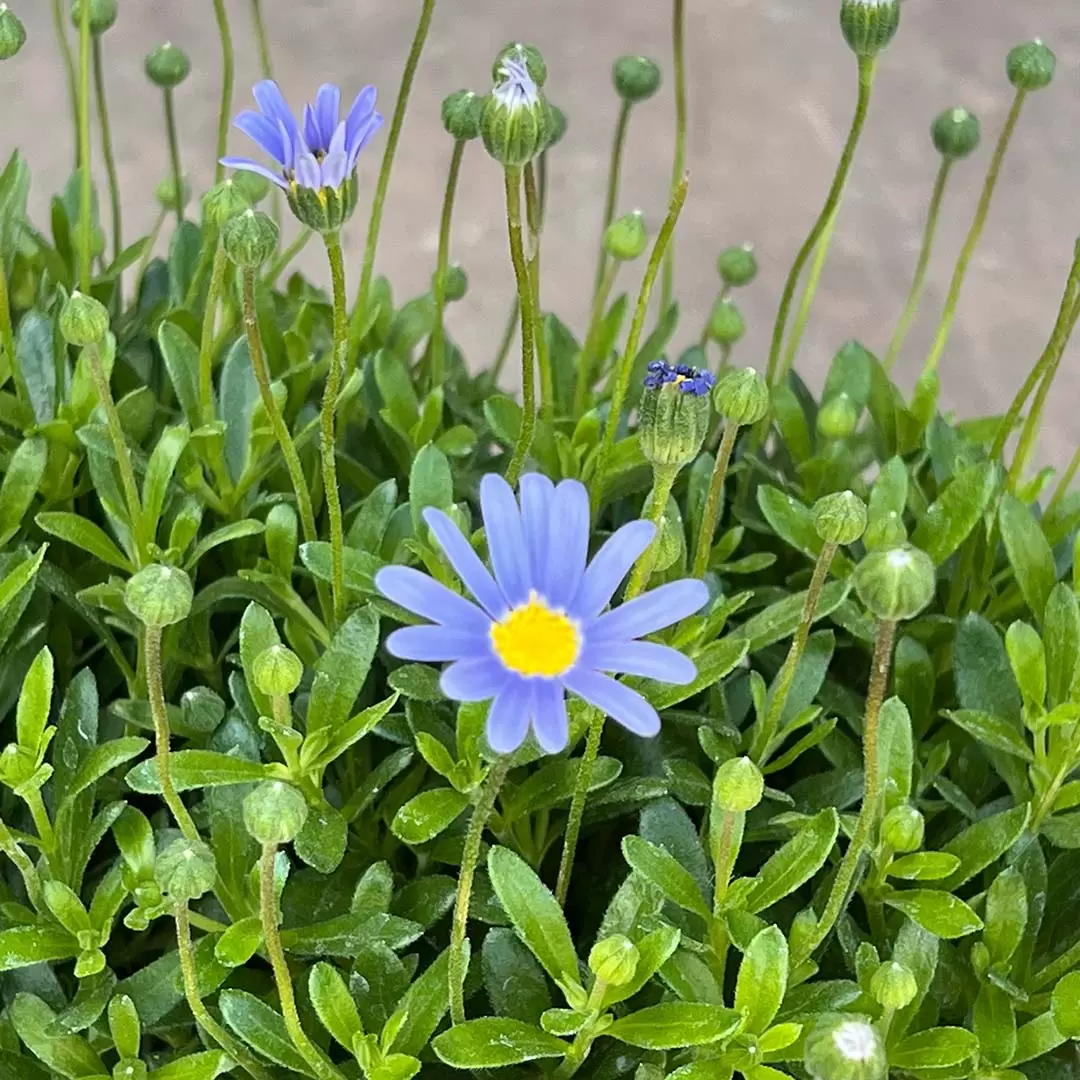
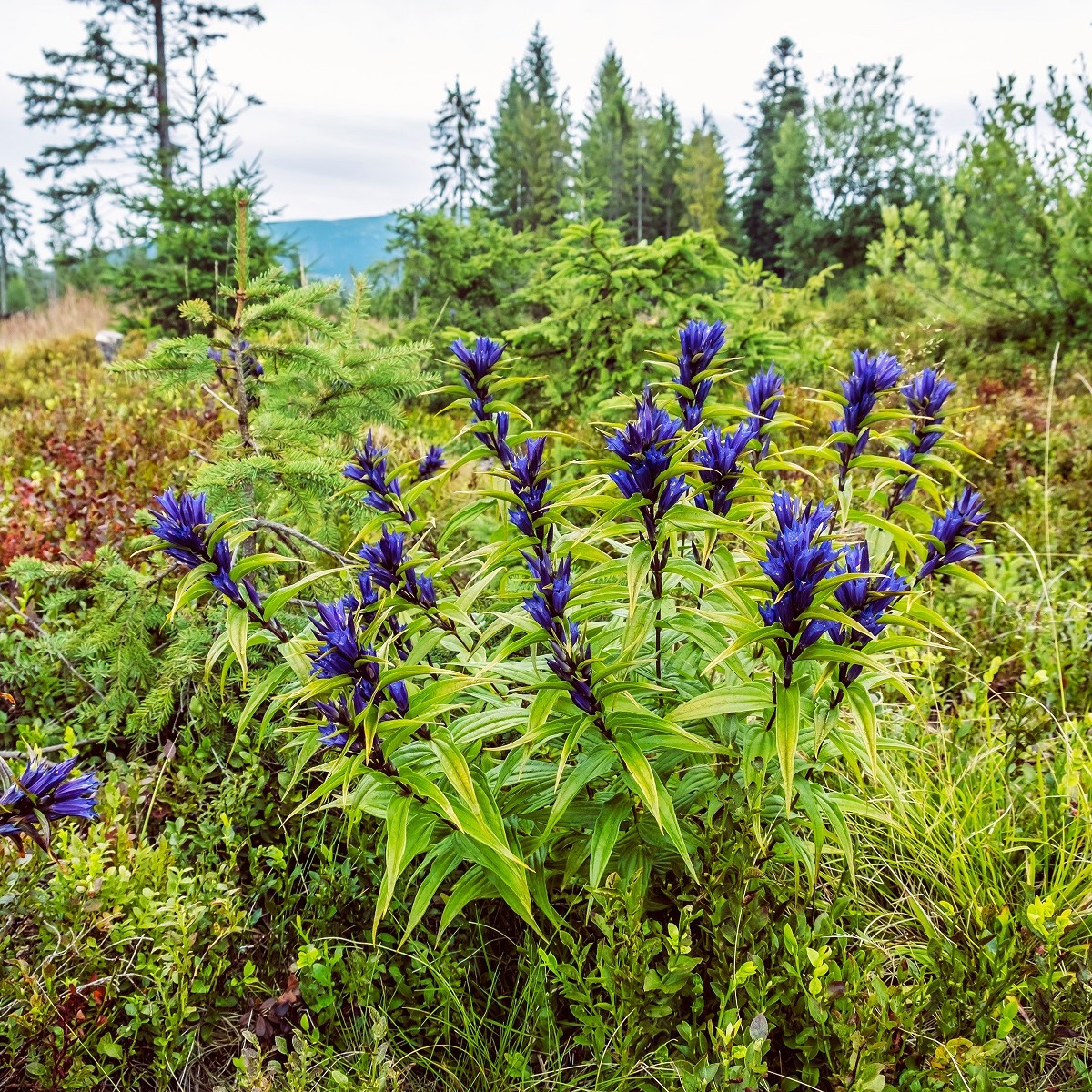
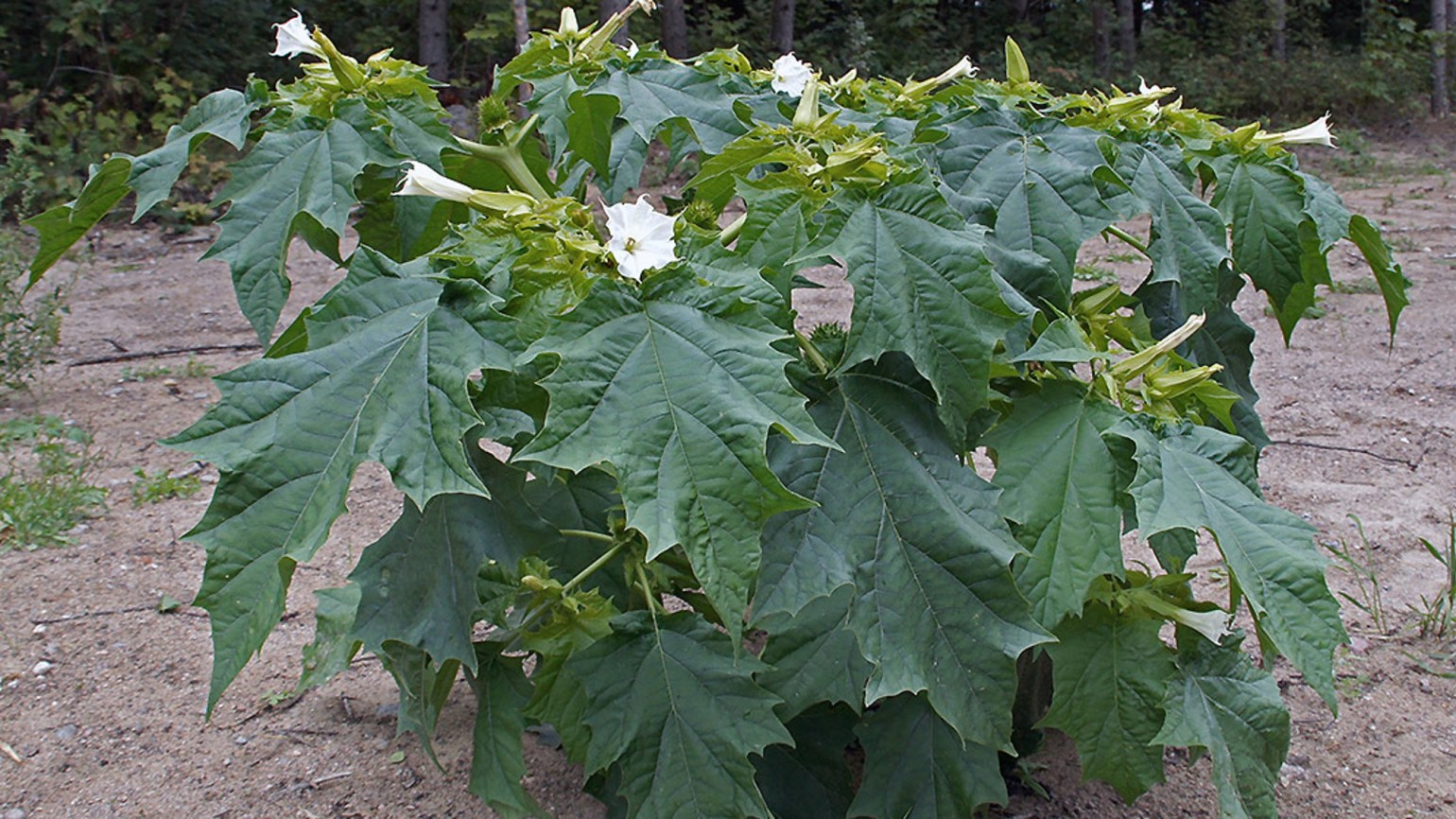
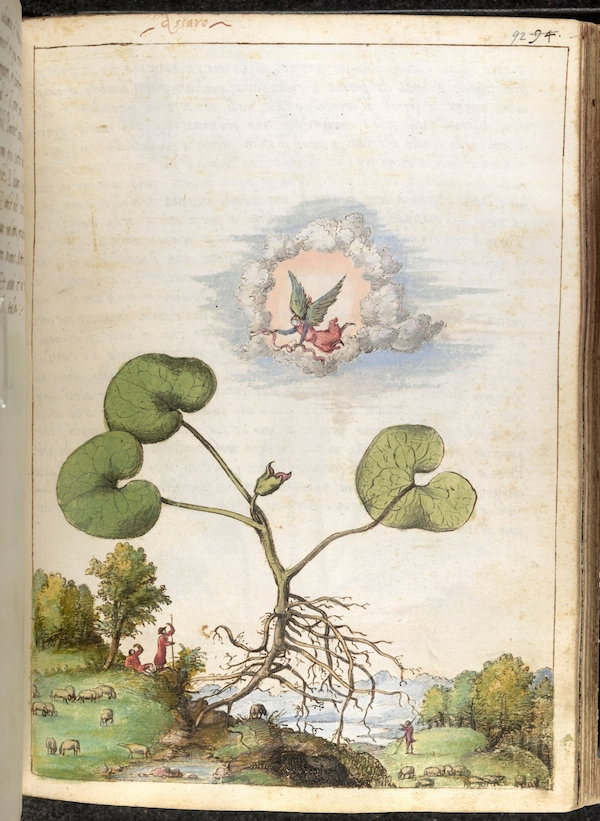
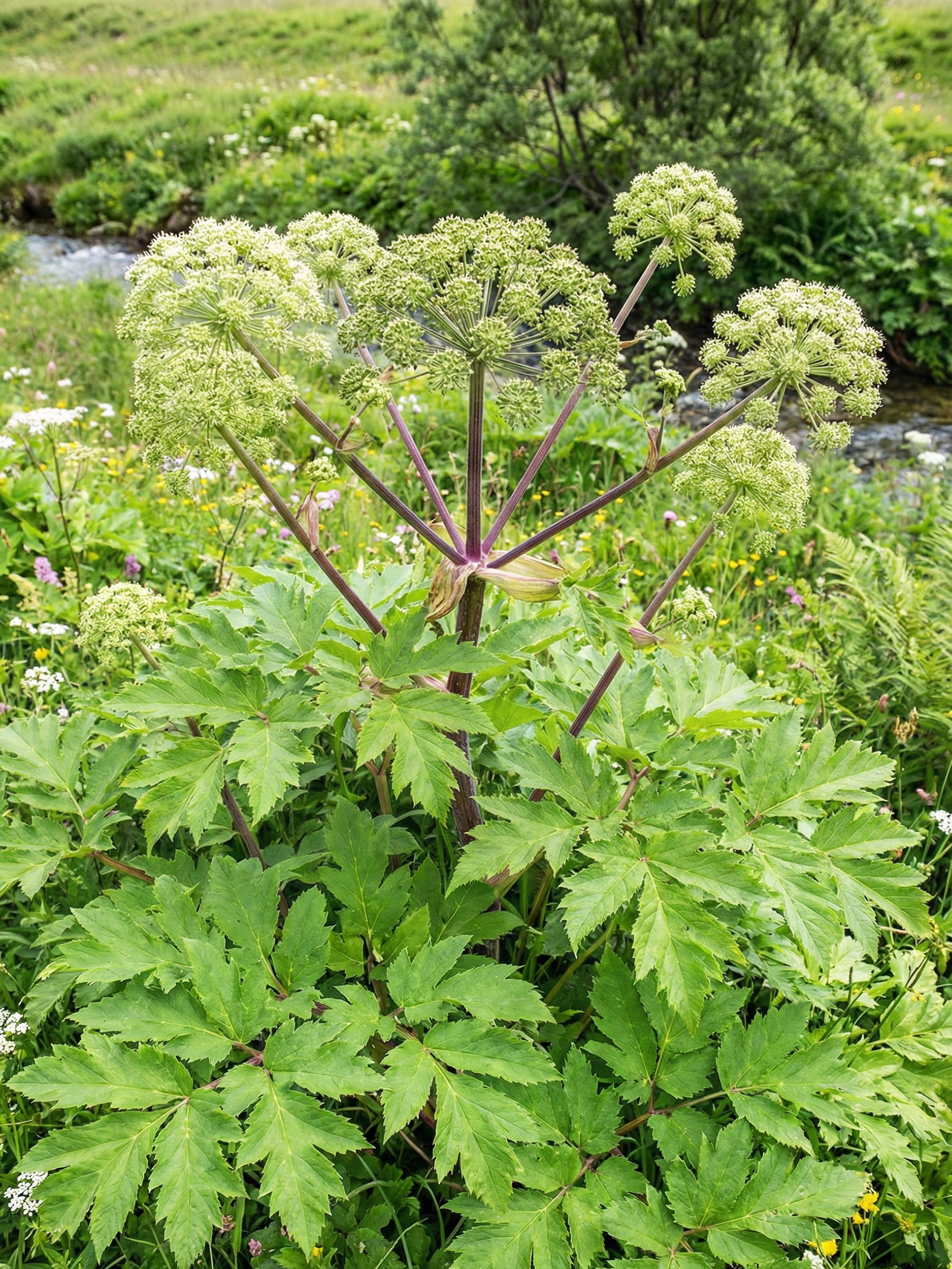
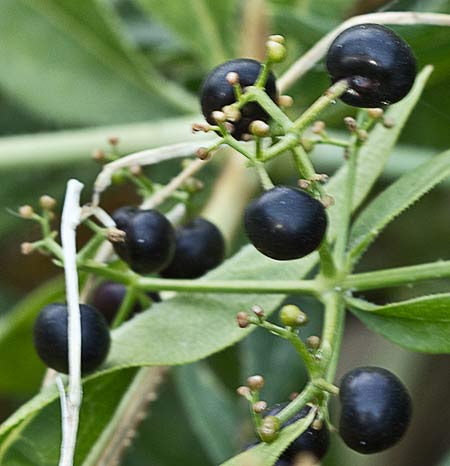
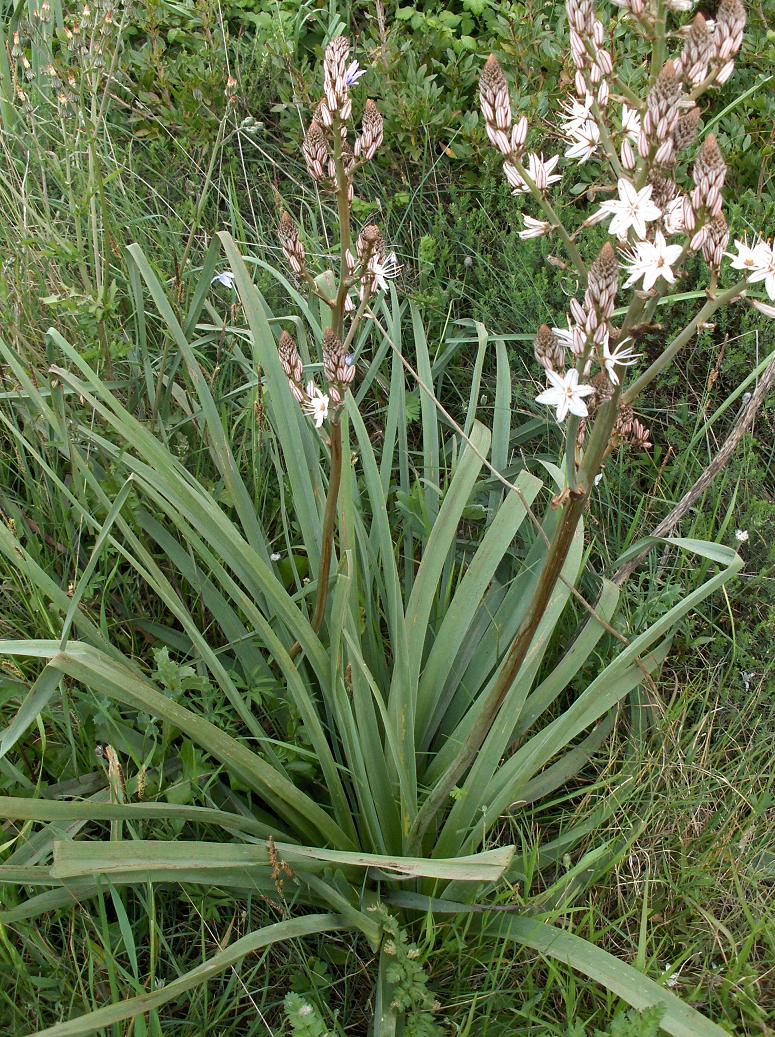
Both lanes contain 134 records across 126 unchanged Yale source views. Each record has at least one researcher-inspected lead or rival picture; this does not mean every candidate or diagnostic organ was tested. Zero plant identities are accepted. The independent review audited all 268 records, personally inspected nine source views and 25 reference pictures, then checked the four recovered historical comparisons. It did not visually reassess every comparison.
Lane candidates were frozen before comparison. Same-lane historical reference metadata sharing is disclosed; reviewer/coordinator additions are separate from the original batches. This supports procedural separation, not proof of mental independence. The interrupted modern assignment was preserved and completed by a fresh modern-only worker; no baseline gaps or duplicate assignments remain.
Exact Nummularia and Egerton 747 Ruta f85r pictures remain deferred. The recovered Brunfels Primula, Fuchs Rumex, Cibo Asarum rival and Gerard Rue pictures are link-only. Fuchs/Gerard edition and holding-copy metadata remain unverified; the Rue vendor page later returned HTTP 404 despite the saved picture having been inspected. A mismatch with the Cibo Asarum comparator does not exclude its genus. Broader flora, herbarium, medieval/Arabic herbal, diagnostic-organ and alternative searches remain incomplete.
These are 134 external whole-plant mappings, not 134 validated standalone plant extractions. Multiple-plant boundaries remain unverified; small pharmaceutical parts outside the crosswalk were not inventoried. No geographic origin, source-copy relationship or accuracy percentage follows from this first pass. Browser-width checks do not establish physical iPhone Files success.
Exploratory candidate evidence, 4 October 2026. No accepted plant identity or geographic conclusion.
Project Summary
Question: Can we identify the plants, and what supports or contradicts each candidate?
Method: Two independent cloud research lanes inspect actual Yale-derived source views, search modern botanical pictures and historical herbal illustrations separately, and freeze candidates before comparison. No local models or generated reference pictures are used.
Coverage: 134/134 modern records; 134/134 historical records. Records with at least one reference picture inspected: 134 modern, 134 historical. This sheet displays 134 instances. A recorded row may remain unresolved or have a reference-access limitation; these totals do not measure successful identification or exhaustive search. A reference-view flag does not mean every named candidate or rival was visually tested.
Meaning: Matches nominate comparison leads. Contradictions and missing diagnostic characters limit identification; shared outline or artistic convention does not establish a species.
Corpus limitation: 134 external whole-plant instance mappings, 126 unchanged Yale source views, all source hashes verified. No verified 134-image standalone plant extraction was found. Boundaries and multiple-plant attribution remain provisional. External suffixes are illustration labels, not invented folios. Earlier Qwen/Gemma trials and v006 are preserved.
Every candidate remains provisional. Review alternative taxa, diagnostic organs, comparator orientation and uncertain plant boundaries. The complete research is now presented through the project front door. Browser checks do not establish physical iPhone Files success.
Review Needed
No candidate is accepted. Review plant boundaries, competing taxa, diagnostic structures, and whether historical images share generic conventions. Unresolved and pending cases remain visible in the complete results below.
Visible features: Branched upright stem; repeated smooth ovate leaves painted green/brown, short petioles; one terminal pale lobed cup around brown dome; broad scaly drawn root mass, no diagnostic veins.
Finding: Unresolved; no coherent genus candidate.
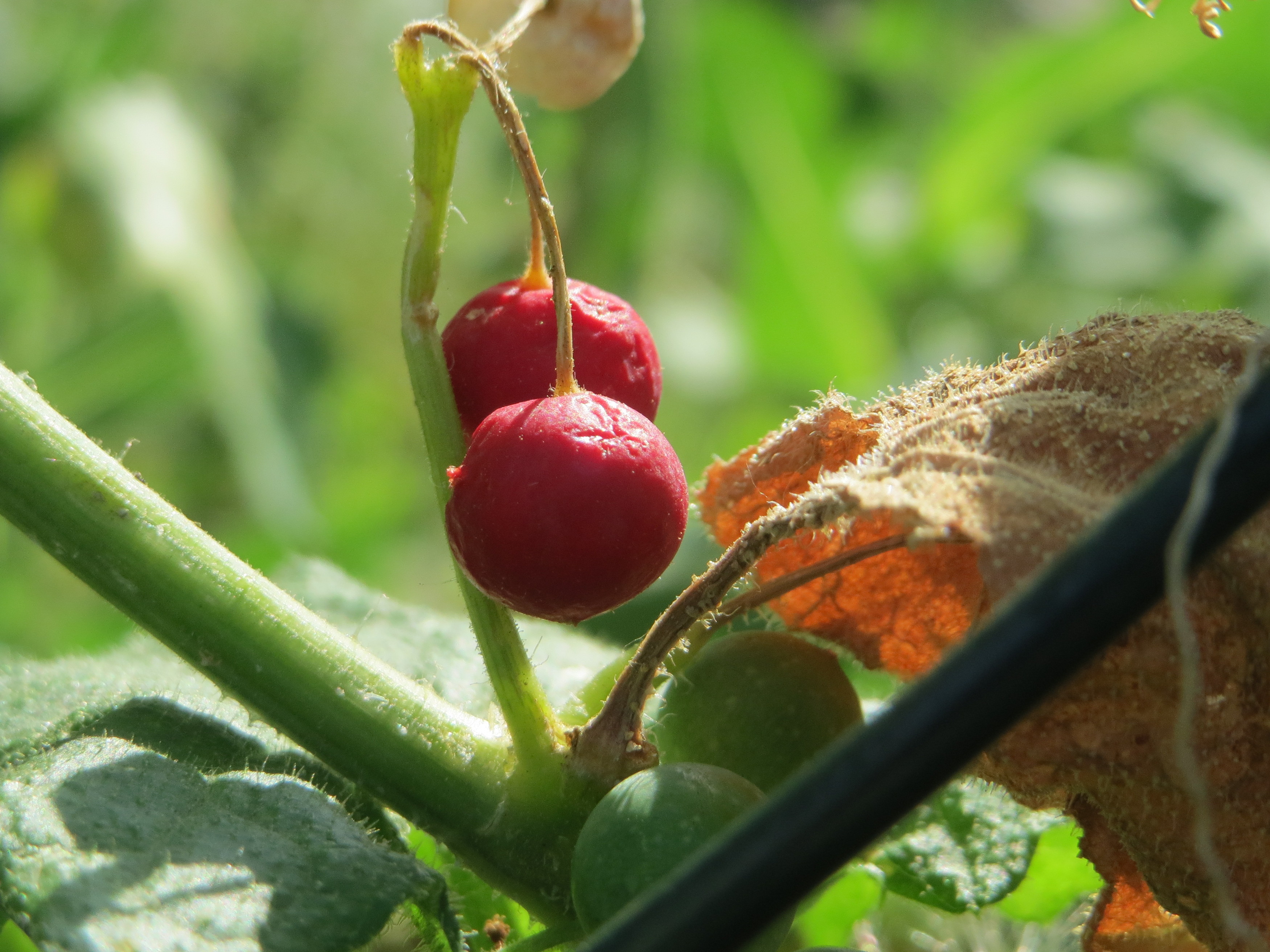
Solanaceae (Atropa-type only as rejected comparison) very low
Reference picture available through source link; no permission-clear local picture embedded.
Atropa belladonna flowers and leaves Magic Garden Seeds; photographer not verified Copyright/permission not established; inspection-only local copy; link publicly, do not embed; scaled for report, no botanical alteration; visual inspection: True Open original reference picture
Supports: Entire ovate leaves and cup/tube outline offer generic resemblance.
Contradicts / missing: Inspected Atropa has nodding axillary purple tubes and paired unequal leaves; manuscript has solitary upright terminal pale structure and an unmatched scaly base.
Alternatives: Unassigned broad-leaved flowering herb/shrub; Terminal structure may be fruit or stylized head
Limits: Whole-source-view mapping; individual extraction boundary unverified.; No accepted identity; stylization and missing diagnostic details limit comparisons.; Reference copies used for inspection only; rights must be cleared before embedding.
Historical lane deferred exact plate
Visible features: Branched upright stem with many entire ovate leaves, green and ochre fills; one terminal pale cup with dark semicircular cap; large uncolored textured mound/root base.
Finding: Unresolved. Search lead only; historical reference pixels deferred.
solanum / broad-leaved herb motif very low; provisional search lead
Supports: Both references show branching whole herbs with numerous entire leaves; Platearius birthwort also has pale hanging bodies.
Contradicts / missing: Voynich single terminal dark-capped cup is unlike the small reference bodies.; Nightshade reference carries black berries and angular leaves; these are absent.; Huge textured root mound is unexplained.
Finding: Unresolved; morphology/iconographic lead or negative comparator only. No accepted plant identity or manuscript exemplar.
Limits: External mapping identifies whole source view; plant boundary is unverified.; Similarity may reflect generic herbal conventions; no copying or species identity established.; Later reference dates do not support a pre1450 exemplar.; Remaining diagnostic alternatives and exact manuscript matches deferred.
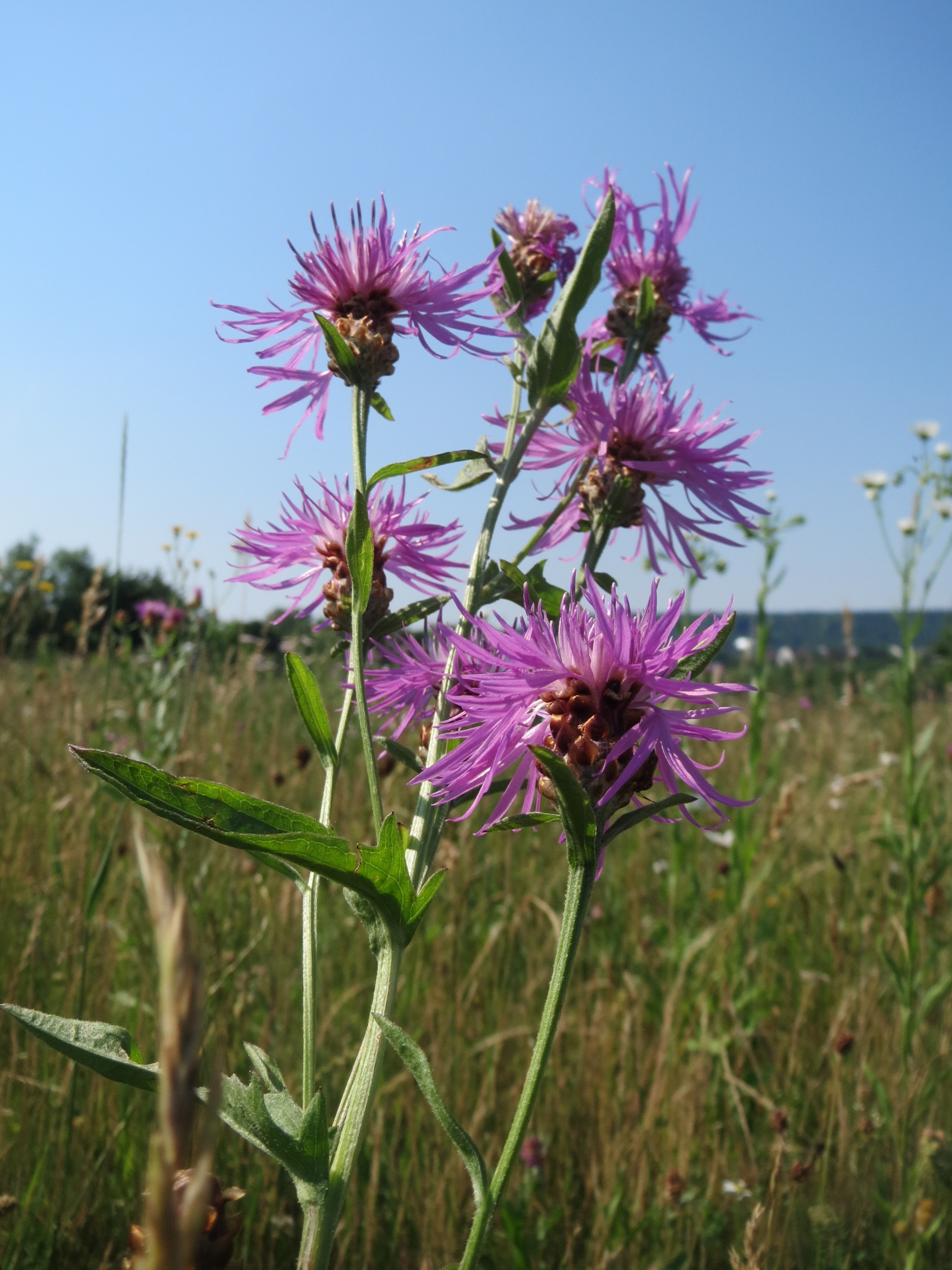
Visible features: Three erect peduncles end in many narrow pointed units; several deeply divided/pinnatifid leaves attached along branching reddish stem; small curled root.
Reference picture available through source link; no permission-clear local picture embedded.
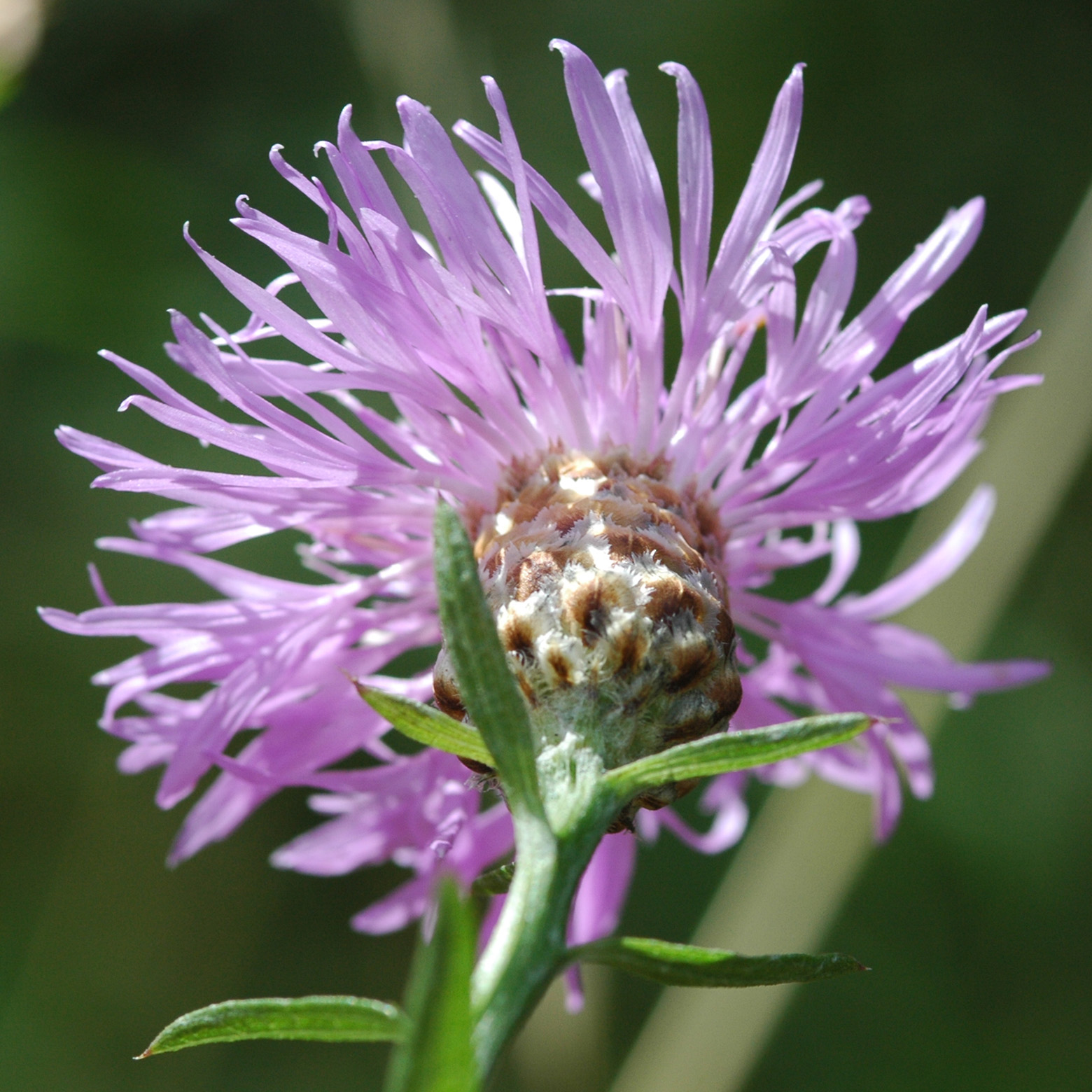
Centaurea scabiosa, Plantarium photograph Plantarium contributor; photographer name not independently verified Copyright/permission not established; inspection-only local copy; link publicly, do not embed; scaled for report, no botanical alteration; visual inspection: True Open original reference picture
Contradicts / missing: Centaurea photograph shows bract cup below projecting tubular florets; manuscript pointed units may all be bracts, lacks clear florets and leaf armature.
Limits: Whole-source-view mapping; individual extraction boundary unverified.; No accepted identity; stylization and missing diagnostic details limit comparisons.; Reference copies used for inspection only; rights must be cleared before embedding.
Historical lane deferred exact plate
Visible features: Three terminal pointed many-part heads on branching reddish-green stalks; large deeply fingered or toothed green leaves; short red curling root branches.
Finding: Unresolved. Search lead only; historical reference pixels deferred.
thistle / spiny composite motif very low; provisional search lead
Supports: Independent visual search lead from observed source morphology only; exact historical counterpart not yet visually tested.
Contradicts / missing: Leaf shape and many-part heads support a broad visual lead only.; Curling roots are stylized.
Alternatives: Composite or schematic medicinal-plant drawing; no accepted identity
Limits: Mapped plant-instance boundary unverified; inspected whole source view.; Exact reference pixels inaccessible during tool transport failures; no visual-match claim.
Historical supplementary comparison
Spiny composite / thistle-like motif low for broad motif; very low for named species
Voynich source view; whole page, unverified instance boundaryBook of Flower Studies thistle, folio8; ca1510–1515 The Metropolitan Museum of Art; Master of Claude de France Public Domain; Met object record verified; scaled for report, no botanical alteration; visual inspection: True Period limit: Later comparator; no evidence of pre-1450 source match Open original reference picture
Supports: Actual plates share many-part pointed heads, branching stems and dissected/spiny leaf silhouettes.
Contradicts / missing: Voynich leaf cuts are unusually fingerlike and head structure lacks the reference thistle purple tubular tuft.; Knikos has star-shaped orange flowers rather than Voynich stacked pointed head scales.; Roots are decorative curling forms.
Alternatives: Teasel; knapweed; other composite-head herb
Finding: Unresolved; morphology/iconographic lead or negative comparator only. No accepted plant identity or manuscript exemplar.
Limits: External mapping identifies whole source view; plant boundary is unverified.; Similarity may reflect generic herbal conventions; no copying or species identity established.; Later reference dates do not support a pre1450 exemplar.; Remaining diagnostic alternatives and exact manuscript matches deferred.
Visible features: One large nearly circular blade with basal notch, long slender stalk; separate elevated pale angular flower; rhizome drawn horizontally among many circles; no evidence of floating water itself.
Finding: Useful water-lily family hypothesis, species unassigned.
Nymphaeaceae (Nuphar/Nymphaea) low to moderate at family level
Reference picture available through source link; no permission-clear local picture embedded.
Nuphar lutea, yellow water-lily Jiří Bohdal / NaturePhoto.cz Copyright/permission not established; inspection-only local copy; link publicly, do not embed; scaled for report, no botanical alteration; visual inspection: True Open original reference picture
Supports: Inspected Nuphar has round/oval deeply notched blade and isolated flower rising from water; rhizome-associated architecture plausible.
Contradicts / missing: Nuphar photographed flower is rounded yellow bowl; manuscript pale pointed/lobed flower has very different outline. Single blade and vertical alignment may be schematic.
Alternatives: Nymphaea alba (public result found; photo request returned 403, not inspected); Other peltate/reniform aquatic herbs
Limits: Whole-source-view mapping; individual extraction boundary unverified.; No accepted identity; stylization and missing diagnostic details limit comparisons.; Reference copies used for inspection only; rights must be cleared before embedding.
Historical lane deferred exact plate
Visible features: One very large round green leaf with deep basal notch, narrow vertical stalk, a single pale irregular/fringed trumpet-like flower above, horizontal bead-textured basal organ.
Finding: Unresolved. Search lead only; historical reference pixels deferred.
nenufar / water-lily motif very low; provisional search lead
Supports: The named Nifea plate establishes a historical aquatic-plant motif with broad blades on long stalks; Voynich orbicular notched blade is a useful independent aquatic lead.
Contradicts / missing: Inspected Nifea has three diamond-shaped blades, not the single round notched blade.; Voynich fringed/trumpet-like flower and horizontal scaly rhizome are not matched by this plate.; Nifea shelfmark, date and exact folio remain unverified.
Finding: Unresolved; morphology/iconographic lead or negative comparator only. No accepted plant identity or manuscript exemplar.
Limits: External mapping identifies whole source view; plant boundary is unverified.; Similarity may reflect generic herbal conventions; no copying or species identity established.; Later reference dates do not support a pre1450 exemplar.; Remaining diagnostic alternatives and exact manuscript matches deferred.
Additional visual evidence and review
coordinator visual supplement after modern candidate freeze; not an independent lane result
Nymphaea alba: species-level rival comparison, unresolved low; no identity accepted
Supports: Actual photograph has an orbicular notched floating blade and white flower; these support the water-lily search direction. Source drawing shows a large notched circular blade and a separate pale flower.
Contradicts / missing: Photo has numerous smooth overlapping petals surrounding abundant yellow stamens. Voynich shows only a few large scalloped lobes, a contrasting green basal cup, and no clearly represented dense yellow stamens. Photo lacks underground root evidence. Matching white colour does not repair these differences.
Family-level aquatic hypothesis remains useful; alba is not established and yellow-water-lily contradiction is not a unique species exclusion.
Additional visual evidence and review
Fresh reviewer-requested rival-family comparison; coordinator supplement after lane candidate freezes
Reference picture available through source link; no permission-clear local picture embedded.
Nymphoides peltata photograph, Vivero los Nenufares Vivero los Nenufares; photographer unverified Copyright permission not established; link only, no embedding; scaled for report, no botanical alteration; visual inspection: True
Supports: Actual yellow floating-heart photograph has notched round floating blades and a five-lobed flower with fringed petal margins. Notched blade plus fringed lobes tests a non-Nymphaeaceae alternative. Native Plant Trust independently describes orbicular/reniform basal-lobed floating leaves,5fused fringed yellow petals and a rhizome.
Contradicts / missing: The inspected exemplar is yellow and radially5lobed, unlike the unpainted/few broad lobes in Voynich. Reference whole habit has several floating leaves and flowers; drawing lacks explicit water and represents one enormous blade. This species mismatch cannot exclude all Nymphoides or all Menyanthaceae. Underground anatomy not visible in photograph.
Visible features: Tall stalk ends in comb-like frond with alternating curved green/red lobes and pointed ends; two broad basal blades at frond base; long branched root bundle.
Supports: Regular divisions either side of central axis resemble a pinnate leaf.
Contradicts / missing: Inspected Dryopteris has numerous secondary pinnules and a gradually tapering triangular frond; manuscript has simple recurved segments, contrasting red bands and paired whole blades. No sori or fern diagnostic features.
Alternatives: Deeply pinnatifid seed-plant leaf; Composite/stylized form
Limits: Whole-source-view mapping; individual extraction boundary unverified.; No accepted identity; stylization and missing diagnostic details limit comparisons.; Reference copies used for inspection only; rights must be cleared before embedding.
Historical lane deferred exact plate
Visible features: Upright stem carries dense alternating curved blade/lobe forms in green/red with pale margins; two broader leaves below; tuft of long red roots.
Finding: Unresolved. Search lead only; historical reference pixels deferred.
filix / fern motif very low; provisional search lead
Supports: Independent visual search lead from observed source morphology only; exact historical counterpart not yet visually tested.
Contradicts / missing: Repeated lateral lobes look frond-like.; Two basal leaves and green/red alternation are unexplained.
Alternatives: Composite or schematic medicinal-plant drawing; no accepted identity
Limits: Mapped plant-instance boundary unverified; inspected whole source view.; Exact reference pixels inaccessible during tool transport failures; no visual-match claim.
Historical supplementary comparison
Fern / filix motif very low; unresolved
Voynich source view; whole page, unverified instance boundaryBL Egerton 747, f.040r.jpg BL Egerton 747, f.040r.jpg / Wikimedia Commons, source institution on preserved file page Public domain; Commons PD-Art/PD-old; scaled for report, no botanical alteration; visual inspection: True Open original reference picture
Supports: Egerton747 f040r filix has repeated lateral segments around upright axes and a spreading brown root, supporting a broad frond comparison.
Contradicts / missing: Reference is a branching plant with many smaller fronds; Voynich has one dense colored axis and broad basal blades.; Red/green alternating blades and scalloped pale edges do not match the reference.; No accepted fern taxon or copying link.
Finding: Unresolved; morphology/iconographic lead or negative comparator only. No accepted plant identity or manuscript exemplar.
Limits: External mapping identifies whole source view; plant boundary is unverified.; Similarity may reflect generic herbal conventions; no copying or species identity established.; Later reference dates do not support a pre1450 exemplar.; Remaining diagnostic alternatives and exact manuscript matches deferred.
Reference picture available through source link; no permission-clear local picture embedded.
Centaurea scabiosa, Plantarium photograph Plantarium contributor; photographer name not independently verified Copyright/permission not established; inspection-only local copy; link publicly, do not embed; scaled for report, no botanical alteration; visual inspection: True Open original reference picture
Supports: Lobed leaves and terminal many-unit faces can be compared with composite heads.
Contradicts / missing: Inspected Centaurea head has protruding tubular florets and overlapping basal bracts, not large dark hoods with flat pale faces; jointed root not established by reference.
Alternatives: Spiny-leaved composite; Flower parts could be schematic and not a capitulum
Limits: Whole-source-view mapping; individual extraction boundary unverified.; No accepted identity; stylization and missing diagnostic details limit comparisons.; Reference copies used for inspection only; rights must be cleared before embedding.
Historical lane deferred exact plate
Visible features: Two dark-blue side-facing rounded heads with pale patterned faces; deeply lobed hooked green leaves; long horizontal red segmented basal organ.
Finding: Unresolved. Search lead only; historical reference pixels deferred.
poppy or composite-head motif very low; provisional search lead
Supports: Independent visual search lead from observed source morphology only; exact historical counterpart not yet visually tested.
Contradicts / missing: Side-facing heads are ambiguous.; Hooked leaf segments and jointed basal organ need resolution.
Alternatives: Composite or schematic medicinal-plant drawing; no accepted identity
Limits: Mapped plant-instance boundary unverified; inspected whole source view.; Exact reference pixels inaccessible during tool transport failures; no visual-match claim.
Historical supplementary comparison
Composite-head or poppy-like search lead very low; unresolved
Voynich source view; whole page, unverified instance boundaryBook of Flower Studies thistle, folio8; ca1510–1515 The Metropolitan Museum of Art; Master of Claude de France Public Domain; Met object record verified; scaled for report, no botanical alteration; visual inspection: True Period limit: Later comparator; no evidence of pre-1450 source match Open original reference picture
Supports: Thistle plate shows heads from the side and from the face; poppy shows buds and open flowers, providing actual tests of head orientation.
Contradicts / missing: Voynich blue bodies with densely patterned pale faces have neither clear poppy petal cup nor thistle tubular tuft.; Hooked leaves and long segmented root are not matched.
Alternatives: Other composite-head herb; unresolved schematic flower
Finding: Unresolved; morphology/iconographic lead or negative comparator only. No accepted plant identity or manuscript exemplar.
Limits: External mapping identifies whole source view; plant boundary is unverified.; Similarity may reflect generic herbal conventions; no copying or species identity established.; Later reference dates do not support a pre1450 exemplar.; Remaining diagnostic alternatives and exact manuscript matches deferred.
Visible features: Numerous erect branches with many very narrow paired/near-opposite leaves painted green/red; small pale terminal bud clusters; fine divided roots.
Reference picture available through source link; no permission-clear local picture embedded.
Linum perenne flowering whole plant Plantes Avenue; photographer not verified Copyright/permission not established; inspection-only local copy; link publicly, do not embed; scaled for report, no botanical alteration; visual inspection: True Open original reference picture
Supports: Fine narrow leaves, erect branching stems and small terminal flowers fit general habit.
Contradicts / missing: Inspected flowering Linum has alternate crowded leaves and open flat five-petaled blue flowers; manuscript paired leaves and clustered pale tubular buds differ.
Alternatives: Thymus or another small opposite-leaved Lamiaceae herb; Dianthus-like narrow-leaved herb
Limits: Whole-source-view mapping; individual extraction boundary unverified.; No accepted identity; stylization and missing diagnostic details limit comparisons.; Reference copies used for inspection only; rights must be cleared before embedding.
Historical lane deferred exact plate
Visible features: Multiple upright branches with small narrow paired/alternating leaves in red/green; terminal small pale clustered flowers; thin uncolored roots.
Finding: Unresolved. Search lead only; historical reference pixels deferred.
small-leaved flowering herb motif very low; provisional search lead
Supports: Independent visual search lead from observed source morphology only; exact historical counterpart not yet visually tested.
Contradicts / missing: No diagnostic head anatomy.; Leaf arrangement and roots too schematic.
Alternatives: Composite or schematic medicinal-plant drawing; no accepted identity
Limits: Mapped plant-instance boundary unverified; inspected whole source view.; Exact reference pixels inaccessible during tool transport failures; no visual-match claim.
Historical supplementary comparison
Small-leaved branching herb; centaury motif tested very low; unresolved
Voynich source view; whole page, unverified instance boundaryBL Egerton 747, f.021r.jpg BL Egerton 747, f.021r.jpg / Wikimedia Commons, source institution on preserved file page Public domain; Commons PD-Art/PD-old; scaled for report, no botanical alteration; visual inspection: True Open original reference picture
Supports: Egerton747 f021r depicts branching flowering herbs with narrow upper leaves and several terminal small flowers, a limited architectural analogue.
Contradicts / missing: Reference lower leaves are broader opposite pairs and flowers are small separated heads.; Voynich leaves are repeatedly red/green and terminal organs form unusual clustered pale cups.; No exact flax or centaury plate match established.
Alternatives: Flax-like slender herb; thyme or other small-leaved herb
Finding: Unresolved; morphology/iconographic lead or negative comparator only. No accepted plant identity or manuscript exemplar.
Limits: External mapping identifies whole source view; plant boundary is unverified.; Similarity may reflect generic herbal conventions; no copying or species identity established.; Later reference dates do not support a pre1450 exemplar.; Remaining diagnostic alternatives and exact manuscript matches deferred.
Visible features: Slender branching stalk with repeated short sickle leaves; several star-like calyces; large terminal dark-blue bell/hood; two swollen root portions and branched thin roots.
Finding: Low-confidence bellflower lead; no species identity.
Reference picture available through source link; no permission-clear local picture embedded.
Campanula rapunculus, leaves and roots University of Udine FLORA; photograph credit not verified Copyright/permission not established; inspection-only local copy; link publicly, do not embed; scaled for report, no botanical alteration; visual inspection: True Open original reference picture
Supports: Blue terminal bell and narrow leaves are compatible at broad visual level.
Contradicts / missing: Inspected C. rapunculus leaves are straight to lanceolate, not repeated crescents; its photographed root system not two beadlike swellings. Flower reference photo not obtained here, only leaf/root photo inspected.
Alternatives: Other tubular-flowered herb; Campanula species not settled
Limits: Whole-source-view mapping; individual extraction boundary unverified.; No accepted identity; stylization and missing diagnostic details limit comparisons.; Reference copies used for inspection only; rights must be cleared before embedding.
Historical lane deferred exact plate
Visible features: A tall dark-blue pendant vessel/flower near top, starburst shapes at several levels, crescent-like narrow leaves along curving branches; swollen two-part brown basal body and roots.
Finding: Unresolved. Search lead only; historical reference pixels deferred.
star-calyx herb motif very low; provisional search lead
Supports: Dioscorides Delphinion supplies narrow divided foliage and distinctly curved floral projections; lily plate tests a large trumpet/pendant body.
Contradicts / missing: Voynich has one giant blue hanging body and scattered stars, unlike the larkspur racemes.; Lily flowers have evident six-part reflexed segments and stamens absent here.; The two swollen root bodies are unexplained.
Voynich source viewWhite lily, Gart der Gesundheit, chapter183;1485-03-28 The Metropolitan Museum of Art; anonymous German artist, Peter Schöffer printer Public Domain; Met object record verified; scaled for report, no botanical alteration; visual inspection: True Period limit: Later comparator; no evidence of pre-1450 source match Open original reference picture
Finding: Unresolved; morphology/iconographic lead or negative comparator only. No accepted plant identity or manuscript exemplar.
Limits: External mapping identifies whole source view; plant boundary is unverified.; Similarity may reflect generic herbal conventions; no copying or species identity established.; Later reference dates do not support a pre1450 exemplar.; Remaining diagnostic alternatives and exact manuscript matches deferred.
Visible features: Broad curved leaves in an elevated compact rosette/whorl, drawn pale internal ribs; one flower with long drooping lobes and dark top; slender stalk and irregular horizontal root.
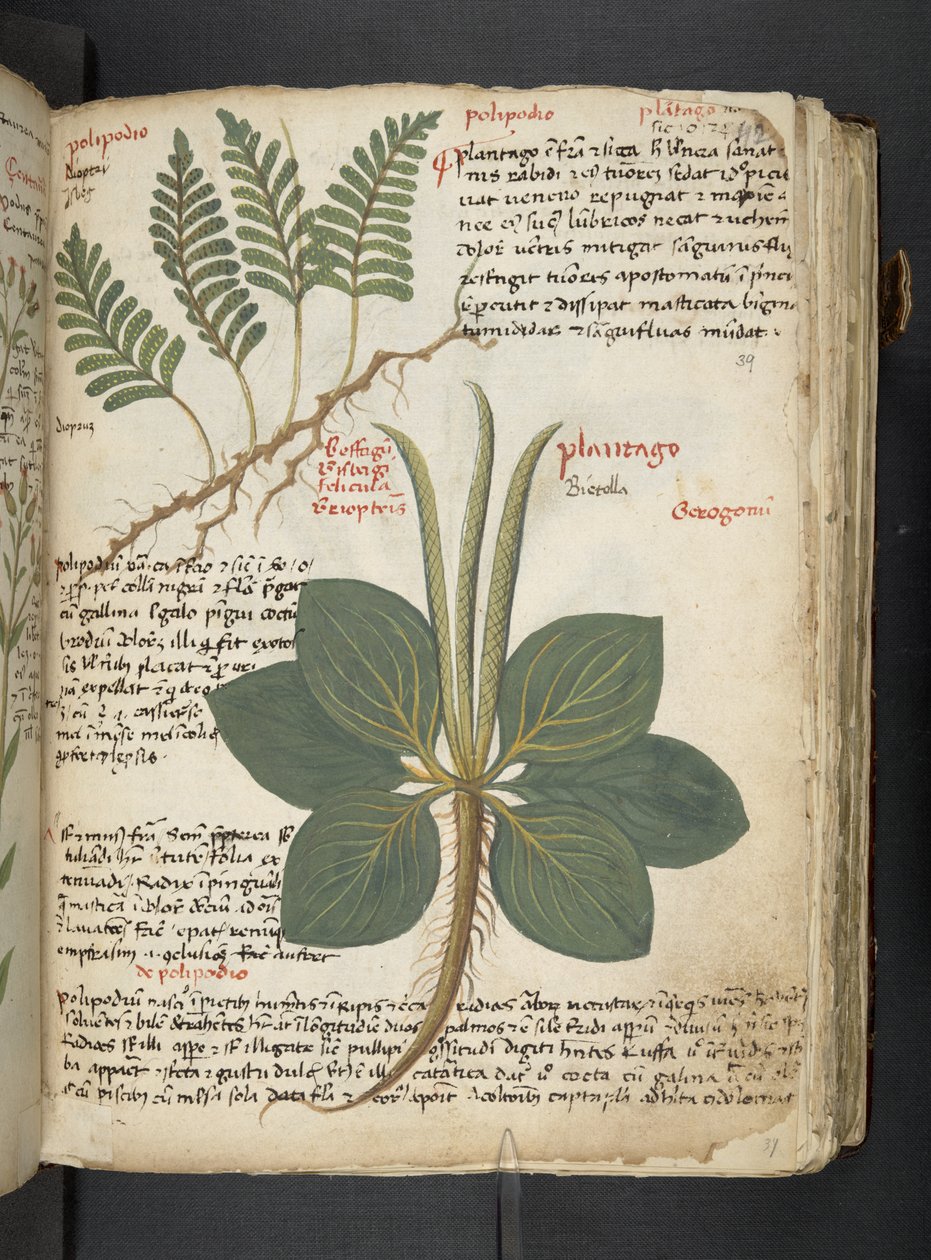
Finding: Unresolved; plantain rejected as whole-plant match.
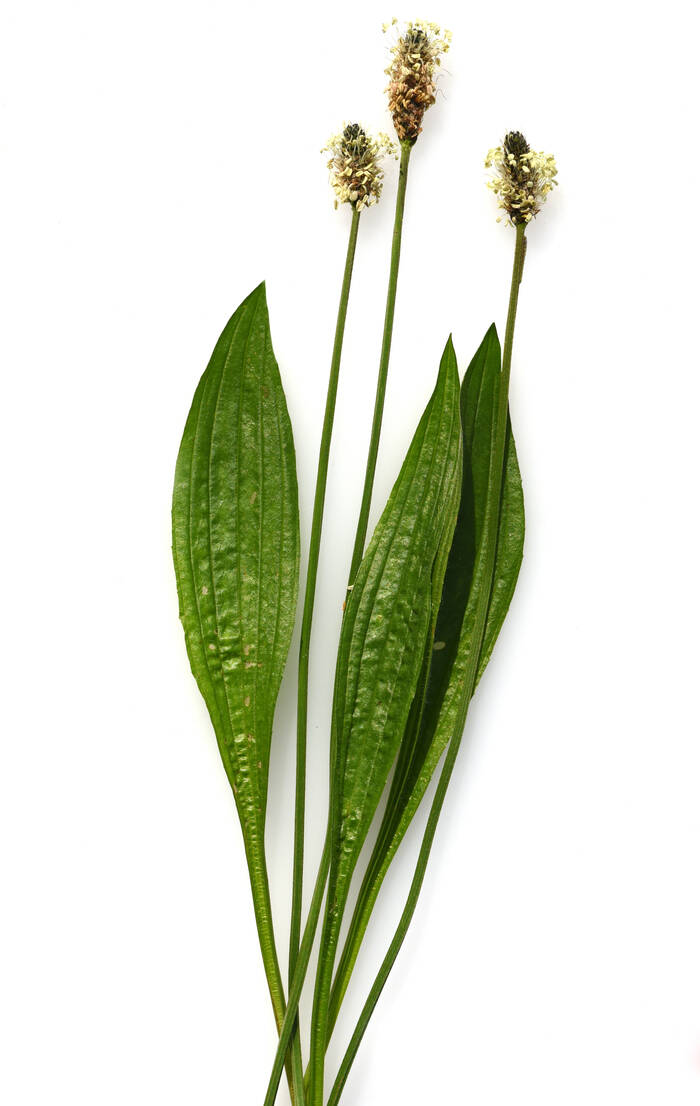
Supports: Inspected plantain demonstrates radiating entire leaves with longitudinal veins.
Contradicts / missing: Manuscript rosette is elevated above bare stalk; flower has distinct lobes rather than plantain spike; root architecture differs.
Alternatives: Other broad rosette herb; Whorled broad leaves rather than basal rosette
Limits: Whole-source-view mapping; individual extraction boundary unverified.; No accepted identity; stylization and missing diagnostic details limit comparisons.; Reference copies used for inspection only; rights must be cleared before embedding.
Historical lane deferred exact plate
Visible features: Large dark-green arched/rolled leaf forms gather near stem top; pendant pale flower with dark cap; long bare stalk; uncolored branching basal organ.
Finding: Unresolved. Search lead only; historical reference pixels deferred.
elleborus / broad divided-leaf motif very low; provisional search lead
Supports: Morgan white hellebore shows arching broad leaves on an upright stem; Egerton comfrey supplies broad leaves and terminal flowers.
Contradicts / missing: Neither actual plate has the Voynich enormous rolled top crown.; Morgan f45r label hellebore covers historically distinct taxa; it cannot validate Helleborus.; Voynich root and dark-capped pale flower remain unexplained.
Finding: Unresolved; morphology/iconographic lead or negative comparator only. No accepted plant identity or manuscript exemplar.
Limits: External mapping identifies whole source view; plant boundary is unverified.; Similarity may reflect generic herbal conventions; no copying or species identity established.; Later reference dates do not support a pre1450 exemplar.; Remaining diagnostic alternatives and exact manuscript matches deferred.
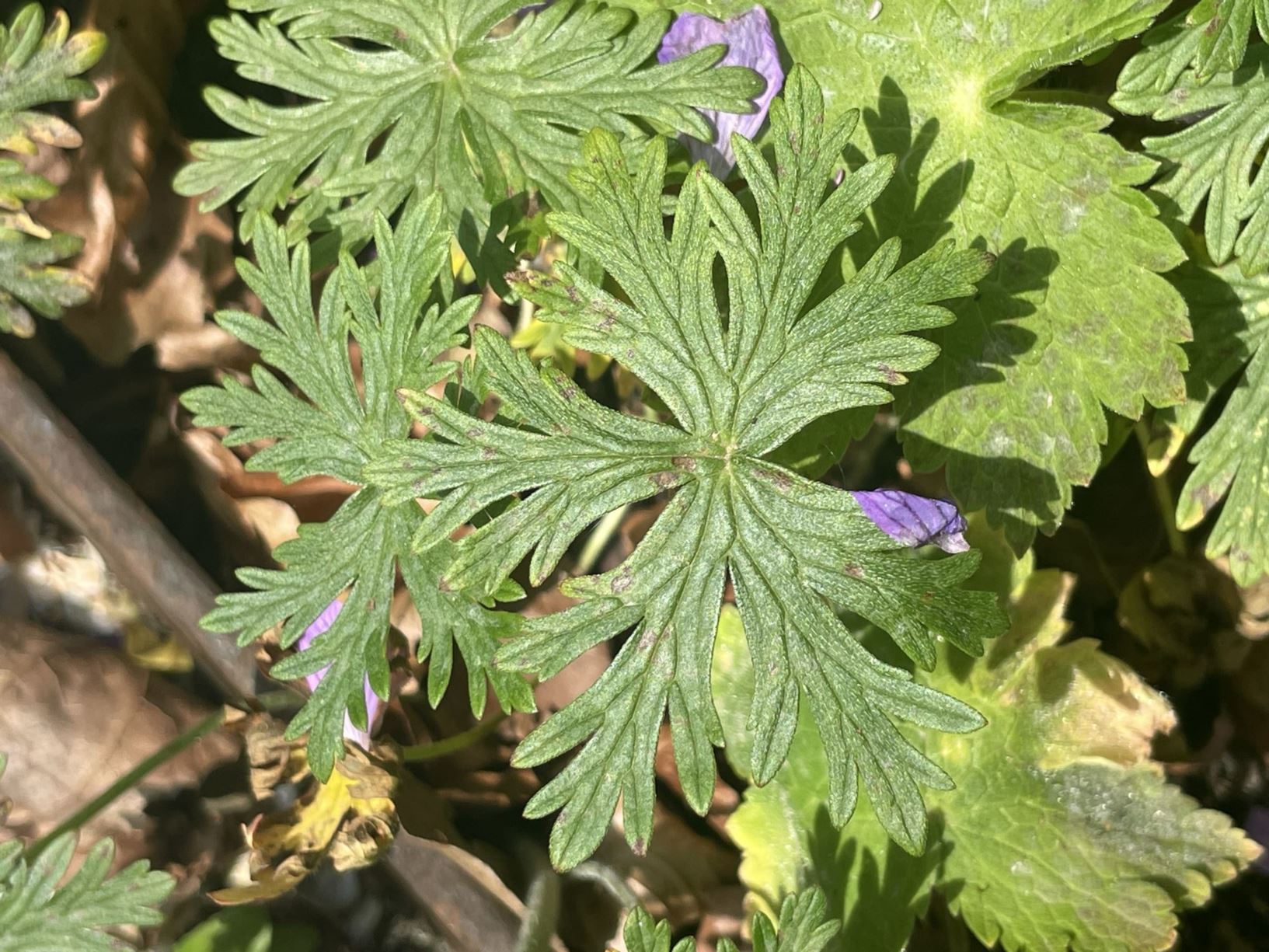
Visible features: Branched herb with several three- to five-lobed serrate blades, small reddish star flowers on long stalks and elongated shallow root/rhizome.
Reference picture available through source link; no permission-clear local picture embedded.
Geranium sanguineum photograph Pflanzmich.de; photographer not verified Copyright/permission not established; inspection-only local copy; link publicly, do not embed; scaled for report, no botanical alteration; visual inspection: True Open original reference picture
Supports: Lobed leaves plus five-part radial flowers are compatible.
Contradicts / missing: Inspected G. sanguineum has deeper five-to-seven leaf lobes and broad overlapping pink petals; manuscript has several apparent three-lobed leaves and very narrow red petal shapes. Diagnostic beaked fruits absent.
Alternatives: Potentilla/Fragaria (could be leaflets rather than lobes); Another lobed-leaf five-petaled herb
Limits: Whole-source-view mapping; individual extraction boundary unverified.; No accepted identity; stylization and missing diagnostic details limit comparisons.; Reference copies used for inspection only; rights must be cleared before embedding.
Historical lane deferred exact plate
Visible features: Thin branching stems with serrated multi-lobed leaf blades; several red star-like flowers on stalks with dark bases; horizontal brown root body with sparse longer roots.
Finding: Unresolved. Search lead only; historical reference pixels deferred.
geranium / cranesbill-like motif very low; provisional search lead
Supports: Mattioli Geranio IIII p905 has strongly lobed leaves, branching stems and red five-part flowers; this combination is a useful lead.
Contradicts / missing: Voynich leaves appear coarsely serrated three-part blades rather than the much more finely divided reference leaves.; Voynich red flowers are sparse small stars; reference flowers are round five-petal cups.; Reference is a later16th-century comparator; thick Voynich root not matched.
Voynich source viewBL Egerton 747, f.040r.jpg BL Egerton 747, f.040r.jpg / Wikimedia Commons, source institution on preserved file page Public domain; Commons PD-Art/PD-old; scaled for report, no botanical alteration; visual inspection: True Open original reference picture
Alternatives: Cinquefoil; buttercup; other lobed-leaf flowering herb
Finding: Unresolved; morphology/iconographic lead or negative comparator only. No accepted plant identity or manuscript exemplar.
Limits: External mapping identifies whole source view; plant boundary is unverified.; Similarity may reflect generic herbal conventions; no copying or species identity established.; Later reference dates do not support a pre1450 exemplar.; Remaining diagnostic alternatives and exact manuscript matches deferred.
Visible features: Three conspicuous inflated green urns with red open-looking rims; broad pinnatifid leaves with wavy finger lobes; long divided roots from swollen crown.
Supports: Upright inflated terminal bodies and divided leaves offer a testable capsule hypothesis.
Contradicts / missing: Inspected Papaver capsule ends in closed flat radiating stigma disk, whereas these bodies have oblique red mouths and constricted elongated bases; root crown and few broad leaves differ.
Limits: Whole-source-view mapping; individual extraction boundary unverified.; No accepted identity; stylization and missing diagnostic details limit comparisons.; Reference copies used for inspection only; rights must be cleared before embedding.
Historical lane deferred exact plate
Visible features: Three deep pinnately cut green leaves; four long inflated green tubes with red-ringed blunt/open ends on upper branches; crown-like root top with many long pale roots.
Finding: Unresolved. Search lead only; historical reference pixels deferred.
aristolochia tubular-flower motif very low; provisional search lead
Supports: Platearius Aristolochia longa provides an actual named tubular/hanging-body comparator; chicory tests deeply cut leaf form.
Contradicts / missing: Birthwort has entire oval leaves, strongly conflicting with Voynich comb-like dissected leaves.; Voynich green tubes end in red-ringed openings, unlike the little pale reference bodies.; Chicory has blue ray flowers, not these tubes.
Voynich source viewBook of Flower Studies chicory, folio4; ca1510–1515 The Metropolitan Museum of Art; Master of Claude de France Public Domain; Met object record verified; scaled for report, no botanical alteration; visual inspection: True Period limit: Later comparator; no evidence of pre-1450 source match Open original reference picture
Finding: Unresolved; morphology/iconographic lead or negative comparator only. No accepted plant identity or manuscript exemplar.
Limits: External mapping identifies whole source view; plant boundary is unverified.; Similarity may reflect generic herbal conventions; no copying or species identity established.; Later reference dates do not support a pre1450 exemplar.; Remaining diagnostic alternatives and exact manuscript matches deferred.
Visible features: Branched erect herb; five-to-seven pointed palmate leaf lobes; round green heads ringed by blue/spiny points on long pedicels; fine root bundle.
Contradicts / missing: Castor capsules in inspected photo are tightly clustered racemes and lobes retain broad connected lamina; manuscript heads separate on long stalks and leaves split almost to center.
Supports: Inspected Eryngium has round heads, blue cast and long pointed involucral bracts.
Contradicts / missing: Photographed E. planum has narrow upper bracts and different foliage; manuscript broad star shapes occur lower as leaves, not only just below heads.
Alternatives: Other palmate-leaf spiny-fruited plant; Stylized composite capitula
Limits: Whole-source-view mapping; individual extraction boundary unverified.; No accepted identity; stylization and missing diagnostic details limit comparisons.; Reference copies used for inspection only; rights must be cleared before embedding.
Historical lane deferred exact plate
Visible features: Branched stem with sharply palmate green leaves and numerous circular spiny blue-green heads; one larger lower head; branching uncolored roots.
Finding: Unresolved. Search lead only; historical reference pixels deferred.
ricinus / castor-like motif very low; provisional search lead
Supports: Boijmans castor plate combines palmate serrate leaves and a spiny clustered seed structure; Voynich also combines palmate blades and spiny circular bodies.
Contradicts / missing: Reference fruits cluster tightly on one terminal spike; Voynich upper bodies are isolated discs on branching stalks.; Voynich blue rims and one large lower ball may be flowers rather than castor fruits.; Later reference lacks comparable roots.
Voynich source viewBook of Flower Studies thistle, folio8; ca1510–1515 The Metropolitan Museum of Art; Master of Claude de France Public Domain; Met object record verified; scaled for report, no botanical alteration; visual inspection: True Period limit: Later comparator; no evidence of pre-1450 source match Open original reference picture
Alternatives: Plane-tree-like leaf/fruit motif; other palmate-leaved herb
Finding: Unresolved; morphology/iconographic lead or negative comparator only. No accepted plant identity or manuscript exemplar.
Limits: External mapping identifies whole source view; plant boundary is unverified.; Similarity may reflect generic herbal conventions; no copying or species identity established.; Later reference dates do not support a pre1450 exemplar.; Remaining diagnostic alternatives and exact manuscript matches deferred.
Visible features: About ten long lanceolate blades radiate around a central hub, with pale inner blade outlines; one long bare stalk; thick forked red root, no discernible flowers.
Finding: Unresolved architecture; no genus supported.
Supports: Inspected P. lanceolata has similarly radiating lanceolate leaves and prominent longitudinal veins.
Contradicts / missing: Manuscript leaves sit at top of long stem and the red bifurcated root is unlike the inspected low rosette; pale areas may be distinct leaves rather than veins. No spike.
Alternatives: Umbellate/palmately compound leaf rather than rosette; Monocot whorl, unresolved
Limits: Whole-source-view mapping; individual extraction boundary unverified.; No accepted identity; stylization and missing diagnostic details limit comparisons.; Reference copies used for inspection only; rights must be cleared before embedding.
Historical lane deferred exact plate
Visible features: A single upright bare stem topped by radial long green lanceolate blades and smaller pale/red-veined inner blades; long symmetrical bifurcating red basal organ.
Finding: Unresolved. Search lead only; historical reference pixels deferred.
elleborus / radial-leaf motif very low; provisional search lead
Supports: Platearius Serpentine has radially divided leaves; Morgan plate supplies actual broad-leaved hellebore iconography for comparison.
Contradicts / missing: Voynich is one star-shaped terminal crown with pale inner blades and no clear spadix/spathe.; Serpentine has several separate divided leaves and a large enclosed central inflorescence.; Forked long red basal organ unmatched.
Alternatives: Single large flower; palmate rosette; unresolved
Finding: Unresolved; morphology/iconographic lead or negative comparator only. No accepted plant identity or manuscript exemplar.
Limits: External mapping identifies whole source view; plant boundary is unverified.; Similarity may reflect generic herbal conventions; no copying or species identity established.; Later reference dates do not support a pre1450 exemplar.; Remaining diagnostic alternatives and exact manuscript matches deferred.
Visible features: Serrated elliptic blades in dense lower rosette and sparse stem leaves, single blue dot in many blades, green/red paint; tiny terminal buds; fine root.
Reference picture available through source link; no permission-clear local picture embedded.
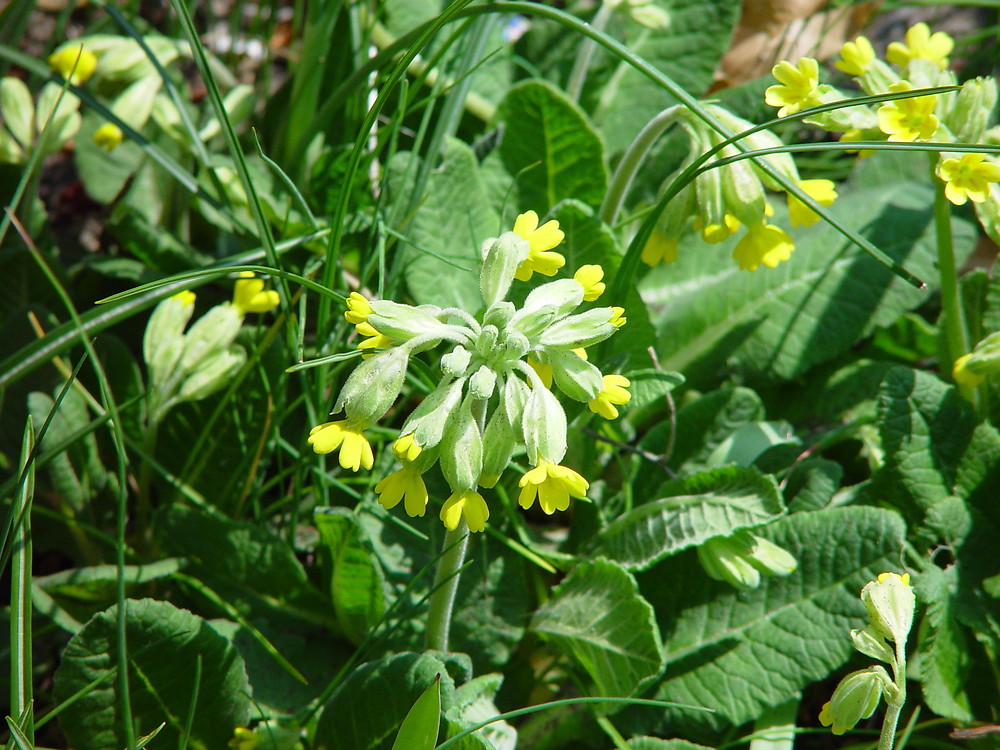
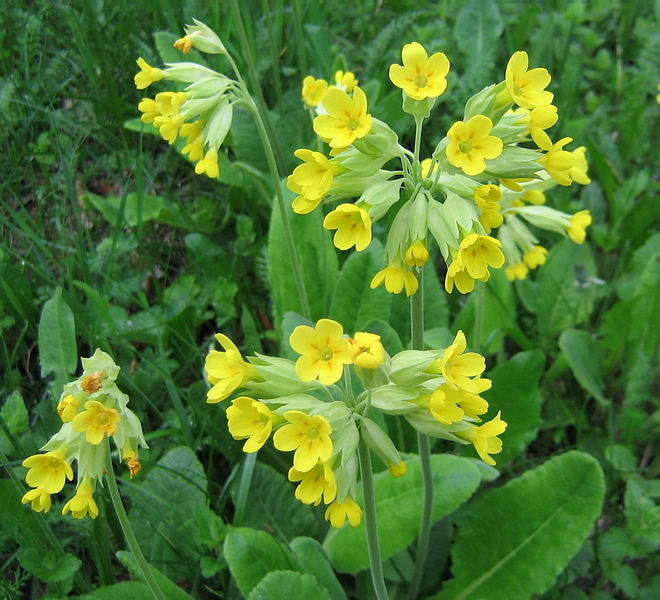
Primula veris whole plant Hayloft; photographer not verified Copyright or reuse permission not established; inspection only, public source link only; scaled for report, no botanical alteration; visual inspection: True Open original reference picture
Supports: Rosette and oval toothed leaves fit broad primrose habit.
Contradicts / missing: Inspected cowslip leaves are heavily wrinkled, all basal, with nodding umbel. Manuscript has distinct stem leaves and no clear umbel; blue spots lack diagnostic meaning.
Alternatives: Other rosette-forming toothed-leaf herbs
Limits: Individual instance boundary unverified; whole Yale source view inspected.; Morphology-only text searches often produced irrelevant dictionary/retail hits, not exhausted coverage.; Reference copies inspection only; exact reuse rights require verification.
Historical lane Searched; bounded comparison, unresolved
Visible features: Basal rosette and upper alternating oval pointed finely edged leaves, some red and some green; each blade has one blue dot; tiny pale branched tip; small red root tuft.
Finding: Unresolved; morphology/iconographic lead or negative comparator only. No accepted plant identity or manuscript exemplar.
Supports: Pseudo-Apuleius Plantago gives an actual broad basal rosette; speedwell gives a rosette with smaller stem leaves.
Contradicts / missing: Voynich upper leaves repeat along one stem and carry isolated blue dots; reference Plantago has basal veined leaves and leafless spikes.; No open blue flowers like speedwell are evident.
Alternatives: Spotted-leaf medicinal herb; dots may be decorative
Limits: External mapping identifies whole source view; plant boundary is unverified.; Similarity may reflect generic herbal conventions; no copying or species identity established.; Later reference dates do not support a pre1450 exemplar.; Remaining diagnostic alternatives and exact manuscript matches deferred.
Visible features: One large sharply pointed sagittate/triangular blade with several angular side lobes; smaller horizontal blade below; long bare petiole and branching roots.
Supports: Inspected Arum leaf has arrow-shaped basal lobes and long petiole.
Contradicts / missing: Arum reference has smooth arrow outline; manuscript has broad angular/scalloped sides and second small blade apparently pierced by stem. Diagnostic spathe/spadix absent; root not confirmed.
Alternatives: Sagittaria or other sagittate-leaved herbs; Stylized solitary leaf
Limits: Individual instance boundary unverified; whole Yale source view inspected.; Morphology-only text searches often produced irrelevant dictionary/retail hits, not exhausted coverage.; Reference copies inspection only; exact reuse rights require verification.
Historical lane Searched; bounded comparison, unresolved
Visible features: One giant green pointed triangular/three-lobed blade on long bare stalk, one smaller horizontal blade below, branched long pale roots; no clear flower.
Finding: Unresolved; morphology/iconographic lead or negative comparator only. No accepted plant identity or manuscript exemplar.
Ivy-like lobed blade or arum motif tested very low; unresolved
Voynich source view; whole page, unverified instance boundaryMunich Cim79 fol63v, De edera nigra; after1440 per source record Unknown artist, Munich Cim79; Commons crop Tricholome, cleaned/brightened Salix Public Domain Mark; Commons source record; scaled for report, no botanical alteration; visual inspection: True Period limit: After1440 is not proof that illustration predates Voynich Open original reference picture
Supports: The ivy crop gives pointed broad blades, and serpentine tests a large medicinal arum outline.
Contradicts / missing: Voynich lacks the ivy woody climbing axis, repeated leaves and berry cluster.; Its single triangular giant blade does not resemble the Serpentine divided leaves or spathe.; No diagnostic reproductive parts.
Alternatives: Sagittate aquatic or arum leaf; non-diagnostic single-leaf schematic
Limits: External mapping identifies whole source view; plant boundary is unverified.; Similarity may reflect generic herbal conventions; no copying or species identity established.; Later reference dates do not support a pre1450 exemplar.; Remaining diagnostic alternatives and exact manuscript matches deferred.
Supports: Five-part flowers protruding from long tubular calyces and opposite leaves offer coherent family-level comparison.
Contradicts / missing: Inspected Saponaria flowers occur in dense cymes with broad pale petals; manuscript flowers few, red and narrow. Leaf/root proportions generic, not diagnostic.
Alternatives: Dianthus/Silene relatives; Another opposite-leaf tubular-flowered herb
Limits: Individual instance boundary unverified; whole Yale source view inspected.; Morphology-only text searches often produced irrelevant dictionary/retail hits, not exhausted coverage.; Reference copies inspection only; exact reuse rights require verification.
Historical lane Searched; bounded comparison, unresolved
Visible features: Upright branched stem, alternate entire ovate green leaves largest below; narrow pale/blue tubular flowers with small red tips; sparse long brown branching root.
Finding: Unresolved; morphology/iconographic lead or negative comparator only. No accepted plant identity or manuscript exemplar.
Comfrey / bugloss-like broad-leaf tube-flower motif low for broad motif; species unresolved
Voynich source view; whole page, unverified instance boundaryBL Egerton 747, f.030v.jpg BL Egerton 747, f.030v.jpg / Wikimedia Commons, source institution on preserved file page Public domain; Commons PD-Art/PD-old; scaled for report, no botanical alteration; visual inspection: True Open original reference picture
Supports: Egerton comfrey and Fuchs Walwurtz show broad lower leaves, narrower upper leaves and terminal small bell/tube flowers, matching several architectural features.
Contradicts / missing: Voynich flowers are erect slender tubes with red tips; Fuchs depicts hanging clustered bells.; Leaf veins and rough hairs are not resolved in Voynich.; Sparse forked root differs from thick multi-rooted Fuchs plate.
Alternatives: Bugloss or other Boraginaceae-like herb; gentian-like tubes
Limits: External mapping identifies whole source view; plant boundary is unverified.; Similarity may reflect generic herbal conventions; no copying or species identity established.; Later reference dates do not support a pre1450 exemplar.; Remaining diagnostic alternatives and exact manuscript matches deferred.
Reference picture available through source link; no permission-clear local picture embedded.
Rheum palmatum whole flowering plant Great Brook Nursery; photographer not verified Copyright or reuse permission not established; inspection only, public source link only; scaled for report, no botanical alteration; visual inspection: True Open original reference picture
Contradicts / missing: Rheum leaves are much larger relative to inflorescence, with broad angular lobes, not curled fingers. Massive root drawing cannot distinguish taxa without root specimen.
Alternatives: Rumex (leaf division contradicts many species); Another large-rooted panicle herb
Limits: Individual instance boundary unverified; whole Yale source view inspected.; Morphology-only text searches often produced irrelevant dictionary/retail hits, not exhausted coverage.; Reference copies inspection only; exact reuse rights require verification.
Historical lane Searched; bounded comparison, unresolved
Visible features: Very large orange textured root with wide spreading branches; several red stalks with curving many-lobed leaves; tall upper red dotted/grain-like panicles.
Finding: Unresolved; morphology/iconographic lead or negative comparator only. No accepted plant identity or manuscript exemplar.
Lobed-leaf flowering herb; coriander-like foliage test very low; unresolved
Supports: Dioscorides Korion combines lobed lower foliage and branched upper inflorescences, supplying a test of mixed leaf/flower levels.
Contradicts / missing: Korion has unmistakable umbels with radiating flower stalks; Voynich top organs are winding narrow bead-spikes.; Geranium flowers and finer divisions do not match.; Huge triangular root unexplained.
Alternatives: Dock/rhubarb-like rhizome drawing; generic lobed herb
Limits: External mapping identifies whole source view; plant boundary is unverified.; Similarity may reflect generic herbal conventions; no copying or species identity established.; Later reference dates do not support a pre1450 exemplar.; Remaining diagnostic alternatives and exact manuscript matches deferred.
Reference picture available through source link; no permission-clear local picture embedded.
Viola tricolor leaves/stipules, Go Botany Go Botany, Native Plant Trust; rights holder requires image-level verification Copyright or reuse permission not established; inspection only, public source link only; scaled for report, no botanical alteration; visual inspection: True Open original reference picture
Supports: Actual Viola photo shows small toothed leaves plus finger-divided stipules; actual FloraVeg flower shows contrasting five petals and bilateral arrangement.
Contradicts / missing: Manuscript low leaves appear paired rather than clearly alternate; one central flower appears radial and six-lobed at sheet scale. Spur absent/uncertain; species cannot be resolved.
Viola tricolor flower, FloraVeg - Copyright or reuse permission not established; inspection only, public source link only; inspected: True
Voynich source view
Reference picture available through source link; no permission-clear local picture embedded.
Viola tricolor flower, FloraVeg Pavel Veselý (visible image credit) / FloraVeg Copyright or reuse permission not established; inspection only, public source link only; scaled for report, no botanical alteration; visual inspection: True Open original reference picture
Alternatives: Other five-petaled divided-leaf herbs; Geranium (flower symmetry/root alternatives)
Limits: Individual instance boundary unverified; whole Yale source view inspected.; Morphology-only text searches often produced irrelevant dictionary/retail hits, not exhausted coverage.; Reference copies inspection only; exact reuse rights require verification.
Historical lane Searched; bounded comparison, unresolved
Visible features: Branched stems with several rounded five-petal blue flowers; upper leaves narrowly divided, lower leaves longer entire/finely toothed; thin forked root.
Finding: Unresolved; morphology/iconographic lead or negative comparator only. No accepted plant identity or manuscript exemplar.
Geranium-like flower motif; borage alternative low for five-petal herb motif; species unresolved
Supports: Geranio has five-part flowers and divided blades; borage supplies five-part blue flowers in a branching whole herb.
Contradicts / missing: Geranium reference leaves are all strongly palmate; Voynich lower entire leaves conflict.; Borage leaves remain entire and hairy while Voynich upper leaves are deeply divided.; Flower shading does not establish taxon.
Voynich source viewBook of Flower Studies borage, folio26; ca1510–1515 The Metropolitan Museum of Art; Master of Claude de France Public Domain; Met object record verified; scaled for report, no botanical alteration; visual inspection: True Period limit: Later comparator; no evidence of pre-1450 source match Open original reference picture
Alternatives: Cinquefoil-like herb; another five-petal flower
Limits: External mapping identifies whole source view; plant boundary is unverified.; Similarity may reflect generic herbal conventions; no copying or species identity established.; Later reference dates do not support a pre1450 exemplar.; Remaining diagnostic alternatives and exact manuscript matches deferred.
Modern supplementary comparison
Correction to frozen comparison: Frozen FloraVeg flower reference is a rear view; do not use it to claim front petal arrangement. New licensed front view supplies that test separately.
Viola / Violaceae remains plausible; species unresolved comparison only; original candidate unchanged
Supports: Actual front V.tricolor photograph shows two upper purple petals, two lateral pale-purple and one yellow lower petal; manuscript lower-right flower approximates this partition. V.arvensis whole shoot photograph visibly shows simple leaves together with deeply divided stipules, a stronger resemblance to manuscript mixed lower simple blades and upper narrow divided units.
Contradicts / missing: Several manuscript flowers appear radial with more even lobes, leaves can appear paired, spur is not visible, lower blades are narrow rather than clearly matching either reference. No scale or diagnostic sepal proportions. V.tricolor photo alone does not show roots or establish leaf attachment.
Concrete rival: V.arvensis is a close concrete rival, sharing divided stipules and five petals. Blue paint makes V.tricolor appealing but pigment hue cannot securely exclude V.arvensis or other Viola taxa.
Native Plant Trust Go Botany:Viola arvensis: Same broad flower/leaf/stipule character package; spur1–4mm. Species distinction needs measurements and sepal/petal relationship unavailable here.
Visible features: Broad opposite/paired serrate curved leaves with brown/green bands; one large dark-blue radial head with pale disk; long branched underground axis with red swellings at ends.
Reference picture available through source link; no permission-clear local picture embedded.
Arnica montana whole plant Bob Gibbons / Science Photo Library; licensed stock, do not embed Copyright or reuse permission not established; inspection only, public source link only; scaled for report, no botanical alteration; visual inspection: True Open original reference picture
Supports: Daisy-like head and paired leaves are broadly compatible with some composites; inspected Arnica supplies whole-plant control.
Contradicts / missing: Arnica head yellow and erect, leaves entire with basal rosette; manuscript head blue/sideways, leaves strongly serrate/curved and root bears separated swellings. Does not identify Arnica.
Alternatives: Other tuberous-rhizome Asteraceae; Root swellings could be symbolic
Limits: Individual instance boundary unverified; whole Yale source view inspected.; Morphology-only text searches often produced irrelevant dictionary/retail hits, not exhausted coverage.; Reference copies inspection only; exact reuse rights require verification.
Historical lane Searched; bounded comparison, unresolved
Visible features: Several large scalloped broad leaves recurved in green/ochre bands; one large blue many-ray head with pale dotted disc and a curved stalk ending in a pale oval body; horizontal basal organ with red swollen end-bodies.
Finding: Unresolved; morphology/iconographic lead or negative comparator only. No accepted plant identity or manuscript exemplar.
Composite ray-flower / chicory motif very low; unresolved
Voynich source view; whole page, unverified instance boundaryBook of Flower Studies chicory, folio4; ca1510–1515 The Metropolitan Museum of Art; Master of Claude de France Public Domain; Met object record verified; scaled for report, no botanical alteration; visual inspection: True Period limit: Later comparator; no evidence of pre-1450 source match Open original reference picture
Supports: Both actual plates show disc-and-ray heads; chicory provides a blue multi-ray test.
Contradicts / missing: Voynich broad banded leaves differ from the references narrow deeply toothed blades.; Curved stalk and dotted oval body are not explained.; Twin red basal swellings are not matched by the plates.
Limits: External mapping identifies whole source view; plant boundary is unverified.; Similarity may reflect generic herbal conventions; no copying or species identity established.; Later reference dates do not support a pre1450 exemplar.; Remaining diagnostic alternatives and exact manuscript matches deferred.
Supports: Inspected comfrey has broad leaves and drooping tubular purple flowers in paired/curved inflorescence units.
Contradicts / missing: Comfrey bears many tightly clustered bells and large decurrent rough leaves; manuscript has two enlarged separated flowers and strongly recurved uniform leaves. Root photo unavailable.
Limits: Individual instance boundary unverified; whole Yale source view inspected.; Morphology-only text searches often produced irrelevant dictionary/retail hits, not exhausted coverage.; Reference copies inspection only; exact reuse rights require verification.
Historical lane Searched; bounded comparison, unresolved
Visible features: Symmetrical opposite broad heart-like green leaves with downward extensions, two long arching stalks ending in blue pendant flowers, orange knobby root with long branches.
Finding: Unresolved; morphology/iconographic lead or negative comparator only. No accepted plant identity or manuscript exemplar.
Pendant bell herb; violet / comfrey motif tested very low; unresolved
Voynich source view; whole page, unverified instance boundaryVienna Dioscorides, ÖNB Cod.med.gr.1 fol148v, violet, c512 Unknown artist, Vienna Dioscorides, Österreichische Nationalbibliothek; Wikimedia Commons Public Domain Mark; PD-Art Commons file record; scaled for report, no botanical alteration; visual inspection: True Open original reference picture
Supports: Vienna violet supplies long curved pendant flower stalks; comfrey supplies a leafy stem with nodding terminal bells.
Contradicts / missing: Violet plate leaves arise from the basal crown, whereas Voynich repeats leaves up a central stem.; Comfrey leaves are pointed/lanceolate and bells occur in clusters.; Orange root is unlike either plate.
Alternatives: Campanula-like herb; unrecognized compound construction
Limits: External mapping identifies whole source view; plant boundary is unverified.; Similarity may reflect generic herbal conventions; no copying or species identity established.; Later reference dates do not support a pre1450 exemplar.; Remaining diagnostic alternatives and exact manuscript matches deferred.
Visible features: Three stems from one thick spiny-looking root system; dense domed canopy of small scalloped leaves; scattered tiny blue lobed flowers; some hanging kidney-shaped leaves.
Reference picture available through source link; no permission-clear local picture embedded.
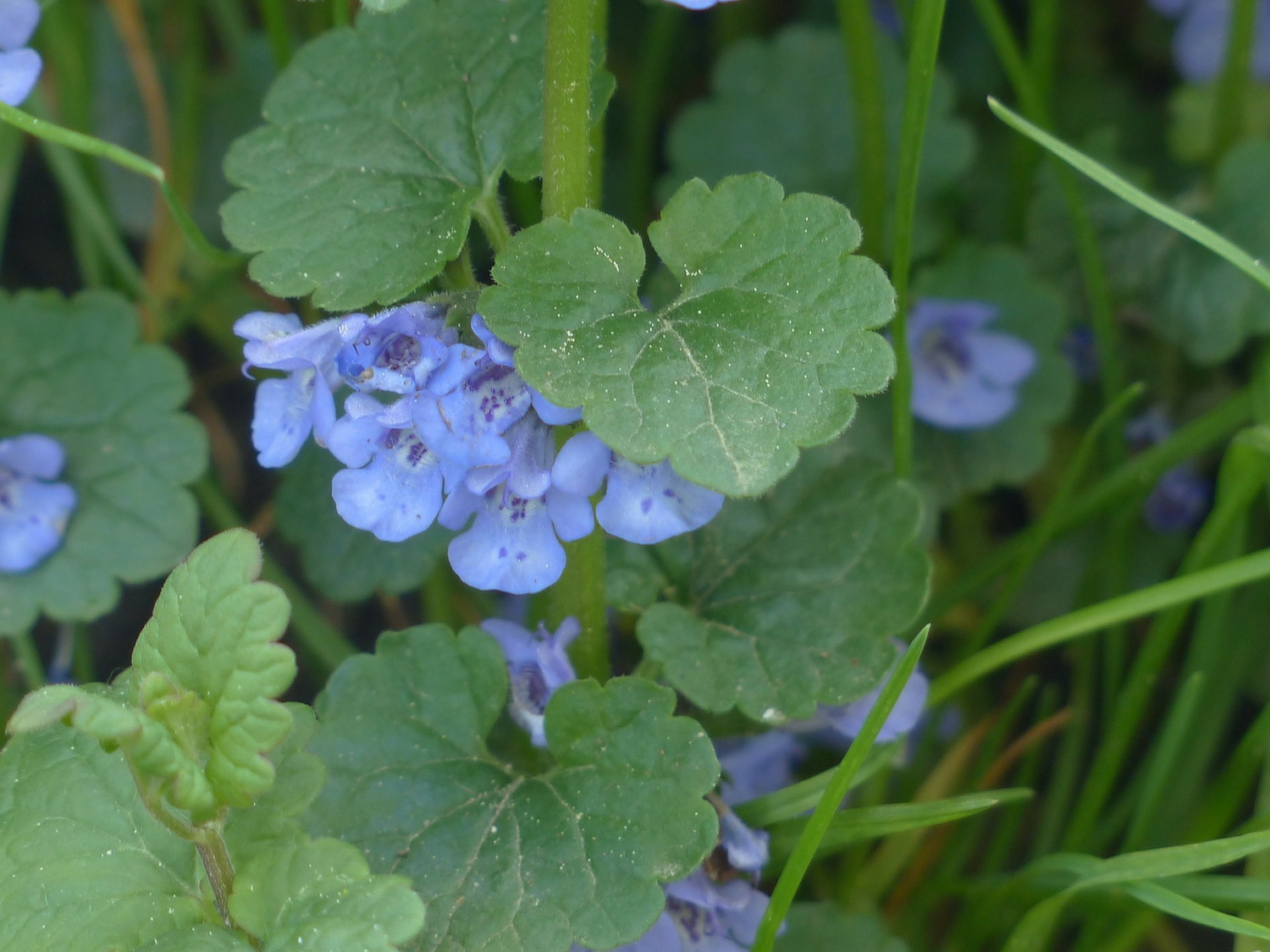
Glechoma hederacea leaves and flowers NatureSpot contributor; photographer not independently verified Copyright or reuse permission not established; inspection only, public source link only; scaled for report, no botanical alteration; visual inspection: True Open original reference picture
Supports: Inspected Glechoma shows scalloped rounded blades and small blue lipped flowers.
Contradicts / missing: Glechoma is creeping with spaced opposing leaves and axillary flowers, not three stiff stems supporting a domed crown. Root spikes and canopy architecture unaccounted for.
Alternatives: Other small scalloped-leaf blue-flowered groundcovers; Illustration could compress repeated shoots
Limits: Individual instance boundary unverified; whole Yale source view inspected.; Morphology-only text searches often produced irrelevant dictionary/retail hits, not exhausted coverage.; Reference copies inspection only; exact reuse rights require verification.
Historical lane Searched; bounded comparison, unresolved
Visible features: Three upright stalks unite into dense dome of many tiered scalloped green/pale blades, tiny blue flowers at edges; three large feathery basal structures and long cross-shaped orange root.
Finding: Unresolved; morphology/iconographic lead or negative comparator only. No accepted plant identity or manuscript exemplar.
Dense small-flowered dome; mint / violet motif tested very low; unresolved
Supports: Speedwell and mallow test scalloped/serrated blades accompanying many small flowers.
Contradicts / missing: Neither plate has an overlapping domed crown or cross-shaped feathered roots.; Blue flower anatomy and true leaf attachment cannot be read confidently.
Alternatives: Matted herb clump; highly schematic foliage; unresolved
Limits: External mapping identifies whole source view; plant boundary is unverified.; Similarity may reflect generic herbal conventions; no copying or species identity established.; Later reference dates do not support a pre1450 exemplar.; Remaining diagnostic alternatives and exact manuscript matches deferred.
Visible features: Single stalk supports dense egg-shaped tessellation of green/brown ovoid units, blue flaring flower at top; thick looped branches/root with circular cut-looking ends.
Reference picture available through source link; no permission-clear local picture embedded.
Cynara cardunculus capitulum Semena.cz; photographer not verified Copyright or reuse permission not established; inspection only, public source link only; scaled for report, no botanical alteration; visual inspection: True Open original reference picture
Supports: Overlapping units and terminal blue emergence can be compared with artichoke involucral bracts.
Contradicts / missing: Inspected Cynara has spiny bracts and brushlike many tubular florets; manuscript units attach by long thin lines as if separate leaves and terminal structure is few flared lobes. No vegetative leaves.
Limits: Individual instance boundary unverified; whole Yale source view inspected.; Morphology-only text searches often produced irrelevant dictionary/retail hits, not exhausted coverage.; Reference copies inspection only; exact reuse rights require verification.
Historical lane Searched; bounded comparison, unresolved
Visible features: Dense cone-shaped crown of alternating green and ochre oval forms, a blue multi-part terminal flower; many thin stems entering one main stalk; pale/red curling root with oval ends.
Finding: Unresolved; morphology/iconographic lead or negative comparator only. No accepted plant identity or manuscript exemplar.
Cone/crown construction; plantain and composite-head motifs tested very low; unresolved
Supports: Plantago tests compact upright spike construction; thistle tests scale-covered head and blue/purple top.
Contradicts / missing: Voynich cone is made from many separately stalked oval forms, unlike one seed spike or thistle head.; Long bare stalk and curling root remain unmatched.
Voynich source viewBook of Flower Studies thistle, folio8; ca1510–1515 The Metropolitan Museum of Art; Master of Claude de France Public Domain; Met object record verified; scaled for report, no botanical alteration; visual inspection: True Period limit: Later comparator; no evidence of pre-1450 source match Open original reference picture
Limits: External mapping identifies whole source view; plant boundary is unverified.; Similarity may reflect generic herbal conventions; no copying or species identity established.; Later reference dates do not support a pre1450 exemplar.; Remaining diagnostic alternatives and exact manuscript matches deferred.
Visible features: Several broad heavily lobed/curved leaves along central axis; compact terminal cluster of small round pale/blue units; large red swollen root with radiating roots and cylinder-like crown marks.
Reference picture available through source link; no permission-clear local picture embedded.
Brassica rapa wild turnip Ed Stikvoort / Saxifraga; exact reuse terms not verified Copyright or reuse permission not established; inspection only, public source link only; scaled for report, no botanical alteration; visual inspection: True Open original reference picture
Supports: Lobed leaves and swollen storage root suggest a root-crop comparison; inspected flowering wild turnip provides a negative control.
Contradicts / missing: Brassica photo has open yellow four-petaled flowers in loose racemes; manuscript has clustered blue/pale rounded units and exaggerated hollow/cut crown marks. Species root evidence not inspected.
Alternatives: Other taproot crops; Blue cluster may represent fruit
Limits: Individual instance boundary unverified; whole Yale source view inspected.; Morphology-only text searches often produced irrelevant dictionary/retail hits, not exhausted coverage.; Reference copies inspection only; exact reuse rights require verification.
Historical lane Searched; bounded comparison, unresolved
Visible features: Four broad round/lobed leaves with green and ochre margins on short stem, narrow blue-white many-part central spike; large red root/bulb with pale ring of circular stumps.
Finding: Unresolved; morphology/iconographic lead or negative comparator only. No accepted plant identity or manuscript exemplar.
Lobed basal-leaf herb; mallow motif tested very low; unresolved
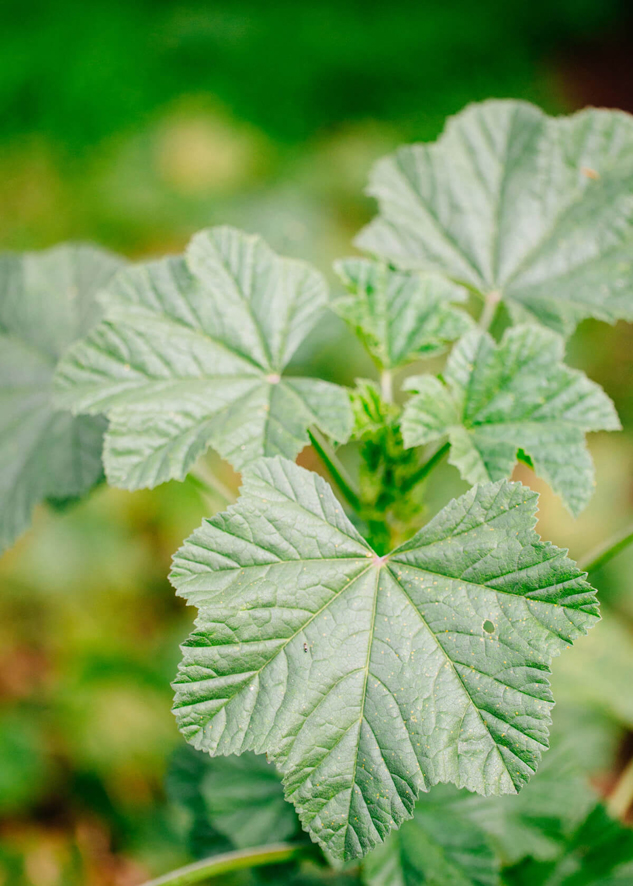
Supports: Malva minor supplies broadly rounded lobed leaves; Serpentine provides a central upright reproductive structure.
Contradicts / missing: Mallow has branched stems, small five-part flowers and different roots.; Serpentine has divided leaves and spathe unlike the segmented blue-white spike.; Circular stump collar around root unexplained.
Alternatives: Mandrake-like root portrayal; unrelated bulbous herb
Limits: External mapping identifies whole source view; plant boundary is unverified.; Similarity may reflect generic herbal conventions; no copying or species identity established.; Later reference dates do not support a pre1450 exemplar.; Remaining diagnostic alternatives and exact manuscript matches deferred.
Visible features: Three leafy branches with strongly arched overlapping green/brown scalloped blades; dark-blue tube/urn flowers with long pale curved lobes or filaments; thick root with multiple short arms.
Reference picture available through source link; no permission-clear local picture embedded.
Salvia officinalis flowering twig Mesarbustes; photographer not verified Copyright or reuse permission not established; inspection only, public source link only; scaled for report, no botanical alteration; visual inspection: True Open original reference picture
Supports: Blue elongated floral tubes and leaves could fit a lipped-flower herb in very broad terms.
Contradicts / missing: Inspected sage has clearly bilabiate flowers in repeated whorls, straight small oval leaves and woody twig; manuscript isolated urns with several long arches and patterned leaf masses not matched.
Alternatives: Campanula-type bells; Unknown composite/stylized organ arrangement
Limits: Individual instance boundary unverified; whole Yale source view inspected.; Morphology-only text searches often produced irrelevant dictionary/retail hits, not exhausted coverage.; Reference copies inspection only; exact reuse rights require verification.
Historical lane Searched; bounded comparison, unresolved
Visible features: Three stems with dense arched layered green/ochre blades; left and central stems end in large blue vessels with pale curling lobes; branched brown root.
Finding: Unresolved; morphology/iconographic lead or negative comparator only. No accepted plant identity or manuscript exemplar.
Tube-flower broad-leaf herb; comfrey and lily tests very low; unresolved
Contradicts / missing: Voynich foliage is a stacked arched pattern unlike either whole plant.; Blue vessels with curling lobes lack clear lily six-part arrangement and stamens.; Brown thick root differs from reference form.
Voynich source viewWhite lily, Gart der Gesundheit, chapter183;1485-03-28 The Metropolitan Museum of Art; anonymous German artist, Peter Schöffer printer Public Domain; Met object record verified; scaled for report, no botanical alteration; visual inspection: True Period limit: Later comparator; no evidence of pre-1450 source match Open original reference picture
Limits: External mapping identifies whole source view; plant boundary is unverified.; Similarity may reflect generic herbal conventions; no copying or species identity established.; Later reference dates do not support a pre1450 exemplar.; Remaining diagnostic alternatives and exact manuscript matches deferred.
Visible features: Two tiers of long lanceolate blades clustered around reddish stem; single small red radial flower atop dark elongated calyx/body; enormous coiled jointed underground axis.
Reference picture available through source link; no permission-clear local picture embedded.
Dianthus chinensis leaves Socfindo Conservation; photographer not verified Copyright or reuse permission not established; inspection only, public source link only; scaled for report, no botanical alteration; visual inspection: True Open original reference picture
Supports: Inspected Dianthus shows narrow paired lanceolate leaves; tubular base below radial flower is compatible.
Contradicts / missing: Manuscript leaves occur in dense petioled fans, not consistent opposite pairs, and long looped segmented root is unmatched. Flower photo not obtained in this row; no species diagnostic.
Alternatives: Other narrow-leaved red-flowered herbs; Root stylization could obscure plant architecture
Limits: Individual instance boundary unverified; whole Yale source view inspected.; Morphology-only text searches often produced irrelevant dictionary/retail hits, not exhausted coverage.; Reference copies inspection only; exact reuse rights require verification.
Historical lane Searched; bounded comparison, unresolved
Visible features: Two levels of long narrow pointed green blade clusters on reddish stalks, one upper red ray-like flower on a dark oval base; enormous horizontal segmented root loops.
Finding: Unresolved; morphology/iconographic lead or negative comparator only. No accepted plant identity or manuscript exemplar.
Long-leaf plantain / cornflower motifs tested very low; unresolved
Supports: Plantago provides lanceolate leaf/spike construction; cornflower provides a ray head with narrow leaves.
Contradicts / missing: Voynich leaf clusters occur at two stem levels unlike basal Plantago.; Red head and enormous ringed looping root conflict with both pictures.
Limits: External mapping identifies whole source view; plant boundary is unverified.; Similarity may reflect generic herbal conventions; no copying or species identity established.; Later reference dates do not support a pre1450 exemplar.; Remaining diagnostic alternatives and exact manuscript matches deferred.
Reference picture available through source link; no permission-clear local picture embedded.
Urtica dioica flowering apex Plantarium contributor; credit unresolved Copyright/reuse terms unverified; inspection-only local copy; link only, do not embed; scaled for report, no botanical alteration; visual inspection: True Open original reference picture
Supports: Serrated blades and beadlike tiny flowers match nettle morphology broadly; U. pilulifera reference supplies compact flower-ball alternative to U. dioica loose strands.
Contradicts / missing: Reference nettles have many opposite leaves and axillary flower clusters; manuscript two giant basal leaves and separate peduncles differ. Thick cut root neither photographed nor diagnostic.
Alternatives: Other serrate-leaved small-flowered herbs
Limits: Whole Yale source view inspected; instance crop boundary unverified.; Morphology search is a reconnaissance pass, not exhaustive botanical elimination.; Root shapes exaggerated; reference photos frequently omit roots.; Inspection copies link-only until rights verified.
Historical lane Searched; bounded comparison, unresolved
Visible features: Two enormous sharply serrated lanceolate green blades, branching pale oval clusters filled with small circles on thin stalks, short red thick root with six blunt/curling arms.
Finding: Unresolved; morphology/iconographic lead or negative comparator only. No accepted plant identity or manuscript exemplar.
Teasel / prickly composite motif low for prickly-head motif; species unresolved
Supports: Both inspected plates have serrate/prickly foliage and oval heads; this is a coherent broad search direction.
Contradicts / missing: Voynich heads consist of looped circles and lack the long teasel bracts or thistle tuft.; Only two giant blades and short cut-ended root are unlike both references.
Voynich source viewBook of Flower Studies thistle, folio8; ca1510–1515 The Metropolitan Museum of Art; Master of Claude de France Public Domain; Met object record verified; scaled for report, no botanical alteration; visual inspection: True Period limit: Later comparator; no evidence of pre-1450 source match Open original reference picture
Alternatives: Burdock-like fruit heads; decorative seed structures
Limits: External mapping identifies whole source view; plant boundary is unverified.; Similarity may reflect generic herbal conventions; no copying or species identity established.; Later reference dates do not support a pre1450 exemplar.; Remaining diagnostic alternatives and exact manuscript matches deferred.
Visible features: Lobed lower leaves ending in strange pale pendent appendages; tall thin bifurcating stalks, one radial pale-many-rayed head with brown disk; long red horizontal root.
Reference picture available through source link; no permission-clear local picture embedded.
Leucanthemum vulgare whole plant, Bugwood Montana Statewide Noxious Weed Awareness and Education Program / Montana State University / Bugwood; reuse terms unverified Copyright/reuse terms unverified; inspection-only local copy; link only, do not embed; scaled for report, no botanical alteration; visual inspection: True Open original reference picture
Supports: Many narrow rays around central disk and lobed leaves consistent with composite herb; actual daisy whole plant inspected.
Contradicts / missing: Reference daisy has simple scalloped leaves, white broad rays and yellow disk; manuscript leaf tips carry separate chained organs and its stem/flower units are oddly sparse. Root not diagnostically matched.
Alternatives: Other white-rayed composites; Appendages may not be leaf tips
Limits: Whole Yale source view inspected; instance crop boundary unverified.; Morphology search is a reconnaissance pass, not exhaustive botanical elimination.; Root shapes exaggerated; reference photos frequently omit roots.; Inspection copies link-only until rights verified.
Historical lane Searched; bounded comparison, unresolved
Visible features: Green pinnately lobed blades with pale dangling hooked appendages, one large pale ray head with ochre centre on long stalk, narrow upper side-branch, red horizontal root.
Finding: Unresolved; morphology/iconographic lead or negative comparator only. No accepted plant identity or manuscript exemplar.
Daisy / composite ray-flower motif very low; unresolved
Supports: Actual daisy and Bouphthalmon plates supply ray-and-disc flowers and dissected leaves.
Contradicts / missing: Voynich leaf tips bear pendant pale hooked bodies absent from references.; Huge single head and long red horizontal root are unexplained.; No accepted species.
Alternatives: Other composite; appended roots/fruits; schematic drawing
Limits: External mapping identifies whole source view; plant boundary is unverified.; Similarity may reflect generic herbal conventions; no copying or species identity established.; Later reference dates do not support a pre1450 exemplar.; Remaining diagnostic alternatives and exact manuscript matches deferred.
Visible features: Four broad smooth hooked oval blades arranged at one hub; long bare upper stalk with two comb-like branches ending in pale teardrops; branched root.
Reference picture available through source link; no permission-clear local picture embedded.
Veratrum album flowers Laurent Francini Copyright/reuse terms unverified; inspection-only local copy; link only, do not embed; scaled for report, no botanical alteration; visual inspection: True Open original reference picture
Supports: A branched pale-flowered inflorescence and broad leaves offer broad monocot lead.
Contradicts / missing: Inspected Veratrum flower cluster has open six-tepal stars in dense erect panicle; manuscript has long pendant teardrops on combs and four leaves in one whorl. Vegetative Veratrum leaves not actually inspected in this photo.
Alternatives: Orchid-family or lily-family comparison; Unknown organs, not securely monocot
Limits: Whole Yale source view inspected; instance crop boundary unverified.; Morphology search is a reconnaissance pass, not exhaustive botanical elimination.; Root shapes exaggerated; reference photos frequently omit roots.; Inspection copies link-only until rights verified.
Historical lane Searched; bounded comparison, unresolved
Visible features: Four large entire green ovate/teardrop blades with curled ends, one has dark central almond-shaped mark; bare stalk bearing pale hook-ended branched top; brown long forked roots.
Finding: Unresolved; morphology/iconographic lead or negative comparator only. No accepted plant identity or manuscript exemplar.
Large-leaf / tubular-flower motif; birthwort test very low; unresolved
Supports: Birthwort tests ovate leaves with hanging reproductive bodies; cyclamen tests whole herb with broad blades and curled stalks.
Contradicts / missing: Voynich large four-leaf cross and pale hook sequence are unlike either reference.; Cyclamen round tuber absent; no distinctive birthwort tube verified.
Alternatives: Stylized broad leaves and immature flower; unresolved
Limits: External mapping identifies whole source view; plant boundary is unverified.; Similarity may reflect generic herbal conventions; no copying or species identity established.; Later reference dates do not support a pre1450 exemplar.; Remaining diagnostic alternatives and exact manuscript matches deferred.
Visible features: Palmate blades/leaflets with about 7–9 very narrow pointed serrate rays, long petioles; branched spikes of small pale/red-centered units with obovate green bracts; thick forked hairy underground form.
Reference picture available through source link; no permission-clear local picture embedded.
Cannabis sativa UBC herbarium specimen V245581 UBC Herbarium/Beaty Biodiversity Museum; specimen collector/determiner Paul Kroeger, 21 September 2016 Copyright/reuse terms unverified; inspection-only local copy; link only, do not embed; scaled for report, no botanical alteration; visual inspection: True Open original reference picture
Supports: Actual labeled UBC herbarium specimen shows palmate serrated narrow leaflets and branched terminal tiny flowers.
Contradicts / missing: Specimen leaves mostly 5–7 broader leaflets; male flowers tiny green opening lobes, while manuscript has conspicuous pale/red units; root drawing contradicts simple annual taproot but is stylized.
Alternatives: Cannabis sativa: UBC specimen inspected, supports serrated palmate leaflets but flowers inconspicuous green, root form unmatched; Other palmately divided herb/shrub
Limits: Whole Yale source view inspected; instance crop boundary unverified.; Morphology search is a reconnaissance pass, not exhaustive botanical elimination.; Root shapes exaggerated; reference photos frequently omit roots.; Inspection copies link-only until rights verified.
Historical lane Searched; bounded comparison, unresolved
Visible features: Multiple sharply palmate long narrow green blades on stalks; upper winding spike/branch clusters filled with red-white bead bodies and small oval leaves; large digitlike orange root.
Finding: Unresolved; morphology/iconographic lead or negative comparator only. No accepted plant identity or manuscript exemplar.
Palmate-leaved fruiting herb; Ricinus-like motif low for palmate-fruit motif; species unresolved
Supports: The castor drawing combines palmate blades with a dense upper fruit cluster, matching a broad combination; Geranio tests palmate foliage.
Contradicts / missing: Voynich upper clusters wind into several branches with paired small blades, unlike castor terminal fruit raceme.; Palmate rays are unusually narrow; huge fingerlike root unmatched.; Geranium open five-part flowers absent.
Alternatives: Cannabis-like palmate leaf lead requires exact plate; lupin; other palmate herb
Limits: External mapping identifies whole source view; plant boundary is unverified.; Similarity may reflect generic herbal conventions; no copying or species identity established.; Later reference dates do not support a pre1450 exemplar.; Remaining diagnostic alternatives and exact manuscript matches deferred.
Additional visual evidence and review
Adversarial taxon-scope correction; frozen modern candidate unchanged
Vitex genus remains unresolved; exemplar mismatch is narrower than genus rejection No accepted genus or species
Supports: Palmate-looking groups of narrow blades motivate the comparison. Source leaf tips and serrations are visible but the separation of individual leaflets remains uncertain.
Contradicts / missing: The frozen V.agnus-castus exemplar has smoother leaflets than the drawing. This is a species/photo contradiction. The independent reviewer verified Flora of China permits dentate, serrate and incised margins elsewhere in Vitex, so it cannot exclude the whole genus. Exact flower and leaf attachment diagnostics remain missing.
Correction narrows the exclusion to the tested exemplar/species; it does not strengthen Vitex into an identification. Coordinator re-inspected Yale source pixels. Primary descriptions were read by reviewer; coordinator web retrieval failed502/403, with no bypass.
Visible features: Four red strongly palmate pointed forms with pale interiors, one immense blue radial top form with four pale long inner units; multiple long stalks from thick curved root.
Supports: Inspected Eryngium flower heads have pointed radial bracts and blue cast.
Contradicts / missing: Manuscript top has exaggerated broad crosswise units, little globular head; red lower palmate forms may be flowers rather than leaves. Root and whole habit unconfirmed.
Alternatives: Spiny Asteraceae; Mixed or stylized organs
Limits: Whole Yale source view inspected; instance crop boundary unverified.; Morphology search is a reconnaissance pass, not exhaustive botanical elimination.; Root shapes exaggerated; reference photos frequently omit roots.; Inspection copies link-only until rights verified.
Historical lane Searched; bounded comparison, unresolved
Visible features: One huge blue star-like upper form with pale cross-shaped inner blades and disc, four red deeply ray-shaped lateral forms with pale centres; basal brown handlike root.
Finding: Unresolved; morphology/iconographic lead or negative comparator only. No accepted plant identity or manuscript exemplar.
Radial leaf/flower composite; arum and composite-head tests very low; unresolved
Supports: Serpentine tests radial lobed blades; thistle tests radial heads with pale/colored central discs.
Contradicts / missing: Neither distinguishes whether Voynich lateral red forms are leaves or flowers.; Top blue star with pale cross and handlike base do not match either reference.
Voynich source viewBook of Flower Studies thistle, folio8; ca1510–1515 The Metropolitan Museum of Art; Master of Claude de France Public Domain; Met object record verified; scaled for report, no botanical alteration; visual inspection: True Period limit: Later comparator; no evidence of pre-1450 source match Open original reference picture
Limits: External mapping identifies whole source view; plant boundary is unverified.; Similarity may reflect generic herbal conventions; no copying or species identity established.; Later reference dates do not support a pre1450 exemplar.; Remaining diagnostic alternatives and exact manuscript matches deferred.
Visible features: Regular opposite pairs of long entire tapered narrow leaves; three terminal blue cups/heads with many pale projecting units; fine branched roots.
Supports: Opposite leaves and terminal blue many-flowered heads offer a coherent broad comparison; Succisa actual heads inspected.
Contradicts / missing: Succisa heads have many small four-lobed projecting florets and outward stamens rather than manuscript's large cup/pale row; reference leaf form not visible fully. No species accepted.
Alternatives: Dianthus-like calyx with petals; Centaurea (alternate leaf arrangement contradiction)
Limits: Whole Yale source view inspected; instance crop boundary unverified.; Morphology search is a reconnaissance pass, not exhaustive botanical elimination.; Root shapes exaggerated; reference photos frequently omit roots.; Inspection copies link-only until rights verified.
Historical lane Searched; bounded comparison, unresolved
Visible features: Slender upright stem with about six paired/alternate long narrow entire blades; three dark blue heads with white pointed rays; thin finely branching root.
Finding: Unresolved; morphology/iconographic lead or negative comparator only. No accepted plant identity or manuscript exemplar.
Cornflower-like narrow-leaf composite motif low for narrow-leaf composite motif; species unresolved
Supports: Cornflower plate has narrow blades, branching upper stalks and blue many-part heads, a relatively coherent architectural lead.
Contradicts / missing: Voynich blue head centres with white rays are reversed from the blue ray petals in the reference.; Very regular paired leaves and missing clear involucre weaken match.
Voynich source viewBook of Flower Studies chicory, folio4; ca1510–1515 The Metropolitan Museum of Art; Master of Claude de France Public Domain; Met object record verified; scaled for report, no botanical alteration; visual inspection: True Period limit: Later comparator; no evidence of pre-1450 source match Open original reference picture
Alternatives: Other knapweed/composite; flower coloring schematic
Limits: External mapping identifies whole source view; plant boundary is unverified.; Similarity may reflect generic herbal conventions; no copying or species identity established.; Later reference dates do not support a pre1450 exemplar.; Remaining diagnostic alternatives and exact manuscript matches deferred.
Visible features: Climbing/arching green stem with leaf-base projections; pointed ovate/cordate blades at closely offset nodes; long curling terminal extension; many red rounded units in short terminal raceme-like clusters; chained hairy underground swellings.
Reference picture available through source link; no permission-clear local picture embedded.
Smilax aspera leaves and berries Floranatolica; photographer unverified Copyright/reuse terms unverified; inspection-only local copy; link only, do not embed; scaled for report, no botanical alteration; visual inspection: True Open original reference picture
Supports: Actual Smilax has cordate pointed leathery leaves, red berries, prickles and tendrils; several independent features resemble manuscript.
Contradicts / missing: Smilax berries form umbels, not orderly short spikes; manuscript leaves may be opposite, and one long terminal coil differs from paired axillary tendrils. Chained root swellings not verified by photograph.
Alternatives: Other thorny berry-bearing vines; Clusters may be flowers rather than berries
Limits: Whole Yale source view inspected; instance crop boundary unverified.; Morphology search is a reconnaissance pass, not exhaustive botanical elimination.; Root shapes exaggerated; reference photos frequently omit roots.; Inspection copies link-only until rights verified.
Historical lane Searched; bounded comparison, unresolved
Visible features: Long slender upright stem, alternating entire ovate pointed leaves with small projections at bases; upper branch bends horizontally carrying red-white bead clusters and terminal curling tendril; root has two elongated swollen segments.
Finding: Unresolved; morphology/iconographic lead or negative comparator only. No accepted plant identity or manuscript exemplar.
Ivy-like fruiting shoot; rhizome-bearing motif tested very low; unresolved
Voynich source view; whole page, unverified instance boundaryMunich Cim79 fol63v, De edera nigra; after1440 per source record Unknown artist, Munich Cim79; Commons crop Tricholome, cleaned/brightened Salix Public Domain Mark; Commons source record; scaled for report, no botanical alteration; visual inspection: True Period limit: After1440 is not proof that illustration predates Voynich Open original reference picture
Supports: Ivy picture provides ovate leaves and terminal berry clusters; Filipendula provides actual nodules along root branches.
Contradicts / missing: Voynich paired projections and long tendril are unlike the woody ivy shoot.; Fruiting spikes are elongated beads rather than ivy round terminal berries.; Filipendula foliage deeply divided and white flower absent.
Limits: External mapping identifies whole source view; plant boundary is unverified.; Similarity may reflect generic herbal conventions; no copying or species identity established.; Later reference dates do not support a pre1450 exemplar.; Remaining diagnostic alternatives and exact manuscript matches deferred.
Modern supplementary comparison
Correction to frozen comparison: Frozen row31 stated umbels versus short spikes too absolutely. Kew describes umbels along an extended rachis; a raceme-like silhouette alone cannot reject Smilax. Diagnostic issue is exact pedicel/umbel attachment, which remains unclear.
Smilax / Smilacaceae remains plausible; species unresolved comparison only; original candidate unchanged
Supports: Drawing pointed somewhat cordate blades, repeated stem projections, a hanging coil and red units forms a feature package compatible with Smilax. Actual licensed photo shows red round berries on branching pedicels; the colour/cluster association is possible.
Contradicts / missing: The photo's berries are round solid globes with distinct pedicels; drawing many hollow-looking red circles sit in orderly short paired rows. Coil is on the long upper extension, not visibly a pair at each petiole. Major basal vein pattern unclear. Photo omits underground organs, and Flora Iberica branched rhizome does not verify drawing large hairy linked tubers.
Concrete rival: Bryonia red berries demonstrate colour and a climbing habit are insufficient. RHS description palmately five-lobed leaves differs from drawing unlobed blades. The licensed Bryonia photo inspected here is a close fruit view and cannot independently test whole leaf shape; use description as that evidence.
Flora Iberica:Smilax: Long horizontal branched rhizome with nodes; leaf shape variable and margin often prickly. No claim its anatomy matches drawn tuber-chain.
Royal Horticultural Society:Bryonia dioica: Tendrilled climber with palmately five-lobed leaves, small flowers in leaf axils and red berry ropes; useful red-fruited climbing rival.
Visible features: Repeated broad entire oval paired leaves, terminal large blue radial many-lobed head with red central units; smaller pale/red buds or flowers along branches; branched root.
Alternatives: Caryophyllaceae if large head is a multi-part stylized single flower; No geographic inference
Limits: Whole Yale source view inspected; instance crop boundary unverified.; Morphology search is a reconnaissance pass, not exhaustive botanical elimination.; Root shapes exaggerated; reference photos frequently omit roots.; Inspection copies link-only until rights verified.
Historical lane Searched; bounded comparison, unresolved
Visible features: Entire elongated oval leaves alternate or pair on a branching stem, large terminal blue many-petal flower with red central dots; smaller pale buds with red tips; thin brown root.
Finding: Unresolved; morphology/iconographic lead or negative comparator only. No accepted plant identity or manuscript exemplar.
Blue open-flower broad-leaf herb; borage motif tested very low; unresolved
Voynich source view; whole page, unverified instance boundaryBook of Flower Studies borage, folio26; ca1510–1515 The Metropolitan Museum of Art; Master of Claude de France Public Domain; Met object record verified; scaled for report, no botanical alteration; visual inspection: True Period limit: Later comparator; no evidence of pre-1450 source match Open original reference picture
Supports: Borage supplies broad entire blades, blue flowers and buds on branches; speedwell tests blue open flowers.
Contradicts / missing: Voynich many long petals exceed borage five points or speedwell four lobes.; Leaves lack obvious rough hairs and reference branch form.; No species diagnosis.
Alternatives: Other broad-leaved blue flower; schematic composite
Limits: External mapping identifies whole source view; plant boundary is unverified.; Similarity may reflect generic herbal conventions; no copying or species identity established.; Later reference dates do not support a pre1450 exemplar.; Remaining diagnostic alternatives and exact manuscript matches deferred.
Visible features: Several rounded five-to-seven-lobed blades on branched upright stems; solitary tall pale bulbous/fringed head with red central spots; sprawling comb-like branched root.
Reference picture available through source link; no permission-clear local picture embedded.
Malva sylvestris flower and foliage Pure Asia Seeds; original photographer unverified Copyright/reuse terms unverified; inspection-only local copy; link only, do not embed; scaled for report, no botanical alteration; visual inspection: True Open original reference picture
Supports: Actual mallow has rounded lobed leaves and solitary/axillary flowers; useful leaf-shape comparison.
Contradicts / missing: Malva has five broad veined notched petals with central staminal column; manuscript has tiered cup/head and many outer units plus red dots. Root and terminal solitary disposition unmatched.
Alternatives: Geranium-like lobed-leaf herb; Flower may be compound head
Limits: Whole Yale source view inspected; instance crop boundary unverified.; Morphology search is a reconnaissance pass, not exhaustive botanical elimination.; Root shapes exaggerated; reference photos frequently omit roots.; Inspection copies link-only until rights verified.
Historical lane Searched; bounded comparison, unresolved
Visible features: Branching stem with many rounded palmate five-to-seven-lobed green leaves; large terminal basket/cylinder head with pale disc and red internal dots; broad horizontal orange knobby root curling at end.
Finding: Unresolved; morphology/iconographic lead or negative comparator only. No accepted plant identity or manuscript exemplar.
Rounded-lobed herb / mallow motif tested very low; unresolved
Supports: Mallow and Geranio supply rounded/palmate lobed blades on branching stalks.
Contradicts / missing: Voynich terminal cylinder/basket head is unlike five-petal mallow or geranium flowers.; Large curled rhizome unmatched.; Organ types remain uncertain.
Alternatives: Other lobed-leaf herb; aggregate fruit; unresolved
Limits: External mapping identifies whole source view; plant boundary is unverified.; Similarity may reflect generic herbal conventions; no copying or species identity established.; Later reference dates do not support a pre1450 exemplar.; Remaining diagnostic alternatives and exact manuscript matches deferred.
Visible features: Two deeply pinnatifid basal blades with long drooping lobes; smaller upper divided leaves; large blue flared trumpet with sharp lobes and green calyx; grouped scaly bodies on branches; thick root crown.
Supports: Inspected Datura has upright flaring pointed-lobed trumpet and toothed/lobed leaves.
Contradicts / missing: Datura stramonium leaves are broad ovate with triangular teeth, not comb-like pinnatifid blades; grouped scaly bodies unlike obvious spiny capsules. D. quercifolia found as rival image-search lead but photo not inspected.
Alternatives: Campanula (deeply divided leaves difficult); Datura quercifolia, uninspected search lead only
Limits: Whole Yale source view inspected; instance crop boundary unverified.; Morphology search is a reconnaissance pass, not exhaustive botanical elimination.; Root shapes exaggerated; reference photos frequently omit roots.; Inspection copies link-only until rights verified.
Historical lane Searched; bounded comparison, unresolved
Visible features: Two lower drooping comb-cut green leaves, smaller upper deeply cut leaves, several blue oval bead heads and one large blue trumpet with green calyx; brown branched root.
Finding: Unresolved; morphology/iconographic lead or negative comparator only. No accepted plant identity or manuscript exemplar.
Divided-leaf / tube-flower mixture; fern and larkspur tests very low; unresolved
Voynich source view; whole page, unverified instance boundaryBL Egerton 747, f.040r.jpg BL Egerton 747, f.040r.jpg / Wikimedia Commons, source institution on preserved file page Public domain; Commons PD-Art/PD-old; scaled for report, no botanical alteration; visual inspection: True Open original reference picture
Contradicts / missing: No single comparator combines the two giant comb leaves, separate blue bead heads and giant top trumpet.; Reference Delphinion has spurred flowers and many fine leaves, not these broad basal blades.
Limits: External mapping identifies whole source view; plant boundary is unverified.; Similarity may reflect generic herbal conventions; no copying or species identity established.; Later reference dates do not support a pre1450 exemplar.; Remaining diagnostic alternatives and exact manuscript matches deferred.
Visible features: Two tiers of fan-like bundles of sharply toothed leaves; several long stalks bearing tiny dark-blue flared tips and pale calyces; woody red crown with branched roots.
Reference picture available through source link; no permission-clear local picture embedded.
Anemone coronaria divided leaf F. Le Driant / FloreAlpes (visible photo credit) Copyright/reuse terms unverified; inspection-only local copy; link only, do not embed; scaled for report, no botanical alteration; visual inspection: True Open original reference picture
Supports: Actual Anemone foliage forms a fan of deeply divided segments, useful geometry test.
Contradicts / missing: Reference has narrow finely divided lobes in one blade, not clusters of broad coarse sawtoothed blades; manuscript small flowers have apparent tube/calyx unlike open many-tepal anemones. No matching whole plant.
Alternatives: Other serrate-fan leaf herb; Unassigned tubular-flowered plant
Limits: Whole Yale source view inspected; instance crop boundary unverified.; Morphology search is a reconnaissance pass, not exhaustive botanical elimination.; Root shapes exaggerated; reference photos frequently omit roots.; Inspection copies link-only until rights verified.
Historical lane Searched; bounded comparison, unresolved
Visible features: Two densely cut upright fan/crown leaf groups on one stem, three fine elongated upper stalks ending in tiny blue/pale calyx-like forms; red star-shaped root crown and long branches.
Finding: Unresolved; morphology/iconographic lead or negative comparator only. No accepted plant identity or manuscript exemplar.
Divided foliage with terminal flowers; coriander / larkspur motif tests very low; unresolved
Supports: Both references show finely divided leaves on multi-branched flowering herbs.
Contradicts / missing: Voynich two compact fan levels and three tall isolated stalks differ from both pictures.; No umbels or larkspur spurs resolved; red star root non-diagnostic.
Alternatives: Fernlike foliage plus flowering stems; unresolved
Limits: External mapping identifies whole source view; plant boundary is unverified.; Similarity may reflect generic herbal conventions; no copying or species identity established.; Later reference dates do not support a pre1450 exemplar.; Remaining diagnostic alternatives and exact manuscript matches deferred.
Visible features: Many narrow elliptic paired leaflets along branching featherlike axes; some red oval units; upper slender stalks with tiny dark-blue terminal structures; fine roots.
Supports: Pinnate compound leaf geometry and small blue/purple flowers fit pea-family comparison; actual Galega leaflet and pea-flower photo inspected.
Contradicts / missing: Galega has separate many-flowered axillary racemes, whereas manuscript blue structures terminate what look like leaflet-bearing axes. Red units could be leaves or flowers; leaflet count and pods unclear.
Alternatives: Astragalus/other pinnate-leaved legumes; Leaf-bearing axes may be stems, changing interpretation
Limits: Whole Yale source view inspected; instance crop boundary unverified.; Morphology search is a reconnaissance pass, not exhaustive botanical elimination.; Root shapes exaggerated; reference photos frequently omit roots.; Inspection copies link-only until rights verified.
Historical lane Searched; bounded comparison, unresolved
Visible features: Small upright branching plant with repeated oval compound/paired leaflets, red/green lower blades and tiny blue terminal ovals; thin fibrous root.
Finding: Unresolved; morphology/iconographic lead or negative comparator only. No accepted plant identity or manuscript exemplar.
Small-leaved flowering herb; centaury/calament motif tested very low; unresolved
Voynich source view; whole page, unverified instance boundaryBL Egerton 747, f.021r.jpg BL Egerton 747, f.021r.jpg / Wikimedia Commons, source institution on preserved file page Public domain; Commons PD-Art/PD-old; scaled for report, no botanical alteration; visual inspection: True Open original reference picture
Supports: Egerton centaury page includes calament with paired small leaves and multiple upright flowering tips; speedwell tests small blue flowers.
Contradicts / missing: Voynich repeated leaflet chains appear compound, unlike simple paired calament blades.; Blue terminal ovals lack diagnostic petals and reference small root differs.
Alternatives: Legume-like compound leaves; small shrub; unresolved
Limits: External mapping identifies whole source view; plant boundary is unverified.; Similarity may reflect generic herbal conventions; no copying or species identity established.; Later reference dates do not support a pre1450 exemplar.; Remaining diagnostic alternatives and exact manuscript matches deferred.
Supports: Tubular blue flowers and narrow entire paired blades are a broad gentian resemblance.
Contradicts / missing: G. asclepiadea reference has clusters close to leaf axils; drawing long tubes on separated pedicels, pale ridged bodies and obscure terminal lobes differ.
Alternatives: Caryophyllaceae tubular-calyx herbs
Limits: Whole Yale source view inspected; instance crop boundary unverified.; Reconnaissance, not exhaustive botanical elimination.; Reference photographs often omit roots.; Original batch04 save failed on tool transport; restored from frozen independent notes before any historical outputs consulted.
Historical lane Searched; bounded comparison, unresolved
Visible features: Branching stem with long narrow blades gathered in horizontal divisions, numerous pale funnel-shaped heads ending in dark blue lobes/discs; thin orange fibrous root.
Finding: Unresolved; morphology/iconographic lead or negative comparator only. No accepted plant identity or manuscript exemplar.
Cornflower / funnel-head motif tested very low; unresolved
Supports: Cornflower picture gives narrow leaves and multiple blue composite heads on branches.
Contradicts / missing: Voynich pale funnels are much longer and blue only at tips.; Repeated horizontal blade arrays may be divided leaves, unlike reference simple blades.
Voynich source viewBook of Flower Studies chicory, folio4; ca1510–1515 The Metropolitan Museum of Art; Master of Claude de France Public Domain; Met object record verified; scaled for report, no botanical alteration; visual inspection: True Period limit: Later comparator; no evidence of pre-1450 source match Open original reference picture
Alternatives: Campanula-like funnels; another narrow-leaf flower
Limits: External mapping identifies whole source view; plant boundary is unverified.; Similarity may reflect generic herbal conventions; no copying or species identity established.; Later reference dates do not support a pre1450 exemplar.; Remaining diagnostic alternatives and exact manuscript matches deferred.
Supports: Paired small leaves and terminal overlapping bracts are compatible with some marjoram/thyme herbs.
Contradicts / missing: No open diagnostic bilabiate flowers. Manuscript cone scales and root shape not confirmed in photo; small opposite leaves are generic.
Alternatives: Thymus; Teucrium
Limits: Whole Yale source view inspected; instance crop boundary unverified.; Reconnaissance, not exhaustive botanical elimination.; Reference photographs often omit roots.; Original batch04 save failed on tool transport; restored from frozen independent notes before any historical outputs consulted.
Historical lane Searched; bounded comparison, unresolved
Visible features: Small sprawling shrub with many tiny paired oval green leaves and ochre bead/spike groups along branch axes; slender bare trunk and fine roots.
Finding: Unresolved; morphology/iconographic lead or negative comparator only. No accepted plant identity or manuscript exemplar.
Small-leaved spike herb; calament/centaury test very low; unresolved
Voynich source view; whole page, unverified instance boundaryBL Egerton 747, f.021r.jpg BL Egerton 747, f.021r.jpg / Wikimedia Commons, source institution on preserved file page Public domain; Commons PD-Art/PD-old; scaled for report, no botanical alteration; visual inspection: True Open original reference picture
Supports: Egerton747 f021r calament at left has oval lower leaves, repeated small paired upper leaves and several upright spike-like tops.
Contradicts / missing: Voynich habit spreads radially and ochre bodies run along branches rather than only terminal spikes.; No clear petal evidence or diagnostic bark.
Alternatives: Thyme-like or heather-like small shrub; unresolved
Limits: External mapping identifies whole source view; plant boundary is unverified.; Similarity may reflect generic herbal conventions; no copying or species identity established.; Later reference dates do not support a pre1450 exemplar.; Remaining diagnostic alternatives and exact manuscript matches deferred.
Supports: Actual reference supplies pinnate leaf arrangement and blue flowers on upright branches.
Contradicts / missing: Reference leaflets comparatively straight and flowers open five-lobed bells; drawing dark segmented tubes, curved leaves and root remain poor matches.
Alternatives: Fabaceae pinnate-leaved herbs
Limits: Whole Yale source view inspected; instance crop boundary unverified.; Reconnaissance, not exhaustive botanical elimination.; Reference photographs often omit roots.; Original batch04 save failed on tool transport; restored from frozen independent notes before any historical outputs consulted.
Historical lane Searched; bounded comparison, unresolved
Visible features: Symmetrical branching stem, repeated oblique crescent/triangular green leaf segments with pale gaps along lateral axes; many upper blue pointed flower groups with red tips; small looped brown root.
Finding: Unresolved; morphology/iconographic lead or negative comparator only. No accepted plant identity or manuscript exemplar.
Pinnate foliage / small flowers; fern and larkspur motifs tested very low; unresolved
Voynich source view; whole page, unverified instance boundaryBL Egerton 747, f.040r.jpg BL Egerton 747, f.040r.jpg / Wikimedia Commons, source institution on preserved file page Public domain; Commons PD-Art/PD-old; scaled for report, no botanical alteration; visual inspection: True Open original reference picture
Limits: External mapping identifies whole source view; plant boundary is unverified.; Similarity may reflect generic herbal conventions; no copying or species identity established.; Later reference dates do not support a pre1450 exemplar.; Remaining diagnostic alternatives and exact manuscript matches deferred.
Reference picture available through source link; no permission-clear local picture embedded.
Salvia officinalis flowering twig Mesarbustes; photographer not verified Copyright or reuse permission not established; inspection only, public source link only; scaled for report, no botanical alteration; visual inspection: True Open original reference picture
Supports: Serrated paired leaves and terminal flower spikes have a general sage resemblance.
Contradicts / missing: Actual Salvia has flower whorls and bilateral tubes rather than orderly bead-fans and three large radial blue bodies. Blue bodies may be fruit, not flowers.
Alternatives: Other paired-leaf herbs; fruiting interpretation
Limits: Whole Yale source view inspected; instance crop boundary unverified.; Reconnaissance, not exhaustive botanical elimination.; Reference photographs often omit roots.; Original batch04 save failed on tool transport; restored from frozen independent notes before any historical outputs consulted.
Historical lane Searched; bounded comparison, unresolved
Visible features: Two tall pale stems carry broad recurved scalloped green leaves; many red/pale bead spikes at top plus three dark blue hanging bodies; red long fibrous root.
Finding: Unresolved; morphology/iconographic lead or negative comparator only. No accepted plant identity or manuscript exemplar.
Mixed spike and pendant-head herb; white-hellebore / comfrey tests very low; unresolved
Supports: White hellebore reference has arching leaves up an upright stem; comfrey gives nodding flower groups.
Contradicts / missing: Voynich simultaneously carries many upright bead spikes and three blue hanging bodies, unexplained by either.; Two bare lower stems and large scalloped blades differ.
Limits: External mapping identifies whole source view; plant boundary is unverified.; Similarity may reflect generic herbal conventions; no copying or species identity established.; Later reference dates do not support a pre1450 exemplar.; Remaining diagnostic alternatives and exact manuscript matches deferred.
Supports: Hood-like upper unit prompted Arum/Arisaema comparison.
Contradicts / missing: Inspected Arum has smooth sagittate blade and distinct spadix. No clear spadix here; stripes and scallops differ. Arisaema authoritative photo download failed; early retail picture authenticity unknown and excluded.
Alternatives: Arisaema: deferred authoritative reference inspection; Other hooded-flower herbs
Limits: Whole Yale source view inspected; instance crop boundary unverified.; Reconnaissance, not exhaustive botanical elimination.; Reference photographs often omit roots.; Original batch04 save failed on tool transport; restored from frozen independent notes before any historical outputs consulted.
Historical lane Searched; bounded comparison, unresolved
Visible features: Six tiered oval green forms with repeated pale/green transverse bands on paired long stalks; single pale top vessel with blue/ochre lobes; red spiky horizontal root loop with chained oval links.
Finding: Unresolved; morphology/iconographic lead or negative comparator only. No accepted plant identity or manuscript exemplar.
Repeated foliage / large vessel motif; mallow and lily tests very low; unresolved
Supports: Mallow tests large rounded blades and lily tests large cup with lobes.
Contradicts / missing: Voynich transverse repeated bands may not be real leaf anatomy.; Root loop with linked ovals is unlike both references.; Neither five-part mallow nor six-part lily flower demonstrated.
Voynich source viewWhite lily, Gart der Gesundheit, chapter183;1485-03-28 The Metropolitan Museum of Art; anonymous German artist, Peter Schöffer printer Public Domain; Met object record verified; scaled for report, no botanical alteration; visual inspection: True Period limit: Later comparator; no evidence of pre-1450 source match Open original reference picture
Limits: External mapping identifies whole source view; plant boundary is unverified.; Similarity may reflect generic herbal conventions; no copying or species identity established.; Later reference dates do not support a pre1450 exemplar.; Remaining diagnostic alternatives and exact manuscript matches deferred.
Supports: Actual G. pratense photo agrees in palmate leaves and five blue petals.
Contradicts / missing: Drawing leaf divisions are smoother and more finger-like; root architecture unverified and diagnostic beaked fruit absent.
Alternatives: Geranium macrorrhizum: root-led alternative not separately photo-tested
Limits: Whole Yale source view inspected; instance crop boundary unverified.; Reconnaissance, not exhaustive botanical elimination.; Reference photographs often omit roots.; Original batch04 save failed on tool transport; restored from frozen independent notes before any historical outputs consulted.
Historical lane Searched; bounded comparison, unresolved
Visible features: Several upright branching stems with many deeply palmate green leaves, several blue five-petal open flowers with pale discs; long horizontal cylindrical ringed/scarred rhizome with rootlets below.
Finding: Unresolved; morphology/iconographic lead or negative comparator only. No accepted plant identity or manuscript exemplar.
Geranium / cinquefoil-like leafy flower; root motif unresolved low for lobed-leaf five-petal motif; species unresolved
Supports: Geranio plate combines palmate leaves and five-part flowers; Egerton fern gives spreading root silhouette as a negative control.
Contradicts / missing: Voynich thick horizontal scarred rhizome unlike Geranio fine clustered root.; Voynich leaves have broader blunt rays, and blue flowers lack Geranio reproductive detail.; Fern has no flowers and cannot explain whole plant.
Voynich source viewBL Egerton 747, f.040r.jpg BL Egerton 747, f.040r.jpg / Wikimedia Commons, source institution on preserved file page Public domain; Commons PD-Art/PD-old; scaled for report, no botanical alteration; visual inspection: True Open original reference picture
Alternatives: Cinquefoil; other palmate flower; rhizome combined from another organ
Limits: External mapping identifies whole source view; plant boundary is unverified.; Similarity may reflect generic herbal conventions; no copying or species identity established.; Later reference dates do not support a pre1450 exemplar.; Remaining diagnostic alternatives and exact manuscript matches deferred.
Supports: Central disk plus surrounding blue rays gives a possible composite-flower outline.
Contradicts / missing: Inspected Felicia reference has many narrow rays and smaller entire leaves. Drawing thick ring of few rays and crenate round blades disagree; modern cultivated retail exemplar cannot establish ancient identity.
Malva sylvestris flower and foliage - Copyright/reuse terms unverified; inspection-only local copy; link only, do not embed; inspected: True
Voynich source view
Reference picture available through source link; no permission-clear local picture embedded.
Malva sylvestris flower and foliage Pure Asia Seeds; original photographer unverified Copyright/reuse terms unverified; inspection-only local copy; link only, do not embed; scaled for report, no botanical alteration; visual inspection: True Open original reference picture
Alternatives: Malvaceae if the central structure is a staminal column
Limits: Whole Yale source view inspected; instance crop boundary unverified.; Reconnaissance, not exhaustive botanical elimination.; Reference photographs often omit roots.; Original batch04 save failed on tool transport; restored from frozen independent notes before any historical outputs consulted.
Historical lane Searched; bounded comparison, unresolved
Visible features: Several branched crowns with many rounded scalloped green/ochre/pale leaves; large blue few-ray flower with pale disc, smaller blue stars below; very large red branching roots.
Finding: Unresolved; morphology/iconographic lead or negative comparator only. No accepted plant identity or manuscript exemplar.
Round-leaf composite / mallow or speedwell motif tested very low; unresolved
Supports: Mallow/speedwell test rounded toothed leaves with flowers; daisy supplies ray/disc anatomy.
Contradicts / missing: Voynich giant flower has sparse long blue rays unlike speedwell small four-lobe or mallow five-petal flowers.; Leaf crown and red roots are disproportionate and do not match whole-plant pictures.
Alternatives: Another rounded-leaf ray flower; composite illustration
Limits: External mapping identifies whole source view; plant boundary is unverified.; Similarity may reflect generic herbal conventions; no copying or species identity established.; Later reference dates do not support a pre1450 exemplar.; Remaining diagnostic alternatives and exact manuscript matches deferred.
Supports: Many pale rays around disks and divided leaves resemble daisy-family herbs.
Contradicts / missing: Anthemis actual finely bipinnate leaflets differ from drawing few broad sickle lobes; Leucanthemum leaf shape also differs. Root and ray count stylized.
Reference picture available through source link; no permission-clear local picture embedded.
Leucanthemum vulgare whole plant, Bugwood Montana Statewide Noxious Weed Awareness and Education Program / Montana State University / Bugwood; reuse terms unverified Copyright/reuse terms unverified; inspection-only local copy; link only, do not embed; scaled for report, no botanical alteration; visual inspection: True Open original reference picture
Alternatives: Ranunculaceae if apparent rays are stylized petals
Limits: Whole Yale source view inspected; instance crop boundary unverified.; Reconnaissance, not exhaustive botanical elimination.; Reference photographs often omit roots.; Original batch04 save failed on tool transport; restored from frozen independent notes before any historical outputs consulted.
Historical lane Searched; bounded comparison, unresolved
Visible features: Tall branching stalks with small blunt three-lobed drooping leaves and two large pale many-ray heads, long green curved bodies beneath each; pale many-branched roots.
Finding: Unresolved; morphology/iconographic lead or negative comparator only. No accepted plant identity or manuscript exemplar.
Daisy / chamomile-like ray flower motif low for ray-flower motif; species unresolved
Supports: The actual plates show pale ray petals around a central disc; daisy also supplies dissected stem leaves.
Contradicts / missing: Voynich tiny blunt lobed leaves lack the finely divided chamomile foliage.; Long curved green bodies under each head do not match ordinary calyx/involucre in these plates.; No species-level morphology.
Alternatives: Another composite ray-flower herb; stylized involucre
Limits: External mapping identifies whole source view; plant boundary is unverified.; Similarity may reflect generic herbal conventions; no copying or species identity established.; Later reference dates do not support a pre1450 exemplar.; Remaining diagnostic alternatives and exact manuscript matches deferred.
Supports: Round basal leaves plus blue bell-like flowers supplies a broad harebell comparison.
Contradicts / missing: C. rotundifolia actual upper foliage narrow linear, unlike all round long-tailed drawing leaves; swollen underbody and grouped blue lobes differ.
Silene vulgaris inflated calyces - Copyright/reuse terms unverified; inspection-only local copy; link only, do not embed; inspected: True
Reference picture available through source link; no permission-clear local picture embedded.
Silene vulgaris inflated calyces E-Flora BC / UBC; photographer unknown Copyright/reuse terms unverified; inspection-only local copy; link only, do not embed; scaled for report, no botanical alteration; visual inspection: True Open original reference picture
Voynich source view
Reference picture available through source link; no permission-clear local picture embedded.
Alternatives: Silene vulgaris: swollen calyx but white bifid petals and narrow paired leaves disagree; Mertensia: drooping blue tubes but no inflated calyx
Limits: Whole Yale source view inspected; instance crop boundary unverified.; Reconnaissance, not exhaustive botanical elimination.; Reference photographs often omit roots.; Original batch04 save failed on tool transport; restored from frozen independent notes before any historical outputs consulted.
Historical lane Searched; bounded comparison, unresolved
Visible features: Upright stem with many rounded green blades ending in long drooping curled tails; several blue open vessel flowers on long stalks; brown fine roots with multiple elongated nodules.
Finding: Unresolved; morphology/iconographic lead or negative comparator only. No accepted plant identity or manuscript exemplar.
Nodular-root medicinal herb; Filipendula root motif tested low for root motif; species unresolved
Supports: Penn LJS419 f95r Philypendula provides unusually comparable elongated nodules along root branches; Vienna violet supplies round blades and curved flower stalks for contrast.
Contradicts / missing: Filipendula plate foliage is finely divided; Voynich round tailed blades and blue cup flowers conflict.; Violet has no nodular root chains.; Root resemblance alone cannot identify plant or establish copying.
Alternatives: Valerian-like nodular roots; other tuber-bearing herb; schematic plant
Limits: External mapping identifies whole source view; plant boundary is unverified.; Similarity may reflect generic herbal conventions; no copying or species identity established.; Later reference dates do not support a pre1450 exemplar.; Remaining diagnostic alternatives and exact manuscript matches deferred.
Alternatives: Named alternatives have not yet received complete visual tests
Limits: Unverified whole-page plant-instance boundaries; Reference picture not inspected; exact comparisons incomplete; Generic web search degraded; DNS denial and CUA transport hang preserved as operational limitations
Historical lane Searched; bounded comparison, unresolved
Visible features: Opposite broad oval serrate leaves on tall almost unpainted stem; terminal fan of leaves; red axillary marks; ladder-like red root.
Finding: unresolved; no accepted identification
Nettle/mint-type herbal portrait low: resemblance/search lead only
Supports: Opposite serrate leaves and axillary marks suggest a common nettle/mint convention.
Contradicts / missing: Terminal leaf fan and sparse red marks do not establish inflorescence or stinging hairs; no exact historical nettle plate acquired.
Alternatives: Dead-nettle; Unresolved opposite-leaved herb
Limits: Instance boundary unverified: whole-source view, not a validated standalone extraction.; Bounded candidate search; manuscript-wide coverage and exact historical folio search not exhaustive.; A later comparator cannot establish a pre-1450 exemplar.; No prior Voynich proposals, frozen pilot answers, modern lane or other historical lane conclusions read.
Supports: Lamium close photo has paired toothed leaves and small axillary purple tubes; Urtica photo shares paired serrated blades.
Contradicts / missing: Lamium actual hooded tubes, upper purple foliage and leaf shape differ from drawing sparse red lobes; Urtica actual strands of many green tiny flowers differ. Neither actual photo supplies drawn lateral root pattern.
Urtica dioica flowering apex - Copyright/reuse terms unverified; inspection-only local copy; link only, do not embed; inspected: True
Voynich source view
Reference picture available through source link; no permission-clear local picture embedded.
Urtica dioica flowering apex Plantarium contributor; credit unresolved Copyright/reuse terms unverified; inspection-only local copy; link only, do not embed; scaled for report, no botanical alteration; visual inspection: True Open original reference picture
Alternatives: Urticaceae: flower-cluster mismatch; Other paired serrate-leaf herbs
Finding: Bounded actual reference-picture comparisons completed; identity unresolved.
Limits: Original modern_b frozen notes remain unchanged; this is supplementary modern-lane visual evidence.; Whole-source-view mappings; plant boundaries unverified, particularly f027r-a/b.; Bounded comparisons, not exhaustive flora elimination; root evidence largely missing.; Unknown-rights pictures remain link-only; limited explicit permission recorded where present.
Alternatives: Named alternatives have not yet received complete visual tests
Limits: Unverified whole-page plant-instance boundaries; Reference picture not inspected; exact comparisons incomplete; Generic web search degraded; DNS denial and CUA transport hang preserved as operational limitations
Historical lane Searched; bounded comparison, unresolved
Visible features: Starburst of long pointed leaves, fine root fan, no visible flower; marginal animal is separate.
Finding: unresolved; no accepted identification
Rosette herb, plantain-like convention low: resemblance/search lead only
Supports: Veined lanceolate leaves and fibrous roots overlap plantain portrait.
Contradicts / missing: Leaves radiate above an apparent stalk and flowers absent; historical plantain has independent upright spikes and true basal rosette.
Alternatives: Gentian; Leaf fan rather than diagnostic rosette
Limits: Instance boundary unverified: whole-source view, not a validated standalone extraction.; Bounded candidate search; manuscript-wide coverage and exact historical folio search not exhaustive.; A later comparator cannot establish a pre-1450 exemplar.; No prior Voynich proposals, frozen pilot answers, modern lane or other historical lane conclusions read.
Supports: Actual Plantago photo has basal narrow blades with prominent longitudinal ribs, a reasonable vegetative silhouette.
Contradicts / missing: Actual Plantago has separated basal leaves and bare flower scapes; drawing crowded central attachment and irregular pale pointed units ambiguous. Rumex modern botanical illustration has wavy leaves and leafy stem rather than radial star; lack of flowers prevents diagnostic separation.
Modern later correction: Modern Native Plant Trust places Veronica in Plantaginaceae. Frozen Scrophulariaceae is preserved as old broad-family wording, not modern taxonomy.
Modern lane source inspected search deferred
Visible features: Rounded crenate blades on branches, two tall branches small blue ovals, long roots
Finding: Unresolved. Source morphology inspected; actual reference pictures deferred.
Veronica / Scrophulariaceae Low; provisional morphological lead
Alternatives: Named alternatives have not yet received complete visual tests
Limits: Unverified whole-page plant-instance boundaries; Reference picture not inspected; exact comparisons incomplete; Generic web search degraded; DNS denial and CUA transport hang preserved as operational limitations
Historical lane Searched; bounded comparison, unresolved
Visible features: Numerous rounded crenate leaves on petioles; two high slender branches bearing blue oval bodies; red narrow multiple roots.
Finding: unresolved; no accepted identification
Speedwell/saxifrage-like herb low: resemblance/search lead only
Supports: Rounded toothed leaves and small blue terminal bodies invite speedwell comparator.
Contradicts / missing: Actual1510 speedwell has open lobed flowers and lower lanceolate leaves; Voynich bodies are unopened or fruitlike; Saxifraga exact historical plate remains uninspected.
Alternatives: Saxifrage; Other crenate-leaved herb
Limits: Instance boundary unverified: whole-source view, not a validated standalone extraction.; Bounded candidate search; manuscript-wide coverage and exact historical folio search not exhaustive.; A later comparator cannot establish a pre-1450 exemplar.; No prior Voynich proposals, frozen pilot answers, modern lane or other historical lane conclusions read.
Supports: Actual V.officinalis shoot photo has toothed simple opposite leaves and long flower racemes; V.chamaedrys photo supplies blue four-lobed flowers.
Contradicts / missing: Manuscript leaves often alternate or obscure in attachment and rounder; blue units drawn as closed oval lobes, with no four-part face or two stamens. Long naked peduncles and large root unverified.
Contradicts / missing: Blue-white heads; no floral details
Alternatives: Named alternatives have not yet received complete visual tests
Limits: Unverified whole-page plant-instance boundaries; Reference picture not inspected; exact comparisons incomplete; Generic web search degraded; DNS denial and CUA transport hang preserved as operational limitations
Historical lane Searched; bounded comparison, unresolved
Visible features: Four large pinnate-looking leaf branches made of round crenate units; terminal spray of blue-white cups; looping red roots.
Finding: unresolved; no accepted identification
Pinnate-leaved flowering herb; no secure named portrait low: resemblance/search lead only
Supports: Exposed roots and terminal branch are conventional herbal construction.
Contradicts / missing: Comfrey reference has simple leaves, not round units on compound rachises, so bell-like heads alone do not support it.
Alternatives: Burnet saxifrage; Sanguisorba-type herb
Limits: Instance boundary unverified: whole-source view, not a validated standalone extraction.; Bounded candidate search; manuscript-wide coverage and exact historical folio search not exhaustive.; A later comparator cannot establish a pre-1450 exemplar.; No prior Voynich proposals, frozen pilot answers, modern lane or other historical lane conclusions read.
Modern supplementary comparison
Sanguisorba / Rosaceae comparison low
Voynich source view; whole page, unverified instance boundaryActual botanical photograph: sanguisorba minor Jason Sachs Explicit source caption: No permission needed for non-commercial uses, with proper credit. Non-commercial research only; credit Jason Sachs.; scaled for report, no botanical alteration; visual inspection: True Open original reference picture
Supports: S.minor actual habit photo has many short-stalked toothed leaflets along a central axis and rounded compact flower heads; stronger than generic pinnate resemblance.
Contradicts / missing: Actual flower closeup has green exposed sepals, pink stigma tufts and long pale stamens; drawing blue cup bases with pale crenate caps differs. Many heads/broad branching and looped roots not established.
Contradicts / missing: Cup heads rather than spike
Alternatives: Named alternatives have not yet received complete visual tests
Limits: Unverified whole-page plant-instance boundaries; Reference picture not inspected; exact comparisons incomplete; Generic web search degraded; DNS denial and CUA transport hang preserved as operational limitations
Historical lane Searched; bounded comparison, unresolved
Visible features: Larger LEFT plant: three enormous lanceolate leaves sharing a high attachment, two blue tubular terminal heads; hooked spreading root.
Finding: unresolved; no accepted identification
Plantain/bellflower alternatives low: resemblance/search lead only
Contradicts / missing: Plantago29v has basal leaves and separate simple seed spikes; the Voynich branching flowers and high fan disagree. Mapping suffix a not independently validated.
Alternatives: Bellflower; Comfrey
Limits: Instance boundary unverified: whole-source view, not a validated standalone extraction.; Bounded candidate search; manuscript-wide coverage and exact historical folio search not exhaustive.; A later comparator cannot establish a pre-1450 exemplar.; No prior Voynich proposals, frozen pilot answers, modern lane or other historical lane conclusions read.
Supports: Plantago actual narrow basal leaves share ribbed blade form; Primula actual flower photo supplies grouped tubes with enclosing pale calyx.
Contradicts / missing: Main stalk in drawing carries leaf-like divisions and two separated heads; Plantago actual leafless scapes with dense spikes differ. Primula actual many yellow flowers in one terminal umbel and crinkled rounded basal leaves differ. Whether main leaf unit is three leaves or one divided leaf unclear.
Alternatives: Named alternatives have not yet received complete visual tests
Limits: Unverified whole-page plant-instance boundaries; Reference picture not inspected; exact comparisons incomplete; Generic web search degraded; DNS denial and CUA transport hang preserved as operational limitations
Historical lane Searched; bounded comparison, unresolved
Visible features: Smaller RIGHT plant: three round crenate leaflets on a forked stem; brown root with fine fans; no flower.
Finding: unresolved; no accepted identification
Unresolved trifoliate herb low: resemblance/search lead only
Supports: Three leaflets provide a usable independent search feature.
Contradicts / missing: Speedwell image has separate leaves and flowers; absence of reproductive parts prevents choosing strawberry/clover; suffix b not validated.
Alternatives: Strawberry; Clover; Three simple leaves rather than one compound leaf
Limits: Instance boundary unverified: whole-source view, not a validated standalone extraction.; Bounded candidate search; manuscript-wide coverage and exact historical folio search not exhaustive.; A later comparator cannot establish a pre-1450 exemplar.; No prior Voynich proposals, frozen pilot answers, modern lane or other historical lane conclusions read.
Modern supplementary comparison
Viola / Primula vegetative comparison low
Voynich source view; whole page, unverified instance boundaryActual botanical photograph: viola odorata Paul Busselen Explicit source caption: No permission necessary; any use permitted. Retain Paul Busselen attribution and source link.; scaled for report, no botanical alteration; visual inspection: True Open original reference picture
Supports: Actual V.odorata photo has round crenate petiolate basal leaves; generic resemblance useful.
Contradicts / missing: Actual violet has conspicuous heart-shaped base; drawing bases obscure and possibly narrowed. No flower, spur, stolon or measurable leaf attachment establishes Viola. Primula actual basal crinkled oblong blades differ, but flowerless drawing insufficient.
Supports: Source has three rounded green blades with shallow toothed/scalloped margins. Actual primary-flora Fragaria photo shows toothed broad leaflets; actual Trifolium photo shows three rounded leaflets, so both explain some generic leaf shape.
Contradicts / missing: The manuscript small plant appears to attach each blade to its own branch or long stalk at different heights. Both actual reference photos show trifoliate leaves sharing a common distal junction. Fragaria teeth are sharper and its blades more oval; Trifolium has a visible pale band and smaller fine teeth. The manuscript has no diagnostic flower, fruit, stipules or clear creeping stolon. Root form is not visible in either reference picture. Painted edges could be schematic; no taxon excluded from genus by one photograph.
Strawberry and clover remain tested weak alternatives; source may depict three simple leaves rather than one three-leaflet compound leaf. Plant-instance boundary and plant identity unresolved.
Additional visual evidence and review
Fresh independent reviewer historical strawberry-picture comparison after candidate freeze; frozen historical B unchanged
Medieval strawberry-type illustration: Egerton747 f040r RIGHT plant; no accepted Voynich identity Low; unresolved
Supports: RIGHT historical plant has broad toothed rounded leaflets, in three-leaflet groups, testing a named medieval strawberry-type alternative beyond generic speedwell.
Contradicts / missing: Historical ternate junction and red reproductive clusters differ from manuscript three apparently separately stalked blades/no flower or fruit. Historical root thin fibrous axes versus drawn brown segmented base. Whole page LEFT fern must not be assigned to strawberry or vice versa.
One exact historical strawberry comparator now tested; no unique species/source-copy inference. Exact clover plate and broader taxa remain deferred.
Contradicts / missing: No involucre; Bellis leaf mismatch
Alternatives: Named alternatives have not yet received complete visual tests
Limits: Unverified whole-page plant-instance boundaries; Reference picture not inspected; exact comparisons incomplete; Generic web search degraded; DNS denial and CUA transport hang preserved as operational limitations
Historical lane Searched; bounded comparison, unresolved
Visible features: Several circular red-centered heads with fine rays; narrow serrate leaves along branching stems; blocky brown rootstock.
Finding: unresolved; no accepted identification
Composite-flower herbal convention low: resemblance/search lead only
Supports: Bouphthalmon75v and Chamomilla have terminal radiate heads with differentiated centers.
Contradicts / missing: Both historical comparators have finely divided leaves rather than entire narrow serrate blades; root is also unlike slender branched root.
Alternatives: Inula-type daisy; Chamomile only weak alternative
Limits: Instance boundary unverified: whole-source view, not a validated standalone extraction.; Bounded candidate search; manuscript-wide coverage and exact historical folio search not exhaustive.; A later comparator cannot establish a pre-1450 exemplar.; No prior Voynich proposals, frozen pilot answers, modern lane or other historical lane conclusions read.
Reference picture available through source link; no permission-clear local picture embedded.
Leucanthemum vulgare whole plant, Bugwood Montana Statewide Noxious Weed Awareness and Education Program / Montana State University / Bugwood; reuse terms unverified Copyright/reuse terms unverified; inspection-only local copy; link only, do not embed; scaled for report, no botanical alteration; visual inspection: True Open original reference picture
Supports: Actual Leucanthemum and Anthemis photos have many pale rays around contrasting disks; toothed Leucanthemum leaves give broad leaf comparison.
Contradicts / missing: Actual disks yellow, rays broader and stem foliage sparse; drawing red disks with extremely thin rays and paired broad serrated leaves differ. Anthemis actual leaves finely divided, unlike simple manuscript blades. Involucre/root not diagnostic.
Contradicts / missing: Organ topology inconsistent
Alternatives: Named alternatives have not yet received complete visual tests
Limits: Unverified whole-page plant-instance boundaries; Reference picture not inspected; exact comparisons incomplete; Generic web search degraded; DNS denial and CUA transport hang preserved as operational limitations
Historical lane Searched; bounded comparison, unresolved
Visible features: Large blue-green curled lobed form enclosing a white ribbed central body; two more ribbed bodies stacked on red stem; round red tuber with prongs.
Finding: unresolved; no accepted identification
Arum/Dracunculus iconographic analogue low: resemblance/search lead only
Supports: Serpentine397 shows a central elongated spadix within surrounding spathe and divided leaves above a round basal tuber.
Contradicts / missing: Historical Serpentine has distinct petiolate divided leaves and one obvious spadix/spathe; Voynich has three stacked ribbed bodies and one contiguous lobed surrounding form.
Alternatives: Plantain spike with stylized leaves; Composite or schematic construction
Limits: Instance boundary unverified: whole-source view, not a validated standalone extraction.; Bounded candidate search; manuscript-wide coverage and exact historical folio search not exhaustive.; A later comparator cannot establish a pre-1450 exemplar.; No prior Voynich proposals, frozen pilot answers, modern lane or other historical lane conclusions read.
Supports: Arisaema actual reference has compound radiating leaf divisions and long spadix in enclosing spathe; Arum photo supplies a different aroid leaf form.
Contradicts / missing: Arisaema photo has distinct separate entire leaflets and spadix closely enclosed by small green spathe, unlike drawing broad curled contiguous unit with central ribbed oval and remotely hanging upper organ. Arum actual sagittate leaf has two basal lobes, not this many lobes. Root resemblance unverified.
Alternatives: Named alternatives have not yet received complete visual tests
Limits: Unverified whole-page plant-instance boundaries; Reference picture not inspected; exact comparisons incomplete; Generic web search degraded; DNS denial and CUA transport hang preserved as operational limitations
Historical lane Searched; bounded comparison, unresolved
Visible features: Radial circle of curved green points with long unpainted threadlike tips; green stem with opposite short leaves; fan root.
Finding: unresolved; no accepted identification
Unresolved radial-flowered herb low: resemblance/search lead only
Supports: Radiate organization overlaps composite-flower portrait only broadly.
Contradicts / missing: Bouphthalmon has recognizable heads on peduncles and dissected foliage; the Voynich ring could instead depict detached parts or another structure.
Alternatives: Centaurea-type flower; Diagrammatic parts display
Limits: Instance boundary unverified: whole-source view, not a validated standalone extraction.; Bounded candidate search; manuscript-wide coverage and exact historical folio search not exhaustive.; A later comparator cannot establish a pre-1450 exemplar.; No prior Voynich proposals, frozen pilot answers, modern lane or other historical lane conclusions read.
Modern supplementary comparison
Unresolved; Caryophyllaceae structural test only low
Supports: Actual Silene and Dianthus reference photos supply paired entire blades; silhouette test is possible at lower stem.
Contradicts / missing: Actual Silene has connected branched stalks and white bifid petals in swollen calyx; actual Dianthus visible leaves elongated on repeated nodes. Neither explains detached ring of green tail-bearing units, central gap or thick axis. Ring may be stylized flower or leaves; cannot select family.
Silene vulgaris inflated calyces - Copyright/reuse terms unverified; inspection-only local copy; link only, do not embed; inspected: True
Dianthus chinensis leaves - Copyright or reuse permission not established; inspection only, public source link only; inspected: True
Voynich source view
Reference picture available through source link; no permission-clear local picture embedded.
Silene vulgaris inflated calyces E-Flora BC / UBC; photographer unknown Copyright/reuse terms unverified; inspection-only local copy; link only, do not embed; scaled for report, no botanical alteration; visual inspection: True Open original reference picture
Voynich source view
Reference picture available through source link; no permission-clear local picture embedded.
Dianthus chinensis leaves Socfindo Conservation; photographer not verified Copyright or reuse permission not established; inspection only, public source link only; scaled for report, no botanical alteration; visual inspection: True Open original reference picture
Alternatives: Unknown composite/stylized organ; no supported named identification
Finding: Bounded actual reference-picture comparisons completed; identity unresolved.
Limits: Original modern_b frozen notes remain unchanged; this is supplementary modern-lane visual evidence.; Whole-source-view mappings; plant boundaries unverified, particularly f027r-a/b.; Bounded comparisons, not exhaustive flora elimination; root evidence largely missing.; Unknown-rights pictures remain link-only; limited explicit permission recorded where present.
Contradicts / missing: Paired nodes and upward branched organs mismatch
Alternatives: Named alternatives have not yet received complete visual tests
Limits: Unverified whole-page plant-instance boundaries; Reference picture not inspected; exact comparisons incomplete; Generic web search degraded; DNS denial and CUA transport hang preserved as operational limitations
Historical lane Searched; bounded comparison, unresolved
Visible features: Two stacked ranks of broad strongly drooping curled blades; tall bare inflorescence with red-capped tubular bodies; roots spread in paired horizontal rows.
Finding: unresolved; no accepted identification
Unresolved broad-leaved spike-bearing herb low: resemblance/search lead only
Supports: Plantago29v offers independently drawn long spikes and prominently veined broad leaves.
Contradicts / missing: Plantago has basal upright leaves and single simple spike on each scape; curled blade ranks and serial red capped bodies disagree.
Alternatives: Gentian; Monocot spike portrait
Limits: Instance boundary unverified: whole-source view, not a validated standalone extraction.; Bounded candidate search; manuscript-wide coverage and exact historical folio search not exhaustive.; A later comparator cannot establish a pre-1450 exemplar.; No prior Voynich proposals, frozen pilot answers, modern lane or other historical lane conclusions read.
Modern supplementary comparison
Broad monocot comparison; Convallaria versus Maianthemum low
Supports: Actual Convallaria photo has curved longitudinally veined broad leaves and drooping floral raceme; Maianthemum actual fruit photo tests terminal branched red berry alternative.
Contradicts / missing: Convallaria primary page and actual photograph indicate basal leaves and unbranched raceme; drawing paired blades along stem and branched upper structures disagree. Maianthemum primary page specifies alternate leaves; its berry photo red globes lack long pale bodies shown here. Root undetermined.
Alternatives: Named alternatives have not yet received complete visual tests
Limits: Unverified whole-page plant-instance boundaries; Reference picture not inspected; exact comparisons incomplete; Generic web search degraded; DNS denial and CUA transport hang preserved as operational limitations
Historical lane Searched; bounded comparison, unresolved
Visible features: Two large strongly spiny curved basal fans; high blue many-part head and five green pointed oval cups; horizontally knotted rootstock.
Finding: unresolved; no accepted identification
Thistle-type herbal convention low: resemblance/search lead only
Supports: Spiny foliage and terminal heads justify searching thistle portraits.
Contradicts / missing: No securely labelled exact thistle plate acquired; downloaded Buglosson catalogue label contradicted by actual spiny image and is not accepted as borage reference.
Alternatives: Centaurea; Composite ornamental construction
Limits: Instance boundary unverified: whole-source view, not a validated standalone extraction.; Bounded candidate search; manuscript-wide coverage and exact historical folio search not exhaustive.; A later comparator cannot establish a pre-1450 exemplar.; No prior Voynich proposals, frozen pilot answers, modern lane or other historical lane conclusions read.
Modern supplementary comparison
Caryophyllaceae versus Centaurea structural tests low
Reference picture available through source link; no permission-clear local picture embedded.
Silene vulgaris inflated calyces E-Flora BC / UBC; photographer unknown Copyright/reuse terms unverified; inspection-only local copy; link only, do not embed; scaled for report, no botanical alteration; visual inspection: True Open original reference picture
Supports: Silene actual inflated bodies and Centaurea actual bracted heads offer competing calyx/involucre interpretations for green cups.
Contradicts / missing: Actual Silene has pale inflated veined calyx and white bifid petals; drawing green tooth-tipped cups and blue crown differ. Centaurea actual overlapping bracts and many tubular florets could explain a head, but manuscript cups smooth and few-tipped; jagged fans and linked root unverified.
Reference picture available through source link; no permission-clear local picture embedded.
Centaurea scabiosa, Plantarium photograph Plantarium contributor; photographer name not independently verified Copyright/permission not established; inspection-only local copy; link publicly, do not embed; scaled for report, no botanical alteration; visual inspection: True Open original reference picture
Voynich source view
Reference picture available through source link; no permission-clear local picture embedded.
Contradicts / missing: Cauline three-leaf groups and separate heads mismatch
Alternatives: Named alternatives have not yet received complete visual tests
Limits: Unverified whole-page plant-instance boundaries; Reference picture not inspected; exact comparisons incomplete; Generic web search degraded; DNS denial and CUA transport hang preserved as operational limitations
Historical lane Searched; bounded comparison, unresolved
Visible features: Broad lanceolate blades in groups at stem nodes; arching terminal row of blue-white dangling oval bells; small fibrous root.
Finding: unresolved; no accepted identification
Bell-flowered monocot or comfrey-like portrait low: resemblance/search lead only
Contradicts / missing: Comfrey has many simple alternate/decurrent leaves and multiple crowded flower clusters; Voynich groups three blades per node and regular one-sided row.
Alternatives: Solomon’s seal; Lily of the valley; Bellflower
Limits: Instance boundary unverified: whole-source view, not a validated standalone extraction.; Bounded candidate search; manuscript-wide coverage and exact historical folio search not exhaustive.; A later comparator cannot establish a pre-1450 exemplar.; No prior Voynich proposals, frozen pilot answers, modern lane or other historical lane conclusions read.
Supports: Actual Plantago narrow ribbed blades offer leaf comparison; actual Primula supplies small pendulous tubular flower clusters; Convallaria broad curved-vein leaves alternative.
Contradicts / missing: Plantago primary text/actual photo basal leaves and compact heads on naked scapes differ from two elevated three-blade groups. Primula actual all flowers converge in umbel and yellow corollas, unlike separate blue units along a curve. Convallaria leaves basal, not two stem groups; no identity accepted.
Reference picture available through source link; no permission-clear local picture embedded.
Go Botany / Native Plant Trust: urtica dioica Native Plant Trust / Go Botany; image filename preserves contributor code; full individual permission not established. Various copyright holders; no reuse permission established. Inspection only; link only.; scaled for report, no botanical alteration; visual inspection: True Open original reference picture
Contradicts / missing: Nettle flower photographs show crowded small flowers on axillary sprays, not large isolated beads arranged on terminal curved branches. No diagnostic hairs visible; rhizome is schematic.
Reference picture available through source link; no permission-clear local picture embedded.
Go Botany / Native Plant Trust: urtica dioica Native Plant Trust / Go Botany; image filename preserves contributor code; full individual permission not established. Various copyright holders; no reuse permission established. Inspection only; link only.; scaled for report, no botanical alteration; visual inspection: True Open original reference picture
Voynich source view
Reference picture available through source link; no permission-clear local picture embedded.
Go Botany / Native Plant Trust: urtica dioica Native Plant Trust / Go Botany; image filename preserves contributor code; full individual permission not established. Various copyright holders; no reuse permission established. Inspection only; link only.; scaled for report, no botanical alteration; visual inspection: True Open original reference picture
Alternatives: Mercurialis or another opposite-leaved herb with inconspicuous reproductive units; untested.; Round units might represent fruits rather than flowers.
Limits: Exploratory retrospective modern morphology lane; not exhaustive botanical search.; One or a few reference taxa provide bounded comparisons, not exclusion of all alternatives.; Species-level diagnosis, native instance boundaries, roots and flower architecture remain uncertain.; No origin, date, manuscript copying, translation or geographic inference.; No local model inference, reverse-image submission or generated reference images.
Historical lane Searched; bounded comparison, unresolved
Visible features: Upright stem with three opposite pairs of sharply toothed brown leaves; branched yellow round terminal bodies; horizontal brown rootstock.
Finding: unresolved; no accepted identification
Nettle/mint-type herbal convention low: resemblance/search lead only
Supports: Opposite toothed blades broadly overlap Morgan Melissophyllon.
Contradicts / missing: Actual balm has rounder crenate leaves and slender small flowers, not prominent yellow globes; reproductive bodies not secure.
Alternatives: Mercurialis; Other opposite-leaved herb
Limits: Instance boundary unverified: whole-source view, not a validated standalone extraction.; Bounded candidate search; exact historical manuscript coverage not exhaustive.; Shared portrait convention does not establish plant identity or direct exemplar.; No prior Voynich proposals, frozen pilots, modern lane or other historical lane conclusions read.
Modern lane bounded comparison complete unresolved
Visible features: Tall branching stem with broad ovate pointed green leaves and clustered daisy-like heads showing rounded rays and dotted centers; curved red root with many laterals.
Finding: Unresolved. A broad morphology analogy is retained; no accepted identification.
Asteraceae, fleabane-type comparator Erigeron annuus low-to-moderate at family level; very low species
Reference picture available through source link; no permission-clear local picture embedded.
Go Botany / Native Plant Trust: erigeron annuus Native Plant Trust / Go Botany; image filename preserves contributor code; full individual permission not established. Various copyright holders; no reuse permission established. Inspection only; link only.; scaled for report, no botanical alteration; visual inspection: True Open original reference picture
Supports: Inspected habit shows branched clusters of small ray-and-disc heads and broad lower leaves.
Contradicts / missing: Reference rays are much thinner and more numerous; manuscript leaves are larger and crowded on one side. Red curled root lacks species-diagnostic correspondence.
Reference picture available through source link; no permission-clear local picture embedded.
Go Botany / Native Plant Trust: erigeron annuus Native Plant Trust / Go Botany; image filename preserves contributor code; full individual permission not established. Various copyright holders; no reuse permission established. Inspection only; link only.; scaled for report, no botanical alteration; visual inspection: True Open original reference picture
Voynich source view
Reference picture available through source link; no permission-clear local picture embedded.
Go Botany / Native Plant Trust: erigeron annuus Native Plant Trust / Go Botany; image filename preserves contributor code; full individual permission not established. Various copyright holders; no reuse permission established. Inspection only; link only.; scaled for report, no botanical alteration; visual inspection: True Open original reference picture
Alternatives: Other daisy-headed composites including asters; untested.; Illustration may combine leaves, flowers and a mnemonic root.
Limits: Exploratory retrospective modern morphology lane; not exhaustive botanical search.; One or a few reference taxa provide bounded comparisons, not exclusion of all alternatives.; Species-level diagnosis, native instance boundaries, roots and flower architecture remain uncertain.; No origin, date, manuscript copying, translation or geographic inference.; No local model inference, reverse-image submission or generated reference images.
Historical lane Searched; bounded comparison, unresolved
Visible features: Broad simple drooping leaves and several white-yellow radiate heads on lateral branches; red hooked root.
Finding: unresolved; no accepted identification
Broad-leaved composite low: resemblance/search lead only
Supports: Radiate white heads with yellow centers resemble Chamomilla construction.
Contradicts / missing: Actual Chamomilla has finely dissected leaves and delicate roots, unlike simple blades and hook root.
Alternatives: Inula-type composite; Oxeye daisy
Limits: Instance boundary unverified: whole-source view, not a validated standalone extraction.; Bounded candidate search; exact historical manuscript coverage not exhaustive.; Shared portrait convention does not establish plant identity or direct exemplar.; No prior Voynich proposals, frozen pilots, modern lane or other historical lane conclusions read.
Modern lane bounded comparison complete unresolved
Visible features: Dense triangular pointed green mass on ochre base; many fine rays terminate in tiny rings in a fan; two isolated pale cup-like side forms; long fine roots.
Finding: No identification. The sundew analogy is rejected on habit and leaf shape.
Drosera comparator, strongly contradicted very low; retained rejected analogy
Reference picture available through source link; no permission-clear local picture embedded.
Go Botany / Native Plant Trust: drosera rotundifolia Native Plant Trust / Go Botany; image filename preserves contributor code; full individual permission not established. Various copyright holders; no reuse permission established. Inspection only; link only.; scaled for report, no botanical alteration; visual inspection: True Open original reference picture
Supports: Fine rays with small terminal rounded units superficially suggest gland-tipped structures in inspected sundew leaves.
Contradicts / missing: Sundew has separate rounded glandular rosette leaves and a sparse curled flower stalk; manuscript has a triangular overlapping mass and a large fan of long rays. This fails whole-plant comparison.
Reference picture available through source link; no permission-clear local picture embedded.
Go Botany / Native Plant Trust: drosera rotundifolia Native Plant Trust / Go Botany; image filename preserves contributor code; full individual permission not established. Various copyright holders; no reuse permission established. Inspection only; link only.; scaled for report, no botanical alteration; visual inspection: True Open original reference picture
Voynich source view
Reference picture available through source link; no permission-clear local picture embedded.
Go Botany / Native Plant Trust: drosera rotundifolia Native Plant Trust / Go Botany; image filename preserves contributor code; full individual permission not established. Various copyright holders; no reuse permission established. Inspection only; link only.; scaled for report, no botanical alteration; visual inspection: True Open original reference picture
Alternatives: A composite or umbelliferous fan of flowers, with heavily stylized foliage; untested.; No defensible taxon nomination from these structures.
Limits: Exploratory retrospective modern morphology lane; not exhaustive botanical search.; One or a few reference taxa provide bounded comparisons, not exclusion of all alternatives.; Species-level diagnosis, native instance boundaries, roots and flower architecture remain uncertain.; No origin, date, manuscript copying, translation or geographic inference.; No local model inference, reverse-image submission or generated reference images.
Historical lane Searched; bounded comparison, unresolved
Visible features: Terminal many-dot rounded fan; left two blue cuplike heads, right stacked broad chevron-like lamina; fine root fan.
Finding: unresolved; no accepted identification
Umbel-bearing herb, highly uncertain construction low: resemblance/search lead only
Supports: Korion has branched terminal umbels and separate rounded fruits.
Contradicts / missing: Voynich large opposed cup/lamina shapes unlike coriander leaves; adjacency may encode separate components.
Alternatives: Schematic floral parts; Mixed construction
Limits: Instance boundary unverified: whole-source view, not a validated standalone extraction.; Bounded candidate search; exact historical manuscript coverage not exhaustive.; Shared portrait convention does not establish plant identity or direct exemplar.; No prior Voynich proposals, frozen pilots, modern lane or other historical lane conclusions read.
Reference picture available through source link; no permission-clear local picture embedded.
Go Botany / Native Plant Trust: myosotis scorpioides Native Plant Trust / Go Botany; image filename preserves contributor code; full individual permission not established. Various copyright holders; no reuse permission established. Inspection only; link only.; scaled for report, no botanical alteration; visual inspection: True Open original reference picture
Supports: Reference photographs show grouped small blue flowers with yellow centers and simple leaves.
Contradicts / missing: Reference leaves are narrower and alternate; manuscript often appears opposite and broadly ovate. Flower segmentation and arrangement are too stylized to diagnose Myosotis.
Reference picture available through source link; no permission-clear local picture embedded.
Go Botany / Native Plant Trust: myosotis scorpioides Native Plant Trust / Go Botany; image filename preserves contributor code; full individual permission not established. Various copyright holders; no reuse permission established. Inspection only; link only.; scaled for report, no botanical alteration; visual inspection: True Open original reference picture
Voynich source view
Reference picture available through source link; no permission-clear local picture embedded.
Go Botany / Native Plant Trust: myosotis scorpioides Native Plant Trust / Go Botany; image filename preserves contributor code; full individual permission not established. Various copyright holders; no reuse permission established. Inspection only; link only.; scaled for report, no botanical alteration; visual inspection: True Open original reference picture
Alternatives: Opposite-leaved shrubs or herbs with terminal flower clusters, including Lantana-like forms; not visually tested.; Boraginaceae more broadly if arrangement is schematic.
Limits: Exploratory retrospective modern morphology lane; not exhaustive botanical search.; One or a few reference taxa provide bounded comparisons, not exclusion of all alternatives.; Species-level diagnosis, native instance boundaries, roots and flower architecture remain uncertain.; No origin, date, manuscript copying, translation or geographic inference.; No local model inference, reverse-image submission or generated reference images.
Historical lane Searched; bounded comparison, unresolved
Visible features: Branching stem, opposite broad oval leaves, five dense conical blue-white heads with yellow star tips; green horizontal root bars.
Finding: unresolved; no accepted identification
Mint-family-style herbal portrait low: resemblance/search lead only
Supports: Melissophyllon shares opposite rounded blades and branching stems.
Contradicts / missing: Actual balm has very small axillary/terminal flowers rather than conspicuous conical star-tipped heads; root bars unexplained.
Alternatives: Prunella-like spike; Other opposite-leaved herb
Limits: Instance boundary unverified: whole-source view, not a validated standalone extraction.; Bounded candidate search; exact historical manuscript coverage not exhaustive.; Shared portrait convention does not establish plant identity or direct exemplar.; No prior Voynich proposals, frozen pilots, modern lane or other historical lane conclusions read.
Modern lane bounded comparison complete unresolved
Visible features: Three dark blue flaring tubular flowers, long white lower tubes/calyces; many small star-shaped palmate leaves; upright branched stem; long bending root.
Finding: Unresolved. A broad morphology analogy is retained; no accepted identification.
Convolvulaceae / bindweed-like trumpet comparison low family analogy; species contradicted
Reference picture available through source link; no permission-clear local picture embedded.
Go Botany / Native Plant Trust: convolvulus arvensis Native Plant Trust / Go Botany; image filename preserves contributor code; full individual permission not established. Various copyright holders; no reuse permission established. Inspection only; link only.; scaled for report, no botanical alteration; visual inspection: True Open original reference picture
Supports: Inspected flower photograph shows a fused flaring trumpet with radiating folds; creeping-root architecture is broadly compatible.
Contradicts / missing: C. arvensis leaves are arrow-shaped, not star-shaped, and habit twines rather than standing as this stem. Blue three-cornered lobes and long lower flower tube do not diagnose this species.
Reference picture available through source link; no permission-clear local picture embedded.
Go Botany / Native Plant Trust: convolvulus arvensis Native Plant Trust / Go Botany; image filename preserves contributor code; full individual permission not established. Various copyright holders; no reuse permission established. Inspection only; link only.; scaled for report, no botanical alteration; visual inspection: True Open original reference picture
Voynich source view
Reference picture available through source link; no permission-clear local picture embedded.
Go Botany / Native Plant Trust: convolvulus arvensis Native Plant Trust / Go Botany; image filename preserves contributor code; full individual permission not established. Various copyright holders; no reuse permission established. Inspection only; link only.; scaled for report, no botanical alteration; visual inspection: True Open original reference picture
Alternatives: Palmately lobed morning-glory-type relatives; not inspected.; Bellflowers or a composite stylized flower; untested.
Limits: Exploratory retrospective modern morphology lane; not exhaustive botanical search.; One or a few reference taxa provide bounded comparisons, not exclusion of all alternatives.; Species-level diagnosis, native instance boundaries, roots and flower architecture remain uncertain.; No origin, date, manuscript copying, translation or geographic inference.; No local model inference, reverse-image submission or generated reference images.
Historical lane Searched; bounded comparison, unresolved
Visible features: Star-shaped leaves along stem; three large blue funnels; large horizontal curved root.
Finding: unresolved; no accepted identification
Palmate-leaved flowering herb; larkspur alternative weak low: resemblance/search lead only
Supports: Delphinion has lobed leaves and blue/dark branched flowering stem.
Contradicts / missing: Actual Delphinion96r has narrow deeply linear foliage and obvious long curved flower spurs, not broad star blades and open funnels.
Alternatives: Aconite; Campanula-like flower
Limits: Instance boundary unverified: whole-source view, not a validated standalone extraction.; Bounded candidate search; exact historical manuscript coverage not exhaustive.; Shared portrait convention does not establish plant identity or direct exemplar.; No prior Voynich proposals, frozen pilots, modern lane or other historical lane conclusions read.
Modern lane bounded comparison complete unresolved
Visible features: Two large inflated pale ovate bodies with longitudinal lines and dots, topped by green radial crowns around dotted discs; broad pointed leaves with small basal projections; branched thick roots with face-like terminals.
Finding: Unresolved. A broad morphology analogy is retained; no accepted identification.
Silene / inflated-calyx comparison low; inflated-calyx analogy only
Reference picture available through source link; no permission-clear local picture embedded.
Go Botany / Native Plant Trust: silene vulgaris Native Plant Trust / Go Botany; image filename preserves contributor code; full individual permission not established. Various copyright holders; no reuse permission established. Inspection only; link only.; scaled for report, no botanical alteration; visual inspection: True Open original reference picture
Supports: Inspected flower image has a balloon-like pale veined calyx beneath a small distal petal crown.
Contradicts / missing: Manuscript crown is many green broad lobes around a large central disc; Silene has five white split petals, slender opposing leaves and different branching. Root faces are non-botanical detail.
Reference picture available through source link; no permission-clear local picture embedded.
Go Botany / Native Plant Trust: silene vulgaris Native Plant Trust / Go Botany; image filename preserves contributor code; full individual permission not established. Various copyright holders; no reuse permission established. Inspection only; link only.; scaled for report, no botanical alteration; visual inspection: True Open original reference picture
Voynich source view
Reference picture available through source link; no permission-clear local picture embedded.
Go Botany / Native Plant Trust: silene vulgaris Native Plant Trust / Go Botany; image filename preserves contributor code; full individual permission not established. Various copyright holders; no reuse permission established. Inspection only; link only.; scaled for report, no botanical alteration; visual inspection: True Open original reference picture
Alternatives: Inflated composite involucres or capsules such as poppy; untested.; The large bodies may be fruits rather than flowers.
Limits: Exploratory retrospective modern morphology lane; not exhaustive botanical search.; One or a few reference taxa provide bounded comparisons, not exclusion of all alternatives.; Species-level diagnosis, native instance boundaries, roots and flower architecture remain uncertain.; No origin, date, manuscript copying, translation or geographic inference.; No local model inference, reverse-image submission or generated reference images.
Historical lane Searched; bounded comparison, unresolved
Visible features: Three flowerheads: green flat rays above inflated ribbed cups; pointed oval leaves; root projections resemble profile faces.
Finding: unresolved; no accepted identification
Silene/calyx iconographic analogue low: resemblance/search lead only
Supports: Morgan frothy poppy has inflated-looking dark oval bodies and opposite narrow leaves.
Contradicts / missing: Actual Morgan102r lacks large ribbed cups, flat radiating flowers and face-like roots; catalogue taxon not a visual confirmation.
Alternatives: Papaver; Composite floral construction
Limits: Instance boundary unverified: whole-source view, not a validated standalone extraction.; Bounded candidate search; exact historical manuscript coverage not exhaustive.; Shared portrait convention does not establish plant identity or direct exemplar.; No prior Voynich proposals, frozen pilots, modern lane or other historical lane conclusions read.
Modern lane bounded comparison complete unresolved
Visible features: Two elongated oval terminal heads with tiled yellow central units and blue heart-like border lobes; radiately deeply lobed green leaves; thick lateral roots ending in round dotted structures.
Finding: Unresolved. A broad morphology analogy is retained; no accepted identification.
Anemone-type elongated fruit-head comparison very low; no species nomination
Reference picture available through source link; no permission-clear local picture embedded.
Go Botany / Native Plant Trust: anemone virginiana Native Plant Trust / Go Botany; image filename preserves contributor code; full individual permission not established. Various copyright holders; no reuse permission established. Inspection only; link only.; scaled for report, no botanical alteration; visual inspection: True Open original reference picture
Supports: Reference flowers/fruit heads show an elongated central receptacle and lobed leaves on slender flowering stems.
Contradicts / missing: Anemone leaves have broad toothed lobes rather than many narrow rounded radii; elongated mature heads do not have a large border of blue heart-shaped petals. Round root objects have no reference match.
Reference picture available through source link; no permission-clear local picture embedded.
Go Botany / Native Plant Trust: anemone virginiana Native Plant Trust / Go Botany; image filename preserves contributor code; full individual permission not established. Various copyright holders; no reuse permission established. Inspection only; link only.; scaled for report, no botanical alteration; visual inspection: True Open original reference picture
Voynich source view
Reference picture available through source link; no permission-clear local picture embedded.
Go Botany / Native Plant Trust: anemone virginiana Native Plant Trust / Go Botany; image filename preserves contributor code; full individual permission not established. Various copyright holders; no reuse permission established. Inspection only; link only.; scaled for report, no botanical alteration; visual inspection: True Open original reference picture
Alternatives: Composite flower heads flattened into an oval by perspective; untested.; Ranunculaceae more broadly; leaf and flower representations conflict.
Limits: Exploratory retrospective modern morphology lane; not exhaustive botanical search.; One or a few reference taxa provide bounded comparisons, not exclusion of all alternatives.; Species-level diagnosis, native instance boundaries, roots and flower architecture remain uncertain.; No origin, date, manuscript copying, translation or geographic inference.; No local model inference, reverse-image submission or generated reference images.
Historical lane Searched; bounded comparison, unresolved
Visible features: Two huge elongated oval flowerheads, yellow scaly disks, blue heart-shaped rays; palmate leaves; three wheel-like root bodies.
Finding: unresolved; no accepted identification
Composite flower convention only low: resemblance/search lead only
Limits: Instance boundary unverified: whole-source view, not a validated standalone extraction.; Bounded candidate search; exact historical manuscript coverage not exhaustive.; Shared portrait convention does not establish plant identity or direct exemplar.; No prior Voynich proposals, frozen pilots, modern lane or other historical lane conclusions read.
Modern lane bounded comparison complete unresolved
Visible features: Several broad pointed/spiny-looking leaves; three raised cup heads with narrow green projections and one bent-over head; thick branching red root.
Finding: Unresolved. A broad morphology analogy is retained; no accepted identification.
Thistle-type Asteraceae (Cirsium comparator) moderate broad thistle analogy; low genus
Reference picture available through source link; no permission-clear local picture embedded.
Go Botany / Native Plant Trust: cirsium vulgare Native Plant Trust / Go Botany; image filename preserves contributor code; full individual permission not established. Various copyright holders; no reuse permission established. Inspection only; link only.; scaled for report, no botanical alteration; visual inspection: True Open original reference picture
Supports: Inspected images show spiny divided leaves and a cup-like involucre of narrow pointed bracts beneath florets.
Contradicts / missing: Manuscript leaves have fingers concentrated toward one end and heads have few indistinct flowers; C. vulgare leaves have deep side lobes and spines along the stem. Root color/form is not diagnostic.
Reference picture available through source link; no permission-clear local picture embedded.
Go Botany / Native Plant Trust: cirsium vulgare Native Plant Trust / Go Botany; image filename preserves contributor code; full individual permission not established. Various copyright holders; no reuse permission established. Inspection only; link only.; scaled for report, no botanical alteration; visual inspection: True Open original reference picture
Voynich source view
Reference picture available through source link; no permission-clear local picture embedded.
Go Botany / Native Plant Trust: cirsium vulgare Native Plant Trust / Go Botany; image filename preserves contributor code; full individual permission not established. Various copyright holders; no reuse permission established. Inspection only; link only.; scaled for report, no botanical alteration; visual inspection: True Open original reference picture
Alternatives: Carduus, Onopordum or another thistle; not excluded.; The pointed leaves could be exaggerated serrations.
Limits: Exploratory retrospective modern morphology lane; not exhaustive botanical search.; One or a few reference taxa provide bounded comparisons, not exclusion of all alternatives.; Species-level diagnosis, native instance boundaries, roots and flower architecture remain uncertain.; No origin, date, manuscript copying, translation or geographic inference.; No local model inference, reverse-image submission or generated reference images.
Historical lane Searched; bounded comparison, unresolved
Visible features: Broad spiny fanlike leaves; three cup heads with long pointed green bracts, one nodding; red fleshy roots.
Finding: unresolved; no accepted identification
Thistle/teasel herbal analogue low: resemblance/search lead only
Limits: Instance boundary unverified: whole-source view, not a validated standalone extraction.; Bounded candidate search; exact historical manuscript coverage not exhaustive.; Shared portrait convention does not establish plant identity or direct exemplar.; No prior Voynich proposals, frozen pilots, modern lane or other historical lane conclusions read.
Modern lane bounded comparison complete unresolved
Visible features: Branching axes bearing rows of round paired disks on short stalks; three terminal elongated scaly heads; large thick many-branched root crown.
Finding: Unresolved. A broad morphology analogy is retained; no accepted identification.
Astragalus / pinnate-legume analogy low; species unsubstantiated
Reference picture available through source link; no permission-clear local picture embedded.
Go Botany / Native Plant Trust: astragalus canadensis Native Plant Trust / Go Botany; image filename preserves contributor code; full individual permission not established. Various copyright holders; no reuse permission established. Inspection only; link only.; scaled for report, no botanical alteration; visual inspection: True Open original reference picture
Supports: Reference has pinnately compound leaves with multiple paired oval leaflets and an elongated dense raceme.
Contradicts / missing: Manuscript units are almost circular, fringed and ambiguously leaves/fruits; branch architecture is not clearly compound leaves. No recognizable pea flowers or pods; root is highly exaggerated.
Reference picture available through source link; no permission-clear local picture embedded.
Go Botany / Native Plant Trust: astragalus canadensis Native Plant Trust / Go Botany; image filename preserves contributor code; full individual permission not established. Various copyright holders; no reuse permission established. Inspection only; link only.; scaled for report, no botanical alteration; visual inspection: True Open original reference picture
Alternatives: Another compound-leaved legume.; Rows might be fruits on a branching inflorescence rather than leaflets.
Limits: Exploratory retrospective modern morphology lane; not exhaustive botanical search.; One or a few reference taxa provide bounded comparisons, not exclusion of all alternatives.; Species-level diagnosis, native instance boundaries, roots and flower architecture remain uncertain.; No origin, date, manuscript copying, translation or geographic inference.; No local model inference, reverse-image submission or generated reference images.
Historical lane Searched; bounded comparison, unresolved
Visible features: Branches composed of alternating green/brown rounded disc units; three erect narrow scaly heads; thick horizontal rootstock.
Finding: unresolved; no accepted identification
Unresolved compound-leaved herb low: resemblance/search lead only
Supports: Repeated rounded units invite water-plant and compound-leaf alternatives.
Contradicts / missing: Actual Nifea reference has three bare branches with angular cup/diamond units; neither pinnate rounded units nor scaly heads match.
Alternatives: Leguminous herb; Unclear leaf/fruit units
Limits: Instance boundary unverified: whole-source view, not a validated standalone extraction.; Bounded candidate search; exact historical manuscript coverage not exhaustive.; Shared portrait convention does not establish plant identity or direct exemplar.; No prior Voynich proposals, frozen pilots, modern lane or other historical lane conclusions read.
Modern lane bounded comparison complete unresolved
Visible features: A huge brown fan or cup with green toothed upper rim on long narrow red stem; a blue-lobed flower on short stalk centrally above it; fine two-way roots.
Finding: No identification; large-leaf hypothesis deferred because retrieved flora covered flower only.
Reference picture available through source link; no permission-clear local picture embedded.
Go Botany / Native Plant Trust: petasites hybridus Native Plant Trust / Go Botany; image filename preserves contributor code; full individual permission not established. Various copyright holders; no reuse permission established. Inspection only; link only.; scaled for report, no botanical alteration; visual inspection: True Open original reference picture
Supports: Large leaf architecture motivated a butterbur comparison; retrieved reference confirms clusters of small florets.
Contradicts / missing: Only flower photo was available from flora; it lacks the manuscript blue-lobed flower. No inspected Petasites leaf evidence supports the huge fan; no scientific whole-plant match.
Alternatives: A giant stylized leaf with unrelated flower, or an expanded involucre.; No defensible identification.
Limits: Exploratory retrospective modern morphology lane; not exhaustive botanical search.; One or a few reference taxa provide bounded comparisons, not exclusion of all alternatives.; Species-level diagnosis, native instance boundaries, roots and flower architecture remain uncertain.; No origin, date, manuscript copying, translation or geographic inference.; No local model inference, reverse-image submission or generated reference images.
Historical lane Searched; bounded comparison, unresolved
Visible features: Large contiguous cupped brown-green fan with short spikes above very long red stem; blue curled terminal branching structure; three fine root fans.
Finding: unresolved; no accepted identification
Unresolved spiny fan construction low: resemblance/search lead only
Voynich source view; whole page, unverified instance boundaryVienna Dioscurides, Knikos, folio198v Vienna Dioscurides, Knikos, folio198v Public Domain Mark, Commons file page; scaled for report, no botanical alteration; visual inspection: True Open original reference picture
Supports: Knikos provides spiny leaves and a raised flower-bearing shoot.
Contradicts / missing: Knikos leaves separate and pinnately cut; Voynich contiguous cup and curled top do not match any inspected plate.
Alternatives: Composite floral part; Schematic parts portrait
Limits: Instance boundary unverified: whole-source view, not a validated standalone extraction.; Bounded candidate search; exact historical manuscript coverage not exhaustive.; Shared portrait convention does not establish plant identity or direct exemplar.; No prior Voynich proposals, frozen pilots, modern lane or other historical lane conclusions read.
Modern lane bounded comparison complete unresolved
Visible features: Large terminal mass of scalloped palmate-looking foliage; smaller lobed leaves on branched stems; many circular green units in little clusters; long looping stems and spreading root.
Finding: Unresolved. A broad morphology analogy is retained; no accepted identification.
Reference picture available through source link; no permission-clear local picture embedded.
Go Botany / Native Plant Trust: ribes rubrum Native Plant Trust / Go Botany; image filename preserves contributor code; full individual permission not established. Various copyright holders; no reuse permission established. Inspection only; link only.; scaled for report, no botanical alteration; visual inspection: True Open original reference picture
Supports: Inspected reference shows palmately lobed leaves and clusters of rounded berries.
Contradicts / missing: Ribes fruit is borne in hanging racemes, not repeated little umbel-like clusters. Manuscript giant terminal crown and looping herbaceous stems differ from shrub habit.
Reference picture available through source link; no permission-clear local picture embedded.
Go Botany / Native Plant Trust: ribes rubrum Native Plant Trust / Go Botany; image filename preserves contributor code; full individual permission not established. Various copyright holders; no reuse permission established. Inspection only; link only.; scaled for report, no botanical alteration; visual inspection: True Open original reference picture
Voynich source view
Reference picture available through source link; no permission-clear local picture embedded.
Go Botany / Native Plant Trust: ribes rubrum Native Plant Trust / Go Botany; image filename preserves contributor code; full individual permission not established. Various copyright holders; no reuse permission established. Inspection only; link only.; scaled for report, no botanical alteration; visual inspection: True Open original reference picture
Alternatives: Araliaceae or another berry-bearing lobed-leaved plant; untested.; Circular units may be buds, not fruit.
Limits: Exploratory retrospective modern morphology lane; not exhaustive botanical search.; One or a few reference taxa provide bounded comparisons, not exclusion of all alternatives.; Species-level diagnosis, native instance boundaries, roots and flower architecture remain uncertain.; No origin, date, manuscript copying, translation or geographic inference.; No local model inference, reverse-image submission or generated reference images.
Historical lane Searched; bounded comparison, unresolved
Visible features: Palmately lobed upper leaf cluster plus two smaller lobed leaves; hanging round blue bodies in small clusters; green branched stem and red horizontal root.
Finding: unresolved; no accepted identification
Apiaceae-like iconographic lead low: resemblance/search lead only
Supports: Korion lower foliage is divided into broad wedge lobes and has terminal rounded fruit bodies.
Contradicts / missing: Korion upper leaves much more finely divided and fruits arranged on spokes/umbels, not hanging bunches.
Alternatives: Berry-bearing herb; Round flowers instead of fruits
Limits: Instance boundary unverified: whole-source view, not a validated standalone extraction.; Bounded candidate search; exact historical manuscript coverage not exhaustive.; Shared portrait convention does not establish plant identity or direct exemplar.; No prior Voynich proposals, frozen pilots, modern lane or other historical lane conclusions read.
Reference picture available through source link; no permission-clear local picture embedded.
Go Botany / Native Plant Trust: geranium maculatum Native Plant Trust / Go Botany; image filename preserves contributor code; full individual permission not established. Various copyright holders; no reuse permission established. Inspection only; link only.; scaled for report, no botanical alteration; visual inspection: True Open original reference picture
Supports: Reference leaf photograph has broad palmate divisions with subordinate teeth; reference flowers have five radial petals on branching pedicels.
Contradicts / missing: Manuscript leaves have more numerous rounded fingers; tiny flowers do not show the broad five-petal corolla clearly. No cranesbill fruit is depicted; species-level features missing.
Reference picture available through source link; no permission-clear local picture embedded.
Go Botany / Native Plant Trust: geranium maculatum Native Plant Trust / Go Botany; image filename preserves contributor code; full individual permission not established. Various copyright holders; no reuse permission established. Inspection only; link only.; scaled for report, no botanical alteration; visual inspection: True Open original reference picture
Voynich source view
Reference picture available through source link; no permission-clear local picture embedded.
Go Botany / Native Plant Trust: geranium maculatum Native Plant Trust / Go Botany; image filename preserves contributor code; full individual permission not established. Various copyright holders; no reuse permission established. Inspection only; link only.; scaled for report, no botanical alteration; visual inspection: True Open original reference picture
Alternatives: Ranunculus or another palmately divided herb.; Leaves may be schematic enough to conceal pinnate division.
Limits: Exploratory retrospective modern morphology lane; not exhaustive botanical search.; One or a few reference taxa provide bounded comparisons, not exclusion of all alternatives.; Species-level diagnosis, native instance boundaries, roots and flower architecture remain uncertain.; No origin, date, manuscript copying, translation or geographic inference.; No local model inference, reverse-image submission or generated reference images.
Historical lane Searched; bounded comparison, unresolved
Visible features: Many deeply divided rounded lobes with three principal divisions; small blue-white upper heads; large brown rootstock.
Finding: unresolved; no accepted identification
Celandine-like leaf iconography low: resemblance/search lead only
Supports: Leiden Caelidonia has similarly rounded deeply divided leaf lobes.
Contradicts / missing: Actual Leiden flower is orange six-pointed star and thin root; Voynich small blue-white heads and large rootstock differ; dating unresolved.
Alternatives: Other lobed-leaved herb; Chelidonium only provisional
Limits: Instance boundary unverified: whole-source view, not a validated standalone extraction.; Bounded candidate search; exact historical manuscript coverage not exhaustive.; Shared portrait convention does not establish plant identity or direct exemplar.; No prior Voynich proposals, frozen pilots, modern lane or other historical lane conclusions read.
Modern lane bounded comparison complete unresolved
Visible features: Many radial narrow rounded leaf segments or leaflets at stalk ends; branching stem; upper three small crowded curved heads and further lateral heads; arched lateral roots.
Finding: Unresolved. A broad morphology analogy is retained; no accepted identification.
Reference picture available through source link; no permission-clear local picture embedded.
Go Botany / Native Plant Trust: lupinus perennis Native Plant Trust / Go Botany; image filename preserves contributor code; full individual permission not established. Various copyright holders; no reuse permission established. Inspection only; link only.; scaled for report, no botanical alteration; visual inspection: True Open original reference picture
Supports: Inspected habit and leaves have numerous narrow leaflets radiating from one point, strongly resembling the radial units.
Contradicts / missing: Lupinus flowers form long upright racemes with conspicuous pea flowers; manuscript heads are short, curved, granular clusters. No pods or clear leaflet separation.
Reference picture available through source link; no permission-clear local picture embedded.
Go Botany / Native Plant Trust: lupinus perennis Native Plant Trust / Go Botany; image filename preserves contributor code; full individual permission not established. Various copyright holders; no reuse permission established. Inspection only; link only.; scaled for report, no botanical alteration; visual inspection: True Open original reference picture
Voynich source view
Reference picture available through source link; no permission-clear local picture embedded.
Go Botany / Native Plant Trust: lupinus perennis Native Plant Trust / Go Botany; image filename preserves contributor code; full individual permission not established. Various copyright holders; no reuse permission established. Inspection only; link only.; scaled for report, no botanical alteration; visual inspection: True Open original reference picture
Alternatives: A deeply palmately lobed rather than compound leaf, including Geranium-type plants.; Other palmate-leaved herbs; reproductive structures unresolved.
Limits: Exploratory retrospective modern morphology lane; not exhaustive botanical search.; One or a few reference taxa provide bounded comparisons, not exclusion of all alternatives.; Species-level diagnosis, native instance boundaries, roots and flower architecture remain uncertain.; No origin, date, manuscript copying, translation or geographic inference.; No local model inference, reverse-image submission or generated reference images.
Historical lane Searched; bounded comparison, unresolved
Visible features: Many palmately divided leaves with eight or more narrow round-tipped lobes; three bowed scaly heads; red rib-like root.
Finding: unresolved; no accepted identification
Palmate-leaved herb; identity unresolved low: resemblance/search lead only
Supports: Delphinion shares divided foliage and a tall flowering shoot.
Contradicts / missing: Delphinion foliage finely linear and flowers long-spurred; Voynich many-lobed palms and scaly heads disagree.
Alternatives: Geranium; Aconite
Limits: Instance boundary unverified: whole-source view, not a validated standalone extraction.; Bounded candidate search; exact historical manuscript coverage not exhaustive.; Shared portrait convention does not establish plant identity or direct exemplar.; No prior Voynich proposals, frozen pilots, modern lane or other historical lane conclusions read.
Modern lane bounded comparison complete unresolved
Visible features: Single upright stem; long pointed drooping simple leaves in roughly paired positions; upper branching groups of pink circular units; small swollen root crown and few roots.
Finding: Unresolved. A broad morphology analogy is retained; no accepted identification.
Reference picture available through source link; no permission-clear local picture embedded.
Go Botany / Native Plant Trust: valeriana officinalis Native Plant Trust / Go Botany; image filename preserves contributor code; full individual permission not established. Various copyright holders; no reuse permission established. Inspection only; link only.; scaled for report, no botanical alteration; visual inspection: True Open original reference picture
Supports: Reference has tall stems and many small flowers aggregated into branching terminal clusters.
Contradicts / missing: Reference leaves are pinnately divided into many toothed leaflets; manuscript leaves are simple narrow drooping blades. Pink units may be fruits. Root crown is not diagnostic.
Reference picture available through source link; no permission-clear local picture embedded.
Go Botany / Native Plant Trust: valeriana officinalis Native Plant Trust / Go Botany; image filename preserves contributor code; full individual permission not established. Various copyright holders; no reuse permission established. Inspection only; link only.; scaled for report, no botanical alteration; visual inspection: True Open original reference picture
Voynich source view
Reference picture available through source link; no permission-clear local picture embedded.
Go Botany / Native Plant Trust: valeriana officinalis Native Plant Trust / Go Botany; image filename preserves contributor code; full individual permission not established. Various copyright holders; no reuse permission established. Inspection only; link only.; scaled for report, no botanical alteration; visual inspection: True Open original reference picture
Alternatives: Other terminal-corymb herbs with simple opposite leaves.; A berry-bearing plant rather than a flowering herb.
Limits: Exploratory retrospective modern morphology lane; not exhaustive botanical search.; One or a few reference taxa provide bounded comparisons, not exclusion of all alternatives.; Species-level diagnosis, native instance boundaries, roots and flower architecture remain uncertain.; No origin, date, manuscript copying, translation or geographic inference.; No local model inference, reverse-image submission or generated reference images.
Historical lane Searched; bounded comparison, unresolved
Visible features: Opposite ranks of simple pointed strongly drooping leaves; terminal branching clusters of white round flowers with red centers; branching red-brown root.
Finding: unresolved; no accepted identification
Unresolved clustered-flower herb low: resemblance/search lead only
Contradicts / missing: Actual comfrey bells droop in curls rather than open rounded clusters; no exact valerian historical plate inspected.
Alternatives: Valerian; Centaury-like herb
Limits: Instance boundary unverified: whole-source view, not a validated standalone extraction.; Bounded candidate search; exact historical manuscript coverage not exhaustive.; Shared portrait convention does not establish plant identity or direct exemplar.; No prior Voynich proposals, frozen pilots, modern lane or other historical lane conclusions read.
Modern lane bounded comparison complete unresolved
Visible features: Paired broad scalloped leaves, lower ones rounded and upper ones crescent-shaped; three terminal dark blue oval bodies each with small red-white crown; thick forked root.
Finding: Unresolved. A broad morphology analogy is retained; no accepted identification.
Lamiaceae / skullcap-like opposite-leaf comparison low family analogy; skullcap species rejected
Reference picture available through source link; no permission-clear local picture embedded.
Go Botany / Native Plant Trust: scutellaria galericulata Native Plant Trust / Go Botany; image filename preserves contributor code; full individual permission not established. Various copyright holders; no reuse permission established. Inspection only; link only.; scaled for report, no botanical alteration; visual inspection: True Open original reference picture
Supports: Reference has paired toothed leaves and blue tubular flowers.
Contradicts / missing: Reference corolla is a long bilabiate tube and flowers arise axillary; manuscript has oval terminal bodies and tiny radial crowns. Broad rounded leaves and thick root are unmatched.
Reference picture available through source link; no permission-clear local picture embedded.
Go Botany / Native Plant Trust: scutellaria galericulata Native Plant Trust / Go Botany; image filename preserves contributor code; full individual permission not established. Various copyright holders; no reuse permission established. Inspection only; link only.; scaled for report, no botanical alteration; visual inspection: True Open original reference picture
Voynich source view
Reference picture available through source link; no permission-clear local picture embedded.
Go Botany / Native Plant Trust: scutellaria galericulata Native Plant Trust / Go Botany; image filename preserves contributor code; full individual permission not established. Various copyright holders; no reuse permission established. Inspection only; link only.; scaled for report, no botanical alteration; visual inspection: True Open original reference picture
Alternatives: Other opposite-leaved flowering herbs.; Blue bodies could represent capsules, not corollas.
Limits: Exploratory retrospective modern morphology lane; not exhaustive botanical search.; One or a few reference taxa provide bounded comparisons, not exclusion of all alternatives.; Species-level diagnosis, native instance boundaries, roots and flower architecture remain uncertain.; No origin, date, manuscript copying, translation or geographic inference.; No local model inference, reverse-image submission or generated reference images.
Historical lane Searched; bounded comparison, unresolved
Visible features: Opposite ranks of broad scalloped curling green-white blades; numerous axillary curved projections; three blue oval bodies capped by red-white flowers; thick forked root.
Finding: unresolved; no accepted identification
Silene-like inflated-calyx convention low: resemblance/search lead only
Limits: Instance boundary unverified: whole-source view, not a validated standalone extraction.; Bounded candidate search; exact historical manuscript coverage not exhaustive.; Shared portrait convention does not establish plant identity or direct exemplar.; No prior Voynich proposals, frozen pilots, modern lane or other historical lane conclusions read.
Modern lane bounded comparison complete unresolved
Visible features: Single huge narrow pointed green blade with long edge projections and several pale comma-like holes; tiny basal cup form, two separate small flowers near base; spreading fine root.
Finding: No identification; only a weak spiny-leaf analogy.
Reference picture available through source link; no permission-clear local picture embedded.
Go Botany / Native Plant Trust: onopordum acanthium Native Plant Trust / Go Botany; image filename preserves contributor code; full individual permission not established. Various copyright holders; no reuse permission established. Inspection only; link only.; scaled for report, no botanical alteration; visual inspection: True Open original reference picture
Supports: Reference leaf has long pointed spiny lobes and a strong central axis.
Contradicts / missing: Onopordum is branched with multiple grey-white leaves and large purple heads; manuscript shows one oversized blade and tiny basal flowers. Holes are not diagnostic thistle characters.
Reference picture available through source link; no permission-clear local picture embedded.
Go Botany / Native Plant Trust: onopordum acanthium Native Plant Trust / Go Botany; image filename preserves contributor code; full individual permission not established. Various copyright holders; no reuse permission established. Inspection only; link only.; scaled for report, no botanical alteration; visual inspection: True Open original reference picture
Alternatives: Fern-like divided blade or heavily stylized composite leaf.; No defensible species identification.
Limits: Exploratory retrospective modern morphology lane; not exhaustive botanical search.; One or a few reference taxa provide bounded comparisons, not exclusion of all alternatives.; Species-level diagnosis, native instance boundaries, roots and flower architecture remain uncertain.; No origin, date, manuscript copying, translation or geographic inference.; No local model inference, reverse-image submission or generated reference images.
Historical lane Searched; bounded comparison, unresolved
Visible features: One gigantic green feathered/frond-like body with repeated unpainted comma openings; two small cupped stalks near base; long red stem and fine spread roots.
Finding: unresolved; no accepted identification
Fern-like silhouette, weak low: resemblance/search lead only
Supports: Belluno Polypodio image has long pinnately lobed fronds and exposed rhizome.
Contradicts / missing: Belluno has several distinct fern fronds, rounded pinnae and dotted underside; Voynich one contiguous leaf with large white openings and apparent flowers disagrees.
Alternatives: Highly lobed single leaf; Illustration convention
Limits: Instance boundary unverified: whole-source view, not a validated standalone extraction.; Bounded candidate search; exact historical manuscript coverage not exhaustive.; Shared portrait convention does not establish plant identity or direct exemplar.; No prior Voynich proposals, frozen pilots, modern lane or other historical lane conclusions read.
Modern lane bounded comparison complete unresolved
Visible features: Large stack of pointed triangular green/ochre units along branching axes above long bare stem; small terminal blue many-rayed head; two large forked roots.
Finding: Unresolved. A broad morphology analogy is retained; no accepted identification.
Asteraceae / chicory flower comparison low; flower only
Reference picture available through source link; no permission-clear local picture embedded.
Go Botany / Native Plant Trust: cichorium intybus Native Plant Trust / Go Botany; image filename preserves contributor code; full individual permission not established. Various copyright holders; no reuse permission established. Inspection only; link only.; scaled for report, no botanical alteration; visual inspection: True Open original reference picture
Supports: Inspected chicory flower has a flat head of many blue strap-like rays, compatible with the terminal blue radial outline.
Contradicts / missing: Reference leaves are narrow, irregularly pinnately lobed; manuscript has stacked broad triangular units and a very different growth form. A single head cannot establish chicory.
Reference picture available through source link; no permission-clear local picture embedded.
Go Botany / Native Plant Trust: cichorium intybus Native Plant Trust / Go Botany; image filename preserves contributor code; full individual permission not established. Various copyright holders; no reuse permission established. Inspection only; link only.; scaled for report, no botanical alteration; visual inspection: True Open original reference picture
Voynich source view
Reference picture available through source link; no permission-clear local picture embedded.
Go Botany / Native Plant Trust: cichorium intybus Native Plant Trust / Go Botany; image filename preserves contributor code; full individual permission not established. Various copyright holders; no reuse permission established. Inspection only; link only.; scaled for report, no botanical alteration; visual inspection: True Open original reference picture
Alternatives: Another blue-rayed composite; foliage may be stylized.; A large composite involucre rather than separate leaves.
Limits: Exploratory retrospective modern morphology lane; not exhaustive botanical search.; One or a few reference taxa provide bounded comparisons, not exclusion of all alternatives.; Species-level diagnosis, native instance boundaries, roots and flower architecture remain uncertain.; No origin, date, manuscript copying, translation or geographic inference.; No local model inference, reverse-image submission or generated reference images.
Historical lane Searched; bounded comparison, unresolved
Visible features: Tall bare stem supporting elongated crown of angular folded green-brown blades; single blue star head; thick brown forked roots.
Finding: unresolved; no accepted identification
Unresolved folded-leaf portrait low: resemblance/search lead only
Supports: Cornflower1510 shares a blue terminal many-part head.
Contradicts / missing: Actual cornflower has numerous separate slender leaves and branched smaller heads; the folded canopy and thick root disagree.
Alternatives: Composite schematic construction
Limits: Instance boundary unverified: whole-source view, not a validated standalone extraction.; Bounded candidate search; exact historical manuscript coverage not exhaustive.; Shared portrait convention does not establish plant identity or direct exemplar.; No prior Voynich proposals, frozen pilots, modern lane or other historical lane conclusions read.
Modern lane bounded comparison complete unresolved
Visible features: A line of many small upright shoots along one large horizontal rhizome; shoots have pointed green leaves in pairs or split lobes; rightmost shoot carries one radiate head and a dark blue bud.
Finding: Unresolved. A broad morphology analogy is retained; no accepted identification.
Rhizomatous daisy/aster-type Asteraceae comparison low family analogy; species not supported
Reference picture available through source link; no permission-clear local picture embedded.
Go Botany / Native Plant Trust: symphyotrichum novae-angliae Native Plant Trust / Go Botany; image filename preserves contributor code; full individual permission not established. Various copyright holders; no reuse permission established. Inspection only; link only.; scaled for report, no botanical alteration; visual inspection: True Open original reference picture
Supports: Reference images show slender upright leafy stems and heads with a disc and narrow rays.
Contradicts / missing: Manuscript foliage is broad, paired and sometimes cleft; reference leaves are narrow and alternate. Reference retrieved habit does not reveal underground rhizome. Entire row of shoots is diagrammatic.
Reference picture available through source link; no permission-clear local picture embedded.
Go Botany / Native Plant Trust: symphyotrichum novae-angliae Native Plant Trust / Go Botany; image filename preserves contributor code; full individual permission not established. Various copyright holders; no reuse permission established. Inspection only; link only.; scaled for report, no botanical alteration; visual inspection: True Open original reference picture
Voynich source view
Reference picture available through source link; no permission-clear local picture embedded.
Go Botany / Native Plant Trust: symphyotrichum novae-angliae Native Plant Trust / Go Botany; image filename preserves contributor code; full individual permission not established. Various copyright holders; no reuse permission established. Inspection only; link only.; scaled for report, no botanical alteration; visual inspection: True Open original reference picture
Alternatives: Other rhizomatous composites.; Paired green forms might be lobed leaves, not opposite leaves.
Limits: Exploratory retrospective modern morphology lane; not exhaustive botanical search.; One or a few reference taxa provide bounded comparisons, not exclusion of all alternatives.; Species-level diagnosis, native instance boundaries, roots and flower architecture remain uncertain.; No origin, date, manuscript copying, translation or geographic inference.; No local model inference, reverse-image submission or generated reference images.
Historical lane Searched; bounded comparison, unresolved
Visible features: Many upright leaf shoots rise from continuous white/red horizontal rootstock with descending roots; right shoot has blue oval body crowned by white-yellow flower.
Finding: unresolved; no accepted identification
Rhizomatous colony convention; identity unresolved low: resemblance/search lead only
Supports: Belluno fern illustrates multiple shoots arising along a creeping rhizome.
Contradicts / missing: Voynich broad lanceolate blades and capped flower do not match fern; exact monocot colony comparator not acquired.
Alternatives: Lily-type colony; Stylized ground line
Limits: Instance boundary unverified: whole-source view, not a validated standalone extraction.; Bounded candidate search; exact historical manuscript coverage not exhaustive.; Shared portrait convention does not establish plant identity or direct exemplar.; No prior Voynich proposals, frozen pilots, modern lane or other historical lane conclusions read.
Modern lane bounded comparison complete unresolved
Visible features: Upright stems with paired long oblong leaves, several pale comma-like gaps in each; two terminal groups of blue-and-white star flowers; stout root base and long spreading roots.
Finding: Unresolved. A broad morphology analogy is retained; no accepted identification.
Phlox / opposite-leaf and radial-flower comparison low
Reference picture available through source link; no permission-clear local picture embedded.
Go Botany / Native Plant Trust: phlox divaricata Native Plant Trust / Go Botany; image filename preserves contributor code; full individual permission not established. Various copyright holders; no reuse permission established. Inspection only; link only.; scaled for report, no botanical alteration; visual inspection: True Open original reference picture
Supports: Inspected flower photograph shows grouped five-lobed blue flowers; herbarium images show opposing simple leaves along branched stems.
Contradicts / missing: Manuscript leaves are much broader and have repeated pale holes or motifs absent in reference. Flower clusters seem to have more/narrower divisions. Root is not supported by retrieved herbarium images.
Reference picture available through source link; no permission-clear local picture embedded.
Go Botany / Native Plant Trust: phlox divaricata Native Plant Trust / Go Botany; image filename preserves contributor code; full individual permission not established. Various copyright holders; no reuse permission established. Inspection only; link only.; scaled for report, no botanical alteration; visual inspection: True Open original reference picture
Voynich source view
Reference picture available through source link; no permission-clear local picture embedded.
Go Botany / Native Plant Trust: phlox divaricata Native Plant Trust / Go Botany; image filename preserves contributor code; full individual permission not established. Various copyright holders; no reuse permission established. Inspection only; link only.; scaled for report, no botanical alteration; visual inspection: True Open original reference picture
Alternatives: Other opposite-leaved blue-flowered herbs.; Leaf gaps may be decorative, damaged or anatomical; cannot diagnose from them.
Limits: Exploratory retrospective modern morphology lane; not exhaustive botanical search.; One or a few reference taxa provide bounded comparisons, not exclusion of all alternatives.; Species-level diagnosis, native instance boundaries, roots and flower architecture remain uncertain.; No origin, date, manuscript copying, translation or geographic inference.; No local model inference, reverse-image submission or generated reference images.
Historical lane Searched; bounded comparison, unresolved
Visible features: Several paired horizontal green leaf units with repeated comma-shaped white openings; two upper clusters of white-blue radiate heads; spreading red roots.
Finding: unresolved; no accepted identification
Composite flower convention only low: resemblance/search lead only
Alternatives: Decorative leaf openings; Unresolved radiate-flower herb
Limits: Instance boundary unverified: whole-source view, not a validated standalone extraction.; Bounded candidate search; exact historical manuscript coverage not exhaustive.; Shared portrait convention does not establish plant identity or direct exemplar.; No prior Voynich proposals, frozen pilots, modern lane or other historical lane conclusions read.
Modern lane bounded comparison complete unresolved
Visible features: Several large comb-like leaves with many long pointed fingers; central stalk bears large oval cup/band below one radial blue-and-white flower with patterned center; many long spreading roots.
Finding: Unresolved. A broad morphology analogy is retained; no accepted identification.
Thistle-type Asteraceae comparison low; conflicting flower and foliage
Reference picture available through source link; no permission-clear local picture embedded.
Go Botany / Native Plant Trust: cirsium vulgare Native Plant Trust / Go Botany; image filename preserves contributor code; full individual permission not established. Various copyright holders; no reuse permission established. Inspection only; link only.; scaled for report, no botanical alteration; visual inspection: True Open original reference picture
Supports: Reference has pointed leaf lobes and enlarged involucres below heads.
Contradicts / missing: Reference thistle florets form a brush of slender purple tubes, not a broad radial blue/white daisy. Manuscript green cup lacks bract details and may represent a separate organ.
Reference picture available through source link; no permission-clear local picture embedded.
Go Botany / Native Plant Trust: cirsium vulgare Native Plant Trust / Go Botany; image filename preserves contributor code; full individual permission not established. Various copyright holders; no reuse permission established. Inspection only; link only.; scaled for report, no botanical alteration; visual inspection: True Open original reference picture
Voynich source view
Reference picture available through source link; no permission-clear local picture embedded.
Go Botany / Native Plant Trust: cirsium vulgare Native Plant Trust / Go Botany; image filename preserves contributor code; full individual permission not established. Various copyright holders; no reuse permission established. Inspection only; link only.; scaled for report, no botanical alteration; visual inspection: True Open original reference picture
Reference picture available through source link; no permission-clear local picture embedded.
Go Botany / Native Plant Trust: cichorium intybus Native Plant Trust / Go Botany; image filename preserves contributor code; full individual permission not established. Various copyright holders; no reuse permission established. Inspection only; link only.; scaled for report, no botanical alteration; visual inspection: True Open original reference picture
Supports: Blue many-rayed flower resembles inspected chicory head more than thistle florets.
Contradicts / missing: Chicory leaves and small involucre do not match enormous comb-like leaves and large central cup.
Reference picture available through source link; no permission-clear local picture embedded.
Go Botany / Native Plant Trust: cichorium intybus Native Plant Trust / Go Botany; image filename preserves contributor code; full individual permission not established. Various copyright holders; no reuse permission established. Inspection only; link only.; scaled for report, no botanical alteration; visual inspection: True Open original reference picture
Voynich source view
Reference picture available through source link; no permission-clear local picture embedded.
Go Botany / Native Plant Trust: cichorium intybus Native Plant Trust / Go Botany; image filename preserves contributor code; full individual permission not established. Various copyright holders; no reuse permission established. Inspection only; link only.; scaled for report, no botanical alteration; visual inspection: True Open original reference picture
Alternatives: A composite combining generalized spiny foliage with an exaggerated head.; No defensible genus.
Limits: Exploratory retrospective modern morphology lane; not exhaustive botanical search.; One or a few reference taxa provide bounded comparisons, not exclusion of all alternatives.; Species-level diagnosis, native instance boundaries, roots and flower architecture remain uncertain.; No origin, date, manuscript copying, translation or geographic inference.; No local model inference, reverse-image submission or generated reference images.
Historical lane Searched; bounded comparison, unresolved
Visible features: Four broad green leaf fans with long thin pointed lobes; single blue-white wheel flower above greatly elongated ribbed green cup; long red branched roots.
Finding: unresolved; no accepted identification
Spiny composite/knapweed analogue low: resemblance/search lead only
Limits: Instance boundary unverified: whole-source view, not a validated standalone extraction.; Bounded candidate search; exact historical manuscript coverage not exhaustive.; Shared portrait convention does not establish plant identity or direct exemplar.; No prior Voynich proposals, frozen pilots, modern lane or other historical lane conclusions read.
Modern lane bounded comparison complete unresolved
Visible features: Right-hand large plant has giant oval concentric flower with multicolored radial border, huge red tapered involucre marked with white/green stripes, broad spiny leaves and several rounded tuber-like roots.
Finding: Unresolved. A broad morphology analogy is retained; no accepted identification.
Asteraceae head/involucre comparison, thistle comparator low at family level; genus unsupported
Reference picture available through source link; no permission-clear local picture embedded.
Go Botany / Native Plant Trust: cirsium vulgare Native Plant Trust / Go Botany; image filename preserves contributor code; full individual permission not established. Various copyright holders; no reuse permission established. Inspection only; link only.; scaled for report, no botanical alteration; visual inspection: True Open original reference picture
Supports: Large compound head above a tapered involucre and pointed leaf margins are compatible with a broad composite analogy.
Contradicts / missing: Inspected thistle has a brush of tubular florets rather than concentric broad ray-like units; reference has divided leaves and no pictured rounded tuber cluster. Scale/proportions are extremely stylized.
Reference picture available through source link; no permission-clear local picture embedded.
Go Botany / Native Plant Trust: cirsium vulgare Native Plant Trust / Go Botany; image filename preserves contributor code; full individual permission not established. Various copyright holders; no reuse permission established. Inspection only; link only.; scaled for report, no botanical alteration; visual inspection: True Open original reference picture
Voynich source view
Reference picture available through source link; no permission-clear local picture embedded.
Go Botany / Native Plant Trust: cirsium vulgare Native Plant Trust / Go Botany; image filename preserves contributor code; full individual permission not established. Various copyright holders; no reuse permission established. Inspection only; link only.; scaled for report, no botanical alteration; visual inspection: True Open original reference picture
Alternatives: Dahlia-type tuberous composite suggested by root cluster; no usable reference picture retrieved, untested.; Large flower may include decorative/mnemonic elements.
Limits: Exploratory retrospective modern morphology lane; not exhaustive botanical search.; One or a few reference taxa provide bounded comparisons, not exclusion of all alternatives.; Species-level diagnosis, native instance boundaries, roots and flower architecture remain uncertain.; No origin, date, manuscript copying, translation or geographic inference.; No local model inference, reverse-image submission or generated reference images.
Historical lane Searched; bounded comparison, unresolved
Visible features: Larger RIGHT plant: enormous flat blue-green radiate head on long red scale-patterned involucre; broad spiny fan leaves; several round red root bodies.
Finding: unresolved; no accepted identification
Spiny composite convention low: resemblance/search lead only
Supports: Thistle1510 shows bracted head, purple top and spiny lobed leaves.
Contradicts / missing: Exact head is far flatter/wider and involucre unusually stretched; tuberous root cluster not shown by comparator. Suffix a mapping unvalidated.
Alternatives: Centaurea-type head; Composite construction
Limits: Instance boundary unverified: whole-source view, not a validated standalone extraction.; Bounded candidate search; exact historical manuscript coverage not exhaustive.; Shared portrait convention does not establish plant identity or direct exemplar.; No prior Voynich proposals, frozen pilots, modern lane or other historical lane conclusions read.
Modern lane bounded comparison complete unresolved
Visible features: Left-hand separate small grouping on shared f040v source: three long-stalked pointed/spiny oval leaves and three rounded/tapering swollen roots; no visible flower.
Finding: No identification; limited foliage comparison contradicts Ficaria.
Ficaria / tuberous herb analogy, largely contradicted very low
Reference picture available through source link; no permission-clear local picture embedded.
Go Botany / Native Plant Trust: ficaria verna Native Plant Trust / Go Botany; image filename preserves contributor code; full individual permission not established. Various copyright holders; no reuse permission established. Inspection only; link only.; scaled for report, no botanical alteration; visual inspection: True Open original reference picture
Supports: A small root-swollen herb motivated this comparator; inspected habit has low broad foliage.
Contradicts / missing: Ficaria leaves are rounded/heart-shaped rather than pointed/spiny; its yellow radial flowers are absent. Retrieved photographs do not show tubers, so underground resemblance remains unsupported.
Reference picture available through source link; no permission-clear local picture embedded.
Go Botany / Native Plant Trust: ficaria verna Native Plant Trust / Go Botany; image filename preserves contributor code; full individual permission not established. Various copyright holders; no reuse permission established. Inspection only; link only.; scaled for report, no botanical alteration; visual inspection: True Open original reference picture
Voynich source view
Reference picture available through source link; no permission-clear local picture embedded.
Go Botany / Native Plant Trust: ficaria verna Native Plant Trust / Go Botany; image filename preserves contributor code; full individual permission not established. Various copyright holders; no reuse permission established. Inspection only; link only.; scaled for report, no botanical alteration; visual inspection: True Open original reference picture
Alternatives: A separate diagram of the larger plant's roots/leaves rather than a separate species.; Another tuberous herb; identification deferred.
Limits: Exploratory retrospective modern morphology lane; not exhaustive botanical search.; One or a few reference taxa provide bounded comparisons, not exclusion of all alternatives.; Species-level diagnosis, native instance boundaries, roots and flower architecture remain uncertain.; No origin, date, manuscript copying, translation or geographic inference.; No local model inference, reverse-image submission or generated reference images.
Historical lane Searched; bounded comparison, unresolved
Visible features: Smaller LEFT plant: three strongly spiny green fan blades and three round red roots; no flowers.
Finding: unresolved; no accepted identification
Unresolved spiny vegetative portrait low: resemblance/search lead only
Supports: Thistle1510 shares strongly spiny green foliage.
Contradicts / missing: No flowers and unusual tuber cluster; broad fan leaves differ from elongate pinnately lobed Onopordium blades. Suffix b mapping unvalidated.
Alternatives: Thistle-family lead; Stylized root fan
Limits: Instance boundary unverified: whole-source view, not a validated standalone extraction.; Bounded candidate search; exact historical manuscript coverage not exhaustive.; Shared portrait convention does not establish plant identity or direct exemplar.; No prior Voynich proposals, frozen pilots, modern lane or other historical lane conclusions read.
Modern lane bounded comparison complete unresolved
Visible features: Tall branching pale plant with many cup/fan-shaped green-and-white leaf units carrying rounded finger-like tips; upper spray of tiny uncolored units; lower thick root has two lateral branches and hairs.
Finding: No identification; leaf architecture remains unresolved.
Fumaria / finely divided foliage comparator very low
Reference picture available through source link; no permission-clear local picture embedded.
Go Botany / Native Plant Trust: fumaria officinalis Native Plant Trust / Go Botany; image filename preserves contributor code; full individual permission not established. Various copyright holders; no reuse permission established. Inspection only; link only.; scaled for report, no botanical alteration; visual inspection: True Open original reference picture
Supports: Inspected foliage has repeated fine rounded leaf subdivisions and branched slender herbaceous habit.
Contradicts / missing: Reference leaves are visibly twice-divided along axes, while manuscript units are cupped fans. Fumaria flowers are tubular pink racemes rather than the faint terminal spray; stout root is unmatched.
Reference picture available through source link; no permission-clear local picture embedded.
Go Botany / Native Plant Trust: fumaria officinalis Native Plant Trust / Go Botany; image filename preserves contributor code; full individual permission not established. Various copyright holders; no reuse permission established. Inspection only; link only.; scaled for report, no botanical alteration; visual inspection: True Open original reference picture
Voynich source view
Reference picture available through source link; no permission-clear local picture embedded.
Go Botany / Native Plant Trust: fumaria officinalis Native Plant Trust / Go Botany; image filename preserves contributor code; full individual permission not established. Various copyright holders; no reuse permission established. Inspection only; link only.; scaled for report, no botanical alteration; visual inspection: True Open original reference picture
Alternatives: Folded, palmately lobed leaves rather than compound leaves.; Apiaceae-like foliage with an unresolved inflorescence; untested.
Limits: Exploratory retrospective modern morphology lane; not exhaustive botanical search.; One or a few reference taxa provide bounded comparisons, not exclusion of all alternatives.; Species-level diagnosis, native instance boundaries, roots and flower architecture remain uncertain.; No origin, date, manuscript copying, translation or geographic inference.; No local model inference, reverse-image submission or generated reference images.
Historical lane Searched; bounded comparison, unresolved
Visible features: Many hand/fan-shaped green units edged with unpainted rounded loop tips along branched upright stem; fine upper umbel; brown bifid root.
Finding: unresolved; no accepted identification
Apiaceae-style herbal analogue low: resemblance/search lead only
Supports: Korion has lobed leaves and terminal compound umbels.
Contradicts / missing: Korion upper foliage much more finely dissected; Voynich repeated hand units and looped ends unusual and umbel faint.
Alternatives: Schematic leaf units; Other umbellifer
Limits: Instance boundary unverified: whole-source view, not a validated standalone extraction.; Bounded candidate search; exact historical manuscript coverage not exhaustive.; Shared portrait convention does not establish plant identity or direct exemplar.; No prior Voynich proposals, frozen pilots, modern lane or other historical lane conclusions read.
Modern lane bounded comparison complete unresolved
Visible features: Broad deeply divided green leaves with many rounded secondary teeth; terminal broad fan of fine rays with numerous dark-blue tips; two elongated red swollen underground bodies taper into roots.
Finding: Unresolved. A broad morphology analogy is retained; no accepted identification.
Apiaceae / compound-umbel comparison low family analogy; species rejected
Reference picture available through source link; no permission-clear local picture embedded.
Go Botany / Native Plant Trust: conium maculatum Native Plant Trust / Go Botany; image filename preserves contributor code; full individual permission not established. Various copyright holders; no reuse permission established. Inspection only; link only.; scaled for report, no botanical alteration; visual inspection: True Open original reference picture
Supports: Reference shows many terminal flower groups carried on radiating stalks and finely divided foliage.
Contradicts / missing: Manuscript fan lacks clear second-order umbellets; leaves have broad lobes rather than triangular repeated pinnation. Two swollen red roots conflict with simple reference habit and are not verified as Conium roots.
Reference picture available through source link; no permission-clear local picture embedded.
Go Botany / Native Plant Trust: conium maculatum Native Plant Trust / Go Botany; image filename preserves contributor code; full individual permission not established. Various copyright holders; no reuse permission established. Inspection only; link only.; scaled for report, no botanical alteration; visual inspection: True Open original reference picture
Voynich source view
Reference picture available through source link; no permission-clear local picture embedded.
Go Botany / Native Plant Trust: conium maculatum Native Plant Trust / Go Botany; image filename preserves contributor code; full individual permission not established. Various copyright holders; no reuse permission established. Inspection only; link only.; scaled for report, no botanical alteration; visual inspection: True Open original reference picture
Reference picture available through source link; no permission-clear local picture embedded.
Go Botany / Native Plant Trust: fumaria officinalis Native Plant Trust / Go Botany; image filename preserves contributor code; full individual permission not established. Various copyright holders; no reuse permission established. Inspection only; link only.; scaled for report, no botanical alteration; visual inspection: True Open original reference picture
Supports: Reference leaf has rounded subdivided segments, a closer detail than simple entire-leaved herbs.
Contradicts / missing: Fumaria flowering racemes do not form a fan/umbel and its leaf divisions are smaller and more regular.
Reference picture available through source link; no permission-clear local picture embedded.
Go Botany / Native Plant Trust: fumaria officinalis Native Plant Trust / Go Botany; image filename preserves contributor code; full individual permission not established. Various copyright holders; no reuse permission established. Inspection only; link only.; scaled for report, no botanical alteration; visual inspection: True Open original reference picture
Voynich source view
Reference picture available through source link; no permission-clear local picture embedded.
Go Botany / Native Plant Trust: fumaria officinalis Native Plant Trust / Go Botany; image filename preserves contributor code; full individual permission not established. Various copyright holders; no reuse permission established. Inspection only; link only.; scaled for report, no botanical alteration; visual inspection: True Open original reference picture
Alternatives: Tuberous Apiaceae such as Oenanthe; not inspected and not established.; A compound botanical image; roots and inflorescence may be mnemonic.
Limits: Exploratory retrospective modern morphology lane; not exhaustive botanical search.; One or a few reference taxa provide bounded comparisons, not exclusion of all alternatives.; Species-level diagnosis, native instance boundaries, roots and flower architecture remain uncertain.; No origin, date, manuscript copying, translation or geographic inference.; No local model inference, reverse-image submission or generated reference images.
Historical lane Searched; bounded comparison, unresolved
Visible features: Few large palmate leaves with many secondary scalloped lobes; high broad fan of numerous small blue bodies; two large red root tubers.
Finding: unresolved; no accepted identification
Palmate-leaved tuberous herb, uncertain low: resemblance/search lead only
Supports: Delphinion shares divided leaves and blue/dark floral bodies.
Contradicts / missing: Reference has fine narrow leaf divisions and unmistakable long-spurred flowers; Voynich broad secondary lobes, fan head and paired tubers disagree.
Alternatives: Aconite; Umbellifer
Limits: Instance boundary unverified: whole-source view, not a validated standalone extraction.; Bounded candidate search; exact historical manuscript coverage not exhaustive.; Shared portrait convention does not establish plant identity or direct exemplar.; No prior Voynich proposals, frozen pilots, modern lane or other historical lane conclusions read.
Modern lane bounded comparison complete unresolved
Visible features: One enormous green ovate leaf on long bare stalk; central white midrib with branching lateral veins, two pointed basal lobes and toothed-looking margin; long horizontal root with few branches. Separate red trifoliate grouping shares page.
Finding: Unresolved. A broad morphology analogy is retained; no accepted identification.
Rumex / broad dock leaf comparison low leaf analogy
Reference picture available through source link; no permission-clear local picture embedded.
Go Botany / Native Plant Trust: rumex obtusifolius Native Plant Trust / Go Botany; image filename preserves contributor code; full individual permission not established. Various copyright holders; no reuse permission established. Inspection only; link only.; scaled for report, no botanical alteration; visual inspection: True Open original reference picture
Supports: Reference leaf has a large ovate blade, strong midrib and reticulate lateral veins.
Contradicts / missing: Reference has multiple basal and stem leaves plus tall branching flower sprays; manuscript shows one leaf and no corresponding flowers. Basal points and serrations are not typical R. obtusifolius.
Reference picture available through source link; no permission-clear local picture embedded.
Go Botany / Native Plant Trust: rumex obtusifolius Native Plant Trust / Go Botany; image filename preserves contributor code; full individual permission not established. Various copyright holders; no reuse permission established. Inspection only; link only.; scaled for report, no botanical alteration; visual inspection: True Open original reference picture
Voynich source view
Reference picture available through source link; no permission-clear local picture embedded.
Go Botany / Native Plant Trust: rumex obtusifolius Native Plant Trust / Go Botany; image filename preserves contributor code; full individual permission not established. Various copyright holders; no reuse permission established. Inspection only; link only.; scaled for report, no botanical alteration; visual inspection: True Open original reference picture
Plantago alternative, contradicted by venation very low; rejected alternative
Reference picture available through source link; no permission-clear local picture embedded.
Go Botany / Native Plant Trust: plantago major Native Plant Trust / Go Botany; image filename preserves contributor code; full individual permission not established. Various copyright holders; no reuse permission established. Inspection only; link only.; scaled for report, no botanical alteration; visual inspection: True Open original reference picture
Supports: Inspected plantain has broad ovate leaves with long stalks.
Contradicts / missing: Reference principal veins arise near the leaf base and run roughly parallel; manuscript veins branch off a central midrib. Flower spikes and rosette absent.
Reference picture available through source link; no permission-clear local picture embedded.
Go Botany / Native Plant Trust: plantago major Native Plant Trust / Go Botany; image filename preserves contributor code; full individual permission not established. Various copyright holders; no reuse permission established. Inspection only; link only.; scaled for report, no botanical alteration; visual inspection: True Open original reference picture
Voynich source view
Reference picture available through source link; no permission-clear local picture embedded.
Go Botany / Native Plant Trust: plantago major Native Plant Trust / Go Botany; image filename preserves contributor code; full individual permission not established. Various copyright holders; no reuse permission established. Inspection only; link only.; scaled for report, no botanical alteration; visual inspection: True Open original reference picture
Alternatives: Other sagittate or broad-reticulate-leaved plants.; An isolated leaf illustration may omit diagnostic whole-plant structures.
Limits: Exploratory retrospective modern morphology lane; not exhaustive botanical search.; One or a few reference taxa provide bounded comparisons, not exclusion of all alternatives.; Species-level diagnosis, native instance boundaries, roots and flower architecture remain uncertain.; No origin, date, manuscript copying, translation or geographic inference.; No local model inference, reverse-image submission or generated reference images.
Historical lane Searched; bounded comparison, unresolved
Visible features: Larger upper/LEFT plant: one huge oval green leaf with broad white feathered veins; long bare stalk and horizontal branched root; no flower.
Finding: unresolved; no accepted identification
Broad-leaf portrait; identity unresolved low: resemblance/search lead only
Supports: Plantago29v and Belluno Plantago have conspicuous veins and broad leaves.
Contradicts / missing: References have several basal leaves and independent tall spikes; single elevated leaf without flower insufficient. Suffix a mapping unvalidated.
Alternatives: Single selected leaf; Other broad-leaved herb
Limits: Instance boundary unverified: whole-source view, not a validated standalone extraction.; Bounded candidate search; exact historical manuscript coverage not exhaustive.; Shared portrait convention does not establish plant identity or direct exemplar.; No prior Voynich proposals, frozen pilots, modern lane or other historical lane conclusions read.
Modern lane bounded comparison complete unresolved
Visible features: Separate red three-bladed form on thin long stalk; terminal blade above two lateral rounded toothed blades; small branching root near shared source bottom.
Finding: No identification; only broad trifoliate geometry retained.
Trifoliate legume / Trifolium leaf comparison low; trifoliate shape only
Reference picture available through source link; no permission-clear local picture embedded.
Go Botany / Native Plant Trust: trifolium pratense Native Plant Trust / Go Botany; image filename preserves contributor code; full individual permission not established. Various copyright holders; no reuse permission established. Inspection only; link only.; scaled for report, no botanical alteration; visual inspection: True Open original reference picture
Supports: Reference leaf photograph shows three leaflets meeting at one junction with a distal central leaflet.
Contradicts / missing: Manuscript blades are scalloped and solid red, reference leaflet edges are nearly entire and visibly veined. No characteristic clover head or branching habit; grouping may be symbolic.
Reference picture available through source link; no permission-clear local picture embedded.
Go Botany / Native Plant Trust: trifolium pratense Native Plant Trust / Go Botany; image filename preserves contributor code; full individual permission not established. Various copyright holders; no reuse permission established. Inspection only; link only.; scaled for report, no botanical alteration; visual inspection: True Open original reference picture
Voynich source view
Reference picture available through source link; no permission-clear local picture embedded.
Go Botany / Native Plant Trust: trifolium pratense Native Plant Trust / Go Botany; image filename preserves contributor code; full individual permission not established. Various copyright holders; no reuse permission established. Inspection only; link only.; scaled for report, no botanical alteration; visual inspection: True Open original reference picture
Alternatives: Oxalis, Fragaria or another trifoliate herb; not inspected.; Three red flowers rather than leaflets.
Limits: Exploratory retrospective modern morphology lane; not exhaustive botanical search.; One or a few reference taxa provide bounded comparisons, not exclusion of all alternatives.; Species-level diagnosis, native instance boundaries, roots and flower architecture remain uncertain.; No origin, date, manuscript copying, translation or geographic inference.; No local model inference, reverse-image submission or generated reference images.
Historical lane Searched; bounded comparison, unresolved
Visible features: Smaller lower/RIGHT plant: three rounded crenate red blades on a forked stem; fine root fan; no flower.
Finding: unresolved; no accepted identification
Unresolved three-leaf portrait low: resemblance/search lead only
Contradicts / missing: No reproductive organs; red color not species criterion; speedwell has more leaves and open flowers. Suffix b mapping unvalidated.
Alternatives: Trifoliate herb; Three separate leaves
Limits: Instance boundary unverified: whole-source view, not a validated standalone extraction.; Bounded candidate search; exact historical manuscript coverage not exhaustive.; Shared portrait convention does not establish plant identity or direct exemplar.; No prior Voynich proposals, frozen pilots, modern lane or other historical lane conclusions read.
Modern lane bounded comparison complete unresolved
Visible features: Five broad pointed leaves appear to meet in one whorl below a solitary long-stalked star-like pale flower enclosing a dark oval; one slender stem and three long divergent roots.
Finding: Unresolved. A broad morphology analogy is retained; no accepted identification.
Paris / herb-paris-type morphology low-to-moderate genus candidate; species unaccepted
Reference picture available through source link; no permission-clear local picture embedded.
Jardin Sauvage field flora: paris quadrifolia Jardin Sauvage / Bas-Limousin field flora; photographer not established. Various copyright holders; no reuse permission established. Inspection only; link only.; scaled for report, no botanical alteration; visual inspection: True Open original reference picture
Supports: Actual field-flora photograph shows a whorl of broad entire leaves, solitary flower with long narrow green/yellow segments and a dark central ovary. This combination is more specific than a generic leaf resemblance.
Contradicts / missing: Manuscript appears to have five leaves instead of the reference four; flower is a broad pale stylized star with an eye-like center, not thin distinct perianth parts. Root drawing is long divergent roots rather than an observed Paris rhizome; no root picture was retrieved. Veins are not clear enough to diagnose.
Alternatives: Other whorled-leaved monocots, including related Paris taxa.; The five leaves may be a compound palmate leaf rather than a whorl; not resolved.
Limits: Exploratory retrospective modern morphology lane; not exhaustive botanical search.; One or a few reference taxa provide bounded comparisons, not exclusion of all alternatives.; Species-level diagnosis, native instance boundaries, roots and flower architecture remain uncertain.; No origin, date, manuscript copying, translation or geographic inference.; No local model inference, reverse-image submission or generated reference images.
Historical lane Searched; bounded comparison, unresolved
Visible features: Fan of five broad oval pointed green leaves; long stem ending in tan pointed star/cup with dark center; thin spreading red roots.
Finding: unresolved; no accepted identification
Rosette-leaf portrait, uncertain low: resemblance/search lead only
Supports: Plantago29v shares broad lanceolate leaves and tall bare scape.
Contradicts / missing: Reference seed spike long and narrow, not large star/cup; leaf fan elevated and roots differ.
Alternatives: Gentian-like herb; Unclear capsule
Limits: Instance boundary unverified: whole-source view, not a validated standalone extraction.; Bounded candidate search; exact historical manuscript coverage not exhaustive.; Shared portrait convention does not establish plant identity or direct exemplar.; No prior Voynich proposals, frozen pilots, modern lane or other historical lane conclusions read.
Modern lane bounded comparison complete unresolved
Visible features: Many thin stems arise along one large horizontal rhizome with numerous hanging roots; paired/drooping simple lanceolate leaves; several terminal small composite-like cups with pale rounded border and yellow centers.
Finding: Unresolved. A broad morphology analogy is retained; no accepted identification.
Rhizomatous daisy / Achillea ptarmica comparator low family analogy; species unsupported
Reference picture available through source link; no permission-clear local picture embedded.
Go Botany / Native Plant Trust: achillea ptarmica Native Plant Trust / Go Botany; image filename preserves contributor code; full individual permission not established. Various copyright holders; no reuse permission established. Inspection only; link only.; scaled for report, no botanical alteration; visual inspection: True Open original reference picture
Supports: Inspected habit shows slim leafy stems topped with small daisy heads; close photograph has pale broad rays and central disc.
Contradicts / missing: Reference leaves are much narrower and strongly serrate, flowers are clustered on branched tops, while manuscript has broad drooping paired leaves and solitary cups. Retrieved pictures do not show rhizome.
Reference picture available through source link; no permission-clear local picture embedded.
Go Botany / Native Plant Trust: achillea ptarmica Native Plant Trust / Go Botany; image filename preserves contributor code; full individual permission not established. Various copyright holders; no reuse permission established. Inspection only; link only.; scaled for report, no botanical alteration; visual inspection: True Open original reference picture
Voynich source view
Reference picture available through source link; no permission-clear local picture embedded.
Go Botany / Native Plant Trust: achillea ptarmica Native Plant Trust / Go Botany; image filename preserves contributor code; full individual permission not established. Various copyright holders; no reuse permission established. Inspection only; link only.; scaled for report, no botanical alteration; visual inspection: True Open original reference picture
Alternatives: Other rhizomatous composites, including daisies and asters.; Row may be a growth diagram rather than literal plant habit.
Limits: Exploratory retrospective modern morphology lane; not exhaustive botanical search.; One or a few reference taxa provide bounded comparisons, not exclusion of all alternatives.; Species-level diagnosis, native instance boundaries, roots and flower architecture remain uncertain.; No origin, date, manuscript copying, translation or geographic inference.; No local model inference, reverse-image submission or generated reference images.
Historical lane Searched; bounded comparison, unresolved
Visible features: Repeated shoots in a row above continuous horizontal white rootstock; many drooping pointed leaves and white-yellow cup/ray heads; dense exposed root fans.
Finding: unresolved; no accepted identification
Composite colony convention low: resemblance/search lead only
Supports: Daisy1510 and Chamomilla share white heads with yellow disks.
Contradicts / missing: Voynich heads enclosed in deep cups and leaves crowded simple blades, unlike both references; continuous rhizome not established.
Alternatives: Rhizomatous composite; Schematic garden/ground line
Limits: Instance boundary unverified: whole-source view, not a validated standalone extraction.; Bounded candidate search; exact historical manuscript coverage not exhaustive.; Shared portrait convention does not establish plant identity or direct exemplar.; No prior Voynich proposals, frozen pilots, modern lane or other historical lane conclusions read.
Modern lane bounded comparison complete unresolved
Visible features: Left-hand f043v plant: few narrow three-part pointed green leaves, pale flowering top, long upright stem; underground body drawn as a thick S-shaped coil with small hairs.
Finding: No identification. Coiled-root suggestion is insufficient and modern foliage contradicts Bistorta.
Bistorta / coiled-rhizome hypothesis, foliage contradicted very low; rejected whole-plant match
Reference picture available through source link; no permission-clear local picture embedded.
Go Botany / Native Plant Trust: bistorta officinalis Native Plant Trust / Go Botany; image filename preserves contributor code; full individual permission not established. Various copyright holders; no reuse permission established. Inspection only; link only.; scaled for report, no botanical alteration; visual inspection: True Open original reference picture
Supports: Bistort hypothesis motivated by drawn serpentine underground body; inspected flower habit does have long upright stems with terminal dense flower heads.
Contradicts / missing: Reference leaves are simple broad unlobed blades and inflorescence a pink cylindrical spike; manuscript foliage is trident-like and terminal form flared. No root photograph was retrieved, so the proposed root resemblance is not visually verified.
Reference picture available through source link; no permission-clear local picture embedded.
Go Botany / Native Plant Trust: bistorta officinalis Native Plant Trust / Go Botany; image filename preserves contributor code; full individual permission not established. Various copyright holders; no reuse permission established. Inspection only; link only.; scaled for report, no botanical alteration; visual inspection: True Open original reference picture
Voynich source view
Reference picture available through source link; no permission-clear local picture embedded.
Go Botany / Native Plant Trust: bistorta officinalis Native Plant Trust / Go Botany; image filename preserves contributor code; full individual permission not established. Various copyright holders; no reuse permission established. Inspection only; link only.; scaled for report, no botanical alteration; visual inspection: True Open original reference picture
Alternatives: Another herb with narrow divided leaves and curved rhizome.; Root coil may be mnemonic rather than literal.
Limits: Exploratory retrospective modern morphology lane; not exhaustive botanical search.; One or a few reference taxa provide bounded comparisons, not exclusion of all alternatives.; Species-level diagnosis, native instance boundaries, roots and flower architecture remain uncertain.; No origin, date, manuscript copying, translation or geographic inference.; No local model inference, reverse-image submission or generated reference images.
Historical lane Searched; bounded comparison, unresolved
Visible features: LEFT plant: alternate three-pointed fan blades; high narrow calyx/white-rayed head; long brown root coils twice.
Finding: unresolved; no accepted identification
Unresolved snake-root construction low: resemblance/search lead only
Supports: Wellcome Aristolochia longa has long horizontal root and isolated simple leaves with small cupped bodies.
Contradicts / missing: Reference root straight/forked, leaves pointed simple/cordate rather than three-pronged, flowers do not match; coiled root alone cannot identify birthwort. Suffix a mapping unvalidated.
Alternatives: Schematic root; Other herb with coiled root
Limits: Instance boundary unverified: whole-source view, not a validated standalone extraction.; Bounded candidate search; exact historical manuscript coverage not exhaustive.; Shared portrait convention does not establish plant identity or direct exemplar.; No prior Voynich proposals, frozen pilots, modern lane or other historical lane conclusions read.
Modern lane bounded comparison complete unresolved
Visible features: Right-hand f043v plant: several crescent/kidney-like curled green blades on long stalks from one tuft; each stalk supports a small branching spray of elongated dotted units; numerous long pale roots.
Reference picture available through source link; no permission-clear local picture embedded.
Go Botany / Native Plant Trust: alchemilla monticola Native Plant Trust / Go Botany; image filename preserves contributor code; full individual permission not established. Various copyright holders; no reuse permission established. Inspection only; link only.; scaled for report, no botanical alteration; visual inspection: True Open original reference picture
Supports: A folded kidney-shaped leaf and sprays of small flowers motivate the genus. Actual retrieved flower image shows tiny green radial cups on pedicels.
Contradicts / missing: Only a flower photograph was available; no inspected leaf image supports the crucial folded-leaf shape. Manuscript units are elongated dotted spikes rather than tiny green cups. Thus whole-plant resemblance is unverified.
Kidney-leaf alternative, contradicted by flowers very low
Reference picture available through source link; no permission-clear local picture embedded.
Go Botany / Native Plant Trust: ficaria verna Native Plant Trust / Go Botany; image filename preserves contributor code; full individual permission not established. Various copyright holders; no reuse permission established. Inspection only; link only.; scaled for report, no botanical alteration; visual inspection: True Open original reference picture
Supports: Reference leaf photographs show rounded kidney/heart-like blades in low tufts.
Contradicts / missing: Reference blades are open broad leaves and flowers solitary conspicuous yellow radial flowers; manuscript leaves are crescent-shaped and flowering sprays minute.
Reference picture available through source link; no permission-clear local picture embedded.
Go Botany / Native Plant Trust: ficaria verna Native Plant Trust / Go Botany; image filename preserves contributor code; full individual permission not established. Various copyright holders; no reuse permission established. Inspection only; link only.; scaled for report, no botanical alteration; visual inspection: True Open original reference picture
Voynich source view
Reference picture available through source link; no permission-clear local picture embedded.
Go Botany / Native Plant Trust: ficaria verna Native Plant Trust / Go Botany; image filename preserves contributor code; full individual permission not established. Various copyright holders; no reuse permission established. Inspection only; link only.; scaled for report, no botanical alteration; visual inspection: True Open original reference picture
Alternatives: Leaves may be drawn folded or in profile.; Other basal-leaved herbs with panicles; no defensible species.
Limits: Exploratory retrospective modern morphology lane; not exhaustive botanical search.; One or a few reference taxa provide bounded comparisons, not exclusion of all alternatives.; Species-level diagnosis, native instance boundaries, roots and flower architecture remain uncertain.; No origin, date, manuscript copying, translation or geographic inference.; No local model inference, reverse-image submission or generated reference images.
Historical lane Searched; bounded comparison, unresolved
Visible features: RIGHT plant: six crescent/kidney-like green blades on many long petioles; small branched sprays of blue oval bodies; fine root fan.
Finding: unresolved; no accepted identification
Unresolved kidney-leaf herb low: resemblance/search lead only
Supports: Speedwell shows small blue flowers and toothed rounded blades.
Contradicts / missing: Reference leaves less crescent-shaped and flowers open four-lobed, not narrow clustered blue ovals; no exact ground-ivy historical comparator inspected. Suffix b mapping unvalidated.
Alternatives: Ground ivy; Stylized leaf curls
Limits: Instance boundary unverified: whole-source view, not a validated standalone extraction.; Bounded candidate search; exact historical manuscript coverage not exhaustive.; Shared portrait convention does not establish plant identity or direct exemplar.; No prior Voynich proposals, frozen pilots, modern lane or other historical lane conclusions read.
Modern lane bounded comparison complete unresolved
Visible features: Fan/rosette of many elongated green and dark-blue blunt leaves atop very long curved red-marked root or rhizome; solitary pale flared tubular flower with rounded lobes above central stalk.
Finding: Unresolved. A broad morphology analogy is retained; no accepted identification.
Primula / basal rosette and tubular-flower comparison low
Reference picture available through source link; no permission-clear local picture embedded.
Go Botany / Native Plant Trust: primula veris Native Plant Trust / Go Botany; image filename preserves contributor code; full individual permission not established. Various copyright holders; no reuse permission established. Inspection only; link only.; scaled for report, no botanical alteration; visual inspection: True Open original reference picture
Supports: Reference has broad oblong rosette leaves and flaring tubular flowers.
Contradicts / missing: Primula veris has several nodding yellow flowers in an umbel, not one solitary upright pale trumpet. Leaf texture/veins are not depicted; enormously long rhizome not supported.
Reference picture available through source link; no permission-clear local picture embedded.
Go Botany / Native Plant Trust: primula veris Native Plant Trust / Go Botany; image filename preserves contributor code; full individual permission not established. Various copyright holders; no reuse permission established. Inspection only; link only.; scaled for report, no botanical alteration; visual inspection: True Open original reference picture
Gentiana tubular-flower alternative, contradicted very low
Reference picture available through source link; no permission-clear local picture embedded.
Go Botany / Native Plant Trust: gentiana clausa Native Plant Trust / Go Botany; image filename preserves contributor code; full individual permission not established. Various copyright holders; no reuse permission established. Inspection only; link only.; scaled for report, no botanical alteration; visual inspection: True Open original reference picture
Supports: Inspected gentian has large tubular blue buds/corollas and simple elongated leaves.
Contradicts / missing: Reference flowers remain closed and occur clustered above opposite stem leaves; manuscript flower flares open above a basal fan.
Reference picture available through source link; no permission-clear local picture embedded.
Go Botany / Native Plant Trust: gentiana clausa Native Plant Trust / Go Botany; image filename preserves contributor code; full individual permission not established. Various copyright holders; no reuse permission established. Inspection only; link only.; scaled for report, no botanical alteration; visual inspection: True Open original reference picture
Voynich source view
Reference picture available through source link; no permission-clear local picture embedded.
Go Botany / Native Plant Trust: gentiana clausa Native Plant Trust / Go Botany; image filename preserves contributor code; full individual permission not established. Various copyright holders; no reuse permission established. Inspection only; link only.; scaled for report, no botanical alteration; visual inspection: True Open original reference picture
Alternatives: Other basal-rosette tubular-flowered herbs.; Dark units may be shadowed leaf surfaces or a different organ.
Limits: Exploratory retrospective modern morphology lane; not exhaustive botanical search.; One or a few reference taxa provide bounded comparisons, not exclusion of all alternatives.; Species-level diagnosis, native instance boundaries, roots and flower architecture remain uncertain.; No origin, date, manuscript copying, translation or geographic inference.; No local model inference, reverse-image submission or generated reference images.
Historical lane Searched; bounded comparison, unresolved
Visible features: Dense fan of long green-blue rounded-tipped leaves with descending curled ends; one upright pale funnel; very long bare red stem with horizontal rootlets.
Finding: unresolved; no accepted identification
Broad-leaf funnel-flowered portrait low: resemblance/search lead only
Supports: Plantago leaf fan gives broad-leaf comparator only.
Contradicts / missing: Plantago has seed spikes, not open funnel; high leaf attachment and huge red bare stem conflict. Gentian exact image still uninspected.
Alternatives: Gentian; Unresolved funnel flower
Limits: Instance boundary unverified: whole-source view, not a validated standalone extraction.; Bounded candidate search; exact historical manuscript coverage not exhaustive.; Shared portrait convention does not establish plant identity or direct exemplar.; No prior Voynich proposals, frozen pilots, modern lane or other historical lane conclusions read.
Modern lane bounded comparison complete unresolved
Visible features: Tuft of deeply pinnately lobed green leaves on multiple short stalks; two terminal long oval red-outlined ribbed bodies with flat dotted apical discs and fine projections; stout long root with forked tip.
Finding: Unresolved. A broad morphology analogy is retained; no accepted identification.
Papaver / poppy-type capsule comparison low-to-moderate genus analogy; very low species
Reference picture available through source link; no permission-clear local picture embedded.
Go Botany / Native Plant Trust: papaver rhoeas Native Plant Trust / Go Botany; image filename preserves contributor code; full individual permission not established. Various copyright holders; no reuse permission established. Inspection only; link only.; scaled for report, no botanical alteration; visual inspection: True Open original reference picture
Supports: Inspected modern flora line drawing explicitly shows a ribbed ovoid capsule topped by a flat radial stigma disc; photographed reference leaves are pinnately lobed. These jointly support a Papaver-type candidate.
Contradicts / missing: Manuscript capsules are longer and thinner with fine rays around apical disc; leaves have exaggerated rounded fringes rather than the reference sharp lobes. No flower or stamen features; stout root is unmatched. Comparator is modern flora drawing and leaf photograph, not a capsule photograph.
Reference picture available through source link; no permission-clear local picture embedded.
Go Botany / Native Plant Trust: papaver rhoeas Native Plant Trust / Go Botany; image filename preserves contributor code; full individual permission not established. Various copyright holders; no reuse permission established. Inspection only; link only.; scaled for report, no botanical alteration; visual inspection: True Open original reference picture
Alternatives: Other capsule-bearing plants, including Silene; not excluded by outline alone.; The two ribbed units could be calyces, not mature fruit.
Limits: Exploratory retrospective modern morphology lane; not exhaustive botanical search.; One or a few reference taxa provide bounded comparisons, not exclusion of all alternatives.; Species-level diagnosis, native instance boundaries, roots and flower architecture remain uncertain.; No origin, date, manuscript copying, translation or geographic inference.; No local model inference, reverse-image submission or generated reference images.
Historical lane Searched; bounded comparison, unresolved
Visible features: Several deeply pinnatifid scalloped leaves on short stems; two oval white/red-ribbed bodies with flat disk-like tops; thick tan woody forked rootstock.
Finding: unresolved; no accepted identification
Papaver-like capsule/leaf analogue low: resemblance/search lead only
Supports: Poppy1510 has deeply lobed leaves and ribbed oval bud/capsule with disk-shaped cap; Morgan horned poppy has lobed leaves.
Contradicts / missing: Voynich two red-ribbed bodies may be flowers rather than capsules; rootstock thick/woody unlike later plate, whose roots absent; Morgan102r has long horned fruits.
Alternatives: Silene inflated calyx; Other capsule-bearing herb
Limits: Instance boundary unverified: whole-source view, not a validated standalone extraction.; Bounded candidate search; exact historical manuscript coverage not exhaustive.; Shared portrait convention does not establish plant identity or direct exemplar.; No prior Voynich proposals, frozen pilots, modern lane or other historical lane conclusions read.
Modern lane bounded comparison complete unresolved
Visible features: Several upright shoots with small broad triangular/arrow-like green and ochre leaves; branching curved terminal sprays of dark-blue drooping lobes; thick orange root/rhizome with conspicuous hollow cut-stem ends.
Finding: Unresolved. A broad morphology analogy is retained; no accepted identification.
Campanula / rhizomatous blue-bell comparison low genus analogy
Reference picture available through source link; no permission-clear local picture embedded.
Go Botany / Native Plant Trust: campanula rapunculoides Native Plant Trust / Go Botany; image filename preserves contributor code; full individual permission not established. Various copyright holders; no reuse permission established. Inspection only; link only.; scaled for report, no botanical alteration; visual inspection: True Open original reference picture
Supports: Inspected habit shows upright stems with drooping blue bells; leaf photo is broad pointed, and flowers are borne along curved/simple axes.
Contradicts / missing: Reference flowers form a mostly one-sided raceme rather than several branching sprays; manuscript leaves are strongly triangular with rounded basal projections. Hollow cut branches/root architecture are schematic and not verified in reference.
Reference picture available through source link; no permission-clear local picture embedded.
Go Botany / Native Plant Trust: campanula rapunculoides Native Plant Trust / Go Botany; image filename preserves contributor code; full individual permission not established. Various copyright holders; no reuse permission established. Inspection only; link only.; scaled for report, no botanical alteration; visual inspection: True Open original reference picture
Voynich source view
Reference picture available through source link; no permission-clear local picture embedded.
Go Botany / Native Plant Trust: campanula rapunculoides Native Plant Trust / Go Botany; image filename preserves contributor code; full individual permission not established. Various copyright holders; no reuse permission established. Inspection only; link only.; scaled for report, no botanical alteration; visual inspection: True Open original reference picture
Reference picture available through source link; no permission-clear local picture embedded.
Go Botany / Native Plant Trust: scutellaria galericulata Native Plant Trust / Go Botany; image filename preserves contributor code; full individual permission not established. Various copyright holders; no reuse permission established. Inspection only; link only.; scaled for report, no botanical alteration; visual inspection: True Open original reference picture
Supports: Paired leaves and blue curved flowers are broadly compatible with inspected skullcap habit.
Contradicts / missing: Skullcap has smaller axillary bilabiate flowers, not terminal branched sprays; reference leaves are narrow rather than arrow-like.
Reference picture available through source link; no permission-clear local picture embedded.
Go Botany / Native Plant Trust: scutellaria galericulata Native Plant Trust / Go Botany; image filename preserves contributor code; full individual permission not established. Various copyright holders; no reuse permission established. Inspection only; link only.; scaled for report, no botanical alteration; visual inspection: True Open original reference picture
Voynich source view
Reference picture available through source link; no permission-clear local picture embedded.
Go Botany / Native Plant Trust: scutellaria galericulata Native Plant Trust / Go Botany; image filename preserves contributor code; full individual permission not established. Various copyright holders; no reuse permission established. Inspection only; link only.; scaled for report, no botanical alteration; visual inspection: True Open original reference picture
Alternatives: Other blue-flowered rhizomatous herbs.; Root depiction may illustrate cut plant material rather than growth habit.
Limits: Exploratory retrospective modern morphology lane; not exhaustive botanical search.; One or a few reference taxa provide bounded comparisons, not exclusion of all alternatives.; Species-level diagnosis, native instance boundaries, roots and flower architecture remain uncertain.; No origin, date, manuscript copying, translation or geographic inference.; No local model inference, reverse-image submission or generated reference images.
Historical lane Searched; bounded comparison, unresolved
Visible features: Three upright shoots with alternate pointed green/yellow blades bearing curling marginal hooks; upper branched sprays of dangling blue curved units; red segmented horizontal rootstock with cut branches.
Finding: unresolved; no accepted identification
Unresolved alternate-leaf bell-flowered herb low: resemblance/search lead only
Limits: Instance boundary unverified: whole-source view, not a validated standalone extraction.; Bounded candidate search; exact historical manuscript coverage not exhaustive.; Shared portrait convention does not establish plant identity or direct exemplar.; No prior Voynich proposals, frozen pilots, modern lane or other historical lane conclusions read.
Visible features: Three erect shoots with pairs of narrow scalloped leaves; dark blue terminal bud-like units; exceptionally long thick nodal underground axis with circular red cut-like marks.
Finding: Unresolved; no accepted identification
Veronica officinalis / speedwell-type herb low; search lead only
Supports: Opposite toothed leaves, blue floral structures and creeping axis are compatible at broad habit level.
Contradicts / missing: Flowers are closed blue blobs, not observable four-lobed speedwell corollas; thick nodal root does not resemble the visible fine creeping stem.
Limits: Whole-source-view mapping, instance boundary unverified.; Reference pixels not yet inspected; candidates are morphological search leads only.; Color and organ interpretation may reflect painter conventions; no species or geographic claim.
Historical lane searched exact reference comparison deferred
Visible features: Three erect branching axes; small scalloped paired/alternate leaves, dark blue terminal buds or flowers; enormous horizontal root with red circular cut ends.
Finding: unresolved; comparison lead only
Rhizomatous herb convention (Polygonatum-like lead only) low; candidate/convention, not accepted identification
Supports: The horizontal, cut-ended root resembles a rhizome depiction.
Contradicts / missing: Polygonatum usually bears broad entire leaves and hanging axillary flowers; the terminal blue clusters and toothed leaves conflict.
Limits: unverified; whole-source-view preview only; No independent taxonomic acceptance; no geography inferred; Historical corpus not exhaustively searched; species alternatives remain open
Modern supplementary comparison
Veronica officinalis / speedwell-type herb low; search lead only
Supports: Opposite toothed leaves, blue floral structures and creeping axis are compatible at broad habit level.
Contradicts / missing: Flowers are closed blue blobs, not observable four-lobed speedwell corollas; thick nodal root does not resemble the visible fine creeping stem.
Limits: Whole-source-view mapping; original instance boundary unverified.; At least one lead or rival actual photo inspected; not all alternatives or diagnostic organs searched. No exhaustive flora/herbarium coverage claimed.; All candidates unresolved. Color, organ identity and stylization uncertain; no species acceptance or geographic inference.; Most reference photographs have unchecked redistribution rights and must remain link-only. Embed only explicitly permitted manifest entries.
Historical supplementary comparison
Additional reference comparison comparison only; original candidate unchanged
Supports: Horizontal root/branching whole-herb convention is comparable. Morgan upper Polygonaton has small entire leaves and no matching cut-ended enormous root or blue terminal clusters. Does not strengthen species claim.
Contradicts / missing: See the comparison note and frozen original candidate above.
Visible features: Three upright shoots from a shared horizontal root/rhizome; repeated broad rounded leaves with long pointed lobes; several terminal pale/yellow many-unit cup-like heads; fine roots hang below rhizome.
Finding: Unresolved; no accepted identification
Polygonatum / rhizomatous broadleaf herb low; search lead only
Supports: Repeated leaves on shoots and shared rhizome warrant comparison.
Contradicts / missing: Polygonatum flowers hang from leaf axils, whereas heads here are terminal; broad deeply pointed outlines are unlike entire leaves.
Alternatives: Doronicum; Maianthemum; other rhizomatous broadleaf herbs
Limits: Whole-source-view mapping, instance boundary unverified.; Reference pixels not yet inspected; candidates are morphological search leads only.; Color and organ interpretation may reflect painter conventions; no species or geographic claim.
Historical lane searched exact reference comparison deferred
Visible features: Three stems above a horizontal hairy rhizome; repeated broad asymmetric pointed leaves; cream/yellow small terminal flower clusters.
Finding: unresolved; comparison lead only
Rhizomatous composite-herb convention low; candidate/convention, not accepted identification
Supports: Repeated shoots from creeping root and clustered flower heads.
Contradicts / missing: No viewed historical reference plate recovered; curved leaf tips are schematic and cannot fix genus.
Alternatives: Convallaria-like lead contradicted by flower position; unresolved
Limits: unverified; whole-source-view preview only; No independent taxonomic acceptance; no geography inferred; Historical corpus not exhaustively searched; species alternatives remain open
Modern supplementary comparison
Polygonatum / rhizomatous broadleaf herb low; search lead only
Supports: Repeated leaves on shoots and shared rhizome warrant comparison.
Contradicts / missing: Polygonatum flowers hang from leaf axils, whereas heads here are terminal; broad deeply pointed outlines are unlike entire leaves.
Alternatives: Doronicum; Maianthemum; other rhizomatous broadleaf herbs
Finding: Unresolved; no accepted identification
Limits: Whole-source-view mapping; original instance boundary unverified.; At least one lead or rival actual photo inspected; not all alternatives or diagnostic organs searched. No exhaustive flora/herbarium coverage claimed.; All candidates unresolved. Color, organ identity and stylization uncertain; no species acceptance or geographic inference.; Most reference photographs have unchecked redistribution rights and must remain link-only. Embed only explicitly permitted manifest entries.
Historical supplementary comparison
Additional reference comparison comparison only; original candidate unchanged
Supports: Multiple daisy-like heads on a branched shoot and toothed foliage.
Contradicts / missing: Feverfew leaves are more deeply divided; manuscript heads have a dark blue cup rather than clearly white rays.
Alternatives: Leucanthemum; Geum; other Asteraceae
Limits: Whole-source-view mapping, instance boundary unverified.; Reference pixels not yet inspected; candidates are morphological search leads only.; Color and organ interpretation may reflect painter conventions; no species or geographic claim.
Historical lane searched reference pixels compared
Visible features: Branched terminal heads with yellow centres and pale toothed rays; two large coarse serrated basal leaves; fibrous root crown.
Finding: unresolved; comparison lead only
Chamemelum/chamomile herbal comparison low; candidate/convention, not accepted identification
Limits: unverified; whole-source-view preview only; No independent taxonomic acceptance; no geography inferred; Historical corpus not exhaustively searched; species alternatives remain open
Modern supplementary comparison
Tanacetum parthenium / feverfew low; search lead only
Supports: Multiple daisy-like heads on a branched shoot and toothed foliage.
Contradicts / missing: Feverfew leaves are more deeply divided; manuscript heads have a dark blue cup rather than clearly white rays.
Alternatives: Leucanthemum; Geum; other Asteraceae
Finding: Unresolved; no accepted identification
Limits: Whole-source-view mapping; original instance boundary unverified.; At least one lead or rival actual photo inspected; not all alternatives or diagnostic organs searched. No exhaustive flora/herbarium coverage claimed.; All candidates unresolved. Color, organ identity and stylization uncertain; no species acceptance or geographic inference.; Most reference photographs have unchecked redistribution rights and must remain link-only. Embed only explicitly permitted manifest entries.
Visible features: Two very large rounded five-to-seven-lobed green leaf-like structures joined by a slender bent stem; small reddish spindle below basal structure; no flowers visible.
Supports: Rounded lobed leaf outlines and long petiole-like connector.
Contradicts / missing: No reliable peltate insertion; large central mass could combine leaves.
Alternatives: Alchemilla; Pelargonium-type morphology; water lily only if organs reinterpreted
Limits: Whole-source-view mapping, instance boundary unverified.; Reference pixels not yet inspected; candidates are morphological search leads only.; Color and organ interpretation may reflect painter conventions; no species or geographic claim.
Historical lane searched exact reference comparison deferred
Visible features: Two very large rounded palmate-lobed leaves on long curving stalk; small reddish root; no definite flowers.
Finding: unresolved; comparison lead only
Ivy or rounded-leaf herb illustration lead low; candidate/convention, not accepted identification
Limits: unverified; whole-source-view preview only; No independent taxonomic acceptance; no geography inferred; Historical corpus not exhaustively searched; species alternatives remain open
Supports: Rounded lobed leaf outlines and long petiole-like connector.
Contradicts / missing: No reliable peltate insertion; large central mass could combine leaves.
Alternatives: Alchemilla; Pelargonium-type morphology; water lily only if organs reinterpreted
Finding: Unresolved; no accepted identification
Limits: Whole-source-view mapping; original instance boundary unverified.; At least one lead or rival actual photo inspected; not all alternatives or diagnostic organs searched. No exhaustive flora/herbarium coverage claimed.; All candidates unresolved. Color, organ identity and stylization uncertain; no species acceptance or geographic inference.; Most reference photographs have unchecked redistribution rights and must remain link-only. Embed only explicitly permitted manifest entries.
Historical supplementary comparison
Additional reference comparison comparison only; original candidate unchanged
Voynich source view; whole page, unverified instance boundaryMunich Cim79 fol63v, De edera nigra; after1440 per source record Unknown artist, Munich Cim79; Commons crop Tricholome, cleaned/brightened Salix Public Domain Mark; Commons source record; scaled for report, no botanical alteration; visual inspection: True Period limit: After1440 is not proof that illustration predates Voynich Open original reference picture
Supports: Actual De edera nigra has many alternate heart-shaped entire pointed leaves along hairy climbing curved axis and dark terminal berries. Voynich two large rounded multi-lobed leaves with tiny root do not reproduce that convention.
Contradicts / missing: See the comparison note and frozen original candidate above.
Visible features: Upright single stem with four large broad pointed mostly entire leaves; three separate dark blue approximately five-part flowers; thick crown and several long tapering roots.
Supports: Broad entire paired-looking leaves and blue five-part flowers are worth testing.
Contradicts / missing: Vinca corolla is typically pinwheel-like; manuscript flowers show pale separating structures, and robust upright stem/root differs from creeping habit.
Alternatives: Gentiana; Pulmonaria; other blue-flowered broadleaf herbs
Limits: Whole-source-view mapping, instance boundary unverified.; Reference pixels not yet inspected; candidates are morphological search leads only.; Color and organ interpretation may reflect painter conventions; no species or geographic claim.
Historical lane searched reference pixels compared
Visible features: Three dark blue flowers with rounded petals; broad mostly entire pointed leaves up a central stem; thick multi-fingered brown root.
Finding: unresolved; comparison lead only
Violet-like flowering herb (weak later comparator) low; candidate/convention, not accepted identification
Supports: Cibo violet shows blue/purple flowers and broad leaves.
Contradicts / missing: Cibo has basal heart-shaped scalloped leaves and fine roots; Voynich leaves are stem-borne, pointed and root is massively thick.
Limits: unverified; whole-source-view preview only; No independent taxonomic acceptance; no geography inferred; Historical corpus not exhaustively searched; species alternatives remain open
Modern supplementary comparison
Pulmonaria officinalis comparison only; original candidate unchanged
Supports: Broad foliage plus pink-to-blue funnel-shaped flowers offers a blue-flowered rival.
Contradicts / missing: Spotted alternate foliage and clustered hairy inflorescence differ from manuscript apparently paired unspotted entire blades and separate five-part flowers.
Concrete rival: Pulmonaria officinalis
Unresolved; rival comparison only
Modern supplementary comparison
Vinca / periwinkle low; search lead only
Voynich source view; whole page, unverified instance boundaryVinca minor George Chernilevsky CC0; scaled for report, no botanical alteration; visual inspection: True Open original reference picture
Supports: Broad entire paired-looking leaves and blue five-part flowers are worth testing.
Contradicts / missing: Vinca corolla is typically pinwheel-like; manuscript flowers show pale separating structures, and robust upright stem/root differs from creeping habit.
Alternatives: Gentiana; Pulmonaria; other blue-flowered broadleaf herbs
Finding: Unresolved; no accepted identification
Limits: Whole-source-view mapping; original instance boundary unverified.; At least one lead or rival actual photo inspected; not all alternatives or diagnostic organs searched. No exhaustive flora/herbarium coverage claimed.; All candidates unresolved. Color, organ identity and stylization uncertain; no species acceptance or geographic inference.; Most reference photographs have unchecked redistribution rights and must remain link-only. Embed only explicitly permitted manifest entries.
Visible features: Branched pale shoot with numerous small oval green units terminating in four-to-six long finger-like lobes; three uncolored many-unit terminal heads; small fine root cluster.
Supports: Repeated subdivided organs and compound terminal heads.
Contradicts / missing: No clear umbels or finely divided leaf architecture.
Alternatives: Ranunculus; Geranium; unidentified stylized herb
Limits: Whole-source-view mapping, instance boundary unverified.; Reference pixels not yet inspected; candidates are morphological search leads only.; Color and organ interpretation may reflect painter conventions; no species or geographic claim.
Historical lane searched exact reference comparison deferred
Visible features: Several green rounded appendages ending in thin fingers; pale rounded many-petalled heads; branched stem and fine divided roots.
Finding: unresolved; comparison lead only
Mallow-like historical herbal lead low; candidate/convention, not accepted identification
Limits: unverified; whole-source-view preview only; No independent taxonomic acceptance; no geography inferred; Historical corpus not exhaustively searched; species alternatives remain open
Supports: Repeated subdivided organs and compound terminal heads.
Contradicts / missing: No clear umbels or finely divided leaf architecture.
Alternatives: Ranunculus; Geranium; unidentified stylized herb
Finding: Unresolved; no accepted identification
Limits: Whole-source-view mapping; original instance boundary unverified.; At least one lead or rival actual photo inspected; not all alternatives or diagnostic organs searched. No exhaustive flora/herbarium coverage claimed.; All candidates unresolved. Color, organ identity and stylization uncertain; no species acceptance or geographic inference.; Most reference photographs have unchecked redistribution rights and must remain link-only. Embed only explicitly permitted manifest entries.
Historical supplementary comparison
Additional reference comparison comparison only; original candidate unchanged
Supports: Malva minor reference has many palmate-veined rounded scalloped blades and small five-part flowers. Voynich green rounded forms with extended fingers and broad tufted pale heads differ; no accepted mallow identity.
Contradicts / missing: See the comparison note and frozen original candidate above.
Visible features: Several stems with numerous small deeply lobed green blades; four blue/yellow cup-like heads on two taller branched stalks; modest fine roots.
Finding: Unresolved; no accepted identification
Anemone / deeply divided-leaf flowering herb low; search lead only
Supports: Deeply divided leaves and branching flower stalks.
Contradicts / missing: No five-petalled open flower or beaked fruit visible.
Alternatives: Ranunculus; Tanacetum; unidentified divided-leaf herb
Limits: Whole-source-view mapping, instance boundary unverified.; Reference pixels not yet inspected; candidates are morphological search leads only.; Color and organ interpretation may reflect painter conventions; no species or geographic claim.
Historical lane searched reference pixels compared
Visible features: Highly lobed small green leaves along several branching axes; a few yellow-centred dark-edged heads; fine roots.
Finding: unresolved; comparison lead only
Chamemelum/chamomile convention low; candidate/convention, not accepted identification
Supports: Branched heads, divided foliage and fibrous roots resemble the viewed Chamemelum arrangement.
Contradicts / missing: Voynich foliage is broad lobed, not feathery linear, and coloured flower rims are dark blue.
Alternatives: Anthemis-like composite; Artemisia-like herb
Limits: unverified; whole-source-view preview only; No independent taxonomic acceptance; no geography inferred; Historical corpus not exhaustively searched; species alternatives remain open
Modern supplementary comparison
Anemone / deeply divided-leaf flowering herb low; search lead only
Supports: Deeply divided leaves and branching flower stalks.
Contradicts / missing: No five-petalled open flower or beaked fruit visible.
Alternatives: Ranunculus; Tanacetum; unidentified divided-leaf herb
Finding: Unresolved; no accepted identification
Limits: Whole-source-view mapping; original instance boundary unverified.; At least one lead or rival actual photo inspected; not all alternatives or diagnostic organs searched. No exhaustive flora/herbarium coverage claimed.; All candidates unresolved. Color, organ identity and stylization uncertain; no species acceptance or geographic inference.; Most reference photographs have unchecked redistribution rights and must remain link-only. Embed only explicitly permitted manifest entries.
Visible features: Long pale winding stem with many tiny red three-lobed appendages; two large rounded scalloped green blades; three blue/red irregular flowers; thick elongated loop-like underground axis.
Finding: Unresolved; no accepted identification
Glechoma / ground-ivy-type creeper low; search lead only
Supports: Rounded leaves, separate long flower stalks and thick underground organ.
Contradicts / missing: Long looping rhizome and numerous red stem appendages conflict with tuber and basal foliage.
Alternatives: Viola; another creeper; artistic composite
Limits: Whole-source-view mapping, instance boundary unverified.; Reference pixels not yet inspected; candidates are morphological search leads only.; Color and organ interpretation may reflect painter conventions; no species or geographic claim.
Historical lane searched reference pixels compared
Visible features: Two large rounded scalloped leaves near top; long arching flower stalks with red bases and blue swept petals; looped massive brown root.
Finding: unresolved; comparison lead only
Cyclamen illustration convention low; candidate/convention, not accepted identification
Supports: Viewed Laurenziana cyclamen shares heart/round leaves and bent flower stalks with hanging pointed flowers.
Contradicts / missing: Reference has multiple heart-shaped leaves and round tuber; Voynich root is three thick loops, flower colour/layout differ.
Alternatives: Violet-like lead; stylized tuberous herb
Limits: unverified; whole-source-view preview only; No independent taxonomic acceptance; no geography inferred; Historical corpus not exhaustively searched; species alternatives remain open
Modern supplementary comparison
Glechoma / ground-ivy-type creeper low; search lead only
Supports: Rounded leaves, separate long flower stalks and thick underground organ.
Contradicts / missing: Long looping rhizome and numerous red stem appendages conflict with tuber and basal foliage.
Alternatives: Viola; another creeper; artistic composite
Finding: Unresolved; no accepted identification
Limits: Whole-source-view mapping; original instance boundary unverified.; At least one lead or rival actual photo inspected; not all alternatives or diagnostic organs searched. No exhaustive flora/herbarium coverage claimed.; All candidates unresolved. Color, organ identity and stylization uncertain; no species acceptance or geographic inference.; Most reference photographs have unchecked redistribution rights and must remain link-only. Embed only explicitly permitted manifest entries.
Modern later correction: Original frozen candidate list empty due recording error; Tussilago alternative now explicitly evaluated, no acceptance.
Modern lane source inspected search deferred
Visible features: Long thin nearly leafless stalk terminating in a cluster of large inward-curled rounded green structures; small blue approximately eight-part flower at top right; small round pale base covered in curved marks.
Finding: Unresolved; no accepted identification
Alternatives: Tussilago; Petasites; Umbilicus; organ interpretation unresolved
Limits: Whole-source-view mapping, instance boundary unverified.; Reference pixels not yet inspected; candidates are morphological search leads only.; Color and organ interpretation may reflect painter conventions; no species or geographic claim.
Historical lane searched reference pixels compared
Visible features: Long bare slender stem with small blue top flower; large rolled inward green lobes at top; round dotted basal swelling.
Finding: unresolved; comparison lead only
Cyclamen-like rolled-leaf/tuber convention (very weak) low; candidate/convention, not accepted identification
Limits: unverified; whole-source-view preview only; No independent taxonomic acceptance; no geography inferred; Historical corpus not exhaustively searched; species alternatives remain open
Contradicts / missing: Manuscript structures curl atop a leafless stalk; real leaf attachment and yellow composite flower differ. Tussilago remains only a low-confidence alternative, not accepted.
Alternatives: Tussilago; Petasites; Umbilicus; organ interpretation unresolved
Finding: Unresolved; no accepted identification
Limits: Whole-source-view mapping; original instance boundary unverified.; At least one lead or rival actual photo inspected; not all alternatives or diagnostic organs searched. No exhaustive flora/herbarium coverage claimed.; All candidates unresolved. Color, organ identity and stylization uncertain; no species acceptance or geographic inference.; Most reference photographs have unchecked redistribution rights and must remain link-only. Embed only explicitly permitted manifest entries.
Visible features: One enormous oval radial multiunit blue/white head with yellow center; lower leaf groups of small oval scalloped blades with blue centers; fibrous long brown roots.
Finding: Unresolved; no accepted identification
Inula / large-headed Asteraceae low; search lead only
Limits: Whole-source-view mapping, instance boundary unverified.; Reference pixels not yet inspected; candidates are morphological search leads only.; Color and organ interpretation may reflect painter conventions; no species or geographic claim.
Historical lane searched reference pixels compared
Visible features: Single huge many-part radial head with eye-like oval centre; toothed teardrop leaves with blue centres; thick radiating brown roots.
Finding: unresolved; comparison lead only
Composite-flower illustration convention low; candidate/convention, not accepted identification
Supports: Radial head with surrounding rays motivates composite-herbal comparison.
Contradicts / missing: Viewed Chamemelum has many ordinary small daisies and fine foliage; the enormous eye-shaped centre and blue leaf fills have no match.
Limits: unverified; whole-source-view preview only; No independent taxonomic acceptance; no geography inferred; Historical corpus not exhaustively searched; species alternatives remain open
Modern supplementary comparison
Inula / large-headed Asteraceae low; search lead only
Limits: Whole-source-view mapping; original instance boundary unverified.; At least one lead or rival actual photo inspected; not all alternatives or diagnostic organs searched. No exhaustive flora/herbarium coverage claimed.; All candidates unresolved. Color, organ identity and stylization uncertain; no species acceptance or geographic inference.; Most reference photographs have unchecked redistribution rights and must remain link-only. Embed only explicitly permitted manifest entries.
Modern later correction: Initial Primula query success flag reconciled; actual primary-source lookup and photo comparison now recorded.
Modern lane source inspected search deferred
Visible features: Two broad scalloped overlapping basal leaf masses; several long flower stalks grouped into a terminal blue-white fluted cluster; root crown has finger-like branching lobes.
Finding: Unresolved; no accepted identification
Primula / primrose-type rosette low; search lead only
Supports: Broad basal leaves and tall grouped tubular flowers.
Contradicts / missing: Leaves not visibly wrinkled, flowers blue and deeply divided; no diagnostic calyx or umbel geometry.
Alternatives: Pulmonaria; Campanula; other broad basal rosette herbs
Limits: Whole-source-view mapping, instance boundary unverified.; Reference pixels not yet inspected; candidates are morphological search leads only.; Color and organ interpretation may reflect painter conventions; no species or geographic claim.
Historical lane searched exact reference comparison deferred
Visible features: Pair/stack of broad round basal leaves; bouquet of long-stalked blue-and-pale upright flowers; stout toothed branched root.
Finding: unresolved; comparison lead only
Primula-like herbal lead low; candidate/convention, not accepted identification
Contradicts / missing: Exact historical primula image not recovered; stout root and floral structure remain unexplained.
Alternatives: Viola-like broad-leaf herb; Pulmonaria-like herb
Limits: unverified; whole-source-view preview only; No independent taxonomic acceptance; no geography inferred; Historical corpus not exhaustively searched; species alternatives remain open
Modern supplementary comparison
Pulmonaria officinalis comparison only; original candidate unchanged
Alternatives: Pulmonaria; Campanula; other broad basal rosette herbs
Finding: Unresolved; no accepted identification
Limits: Whole-source-view mapping; original instance boundary unverified.; At least one lead or rival actual photo inspected; not all alternatives or diagnostic organs searched. No exhaustive flora/herbarium coverage claimed.; All candidates unresolved. Color, organ identity and stylization uncertain; no species acceptance or geographic inference.; Most reference photographs have unchecked redistribution rights and must remain link-only. Embed only explicitly permitted manifest entries.
Historical supplementary comparison
Primula-like herbal lead low; comparison lead or rival, no accepted identification
Reference picture available through source link; no permission-clear local picture embedded.
Brunfels, Herbarum vivae eicones, Herba Paralysis/Cowslip, Strassburg1532p96 Edward Worth Library; Otto Brunfels; woodcut Hans Weiditz Underlying1532woodcut public domain by age; digital reproduction rights not verified. Link only.; scaled for report, no botanical alteration; visual inspection: True Source authority: Primary holding-library explanatory page Date / edition: 1532 Page / folio: p96 visible; primary library page confirms Period limit: Later illustration comparator only; no pre-1450 source/copying or geographic implication. Open original reference picture
Supports: Basal leaf group, flower-bearing stalks and clustered tubular flowers give a real Primula comparison.
Contradicts / missing: Brunfels elongated wrinkled toothed leaves, curved stalk with drooping flowers and fibrous roots differ from Voynich broad round overlapping leaves, upright blue elaborate corollas and thick toothed root.
Limits: unverified; whole-source-view preview only; No independent taxonomic acceptance; no geography inferred; Historical corpus not exhaustively searched; species alternatives remain open; Later illustration comparator only; no pre-1450 source/copying or geographic implication.; Digital reproduction linked only; no permission-clear embedding claimed
Visible features: Three long broad green blades with prominent curved projecting teeth; pale erect branching stem with three red-white radial flowers; swollen brown forked root.
Finding: Unresolved; no accepted identification
Potentilla / five-petalled rosaceous herb low; search lead only
Supports: Broad toothed leaves and five-part flowers.
Contradicts / missing: No pinnate basal leaves; floral color/shape unclear.
Alternatives: Geranium; nonliteral toothed-leaf herb
Limits: Whole-source-view mapping, instance boundary unverified.; Reference pixels not yet inspected; candidates are morphological search leads only.; Color and organ interpretation may reflect painter conventions; no species or geographic claim.
Historical lane searched exact reference comparison deferred
Visible features: Four lateral green elongated leaves with curling teeth and central white bands; three upright pale/red daisylike flowers; paired intertwined reddish roots.
Finding: unresolved; comparison lead only
Dandelion/chicory-type herbal lead low; candidate/convention, not accepted identification
Limits: unverified; whole-source-view preview only; No independent taxonomic acceptance; no geography inferred; Historical corpus not exhaustively searched; species alternatives remain open
Modern supplementary comparison
Potentilla / five-petalled rosaceous herb low; search lead only
Supports: Broad toothed leaves and five-part flowers.
Contradicts / missing: No pinnate basal leaves; floral color/shape unclear.
Alternatives: Geranium; nonliteral toothed-leaf herb
Finding: Unresolved; no accepted identification
Limits: Whole-source-view mapping; original instance boundary unverified.; At least one lead or rival actual photo inspected; not all alternatives or diagnostic organs searched. No exhaustive flora/herbarium coverage claimed.; All candidates unresolved. Color, organ identity and stylization uncertain; no species acceptance or geographic inference.; Most reference photographs have unchecked redistribution rights and must remain link-only. Embed only explicitly permitted manifest entries.
Historical supplementary comparison
Additional reference comparison comparison only; original candidate unchanged
Voynich source view; whole page, unverified instance boundaryBook of Flower Studies chicory, folio4; ca1510–1515 The Metropolitan Museum of Art; Master of Claude de France Public Domain; Met object record verified; scaled for report, no botanical alteration; visual inspection: True Period limit: Later comparator; no evidence of pre-1450 source match Open original reference picture
Supports: Actual Met1510–1515 chicory has blue ray flowers and alternate lobed blades. Voynich red/pale little flower heads, symmetric opposite-looking curling leaf teeth and intertwined thick root contradict close match.
Contradicts / missing: See the comparison note and frozen original candidate above.
Visible features: Central erect raceme and two arching lateral racemes bearing many blue round units; alternating curled broad green blades with pointed ends; long brown branching taproot.
Finding: Unresolved; no accepted identification
Phytolacca / pokeweed-type fruiting herb low; search lead only
Supports: Inspected photo has dark round fruits on racemes, broad blades and robust stems.
Contradicts / missing: Photo raceme berries densely clustered on red axes; manuscript branches widely spaced blue units, curled symmetrical blades unlike entire ovate Phytolacca.
Alternatives: Maianthemum; Smilax; generic berry-bearing herb
Limits: Whole-source-view mapping, instance boundary unverified.; Reference photograph inspected as separate actual pixels; simultaneous side-by-side plate pending. Candidate remains low confidence.; Color and organ interpretation may reflect painter conventions; no species or geographic claim.
Historical lane searched exact reference comparison deferred
Visible features: Repeated paired deeply inward-curled green leaves; long narrow central panicle and two hanging branches of small blue ovals; thick forked root.
Finding: unresolved; comparison lead only
Dock/Rumex-like seed-panicle convention low; candidate/convention, not accepted identification
Limits: unverified; whole-source-view preview only; No independent taxonomic acceptance; no geography inferred; Historical corpus not exhaustively searched; species alternatives remain open
Modern supplementary comparison
Phytolacca / pokeweed-type fruiting herb low; search lead only
Supports: Inspected photo has dark round fruits on racemes, broad blades and robust stems.
Contradicts / missing: Photo raceme berries densely clustered on red axes; manuscript branches widely spaced blue units, curled symmetrical blades unlike entire ovate Phytolacca.
Alternatives: Maianthemum; Smilax; generic berry-bearing herb
Finding: Unresolved; no accepted identification
Limits: Whole-source-view mapping; original instance boundary unverified.; At least one lead or rival actual photo inspected; not all alternatives or diagnostic organs searched. No exhaustive flora/herbarium coverage claimed.; All candidates unresolved. Color, organ identity and stylization uncertain; no species acceptance or geographic inference.; Most reference photographs have unchecked redistribution rights and must remain link-only. Embed only explicitly permitted manifest entries.
Historical supplementary comparison
Dock/Rumex-like seed-panicle convention low; comparison lead or rival, no accepted identification
Reference picture available through source link; no permission-clear local picture embedded.
Fuchs, Oxalis/Saur Ampffer, Rumex acetosa reproduction, p464 Leonhart Fuchs, De historia stirpium; publicly displayed reproduction via Meisterdrucke Underlying16th-century woodcut public domain by age; digital reproduction rights unverified. Link only.; scaled for report, no botanical alteration; visual inspection: True Source authority: Vendor-displayed reproduction; attribution not independently checked against holding copy Date / edition: 16th century;1542 associated book, exact edition of displayed reproduction not independently verified Page / folio: p464 visible Period limit: Later illustration comparator only; no pre-1450 source/copying or geographic implication. Open original reference picture
Supports: Tall axis with branched many small oval terminal bodies is comparable to the Rumex seed/flower-panicle depiction.
Contradicts / missing: Fuchs narrow sagittate alternate leaves and fine fibrous root differ strongly from Voynich paired curled blades with openings, two large drooping lateral sprays, blue rounded bodies and stout forked root.
Limits: unverified; whole-source-view preview only; No independent taxonomic acceptance; no geography inferred; Historical corpus not exhaustively searched; species alternatives remain open; Later illustration comparator only; no pre-1450 source/copying or geographic implication.; Digital reproduction linked only; no permission-clear embedding claimed
Visible features: Broad green blades split into several long apical points; two large lower hand-like masses; one blue tubular terminal flower; red round root crown linked to a horizontal red rhizome and smaller shoot.
Finding: Unresolved; no accepted identification
Helleborus / palmate rhizomatous herb low; search lead only
Supports: Palmately divided leaves and persistent rhizomatous habit.
Contradicts / missing: Terminal blue narrow flower unlike large open five-sepal Helleborus; subdivisions are distal fingers rather than full leaflets.
Alternatives: Delphinium; Iris if green masses are leaves folded in tufts; organ interpretation uncertain
Limits: Whole-source-view mapping, instance boundary unverified.; Reference pixels not yet inspected; candidates are morphological search leads only.; Color and organ interpretation may reflect painter conventions; no species or geographic claim.
Historical lane searched reference pixels compared
Visible features: One blue terminal tufted flower; thick lobed/pointed green leaves; small side shoot arising from red horizontal root with looped centre.
Finding: unresolved; comparison lead only
Thistle/knapweed illustration convention low; candidate/convention, not accepted identification
Voynich source view; whole page, unverified instance boundaryBook of Flower Studies thistle, folio8; ca1510–1515 The Metropolitan Museum of Art; Master of Claude de France Public Domain; Met object record verified; scaled for report, no botanical alteration; visual inspection: True Period limit: Later comparator; no evidence of pre-1450 source match Open original reference picture
Supports: Viewed Met thistle has tufted head and very pointed leaf margins.
Contradicts / missing: Voynich lacks definite dense imbricate head bracts; leaves may have fingers rather than spines; reference omits root.
Alternatives: Centaurea-like herb; root mnemonic
Limits: unverified; whole-source-view preview only; No independent taxonomic acceptance; no geography inferred; Historical corpus not exhaustively searched; species alternatives remain open
Modern supplementary comparison
Helleborus / palmate rhizomatous herb low; search lead only
Supports: Palmately divided leaves and persistent rhizomatous habit.
Contradicts / missing: Terminal blue narrow flower unlike large open five-sepal Helleborus; subdivisions are distal fingers rather than full leaflets.
Alternatives: Delphinium; Iris if green masses are leaves folded in tufts; organ interpretation uncertain
Finding: Unresolved; no accepted identification
Limits: Whole-source-view mapping; original instance boundary unverified.; At least one lead or rival actual photo inspected; not all alternatives or diagnostic organs searched. No exhaustive flora/herbarium coverage claimed.; All candidates unresolved. Color, organ identity and stylization uncertain; no species acceptance or geographic inference.; Most reference photographs have unchecked redistribution rights and must remain link-only. Embed only explicitly permitted manifest entries.
Visible features: Upright stem with many alternating green circular curled blades, outward curved teeth, and hollow interior spaces; bulbous brown basal structure; flowers absent.
Contradicts / missing: Manuscript rings curl into closed circles; photo has elongated pinnatifid leaves and spiny winged stems, not concentric discs.
Alternatives: Acanthus; curled immature foliage; no taxon selected
Limits: Whole-source-view mapping, instance boundary unverified.; Reference photograph inspected as separate actual pixels; simultaneous side-by-side plate pending. Candidate remains low confidence.; Color and organ interpretation may reflect painter conventions; no species or geographic claim.
Historical lane searched reference pixels compared
Visible features: Tall leafy axis, alternate spiral inward-curled green leaves with pointed external tips; no clear flowers; short brown forked root.
Finding: unresolved; comparison lead only
Acanthus/thistle-like leaf convention low; candidate/convention, not accepted identification
Voynich source view; whole page, unverified instance boundaryBook of Flower Studies thistle, folio8; ca1510–1515 The Metropolitan Museum of Art; Master of Claude de France Public Domain; Met object record verified; scaled for report, no botanical alteration; visual inspection: True Period limit: Later comparator; no evidence of pre-1450 source match Open original reference picture
Limits: unverified; whole-source-view preview only; No independent taxonomic acceptance; no geography inferred; Historical corpus not exhaustively searched; species alternatives remain open
Contradicts / missing: Manuscript rings curl into closed circles; photo has elongated pinnatifid leaves and spiny winged stems, not concentric discs.
Alternatives: Acanthus; curled immature foliage; no taxon selected
Finding: Unresolved; no accepted identification
Limits: Whole-source-view mapping; original instance boundary unverified.; At least one lead or rival actual photo inspected; not all alternatives or diagnostic organs searched. No exhaustive flora/herbarium coverage claimed.; All candidates unresolved. Color, organ identity and stylization uncertain; no species acceptance or geographic inference.; Most reference photographs have unchecked redistribution rights and must remain link-only. Embed only explicitly permitted manifest entries.
Modern later correction: Cirsium picture belongs to rival; Sonchus-specific photo comparison remains deferred.
Modern lane searched visual comparison
Visible features: Branched slender shoot with about twelve pale red-edged daisy-like heads, one much larger drooping head; elongated green/brown bristly oval lower blades; angular loop-like brown root.
Finding: Unresolved; no accepted identification
Asteraceae; Sonchus-type comparison low; search lead only
Supports: Many flower-head-like structures and prickly lower foliage motivate a composite-flower search.
Contradicts / missing: Inspected Cirsium rival has tubular tufts rather than manuscript broad petal-like rays; no Sonchus reference pixels obtained.
Alternatives: Cirsium; Bellis; Matricaria; mixed-size head convention
Limits: Whole-source-view mapping, instance boundary unverified.; Reference photograph inspected as separate actual pixels; simultaneous side-by-side plate pending. Candidate remains low confidence.; Color and organ interpretation may reflect painter conventions; no species or geographic claim.
Historical lane searched reference pixels compared
Visible features: Many small daisy/rayed heads along curved branches; one giant side head; stiff pointed margins around narrow green/brown leaves; angular looped root.
Finding: unresolved; comparison lead only
Composite flowering herb with prickly leaf convention low; candidate/convention, not accepted identification
Voynich source view; whole page, unverified instance boundaryBook of Flower Studies thistle, folio8; ca1510–1515 The Metropolitan Museum of Art; Master of Claude de France Public Domain; Met object record verified; scaled for report, no botanical alteration; visual inspection: True Period limit: Later comparator; no evidence of pre-1450 source match Open original reference picture
Limits: unverified; whole-source-view preview only; No independent taxonomic acceptance; no geography inferred; Historical corpus not exhaustively searched; species alternatives remain open
Modern supplementary comparison
Asteraceae; Sonchus-type comparison low; search lead only
Supports: Many flower-head-like structures and prickly lower foliage motivate a composite-flower search.
Contradicts / missing: Inspected Cirsium rival has tubular tufts rather than manuscript broad petal-like rays; no Sonchus reference pixels obtained.
Alternatives: Cirsium; Bellis; Matricaria; mixed-size head convention
Finding: Unresolved; no accepted identification
Limits: Whole-source-view mapping; original instance boundary unverified.; At least one lead or rival actual photo inspected; not all alternatives or diagnostic organs searched. No exhaustive flora/herbarium coverage claimed.; All candidates unresolved. Color, organ identity and stylization uncertain; no species acceptance or geographic inference.; Most reference photographs have unchecked redistribution rights and must remain link-only. Embed only explicitly permitted manifest entries.
Visible features: Opposite-looking green arrow/sagittate blades on upright thin stem; terminal cluster of three white/red radial heads above blue base; long narrow thickened root.
Contradicts / missing: Cauline opposite leaves and composite-looking terminal heads conflict with basal emergent leaves and three-part flowers.
Alternatives: Asteraceae with auriculate leaves; unidentified herb
Limits: Whole-source-view mapping, instance boundary unverified.; Reference pixels not yet inspected; candidates are morphological search leads only.; Color and organ interpretation may reflect painter conventions; no species or geographic claim.
Historical lane searched reference pixels compared
Visible features: Terminal cluster of three pale/red ray flowers; paired sagittate-looking leaves with side projections; slender upright stem and fibrous root.
Finding: unresolved; comparison lead only
Chicory-type composite illustration convention low; candidate/convention, not accepted identification
Voynich source view; whole page, unverified instance boundaryBook of Flower Studies chicory, folio4; ca1510–1515 The Metropolitan Museum of Art; Master of Claude de France Public Domain; Met object record verified; scaled for report, no botanical alteration; visual inspection: True Period limit: Later comparator; no evidence of pre-1450 source match Open original reference picture
Supports: Met chicory shares ray flowers and toothed/lobed stem foliage.
Contradicts / missing: Voynich pale/red heads cluster atop one stalk, opposed spear-shaped leaves differ from alternate chicory lobes.
Alternatives: Lactuca/Sonchus-like composite; generic ray-flower herb
Limits: unverified; whole-source-view preview only; No independent taxonomic acceptance; no geography inferred; Historical corpus not exhaustively searched; species alternatives remain open
Contradicts / missing: Cauline opposite leaves and composite-looking terminal heads conflict with basal emergent leaves and three-part flowers.
Alternatives: Asteraceae with auriculate leaves; unidentified herb
Finding: Unresolved; no accepted identification
Limits: Whole-source-view mapping; original instance boundary unverified.; At least one lead or rival actual photo inspected; not all alternatives or diagnostic organs searched. No exhaustive flora/herbarium coverage claimed.; All candidates unresolved. Color, organ identity and stylization uncertain; no species acceptance or geographic inference.; Most reference photographs have unchecked redistribution rights and must remain link-only. Embed only explicitly permitted manifest entries.
Supports: Actual C.jacea photo shows a scaled oval involucre beneath many narrow spreading florets, resembling the two manuscript bases.
Contradicts / missing: Photo leaves simple narrow entire blades; manuscript foliage seems paired/pinnate and bristly. Illustrated florets broad white/red rather than loose purple tubes; genus remains tentative.
Alternatives: Serratula; Cirsium; legume with cone-like calyx if inflorescence interpreted differently
Limits: Whole-source-view mapping, instance boundary unverified.; Reference photograph inspected as separate actual pixels; simultaneous side-by-side plate pending. Candidate remains low confidence.; Color and organ interpretation may reflect painter conventions; no species or geographic claim.
Historical lane searched reference pixels compared
Visible features: Two terminal elongated heads covered in overlapping oval scales, pale/red flower tufts; many serrated narrow leaflets on lateral axes; fine spreading hairy roots.
Finding: unresolved; comparison lead only
Thistle/knapweed historical convention low; candidate/convention, not accepted identification
Voynich source view; whole page, unverified instance boundaryBook of Flower Studies thistle, folio8; ca1510–1515 The Metropolitan Museum of Art; Master of Claude de France Public Domain; Met object record verified; scaled for report, no botanical alteration; visual inspection: True Period limit: Later comparator; no evidence of pre-1450 source match Open original reference picture
Supports: Viewed Met thistle explicitly shows imbricate head bracts, tuft flowers and toothed/spiny foliage.
Contradicts / missing: Voynich heads are more elongated, lateral leaves look pinnate and fine root lacks massive perennial crown.
Alternatives: Centaurea-like herb; Dipsacus-like lead
Limits: unverified; whole-source-view preview only; No independent taxonomic acceptance; no geography inferred; Historical corpus not exhaustively searched; species alternatives remain open
Modern supplementary comparison
Centaurea / knapweed-type composite comparison only; original candidate unchanged
Supports: Two manuscript heads have overlapping scale-like bases and flowers emerging above them. The actual CC0 Centaurea photograph has stacked brown bracts and many long florets, so this is more than a blue-flower color resemblance.
Contradicts / missing: Manuscript leaf-like units are densely bristly and appear repeated on lateral axes; real Centaurea.jacea has simple alternate leaves. Its narrow purple florets differ from the white broad lobes drawn here. Feather-shaped underground units remain unexplained.
Concrete rival: Actual Cirsium reference better explains conspicuous prickles, but its bracts form an outward-pointing spiny cage and its deeply cut clasping leaves differ from the manuscript smoother tiled scales and narrow repeated units. Neither explains all organs.
Native Plant Trust, Centaurea jacea: Simple alternate foliage; no spines; multiple bract cycles around a head of tubular florets. Species separation from related knapweeds depends on bract appendages not securely rendered here.
Unresolved; no accepted identity. Remaining checks: Validate whether manuscript lateral green units are separate leaves or leaflets; inspect original detail of bract-tip markings before proposing any species.
Modern supplementary comparison
Centaurea / knapweed-type composite low; search lead only
Alternatives: Serratula; Cirsium; legume with cone-like calyx if inflorescence interpreted differently
Finding: Unresolved; no accepted identification
Limits: Whole-source-view mapping; original instance boundary unverified.; At least one lead or rival actual photo inspected; not all alternatives or diagnostic organs searched. No exhaustive flora/herbarium coverage claimed.; All candidates unresolved. Color, organ identity and stylization uncertain; no species acceptance or geographic inference.; Most reference photographs have unchecked redistribution rights and must remain link-only. Embed only explicitly permitted manifest entries.
Visible features: Tall red/orange stem with repeated narrow pointed mostly entire leaves; very long terminal hanging raceme of blue cup/bell units with pale tips; underground chain of red swollen units.
Finding: Unresolved; no accepted identification
Polygonatum / Solomon's seal-type rhizomatous herb low; search lead only
Supports: Nodding tubular units, many entire leaves and nodal rhizome merit comparison; NC Extension confirms alternate leaves, nodding axillary tubes and rhizomatous habit.
Contradicts / missing: Flowers here form a distinct terminal raceme beyond leaves; Polygonatum flowers/berries originate in leaf axils. Leaf veins not visible. Requested actual photo download failed429.
Limits: Whole-source-view mapping, instance boundary unverified.; Reference pixels not yet inspected; candidates are morphological search leads only.; Color and organ interpretation may reflect painter conventions; no species or geographic claim.
Historical lane searched exact reference comparison deferred
Visible features: Arched top stem with many blue/pale hanging capsules or flowers; repeated opposite-looking entire lanceolate leaves; chain of red swollen root nodes.
Finding: unresolved; comparison lead only
Solomon-seal/Polygonatum-like herbal lead low; candidate/convention, not accepted identification
Supports: Arching inflorescence and articulated root motivate Polygonatum comparison search.
Contradicts / missing: Flowers seem terminal raceme, not axillary pairs; opposite leaves and chain root remain contradictions; no viewed plate.
Alternatives: Polygonum/Bistorta-like root convention; Convallaria-like lead
Limits: unverified; whole-source-view preview only; No independent taxonomic acceptance; no geography inferred; Historical corpus not exhaustively searched; species alternatives remain open
Modern supplementary comparison
Polygonatum / Solomon's seal-type rhizomatous herb low; search lead only
Supports: Nodding tubular units, many entire leaves and nodal rhizome merit comparison; NC Extension confirms alternate leaves, nodding axillary tubes and rhizomatous habit.
Contradicts / missing: Flowers here form a distinct terminal raceme beyond leaves; Polygonatum flowers/berries originate in leaf axils. Leaf veins not visible. Requested actual photo download failed429.
Limits: Whole-source-view mapping; original instance boundary unverified.; At least one lead or rival actual photo inspected; not all alternatives or diagnostic organs searched. No exhaustive flora/herbarium coverage claimed.; All candidates unresolved. Color, organ identity and stylization uncertain; no species acceptance or geographic inference.; Most reference photographs have unchecked redistribution rights and must remain link-only. Embed only explicitly permitted manifest entries.
Historical supplementary comparison
Additional reference comparison comparison only; original candidate unchanged
Supports: Actual Morgan Polygonaton has upright branching clusters of small entire leaves and short branching brown root. Voynich long arching pendant blue raceme and bead-chain red root are not reproduced. Retain Polygonatum-like candidate only as weak lead.
Contradicts / missing: See the comparison note and frozen original candidate above.
Visible features: Three shoots with many lobed drooping semicircular green leaves; each terminal white/blue approximately five-part flower sits on a long red inflated oval body; fine broad root crown.
Finding: Unresolved; no accepted identification
Silene / inflated-calyx comparison low; search lead only
Supports: Actual Silene photo has conspicuous inflated ovoid calyces bearing white divided petals.
Contradicts / missing: Manuscript red bodies taper asymmetrically and lack calyx veining; lobed leaves conflict with simple entire Silene leaves; flower petals not deeply bifid.
Alternatives: Geum; Papaver if red bodies are capsules; stylized flowers
Limits: Whole-source-view mapping, instance boundary unverified.; Reference photograph inspected as separate actual pixels; simultaneous side-by-side plate pending. Candidate remains low confidence.; Color and organ interpretation may reflect painter conventions; no species or geographic claim.
Historical lane searched exact reference comparison deferred
Visible features: Three stems with small blue/pale flowers atop elongated reddish pointed forms; repeated rounded palmately cut green leaves; wide bowl-shaped root crown with many brown roots.
Finding: unresolved; comparison lead only
Geranium/cranesbill herbal lead low; candidate/convention, not accepted identification
Contradicts / missing: Red pointed organs might be leaves not fruit; no exact viewed Geranium plate; few flower details distinguish genus.
Alternatives: Malva-like leaf herb; Ranunculaceae-like herb
Limits: unverified; whole-source-view preview only; No independent taxonomic acceptance; no geography inferred; Historical corpus not exhaustively searched; species alternatives remain open
Modern supplementary comparison
Silene / inflated-calyx comparison low; search lead only
Supports: Actual Silene photo has conspicuous inflated ovoid calyces bearing white divided petals.
Contradicts / missing: Manuscript red bodies taper asymmetrically and lack calyx veining; lobed leaves conflict with simple entire Silene leaves; flower petals not deeply bifid.
Alternatives: Geum; Papaver if red bodies are capsules; stylized flowers
Finding: Unresolved; no accepted identification
Limits: Whole-source-view mapping; original instance boundary unverified.; At least one lead or rival actual photo inspected; not all alternatives or diagnostic organs searched. No exhaustive flora/herbarium coverage claimed.; All candidates unresolved. Color, organ identity and stylization uncertain; no species acceptance or geographic inference.; Most reference photographs have unchecked redistribution rights and must remain link-only. Embed only explicitly permitted manifest entries.
Historical supplementary comparison
Additional reference comparison comparison only; original candidate unchanged
Supports: Actual Geranio IIII p905 has deeply palmate dissected leaves, red five-petal flowers and conspicuous long narrow cranesbill fruit; root is thin/fibrous. Voynich rounded handlike leaves are compatible broadly, but tiny blue/pale flowers on huge red pointed organs and bowl root contradict this exact plate.
Contradicts / missing: See the comparison note and frozen original candidate above.
Visible features: Huge dense upright broad pointed green leaf mass; thick orange stalk rising above it with fan-branched many tiny blue/green cup units; brown tuberous branching roots.
Finding: Unresolved; no accepted identification
Hosta / basal broad-leaf rosette herb low; search lead only
Supports: Large basal foliage and emergent flower stalk motivate comparison.
Contradicts / missing: Tiny fanlike cups differ from racemose large tubular Hosta flowers; leaf margin appears pointed-lobed rather than entire.
Alternatives: Allium broad-leaf species; Scilla; rosette herb unresolved
Limits: Whole-source-view mapping, instance boundary unverified.; Reference pixels not yet inspected; candidates are morphological search leads only.; Color and organ interpretation may reflect painter conventions; no species or geographic claim.
Historical lane searched reference pixels compared
Visible features: Huge upright broad toothed/pointed leaf fan; central red stalk carrying branching many small blue/pale cups; thick root with horizontal animal-like extension.
Finding: unresolved; comparison lead only
Lily/large-leaf monocot illustration lead low; candidate/convention, not accepted identification
Voynich source view; whole page, unverified instance boundaryWhite lily, Gart der Gesundheit, chapter183;1485-03-28 The Metropolitan Museum of Art; anonymous German artist, Peter Schöffer printer Public Domain; Met object record verified; scaled for report, no botanical alteration; visual inspection: True Period limit: Later comparator; no evidence of pre-1450 source match Open original reference picture
Supports: Vertical central inflorescence and large leaves motivate lily herbal search.
Contradicts / missing: Viewed1485 lily has narrow stem leaves and large six-part flowers; Voynich fan and many tiny cup flowers strongly differ.
Alternatives: Large basal-leaf panicle herb; animal-like root mnemonic
Limits: unverified; whole-source-view preview only; No independent taxonomic acceptance; no geography inferred; Historical corpus not exhaustively searched; species alternatives remain open
Modern supplementary comparison
Hosta / basal broad-leaf rosette herb low; search lead only
Supports: Large basal foliage and emergent flower stalk motivate comparison.
Contradicts / missing: Tiny fanlike cups differ from racemose large tubular Hosta flowers; leaf margin appears pointed-lobed rather than entire.
Alternatives: Allium broad-leaf species; Scilla; rosette herb unresolved
Finding: Unresolved; no accepted identification
Limits: Whole-source-view mapping; original instance boundary unverified.; At least one lead or rival actual photo inspected; not all alternatives or diagnostic organs searched. No exhaustive flora/herbarium coverage claimed.; All candidates unresolved. Color, organ identity and stylization uncertain; no species acceptance or geographic inference.; Most reference photographs have unchecked redistribution rights and must remain link-only. Embed only explicitly permitted manifest entries.
Visible features: Thin orange stem; two lateral dark blue hemispherical bodies with long radiating green spikes; top large blue-white five-part flower and a spiral arc bearing many dark pointed units; narrow interlaced pale base.
Finding: Unresolved; no accepted identification
Eryngium / spiny-bracted head comparison low; search lead only
Supports: Blue rounded units surrounded by pointed bracts suggest sea-holly-like architecture.
Contradicts / missing: Large discrete five-part top flowers and spiral appendages are not Eryngium heads; uncertain whether lower spiny bodies are leaves or inflorescences.
Alternatives: Dipsacus; Centaurea; mixed organ convention
Limits: Whole-source-view mapping, instance boundary unverified.; Reference pixels not yet inspected; candidates are morphological search leads only.; Color and organ interpretation may reflect painter conventions; no species or geographic claim.
Historical lane searched reference pixels compared
Visible features: One bare stem curling into spiral at top with blue pointed appendages; two thick dark blue ovals surrounded by green points; large blue/pale radial flowers; very faint root.
Finding: unresolved; comparison lead only
Borage/scorpioid inflorescence convention low; candidate/convention, not accepted identification
Voynich source view; whole page, unverified instance boundaryBook of Flower Studies borage, folio26; ca1510–1515 The Metropolitan Museum of Art; Master of Claude de France Public Domain; Met object record verified; scaled for report, no botanical alteration; visual inspection: True Period limit: Later comparator; no evidence of pre-1450 source match Open original reference picture
Contradicts / missing: Met borage has ordinary star flowers and hairy lanceolate leaves; Voynich spiral blue points and pointed ovals not reproduced.
Alternatives: Scorpioid cyme shorthand; highly stylized unidentified herb
Limits: unverified; whole-source-view preview only; No independent taxonomic acceptance; no geography inferred; Historical corpus not exhaustively searched; species alternatives remain open
Modern supplementary comparison
Eryngium / spiny-bracted head comparison low; search lead only
Supports: Blue rounded units surrounded by pointed bracts suggest sea-holly-like architecture.
Contradicts / missing: Large discrete five-part top flowers and spiral appendages are not Eryngium heads; uncertain whether lower spiny bodies are leaves or inflorescences.
Alternatives: Dipsacus; Centaurea; mixed organ convention
Finding: Unresolved; no accepted identification
Limits: Whole-source-view mapping; original instance boundary unverified.; At least one lead or rival actual photo inspected; not all alternatives or diagnostic organs searched. No exhaustive flora/herbarium coverage claimed.; All candidates unresolved. Color, organ identity and stylization uncertain; no species acceptance or geographic inference.; Most reference photographs have unchecked redistribution rights and must remain link-only. Embed only explicitly permitted manifest entries.
Visible features: Very large green pinnatifid/angular leaf masses on a tapered upright stem; one top curved pale many-unit head with dark blue downward tips; red branched creeping underground axis.
Finding: Unresolved; no accepted identification
Acanthus / broad pinnatifid foliage herb low; search lead only
Supports: Large jagged/lobed foliage and flowering spike motivate comparison.
Contradicts / missing: Manuscript has stacked huge leaves and one drooping comb-like head; reference text/image-search describes erect flower spike. Actual download failed999.
Alternatives: Cirsium; fern only if top organ is fertile frond; unresolved
Limits: Whole-source-view mapping, instance boundary unverified.; Reference pixels not yet inspected; candidates are morphological search leads only.; Color and organ interpretation may reflect painter conventions; no species or geographic claim.
Historical lane searched reference pixels compared
Visible features: Two tiers of enormous green deeply pointed fronds or fused leaf sprays; upper bowed stem with hanging blue flower tips; red branching looped root.
Finding: unresolved; comparison lead only
Spiny-leaf herbal convention low; candidate/convention, not accepted identification
Voynich source view; whole page, unverified instance boundaryBook of Flower Studies thistle, folio8; ca1510–1515 The Metropolitan Museum of Art; Master of Claude de France Public Domain; Met object record verified; scaled for report, no botanical alteration; visual inspection: True Period limit: Later comparator; no evidence of pre-1450 source match Open original reference picture
Supports: Pointed foliage motivates comparison with viewed thistle.
Contradicts / missing: No ordinary distinct thistle heads or imbricate involucre; fused fans and suspended tips differ fundamentally.
Alternatives: Large-leaf rosette herb; decorative foliage construction
Limits: unverified; whole-source-view preview only; No independent taxonomic acceptance; no geography inferred; Historical corpus not exhaustively searched; species alternatives remain open
Modern supplementary comparison
Acanthus / broad pinnatifid foliage herb low; search lead only
Supports: Large jagged/lobed foliage and flowering spike motivate comparison.
Contradicts / missing: Manuscript has stacked huge leaves and one drooping comb-like head; reference text/image-search describes erect flower spike. Actual download failed999.
Alternatives: Cirsium; fern only if top organ is fertile frond; unresolved
Finding: Unresolved; no accepted identification
Limits: Whole-source-view mapping; original instance boundary unverified.; At least one lead or rival actual photo inspected; not all alternatives or diagnostic organs searched. No exhaustive flora/herbarium coverage claimed.; All candidates unresolved. Color, organ identity and stylization uncertain; no species acceptance or geographic inference.; Most reference photographs have unchecked redistribution rights and must remain link-only. Embed only explicitly permitted manifest entries.
Visible features: Several branches with rounded deeply divided five-to-seven-lobed green blades; four blue cup-like flowers at branch tips; pale crown and several thick horizontal roots.
Supports: Inspected Geranium photo has palmately divided leaves and blue five-petalled flowers, broadly consistent.
Contradicts / missing: Manuscript flowers are cups with pointed calyces, not clear flat five broad petals; leaves stylized, no beaked fruit or diagnostic venation.
Alternatives: Delphinium; Aconitum; Ranunculus
Limits: Whole-source-view mapping, instance boundary unverified.; Reference photograph inspected as separate actual pixels; simultaneous side-by-side plate pending. Candidate remains low confidence.; Color and organ interpretation may reflect painter conventions; no species or geographic claim.
Historical lane searched exact reference comparison deferred
Visible features: Many small palmately radiating lobed leaves on branches; small blue upper flowers; faint bulky hairy root with side extensions.
Finding: unresolved; comparison lead only
Geranium/Ranunculaceae historical herbal lead low; candidate/convention, not accepted identification
Supports: Radiating lobed leaves and blue flowers motivate Geranium search.
Contradicts / missing: No viewed exact plate; flower structure is too small to distinguish cranesbill from buttercup relatives.
Alternatives: Aconitum-like lead; Malva-like herb
Limits: unverified; whole-source-view preview only; No independent taxonomic acceptance; no geography inferred; Historical corpus not exhaustively searched; species alternatives remain open
Supports: Inspected Geranium photo has palmately divided leaves and blue five-petalled flowers, broadly consistent.
Contradicts / missing: Manuscript flowers are cups with pointed calyces, not clear flat five broad petals; leaves stylized, no beaked fruit or diagnostic venation.
Alternatives: Delphinium; Aconitum; Ranunculus
Finding: Unresolved; no accepted identification
Limits: Whole-source-view mapping; original instance boundary unverified.; At least one lead or rival actual photo inspected; not all alternatives or diagnostic organs searched. No exhaustive flora/herbarium coverage claimed.; All candidates unresolved. Color, organ identity and stylization uncertain; no species acceptance or geographic inference.; Most reference photographs have unchecked redistribution rights and must remain link-only. Embed only explicitly permitted manifest entries.
Historical supplementary comparison
Additional reference comparison comparison only; original candidate unchanged
Visible features: Many broad deeply palmate-to-pinnatifid green leaf masses; branched inflorescence of numerous small pale star-shaped units; underground network bearing about eleven swollen red spindle units.
Finding: Unresolved; no accepted identification
Filipendula vulgaris / tuber-bearing dropwort-type herb low; search lead only
Supports: Actual Udine specimen shows multiple spindle-shaped storage swellings on thin roots, a useful independent root-form comparison.
Contradicts / missing: Specimen leaves pinnate with smaller serrated leaflets, not manuscript broad palmate masses; root arrangement more realistic scattered rather than repeated connected chain.
Alternatives: Geranium tuberosum; Ranunculus tuberous species; roots may be conventional
Limits: Whole-source-view mapping, instance boundary unverified.; Reference photograph actual pixels inspected separately; side-by-side presentation pending, candidate low confidence.; Color and organ interpretation may reflect painter conventions; no species or geographic claim.
Historical lane searched reference pixels compared
Visible features: Many palmately radiating deeply lobed green leaves; small unpainted star flowers on branched top; multiple chains of reddish spindle-shaped root swellings.
Finding: unresolved; comparison lead only
Filipendula/dropwort herbal root convention low; candidate/convention, not accepted identification
Supports: Penn LJS41995r philipendula has repeated spindle swellings along slender root branches; this is a specific useful root-form resemblance.
Contradicts / missing: Penn foliage is pinnate-looking fernlike, not Voynich palmate/star leaf arrangement; reference flowers absent, date layer unresolved.
Alternatives: Peony chained-root convention; Ranunculaceae-like tuberous herb
Limits: unverified; whole-source-view preview only; No independent taxonomic acceptance; no geography inferred; Historical corpus not exhaustively searched; species alternatives remain open
Modern supplementary comparison
Filipendula vulgaris / dropwort as a root analogue comparison only; original candidate unchanged
Supports: The University of Udine root photograph has multiple spindle-like swellings on slender roots. That is a useful botanical analogue for the conspicuous manuscript underground swellings.
Contradicts / missing: Manuscript swellings form conspicuous connected serial chains, unlike separate root swellings in the specimen. Its repeated hand-shaped leaf masses conflict with the finely pinnate basal foliage in the actual public-domain/CC Filipendula photograph. Primary flora likewise describes compound toothed leaves.
Concrete rival: Actual Geranium tuberosum foliage has numerous lobes radiating from one insertion and is a better leaf-shape rival than Filipendula. The reference does not show roots or a full flower, so it cannot establish that its tuber architecture matches the manuscript. The small manuscript star-like flowers lack clear five broad geranium petals.
Native Plant Trust, Filipendula vulgaris: Alternate compound toothed leaves; white flowers with many stamens and a variable count of petals. The manuscript floral dots do not establish these features.
Hortus Botanicus Leiden, Geranium tuberosum: Living collection identifies Geranium tuberosum and records bulb/tuber life form; accession photograph shows deeply palmate blades.
Unresolved; no accepted identity. Remaining checks: Find an authoritative whole-root photograph of G.tuberosum and distinguish petiole insertion from leaf segmentation in the manuscript. No origin inference follows from either comparison.
Modern supplementary comparison
Filipendula vulgaris / tuber-bearing dropwort-type herb low; search lead only
Supports: Actual Udine specimen shows multiple spindle-shaped storage swellings on thin roots, a useful independent root-form comparison.
Contradicts / missing: Specimen leaves pinnate with smaller serrated leaflets, not manuscript broad palmate masses; root arrangement more realistic scattered rather than repeated connected chain.
Alternatives: Geranium tuberosum; Ranunculus tuberous species; roots may be conventional
Finding: Unresolved; no accepted identification
Limits: Whole-source-view mapping; original instance boundary unverified.; At least one lead or rival actual photo inspected; not all alternatives or diagnostic organs searched. No exhaustive flora/herbarium coverage claimed.; All candidates unresolved. Color, organ identity and stylization uncertain; no species acceptance or geographic inference.; Most reference photographs have unchecked redistribution rights and must remain link-only. Embed only explicitly permitted manifest entries.
Visible features: Branched green erect stem; many small circular green units on branching pedicels, some ringed by scallops; narrow curved central green leaves; one taller blue tufted flower; several thick tapering roots.
Finding: Unresolved; no accepted identification
Cichorium / composite-bearing branch herb low; search lead only
Supports: Inspected chicory photograph has blue many-rayed heads and branching sparsely leafed stems.
Contradicts / missing: Numerous round green structures have uncertain status as leaves/heads; chicory broad lower leaves and axillary head distribution do not match consistently.
Alternatives: Centaurea; Eryngium; branching herb unresolved
Limits: Whole-source-view mapping, instance boundary unverified.; Reference photograph actual pixels inspected separately; side-by-side presentation pending, candidate low confidence.; Color and organ interpretation may reflect painter conventions; no species or geographic claim.
Historical lane searched reference pixels compared
Visible features: Many small rounded green heads with pale crenellated rims on branched stems; a single tall central blue tuft; few long narrow curling leaves; spreading thick roots.
Finding: unresolved; comparison lead only
Chamemelum/composite-head convention low; candidate/convention, not accepted identification
Supports: Many small rounded heads and forked branching motivate comparison with Chamemelum.
Contradicts / missing: Viewed Chamemelum has distinct rays, yellow centres and feathery leaves; green button heads and one blue central tuft are not explained.
Limits: unverified; whole-source-view preview only; No independent taxonomic acceptance; no geography inferred; Historical corpus not exhaustively searched; species alternatives remain open
Modern supplementary comparison
Cichorium / composite-bearing branch herb low; search lead only
Supports: Inspected chicory photograph has blue many-rayed heads and branching sparsely leafed stems.
Contradicts / missing: Numerous round green structures have uncertain status as leaves/heads; chicory broad lower leaves and axillary head distribution do not match consistently.
Alternatives: Centaurea; Eryngium; branching herb unresolved
Finding: Unresolved; no accepted identification
Limits: Whole-source-view mapping; original instance boundary unverified.; At least one lead or rival actual photo inspected; not all alternatives or diagnostic organs searched. No exhaustive flora/herbarium coverage claimed.; All candidates unresolved. Color, organ identity and stylization uncertain; no species acceptance or geographic inference.; Most reference photographs have unchecked redistribution rights and must remain link-only. Embed only explicitly permitted manifest entries.
Modern later correction: Frozen caption "Geranium / pinnately divided flowering herb" is misleading. Reference G.pratense has palmate blades; the supplement contradiction correctly recognizes that. Do not use the pinnate caption in presentation.; Geranium rival reference separated from fern interpretation; actual Athyrium reference now inspected.
Modern lane searched visual comparison
Visible features: Three large curled green frond-like structures, one central and two lateral; each many repeated inward-curled segments; two small blue flowers on slender separate stalks; red tapering branching root.
Finding: Unresolved; no accepted identification
Fern-like frond morphology, no botanical identity low; search lead only
Supports: Repeated curled segments motivate comparison with coiled fronds.
Contradicts / missing: Visible blue floral-looking parts would contradict true ferns if flowers; fronds are not diagnostically fern pinnate architecture.
Geranium flowering rival (caption corrected; palmate leaves) low; search lead only
Limits: Whole-source-view mapping, instance boundary unverified.; Reference photograph actual pixels inspected separately; side-by-side presentation pending, candidate low confidence.; Color and organ interpretation may reflect painter conventions; no species or geographic claim.
Historical lane searched reference pixels compared
Visible features: Three green curved fanlike/folded striped leaf masses; small blue side flowers; short trunk and red forked root.
Finding: unresolved; comparison lead only
Folded-leaf rosette convention; cabbage comparison low; candidate/convention, not accepted identification
Supports: Hartlieb1462 cabbage supplies broad irregular leaf mass as a historical stylization control.
Contradicts / missing: Hartlieb has contiguous lobed cabbage blade; Voynich fine repeated curved stripes and blue lateral flowers are very different.
Alternatives: Fernlike folding; unknown stylized herb
Limits: unverified; whole-source-view preview only; No independent taxonomic acceptance; no geography inferred; Historical corpus not exhaustively searched; species alternatives remain open
Modern supplementary comparison
Fern-like frond morphology, no botanical identity low; search lead only
Supports: Repeated curled segments motivate comparison with coiled fronds.
Contradicts / missing: Visible blue floral-looking parts would contradict true ferns if flowers; fronds are not diagnostically fern pinnate architecture.
Geranium flowering rival (caption corrected; palmate leaves) low; search lead only
Limits: Whole-source-view mapping; original instance boundary unverified.; At least one lead or rival actual photo inspected; not all alternatives or diagnostic organs searched. No exhaustive flora/herbarium coverage claimed.; All candidates unresolved. Color, organ identity and stylization uncertain; no species acceptance or geographic inference.; Most reference photographs have unchecked redistribution rights and must remain link-only. Embed only explicitly permitted manifest entries.
Visible features: Broad overlapping spatulate basal leaf cluster and another cluster midway on stem; several pale blue heads supported by scaly oval bases; thick brown forked crown roots.
Finding: Unresolved; no accepted identification
Centaurea / knapweed-type head comparison low; search lead only
Supports: Inspected C.jacea photo has enlarged scaled involucre under a floret tuft.
Contradicts / missing: Broad basal clusters and two leaf levels not like narrow simple C.jacea foliage; scales on manuscript heads poorly resolved and may be calyx markings.
Alternatives: Primula; Centaurea species with broad basal foliage; broadleaf rosette unresolved
Limits: Whole-source-view mapping, instance boundary unverified.; Reference photograph actual pixels inspected separately; side-by-side presentation pending, candidate low confidence.; Color and organ interpretation may reflect painter conventions; no species or geographic claim.
Historical lane searched reference pixels compared
Visible features: Two tiers of broad rounded obovate leaves in fans; top stems with narrow scaled bases and blue/pale tufts; thick red fingered root.
Finding: unresolved; comparison lead only
Composite/scabious-like flower convention low; candidate/convention, not accepted identification
Voynich source view; whole page, unverified instance boundaryBook of Flower Studies thistle, folio8; ca1510–1515 The Metropolitan Museum of Art; Master of Claude de France Public Domain; Met object record verified; scaled for report, no botanical alteration; visual inspection: True Period limit: Later comparator; no evidence of pre-1450 source match Open original reference picture
Supports: Viewed thistle has tufted flowers emerging from layered involucres.
Contradicts / missing: Voynich smooth obovate leaves lack thistle spines; floral heads are narrow and root is massive.
Limits: unverified; whole-source-view preview only; No independent taxonomic acceptance; no geography inferred; Historical corpus not exhaustively searched; species alternatives remain open
Modern supplementary comparison
Centaurea / knapweed-type head comparison low; search lead only
Supports: Inspected C.jacea photo has enlarged scaled involucre under a floret tuft.
Contradicts / missing: Broad basal clusters and two leaf levels not like narrow simple C.jacea foliage; scales on manuscript heads poorly resolved and may be calyx markings.
Alternatives: Primula; Centaurea species with broad basal foliage; broadleaf rosette unresolved
Finding: Unresolved; no accepted identification
Limits: Whole-source-view mapping; original instance boundary unverified.; At least one lead or rival actual photo inspected; not all alternatives or diagnostic organs searched. No exhaustive flora/herbarium coverage claimed.; All candidates unresolved. Color, organ identity and stylization uncertain; no species acceptance or geographic inference.; Most reference photographs have unchecked redistribution rights and must remain link-only. Embed only explicitly permitted manifest entries.
Visible features: Whole f087v has two plants: left small spatulate rosette with one pale radial head; right larger divided-leaf herb with two branched clusters of many red-white cup-like heads. External a/b boundary not validated.
Finding: Unresolved; no accepted identification
Bellis / daisy-type rosette: left pictured plant only low; search lead only
Supports: Actual daisy rosette photo has broad spoon-shaped basal blades; NC Extension describes basal leaves and leafless flower stalks.
Contradicts / missing: Manuscript left root huge and forked compared to small real daisy crown; flower disc unclear. Cannot attribute left plant to a without boundary evidence.
Achillea / yarrow-type herb: right pictured plant only low; search lead only
Supports: Inspected yarrow has divided leaves and many small heads in branched terminal groups.
Contradicts / missing: Real yarrow foliage more finely dissected; manuscript heads large separate cups. Attribution to external a unresolved.
Alternatives: Leucanthemum; Tanacetum; two distinct plants must remain separate
Limits: Whole-source-view mapping, instance boundary unverified.; Reference photograph actual pixels inspected separately; side-by-side presentation pending, candidate low confidence.; Color and organ interpretation may reflect painter conventions; no species or geographic claim.; External a/b plant boundary remains unverified; candidate reasoning is page-position-specific, not assigned to an invented crop.
Historical lane searched reference pixels compared
Visible features: Whole f087v has two visible plants: left obovate basal leaves and solitary pale daisy; right lobed/pinnate leaves and two sprays of red-rimmed pale cup heads; thick crossed roots.
Supports: Left fits broad-leaf daisy convention; right fits branching many-headed composite convention.
Contradicts / missing: a/b bounds not established: cannot safely attribute one candidate to119. Chamemelum reference has finer leaves and different root.
Alternatives: Bellis-like left plant; Tanacetum/Achillea-like right plant
Limits: unverified; whole-source-view preview only; No independent taxonomic acceptance; no geography inferred; Historical corpus not exhaustively searched; species alternatives remain open
Modern supplementary comparison
Bellis / lawn-daisy-type rosette comparison only; original candidate unchanged
Supports: The left manuscript plant combines a basal cluster of spatulate blades, a leafless stalk and one radial head. Actual Bellis rosette and wild-flower photographs support that combination.
Contradicts / missing: The enormous branching/forked underground mass is not explained by Bellis small rhizomatous habit. Blade margins, head bracts and disc/ray distinction are too schematic to select Bellis.perennis.
Concrete rival: Actual Leucanthemum habit photo shows foliage along long stems, distinguishing it from the manuscript bare stalk. Yet relative drawn size cannot establish true plant height, and basal leaves/head shape are shared; Bellis remains a genus-level lead only.
Native Plant Trust, Bellis perennis: Basal simple spatulate/obovate foliage, no stem leaves, yellow disc plus rays, flower heads on separate stalks and rhizome.
NC Extension, Leucanthemum vulgare: Also has white-ray/yellow-disc heads and spatulate basal leaves, but flowering stems carry smaller leaves and are taller and often branched.
Unresolved; no accepted identity. Remaining checks: Validate which external f87v-a/f87v-b instance corresponds to the left plant. The right plant is separately Achillea-like in foliage/clustered heads and must not inherit this Bellis hypothesis.
Modern supplementary comparison
Bellis / daisy-type rosette: left pictured plant only low; search lead only
Supports: Actual daisy rosette photo has broad spoon-shaped basal blades; NC Extension describes basal leaves and leafless flower stalks.
Contradicts / missing: Manuscript left root huge and forked compared to small real daisy crown; flower disc unclear. Cannot attribute left plant to a without boundary evidence.
Supports: Inspected yarrow has divided leaves and many small heads in branched terminal groups.
Contradicts / missing: Real yarrow foliage more finely dissected; manuscript heads large separate cups. Attribution to external a unresolved.
Alternatives: Leucanthemum; Tanacetum; two distinct plants must remain separate
Finding: Unresolved; no accepted identification
Limits: Whole-source-view mapping; original instance boundary unverified.; At least one lead or rival actual photo inspected; not all alternatives or diagnostic organs searched. No exhaustive flora/herbarium coverage claimed.; All candidates unresolved. Color, organ identity and stylization uncertain; no species acceptance or geographic inference.; Most reference photographs have unchecked redistribution rights and must remain link-only. Embed only explicitly permitted manifest entries.
Visible features: Same whole f087v view as119, containing left rosette and right larger divided-leaf herb; no validated external b crop. Right herb has deep elongated lobed leaves and two many-headed terminal clusters.
Finding: Unresolved; no accepted identification
Achillea / yarrow-type herb: right pictured plant only low; search lead only
Limits: Whole-source-view mapping, instance boundary unverified.; Reference photograph actual pixels inspected separately; side-by-side presentation pending, candidate low confidence.; Color and organ interpretation may reflect painter conventions; no species or geographic claim.; External a/b plant boundary remains unverified; candidate reasoning is page-position-specific, not assigned to an invented crop.
Historical lane searched reference pixels compared
Visible features: Same whole-source f087v view as119; two contrasting plants with crossed thick roots; no verified b-instance boundary.
Supports: Two distinct forms are genuinely visible; morphology comparisons possible at whole-view level.
Contradicts / missing: Do not count119/120 as independent images or choose right/left from suffix alone; exact assignment remains deferred.
Alternatives: Bellis-like left plant; Tanacetum/Achillea-like right plant
Limits: unverified; whole-source-view preview only; No independent taxonomic acceptance; no geography inferred; Historical corpus not exhaustively searched; species alternatives remain open
Modern supplementary comparison
Bellis / lawn-daisy-type rosette comparison only; original candidate unchanged
Supports: The left manuscript plant combines a basal cluster of spatulate blades, a leafless stalk and one radial head. Actual Bellis rosette and wild-flower photographs support that combination.
Contradicts / missing: The enormous branching/forked underground mass is not explained by Bellis small rhizomatous habit. Blade margins, head bracts and disc/ray distinction are too schematic to select Bellis.perennis.
Concrete rival: Actual Leucanthemum habit photo shows foliage along long stems, distinguishing it from the manuscript bare stalk. Yet relative drawn size cannot establish true plant height, and basal leaves/head shape are shared; Bellis remains a genus-level lead only.
Native Plant Trust, Bellis perennis: Basal simple spatulate/obovate foliage, no stem leaves, yellow disc plus rays, flower heads on separate stalks and rhizome.
NC Extension, Leucanthemum vulgare: Also has white-ray/yellow-disc heads and spatulate basal leaves, but flowering stems carry smaller leaves and are taller and often branched.
Unresolved; no accepted identity. Remaining checks: Validate which external f87v-a/f87v-b instance corresponds to the left plant. The right plant is separately Achillea-like in foliage/clustered heads and must not inherit this Bellis hypothesis.
Modern supplementary comparison
Achillea / yarrow-type herb: right pictured plant only low; search lead only
Limits: Whole-source-view mapping; original instance boundary unverified.; At least one lead or rival actual photo inspected; not all alternatives or diagnostic organs searched. No exhaustive flora/herbarium coverage claimed.; All candidates unresolved. Color, organ identity and stylization uncertain; no species acceptance or geographic inference.; Most reference photographs have unchecked redistribution rights and must remain link-only. Embed only explicitly permitted manifest entries.
Source: f089v_part_and_f090r.tif. Instance boundary unverified. External name retained; catalog cross-reference does not rename Yale asset.
Modern lane searched visual comparison
Visible features: Source foldout centre target: two long curved stalks bearing large blue round drooping bodies with pale densely dotted tips; three green prickly divided units on short stalks; thick pale root crown with long horizontal roots.
Finding: Unresolved; no accepted identification
Eryngium / spiny-bracted herb low; search lead only
Supports: Actual sea-holly photograph shows blue many-flowered heads and spiny leaves/bracts, useful broad comparison.
Contradicts / missing: Manuscript blue spheres much larger, drooping with pale terminal patch; no clear small florets; actual Eryngium axes erect and branched.
Alternatives: Dipsacus; Centaurea; heads versus fruits unresolved
Limits: Whole-source-view mapping, instance boundary unverified.; Reference photograph actual pixels inspected separately; side-by-side presentation pending, candidate low confidence.; Color and organ interpretation may reflect painter conventions; no species or geographic claim.
Historical lane searched reference pixels compared
Visible features: Verified mapped centre position within full foldout source: two giant drooping blue/pale caps; three pointed/fringed green forms; broad radiating long roots.
Finding: unresolved; comparison lead only
Thistle/seedhead convention (centre-view lead only) low; candidate/convention, not accepted identification
Voynich source view; whole page, unverified instance boundaryBook of Flower Studies thistle, folio8; ca1510–1515 The Metropolitan Museum of Art; Master of Claude de France Public Domain; Met object record verified; scaled for report, no botanical alteration; visual inspection: True Period limit: Later comparator; no evidence of pre-1450 source match Open original reference picture
Supports: Pointed green margins and pale-tipped heads invite thistle reference comparison.
Contradicts / missing: Met thistle has dense scale bracts and flat dissected leaves; huge hanging spherical caps and many tubular roots differ.
Alternatives: Poppy-capsule-like heads; unresolved centre-view herb
Limits: unverified; whole-source-view preview only; No independent taxonomic acceptance; no geography inferred; Historical corpus not exhaustively searched; species alternatives remain open
Modern supplementary comparison
Eryngium / spiny-bracted herb low; search lead only
Supports: Actual sea-holly photograph shows blue many-flowered heads and spiny leaves/bracts, useful broad comparison.
Contradicts / missing: Manuscript blue spheres much larger, drooping with pale terminal patch; no clear small florets; actual Eryngium axes erect and branched.
Alternatives: Dipsacus; Centaurea; heads versus fruits unresolved
Finding: Unresolved; no accepted identification
Limits: Whole-source-view mapping; original instance boundary unverified.; At least one lead or rival actual photo inspected; not all alternatives or diagnostic organs searched. No exhaustive flora/herbarium coverage claimed.; All candidates unresolved. Color, organ identity and stylization uncertain; no species acceptance or geographic inference.; Most reference photographs have unchecked redistribution rights and must remain link-only. Embed only explicitly permitted manifest entries.
Source: f089v_part_and_f090r.tif. Instance boundary unverified. External name retained; catalog cross-reference does not rename Yale asset.
Historical later correction: The Cibo Asarum picture provides no sufficient explanation of the full drawing. This comparison does not exclude the Asarum genus. Exact Nummularia picture remains unlocated.
Modern lane searched visual comparison
Visible features: Source foldout right target: rounded serrated green units scattered on many thin radiating stems; a curved top stem bearing small pale green cup-like units; small bulb-like crown and long nodal brown horizontal underground axis.
Finding: Unresolved; no accepted identification
Lysimachia nummularia / round-leaf rhizomatous herb low; search lead only
Supports: Actual photo has round coin-like entire blades and running shoots.
Contradicts / missing: Manuscript units scalloped, stems fan outward rather than opposite paired leaves along creeping axes; top units not yellow five-part flowers.
Alternatives: Hydrocotyle; Chrysosplenium; round-leaf herb unresolved
Limits: Whole-source-view mapping, instance boundary unverified.; Reference photograph actual pixels inspected separately; side-by-side presentation pending, candidate low confidence.; Color and organ interpretation may reflect painter conventions; no species or geographic claim.
Historical lane searched exact reference comparison deferred
Visible features: Mapped right position within same full foldout: many round scalloped green leaves on multiple axes; top arc of pale-tipped small cups; ringed stem base and branched horizontal root.
Finding: unresolved; comparison lead only
Nummularia/round-leaf creeping herb lead low; candidate/convention, not accepted identification
Limits: unverified; whole-source-view preview only; No independent taxonomic acceptance; no geography inferred; Historical corpus not exhaustively searched; species alternatives remain open
Modern supplementary comparison
Lysimachia nummularia / round-leaf rhizomatous herb low; search lead only
Supports: Actual photo has round coin-like entire blades and running shoots.
Contradicts / missing: Manuscript units scalloped, stems fan outward rather than opposite paired leaves along creeping axes; top units not yellow five-part flowers.
Alternatives: Hydrocotyle; Chrysosplenium; round-leaf herb unresolved
Finding: Unresolved; no accepted identification
Limits: Whole-source-view mapping; original instance boundary unverified.; At least one lead or rival actual photo inspected; not all alternatives or diagnostic organs searched. No exhaustive flora/herbarium coverage claimed.; All candidates unresolved. Color, organ identity and stylization uncertain; no species acceptance or geographic inference.; Most reference photographs have unchecked redistribution rights and must remain link-only. Embed only explicitly permitted manifest entries.
Historical supplementary comparison
Asarum-like round-leaf herb (frozen alternative) low; comparison lead or rival, no accepted identification
Reference picture available through source link; no permission-clear local picture embedded.
Asarum europaeum, Gherardo Cibo, BL AddMS22332 Gherardo Cibo; British Library AddMS22332; Public Domain Image Archive PDIA labels underlying Public Domain Worldwide, digital No Additional Rights/source encourages reuse; guidance only, notes UK digital caveat. Link only pending source policy verification.; scaled for report, no botanical alteration; visual inspection: True Source authority: PDIA source identifies British Library manuscript; exact folio catalogue unverified Date / edition: 16th century; collection1564–1584 Page / folio: 92 visible at upper right, adjacent crossed-out94; exact recto/verso not verified Period limit: Later illustration comparator only; no pre-1450 source/copying or geographic implication. Open original reference picture
Supports: Rounded broad leaves, long petioles and root-bearing herb supply a credible historical rival to inspect.
Contradicts / missing: Cibo has only three basal kidney/heart-shaped entire leaves with conspicuous basal notches and one small low bud; Voynich mapped right position has many near-circular scalloped leaves on branching axes, upper cups, ringed base and long horizontal root. Asarum does not explain the drawing. Exact Nummularia candidate plate still absent.
Limits: unverified; whole-source-view preview only; No independent taxonomic acceptance; no geography inferred; Historical corpus not exhaustively searched; species alternatives remain open; Later illustration comparator only; no pre-1450 source/copying or geographic implication.; Digital reproduction linked only; no permission-clear embedding claimed
Visible features: Tall thin stem with many pairs of narrow elongated pointed leaf-like units arranged on side branches; three terminal green-pale cup heads of many narrow units; brown fibrous spreading roots.
Finding: Unresolved; no accepted identification
Polemonium / pinnate-leaf herb low; search lead only
Supports: Pinnate foliage and many-unit terminal heads.
Contradicts / missing: Individual flowers not resolvable; cup-shaped heads differ from normal corymbs.
Alternatives: Sanguisorba; Centaurea with pinnate foliage; unresolved
Limits: Whole-source-view mapping, instance boundary unverified.; Reference pixels not yet inspected; candidates are morphological search leads only.; Color and organ interpretation may reflect painter conventions; no species or geographic claim.
Historical lane searched reference pixels compared
Visible features: Tall axis with many lateral narrow entire paired-looking leaflets; three pale/yellow composite-like cup heads; thick radiating brown roots.
Finding: unresolved; comparison lead only
Composite flowering herb convention low; candidate/convention, not accepted identification
Supports: Viewed Chamemelum has branching yellow/pale-rayed heads above leafy herb.
Contradicts / missing: Voynich leaves are entire pinnate-looking, not fine divided, and thick root crown differs substantially.
Alternatives: Tanacetum/Achillea-like lead; Fabaceae-like foliage but heads conflict
Limits: unverified; whole-source-view preview only; No independent taxonomic acceptance; no geography inferred; Historical corpus not exhaustively searched; species alternatives remain open
Modern supplementary comparison
Polemonium / pinnate-leaf herb low; search lead only
Supports: Pinnate foliage and many-unit terminal heads.
Contradicts / missing: Individual flowers not resolvable; cup-shaped heads differ from normal corymbs.
Alternatives: Sanguisorba; Centaurea with pinnate foliage; unresolved
Finding: Unresolved; no accepted identification
Limits: Whole-source-view mapping; original instance boundary unverified.; At least one lead or rival actual photo inspected; not all alternatives or diagnostic organs searched. No exhaustive flora/herbarium coverage claimed.; All candidates unresolved. Color, organ identity and stylization uncertain; no species acceptance or geographic inference.; Most reference photographs have unchecked redistribution rights and must remain link-only. Embed only explicitly permitted manifest entries.
Source: f090v_part.tif. Instance boundary unverified. External name retained; catalog cross-reference does not rename Yale asset.
Historical later correction: The saved Rue picture visibly labels figure4 Ruta montana / Mountaine Rue. Gerard1597 attribution is vendor metadata, not an independently verified holding-copy date or edition. Reviewer later found the vendor page unavailable (HTTP404); use the original-reference-picture link if it remains accessible. No exact page or manuscript copying conclusion is established.
Modern lane searched visual comparison
Visible features: Branched thin herb with rows of long triangular pointed green units on side axes; three blue and pale angular approximately four-to-five-part terminal flowers; very thick brown forked root.
Finding: Unresolved; no accepted identification
Ruta / rue-type divided-leaf comparison low; search lead only
Alternatives: Legume; Polemonium; unknown pinnate herb
Limits: Whole-source-view mapping, instance boundary unverified.; Reference photograph actual pixels inspected separately; side-by-side presentation pending, candidate low confidence.; Color and organ interpretation may reflect painter conventions; no species or geographic claim.
Historical lane searched exact reference comparison deferred
Visible features: Three terminal blue/pale radial flowers with geometric petal ends; many green triangular/oblong leaflets arranged on lateral sprays; large brown animal-like root.
Finding: unresolved; comparison lead only
Rue/pinnate herb lead low; candidate/convention, not accepted identification
Contradicts / missing: No actual Egerton rue pixels retrieved; blue geometric flowers and massive animal-like root differ from ordinary rue expectation.
Limits: unverified; whole-source-view preview only; No independent taxonomic acceptance; no geography inferred; Historical corpus not exhaustively searched; species alternatives remain open
Modern supplementary comparison
Ruta / rue-type divided-leaf comparison low; search lead only
Alternatives: Legume; Polemonium; unknown pinnate herb
Finding: Unresolved; no accepted identification
Limits: Whole-source-view mapping; original instance boundary unverified.; At least one lead or rival actual photo inspected; not all alternatives or diagnostic organs searched. No exhaustive flora/herbarium coverage claimed.; All candidates unresolved. Color, organ identity and stylization uncertain; no species acceptance or geographic inference.; Most reference photographs have unchecked redistribution rights and must remain link-only. Embed only explicitly permitted manifest entries.
Historical supplementary comparison
Rue/pinnate herb lead low; comparison lead or rival, no accepted identification
Reference picture available through source link; no permission-clear local picture embedded.
Ruta montana/Mountaine Rue woodcut, attributed Gerard Herball1597 John Gerard, Herball1597 as attributed by Granger Collection/Posterazzi; no purchase Underlying1597woodcut public domain by age; vendor digital reuse unverified. Link only.; scaled for report, no botanical alteration; visual inspection: True Source authority: Vendor-displayed reproduction; later edition attribution not independently verified Date / edition: 1597 per source title; holding copy/edition unverified Page / folio: figure4 label visible; page unknown Period limit: Later illustration comparator only; no pre-1450 source/copying or geographic implication. Open original reference picture
Supports: Divided narrow leaflet sprays and terminal flowers/capsules give a real historical Ruta comparator.
Contradicts / missing: Gerard many narrow linear subdivided leaflets, numerous small flowers and rounded capsules and slender branched root differ from Voynich broad angular pointed leaflets, three giant geometric blue/pale flowers and animal-like massive root.
Limits: unverified; whole-source-view preview only; No independent taxonomic acceptance; no geography inferred; Historical corpus not exhaustively searched; species alternatives remain open; Later illustration comparator only; no pre-1450 source/copying or geographic implication.; Digital reproduction linked only; no permission-clear embedding claimed
Visible features: Tall thin stem with two ranks of broad long curved entire green blades; top one very large triangular fan-like pale yellow many-dotted structure with fine hair-like strokes below; thin red fibrous roots.
Finding: Unresolved; no accepted identification
Angelica / large-umbel comparison low; search lead only
Supports: Actual Angelica photo shows large many-flowered umbels and divided leaf architecture.
Contradicts / missing: Manuscript upper structure one flat fan without clear separate umbel rays; leaflets smooth broad crescent units rather than serrate multi-pinnate leaves.
Alternatives: Aralia; fern if dotted upper organ is spore-bearing; unresolved organ interpretation
Limits: Whole-source-view mapping, instance boundary unverified.; Reference photograph actual pixels inspected separately; side-by-side presentation pending, candidate low confidence.; Color and organ interpretation may reflect painter conventions; no species or geographic claim.
Historical lane searched reference pixels compared
Visible features: Very large terminal tan triangular domed mass with many dots and hairy/rayed edge; stacked broad curved green blades; red fine radiating roots.
Finding: unresolved; comparison lead only
Plantago/seed-bearing head convention (weak) low; candidate/convention, not accepted identification
Limits: unverified; whole-source-view preview only; No independent taxonomic acceptance; no geography inferred; Historical corpus not exhaustively searched; species alternatives remain open
Modern supplementary comparison
Angelica / large-umbel comparison low; search lead only
Supports: Actual Angelica photo shows large many-flowered umbels and divided leaf architecture.
Contradicts / missing: Manuscript upper structure one flat fan without clear separate umbel rays; leaflets smooth broad crescent units rather than serrate multi-pinnate leaves.
Alternatives: Aralia; fern if dotted upper organ is spore-bearing; unresolved organ interpretation
Finding: Unresolved; no accepted identification
Limits: Whole-source-view mapping; original instance boundary unverified.; At least one lead or rival actual photo inspected; not all alternatives or diagnostic organs searched. No exhaustive flora/herbarium coverage claimed.; All candidates unresolved. Color, organ identity and stylization uncertain; no species acceptance or geographic inference.; Most reference photographs have unchecked redistribution rights and must remain link-only. Embed only explicitly permitted manifest entries.
Visible features: Several whorled-looking masses of numerous narrow curved green pointed units along thin stems; three terminal racemes of small red round units; brown crown with several swollen teardrop root/tuber bodies.
Finding: Unresolved; no accepted identification
Rubia / madder-type whorled herb low; search lead only
Supports: Whorled narrow leaves and small round fruit-like clusters motivate comparison.
Contradicts / missing: True Rubia leaf whorls have fewer straight elliptic blades; manuscript fruit clusters strictly racemose; root storage bodies unlike thin creeping rhizome. Photo found but not viewed yet.
Alternatives: Galium; Asperula; Phytolacca only if leaves reinterpreted
Limits: Whole-source-view mapping, instance boundary unverified.; Reference pixels not yet inspected; candidates are morphological search leads only.; Color and organ interpretation may reflect painter conventions; no species or geographic claim.
Historical lane searched reference pixels compared
Visible features: Terminal branched red rounded berry/flower bodies; green radially fingered leaf clusters at several levels; bowl root crown with four large swollen tan/red roots.
Finding: unresolved; comparison lead only
Peony/tuberous herb convention low; candidate/convention, not accepted identification
Reference picture available through source link; no permission-clear local picture embedded.
Peony in Gart der Gesundheit1485, chapter352 visible National Library of Medicine; Peter Schöffer, Mainz1485 Not independently verified; link only; scaled for report, no botanical alteration; visual inspection: True Period limit: Record exact reference date only; no manuscript origin or copying inferred Open original reference picture
Supports: 1485 Gart peony shows dissected handlike leaves and chained sausage-shaped roots; both motivate tuberous-herb lead.
Contradicts / missing: Voynich has radial filament-like clusters, tiny terminal red circles rather than large layered peony blooms, and separate pear-shaped tubers.
Limits: unverified; whole-source-view preview only; No independent taxonomic acceptance; no geography inferred; Historical corpus not exhaustively searched; species alternatives remain open
Modern supplementary comparison
Rubia / madder-type whorled herb low; search lead only
Supports: Whorled narrow leaves and small round fruit-like clusters motivate comparison.
Contradicts / missing: True Rubia leaf whorls have fewer straight elliptic blades; manuscript fruit clusters strictly racemose; root storage bodies unlike thin creeping rhizome. Photo found but not viewed yet.
Alternatives: Galium; Asperula; Phytolacca only if leaves reinterpreted
Finding: Unresolved; no accepted identification
Limits: Whole-source-view mapping; original instance boundary unverified.; At least one lead or rival actual photo inspected; not all alternatives or diagnostic organs searched. No exhaustive flora/herbarium coverage claimed.; All candidates unresolved. Color, organ identity and stylization uncertain; no species acceptance or geographic inference.; Most reference photographs have unchecked redistribution rights and must remain link-only. Embed only explicitly permitted manifest entries.
Visible features: Several upright/curled frond-like shoots with rows of rounded triangular scalloped green units; central upright stem ends in several blue round pedicelled units; thick branching brown roots.
Finding: Unresolved; no accepted identification
Polemonium / pinnate-leaved flowering herb low; search lead only
Supports: Actual Polemonium photograph shows ladder-like pairs of leaflets and blue terminal flowers.
Contradicts / missing: Manuscript leaflets rounded triangular/scalloped and curved into rolls rather than pointed entire; top blue units closed globes, not observable five petals.
Alternatives: Thalictrum; Osmunda fern if blue top parts not flowers; unresolved
Limits: Whole-source-view mapping, instance boundary unverified.; Actual reference pixels inspected separately; candidate unresolved and side-by-side layout pending.; Color and organ interpretation may reflect painter conventions; no species or geographic claim.
Historical lane searched reference pixels compared
Visible features: Several tall/lateral sprays of small opposed fan-shaped rounded toothed leaflets; central stalk with few blue/pale hanging ovals; brown branched root.
Finding: unresolved; comparison lead only
Horehound/paired-leaf herbal convention low; candidate/convention, not accepted identification
Limits: unverified; whole-source-view preview only; No independent taxonomic acceptance; no geography inferred; Historical corpus not exhaustively searched; species alternatives remain open
Modern supplementary comparison
Polemonium / pinnate-leaved flowering herb low; search lead only
Supports: Actual Polemonium photograph shows ladder-like pairs of leaflets and blue terminal flowers.
Contradicts / missing: Manuscript leaflets rounded triangular/scalloped and curved into rolls rather than pointed entire; top blue units closed globes, not observable five petals.
Alternatives: Thalictrum; Osmunda fern if blue top parts not flowers; unresolved
Finding: Unresolved; no accepted identification
Limits: Whole-source-view mapping; original instance boundary unverified.; At least one lead or rival actual photo inspected; not all alternatives or diagnostic organs searched. No exhaustive flora/herbarium coverage claimed.; All candidates unresolved. Color, organ identity and stylization uncertain; no species acceptance or geographic inference.; Most reference photographs have unchecked redistribution rights and must remain link-only. Embed only explicitly permitted manifest entries.
Source: f094v_and_f095r.tif. Instance boundary unverified. External name retained; catalog cross-reference does not rename Yale asset.
Modern lane searched reference visual deferred
Visible features: Foldout left plant: dense basal tuft of narrow broad pointed green blades; one long nearly leafless scape ending in blue circular many-unit head; four swollen brown spindle underground organs.
Finding: Unresolved; no accepted identification
Asphodelus / basal narrow-leaf tuberous herb low; search lead only
Supports: Basal narrow blades and several tuber-like underground swellings motivate comparison.
Contradicts / missing: Asphodelus flowers are separate white star-like blooms on racemes, not a single blue circular head; source image download failed999.
Limits: Whole-source-view mapping, instance boundary unverified.; Reference pixels not yet inspected; candidates are morphological search leads only.; Color and organ interpretation may reflect painter conventions; no species or geographic claim.
Historical lane searched reference pixels compared
Visible features: Mapped left within f094v_and_f095r whole source: narrow leaf fan, single blue/pale tall flower, four root tubers (two pale reddish/two dark).
Finding: unresolved; comparison lead only
Tuberous rosette-herb convention low; candidate/convention, not accepted identification
Supports: Penn philipendula95r provides independent tuber illustration comparison; root swellings are a real historical depiction.
Contradicts / missing: Voynich has only four large terminal tubers, fan-shaped narrow leaves and solitary flower; Penn many chained swellings and pinnate foliage.
Alternatives: Asphodel-like tuberous rosette; orchid-like lead
Limits: unverified; whole-source-view preview only; No independent taxonomic acceptance; no geography inferred; Historical corpus not exhaustively searched; species alternatives remain open
Modern supplementary comparison
Asphodelus / basal narrow-leaf tuberous herb low; search lead only
Supports: Basal narrow blades and several tuber-like underground swellings motivate comparison.
Contradicts / missing: Asphodelus flowers are separate white star-like blooms on racemes, not a single blue circular head; source image download failed999.
Limits: Whole-source-view mapping; original instance boundary unverified.; At least one lead or rival actual photo inspected; not all alternatives or diagnostic organs searched. No exhaustive flora/herbarium coverage claimed.; All candidates unresolved. Color, organ identity and stylization uncertain; no species acceptance or geographic inference.; Most reference photographs have unchecked redistribution rights and must remain link-only. Embed only explicitly permitted manifest entries.
Source: f094v_and_f095r.tif. Instance boundary unverified. External name retained; catalog cross-reference does not rename Yale asset.
Modern lane searched visual comparison
Visible features: Foldout centre plant: three erect partly arching shoots with many paired-looking oval green blades; terminal small blue-pale flowers and one left curved cluster of blue drooping units; fine brown spreading root crown.
Finding: Unresolved; no accepted identification
Scutellaria / opposite-leaf blue-flowered herb low; search lead only
Supports: Actual Scutellaria photo has opposite toothed pointed blades and blue tubular bilabiate flowers.
Contradicts / missing: Illustrated leaves rounder and flowers tiny round/simple units; no bilabiate corolla visible; drooping terminal cluster is not diagnostic skullcap arrangement.
Alternatives: Veronica; Campanula; broad opposite-leaf herb
Limits: Whole-source-view mapping, instance boundary unverified.; Actual reference pixels inspected separately; candidate unresolved and side-by-side layout pending.; Color and organ interpretation may reflect painter conventions; no species or geographic claim.
Historical lane searched reference pixels compared
Visible features: Mapped centre in same full source: several stems with rounded green leaves, hanging dark blue pointed bodies ending reddish tips, one cluster of small pale/red flowers; fibrous reddish root.
Finding: unresolved; comparison lead only
Nightshade/berry-bearing herb convention low; candidate/convention, not accepted identification
Supports: Hartlieb1462 nightshade supplies a historical stylized leafy berry-bearing control.
Contradicts / missing: Reference angular square/diamond leaves and small dark round berries differ from rounded Voynich leaves and pendant blue elongated organs.
Limits: unverified; whole-source-view preview only; No independent taxonomic acceptance; no geography inferred; Historical corpus not exhaustively searched; species alternatives remain open
Modern supplementary comparison
Scutellaria / opposite-leaf blue-flowered herb low; search lead only
Supports: Actual Scutellaria photo has opposite toothed pointed blades and blue tubular bilabiate flowers.
Contradicts / missing: Illustrated leaves rounder and flowers tiny round/simple units; no bilabiate corolla visible; drooping terminal cluster is not diagnostic skullcap arrangement.
Alternatives: Veronica; Campanula; broad opposite-leaf herb
Finding: Unresolved; no accepted identification
Limits: Whole-source-view mapping; original instance boundary unverified.; At least one lead or rival actual photo inspected; not all alternatives or diagnostic organs searched. No exhaustive flora/herbarium coverage claimed.; All candidates unresolved. Color, organ identity and stylization uncertain; no species acceptance or geographic inference.; Most reference photographs have unchecked redistribution rights and must remain link-only. Embed only explicitly permitted manifest entries.
Source: f094v_and_f095r.tif. Instance boundary unverified. External name retained; catalog cross-reference does not rename Yale asset.
Modern lane searched visual comparison
Visible features: Foldout right plant: numerous basal narrow pointed green units on stalks from shared horizontal pale root axis; multiple tall stalks ending in small green cup-like structures; long red hanging roots.
Finding: Unresolved; no accepted identification
Plantago / plantain-type basal rosette low; search lead only
Supports: Actual ribwort photo has basal lanceolate blades and leafless stalks bearing small dense heads.
Contradicts / missing: Manuscript leaves appear toothed/split into pointed tufts, no diagnostic parallel ribs; enlarged plate-like rhizome and green open cups differ from narrow spikes.
Alternatives: Allium; Scilla; Polygonatum if shared root and leaves reinterpreted
Limits: Whole-source-view mapping, instance boundary unverified.; Actual reference pixels inspected separately; candidate unresolved and side-by-side layout pending.; Color and organ interpretation may reflect painter conventions; no species or geographic claim.
Historical lane searched reference pixels compared
Visible features: Mapped right same full source: numerous entire long pointed leaves on multiple short shoots; several blue/pale cup bodies; horizontal oval root/rhizome with many red rootlets.
Finding: unresolved; comparison lead only
Rhizomatous herbal/Polygonatum-like convention low; candidate/convention, not accepted identification
Contradicts / missing: Morgan has many branching leafy axes and no matching horizontal oval root or cup bodies; Voynich organs may be leaves/flowers mixed.
Limits: unverified; whole-source-view preview only; No independent taxonomic acceptance; no geography inferred; Historical corpus not exhaustively searched; species alternatives remain open
Modern supplementary comparison
Plantago / plantain-type basal rosette low; search lead only
Supports: Actual ribwort photo has basal lanceolate blades and leafless stalks bearing small dense heads.
Contradicts / missing: Manuscript leaves appear toothed/split into pointed tufts, no diagnostic parallel ribs; enlarged plate-like rhizome and green open cups differ from narrow spikes.
Alternatives: Allium; Scilla; Polygonatum if shared root and leaves reinterpreted
Finding: Unresolved; no accepted identification
Limits: Whole-source-view mapping; original instance boundary unverified.; At least one lead or rival actual photo inspected; not all alternatives or diagnostic organs searched. No exhaustive flora/herbarium coverage claimed.; All candidates unresolved. Color, organ identity and stylization uncertain; no species acceptance or geographic inference.; Most reference photographs have unchecked redistribution rights and must remain link-only. Embed only explicitly permitted manifest entries.
Instance: f95r-a; Yale image 1006242. main plant; clipped neighbour excluded
Source: f095v_part.tif. Instance boundary unverified. External name retained; catalog cross-reference does not rename Yale asset.
Modern lane searched visual comparison
Visible features: Part-view main plant: four groups of overlapping elongated serrated green blades; upper broad panicle of blank round units on many short pedicels; brown forked root with repeated narrow laterals; clipped left neighbour excluded.
Finding: Unresolved; no accepted identification
Sambucus / pinnate-leaf fruiting herb low; search lead only
Supports: Actual elderberry photo has toothed pinnate leaflets and round fruits in branched groups.
Contradicts / missing: Manuscript leaf groups not demonstrably pinnate; round upper units uncolored with no berry anatomy; root fork cannot distinguish herb/tree; candidate only broad search lead.
Alternatives: Valeriana; Sorbus; Apiaceae compound umbel; organ ambiguity
Limits: Whole-source-view mapping, instance boundary unverified.; Actual reference pixels inspected separately; candidate unresolved and side-by-side layout pending.; Color and organ interpretation may reflect painter conventions; no species or geographic claim.
Historical lane searched reference pixels compared
Visible features: Main plant in f095v_part: paired groups of green serrated sagittate-looking leaves; many branched round unpainted heads; red triangular branching root.
Finding: unresolved; comparison lead only
Branched seedhead/paired-leaf herbal convention low; candidate/convention, not accepted identification
Supports: Morgan Prasion shows opposite simple leaves and branched floral herb; comparison tests generic paired-leaf structure.
Contradicts / missing: Voynich long lateral round-head clusters lack the reference whorled flowers; exaggerated three-point leaves/root differ.
Alternatives: Valeriana-like panicle herb; Rumex-like seedhead herb
Limits: unverified; whole-source-view preview only; No independent taxonomic acceptance; no geography inferred; Historical corpus not exhaustively searched; species alternatives remain open
Modern supplementary comparison
Sambucus / pinnate-leaf fruiting herb low; search lead only
Supports: Actual elderberry photo has toothed pinnate leaflets and round fruits in branched groups.
Contradicts / missing: Manuscript leaf groups not demonstrably pinnate; round upper units uncolored with no berry anatomy; root fork cannot distinguish herb/tree; candidate only broad search lead.
Alternatives: Valeriana; Sorbus; Apiaceae compound umbel; organ ambiguity
Finding: Unresolved; no accepted identification
Limits: Whole-source-view mapping; original instance boundary unverified.; At least one lead or rival actual photo inspected; not all alternatives or diagnostic organs searched. No exhaustive flora/herbarium coverage claimed.; All candidates unresolved. Color, organ identity and stylization uncertain; no species acceptance or geographic inference.; Most reference photographs have unchecked redistribution rights and must remain link-only. Embed only explicitly permitted manifest entries.
Visible features: Three erect stems with deeply rounded lobed green leaves; two flower-bearing arches with many small blue circular heads around margins; large horizontal red root/rhizome with swollen hanging units.
Finding: Unresolved; no accepted identification
Tanacetum / feverfew-type many-headed herb low; search lead only
Limits: Whole-source-view mapping, instance boundary unverified.; Actual reference pixels inspected separately; candidate unresolved and side-by-side layout pending.; Color and organ interpretation may reflect painter conventions; no species or geographic claim.
Historical lane searched reference pixels compared
Visible features: Three arched stems lined with small blue/pale round flowers/heads; deeply palmate-lobed leaves; huge red creeping root with many swollen fingerlike divisions.
Finding: unresolved; comparison lead only
Violet/blue-flowered herbal convention, weak low; candidate/convention, not accepted identification
Supports: Hartlieb1462 violet shows blue/purple flowers and leafy branching herb as a stylization comparator.
Contradicts / missing: Hartlieb broad simple leaves and asymmetric flowers strongly differ from Voynich palmate leaves and many round blue heads; rhizome unexplained.
Alternatives: Geranium-like palmate herb; Composite-flowered rhizomatous herb
Limits: unverified; whole-source-view preview only; No independent taxonomic acceptance; no geography inferred; Historical corpus not exhaustively searched; species alternatives remain open
Modern supplementary comparison
Tanacetum / feverfew-type many-headed herb low; search lead only
Limits: Whole-source-view mapping; original instance boundary unverified.; At least one lead or rival actual photo inspected; not all alternatives or diagnostic organs searched. No exhaustive flora/herbarium coverage claimed.; All candidates unresolved. Color, organ identity and stylization uncertain; no species acceptance or geographic inference.; Most reference photographs have unchecked redistribution rights and must remain link-only. Embed only explicitly permitted manifest entries.
Visible features: Many radial whorled-looking groups of long curved narrow green units on side stalks; one upper giant bent green cap exposing many crescent/comb units beneath; thick basal brown axis branching into large tapered leaf-like underground lobes.
Finding: Unresolved; no accepted identification
Asparagus / whorled narrow-organ comparison low; search lead only
Contradicts / missing: Manuscript narrow units broad and strongly curved; enormous terminal cap has no asparagus counterpart; text comparison alone cannot identify. Actual photo not yet viewed.
Alternatives: Rubia; Angelica if leaf organ divisions misread; unresolved composite figure
Limits: Whole-source-view mapping, instance boundary unverified.; Reference pixels not yet inspected; candidates are morphological search leads only.; Color and organ interpretation may reflect painter conventions; no species or geographic claim.
Historical lane searched reference pixels compared
Visible features: Huge bowed terminal green/pale fringed mass; many radiating curled green leaf clusters; stalk node with spiral disc; broad radiating root fans with many fine transverse marks.
Finding: unresolved; comparison lead only
Composite/spiny-head convention (weak) low; candidate/convention, not accepted identification
Voynich source view; whole page, unverified instance boundaryBook of Flower Studies thistle, folio8; ca1510–1515 The Metropolitan Museum of Art; Master of Claude de France Public Domain; Met object record verified; scaled for report, no botanical alteration; visual inspection: True Period limit: Later comparator; no evidence of pre-1450 source match Open original reference picture
Supports: Viewed Met thistle supplies dense head and pointed foliage control.
Contradicts / missing: Voynich head is enormous hanging fringed cap, leaves are circular coils rather than dissected flat blades, roots form broad layered fans.
Limits: unverified; whole-source-view preview only; No independent taxonomic acceptance; no geography inferred; Historical corpus not exhaustively searched; species alternatives remain open
Modern supplementary comparison
Asparagus / whorled narrow-organ comparison low; search lead only
Contradicts / missing: Manuscript narrow units broad and strongly curved; enormous terminal cap has no asparagus counterpart; text comparison alone cannot identify. Actual photo not yet viewed.
Alternatives: Rubia; Angelica if leaf organ divisions misread; unresolved composite figure
Finding: Unresolved; no accepted identification
Limits: Whole-source-view mapping; original instance boundary unverified.; At least one lead or rival actual photo inspected; not all alternatives or diagnostic organs searched. No exhaustive flora/herbarium coverage claimed.; All candidates unresolved. Color, organ identity and stylization uncertain; no species acceptance or geographic inference.; Most reference photographs have unchecked redistribution rights and must remain link-only. Embed only explicitly permitted manifest entries.
Visible features: Tall central stem with two long drooping branches; many green triangular arrow-like simple leaves; lower tips bear several groups of small red round/oval units; one swollen brown root with fine lateral hairs.
Finding: Unresolved; no accepted identification
Rumex / sorrel-type sagittate leaves and fruits low; search lead only
Supports: Actual sorrel fruit photo shows many red-edged flattened round units on branching axes, similar broad fruit-cluster appearance.
Contradicts / missing: Photo contains no leaves; manuscript branches droop far down with serial arrow-shaped blades and fruit at bottoms, unlike typical upper panicle; fruit morphology not demonstrable.
Alternatives: Atriplex; Chenopodium; Persicaria; generic sagittate herb
Limits: Whole-source-view mapping, instance boundary unverified.; Actual reference pixels inspected separately; candidate unresolved and side-by-side layout pending.; Color and organ interpretation may reflect painter conventions; no species or geographic claim.
Historical lane searched exact reference comparison deferred
Visible features: Three arches of triangular arrow-shaped green leaves; lower red clustered rounded bodies; central green trunk; hairy brown oblique tuber/root.
Finding: unresolved; comparison lead only
Ivy/triangular-leaf vine convention low; candidate/convention, not accepted identification
Supports: Triangular leaves on trailing arches motivate Hedera comparison search.
Contradicts / missing: Exact Egerton ivy pixels unretrieved; triangular outlines alone not diagnostic; berry colour/position and solitary tuber do not establish ivy.
Alternatives: Chenopodium/Atriplex-like herb; Climbing vine with tuberous root
Limits: unverified; whole-source-view preview only; No independent taxonomic acceptance; no geography inferred; Historical corpus not exhaustively searched; species alternatives remain open
Modern supplementary comparison
Rumex / sorrel-type sagittate leaves and fruits low; search lead only
Supports: Actual sorrel fruit photo shows many red-edged flattened round units on branching axes, similar broad fruit-cluster appearance.
Contradicts / missing: Photo contains no leaves; manuscript branches droop far down with serial arrow-shaped blades and fruit at bottoms, unlike typical upper panicle; fruit morphology not demonstrable.
Alternatives: Atriplex; Chenopodium; Persicaria; generic sagittate herb
Finding: Unresolved; no accepted identification
Limits: Whole-source-view mapping; original instance boundary unverified.; At least one lead or rival actual photo inspected; not all alternatives or diagnostic organs searched. No exhaustive flora/herbarium coverage claimed.; All candidates unresolved. Color, organ identity and stylization uncertain; no species acceptance or geographic inference.; Most reference photographs have unchecked redistribution rights and must remain link-only. Embed only explicitly permitted manifest entries.
Historical supplementary comparison
Additional reference comparison comparison only; original candidate unchanged
Voynich source view; whole page, unverified instance boundaryMunich Cim79 fol63v, De edera nigra; after1440 per source record Unknown artist, Munich Cim79; Commons crop Tricholome, cleaned/brightened Salix Public Domain Mark; Commons source record; scaled for report, no botanical alteration; visual inspection: True Period limit: After1440 is not proof that illustration predates Voynich Open original reference picture
Supports: Both show arching axes with pointed leaves and terminal small rounded fruits. Reference leaves are heart-shaped/entire, Voynich triangular/sagittate; reference hairy woody axis and black berries differ from Voynich green upright trunk/red panicles and tuber. Ivy convention lead remains low confidence.
Contradicts / missing: See the comparison note and frozen original candidate above.
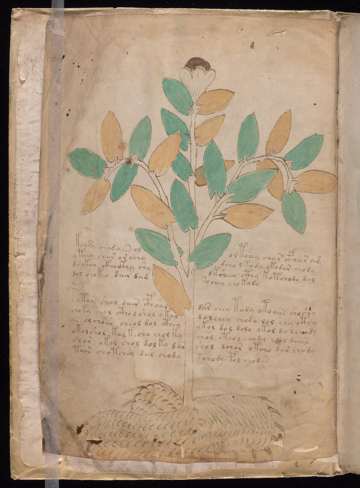
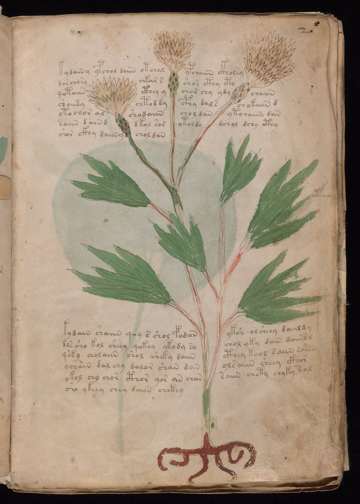
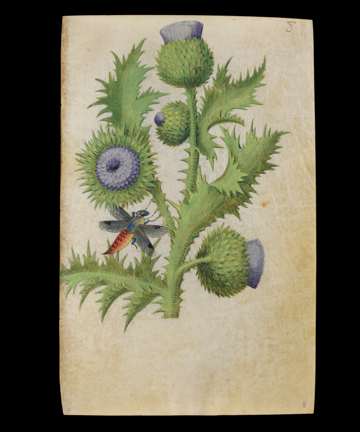
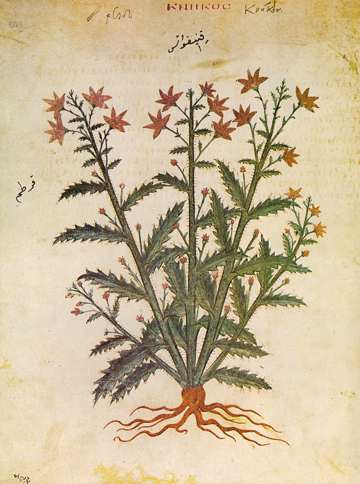
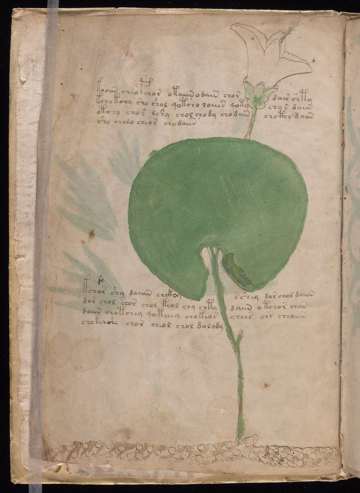
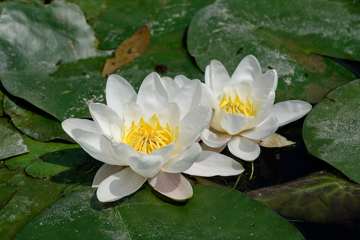
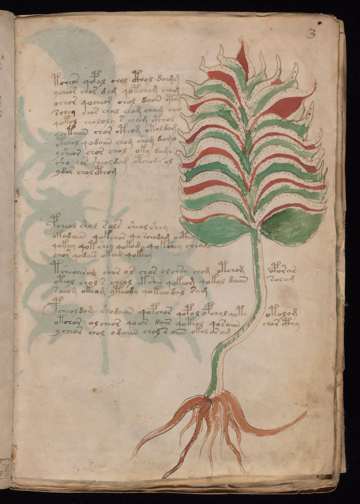
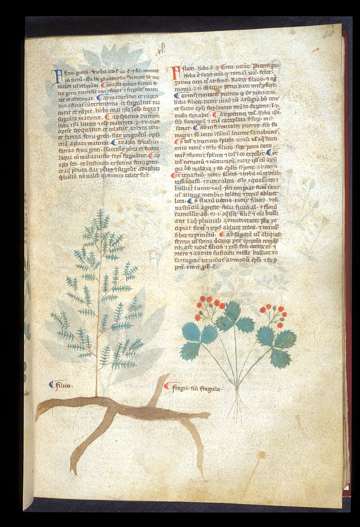
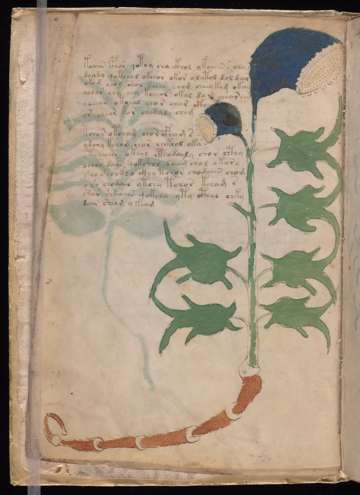
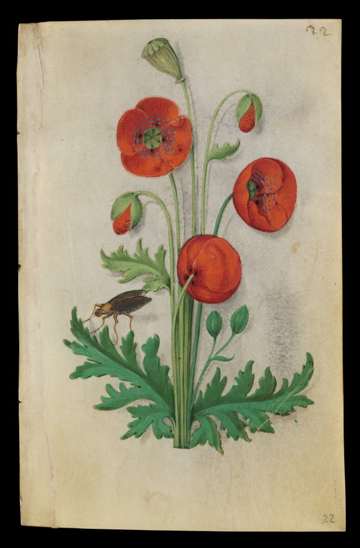
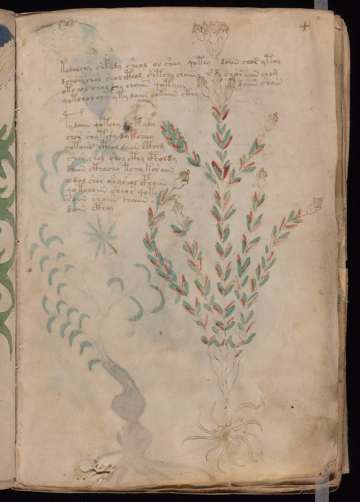
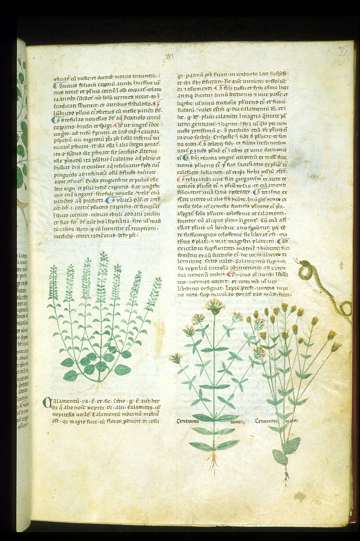
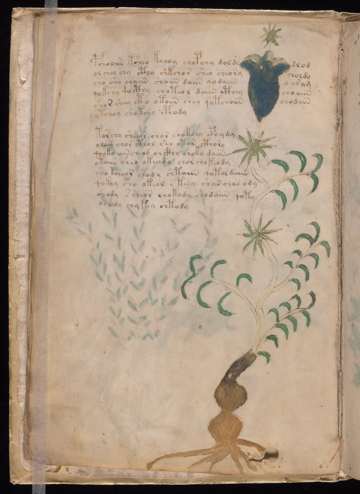
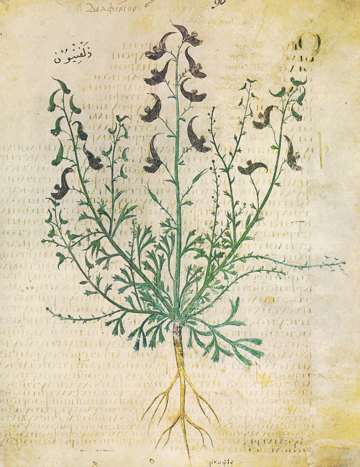
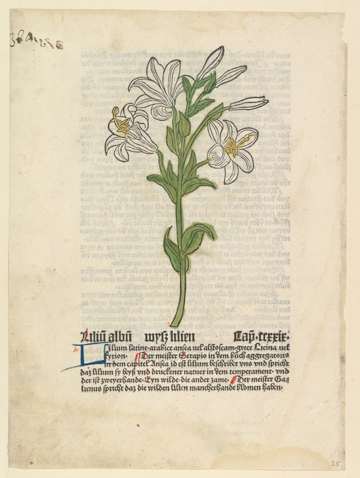
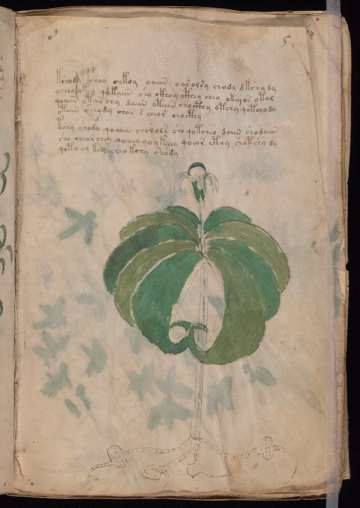
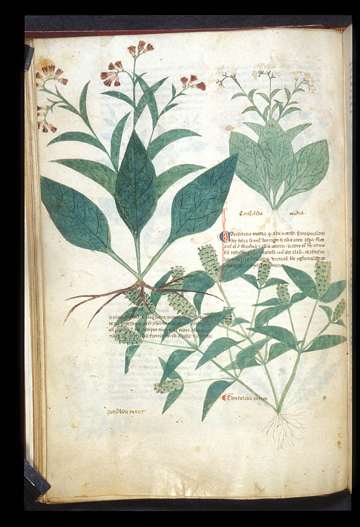
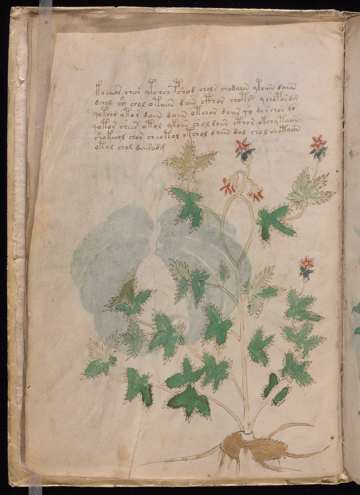
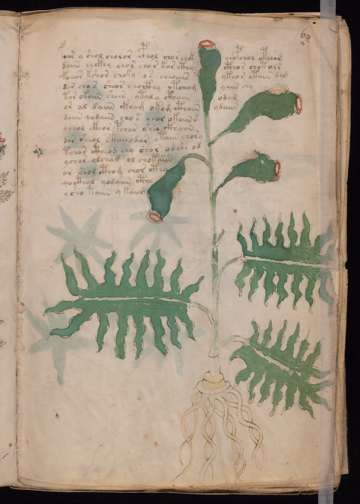
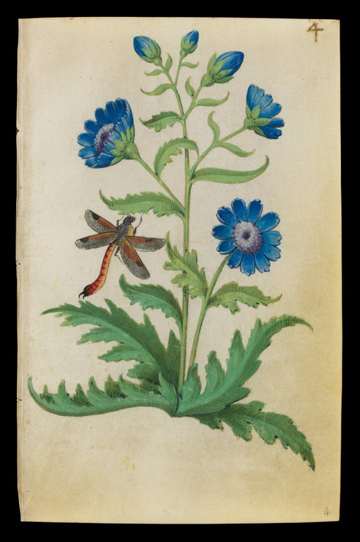
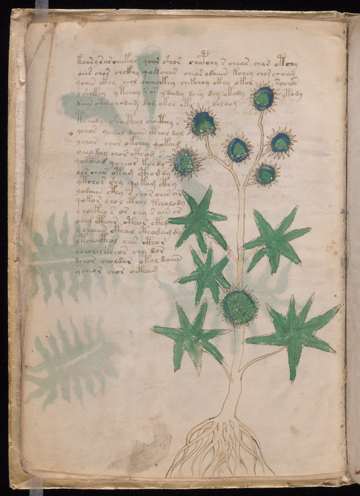
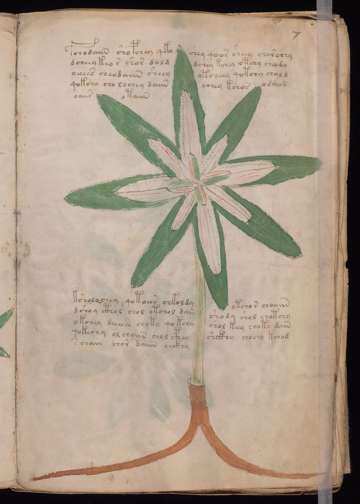
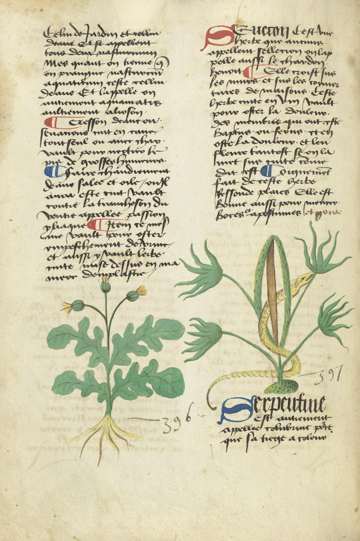
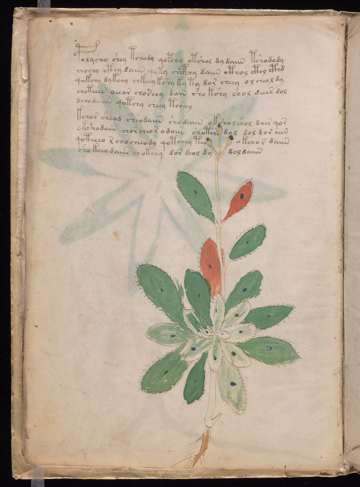
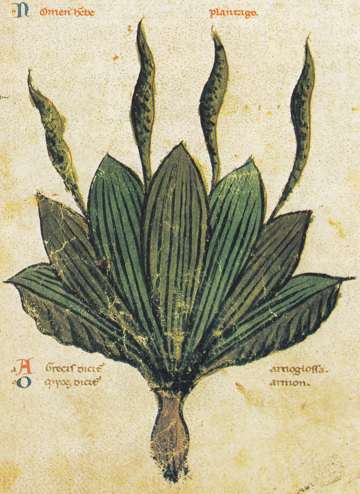
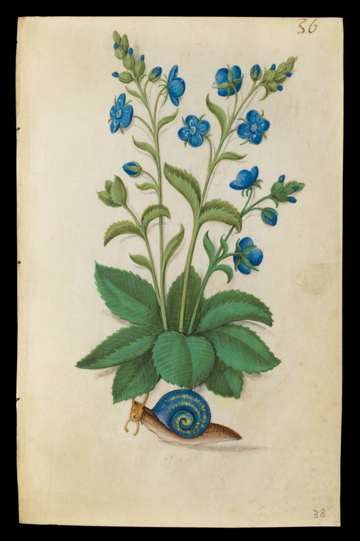
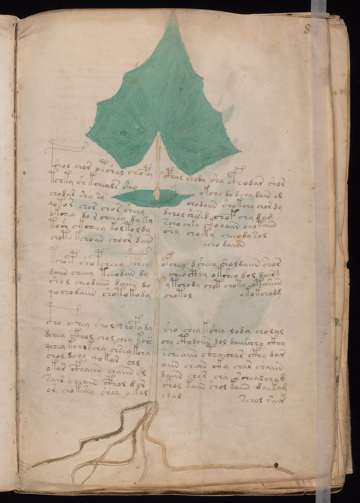
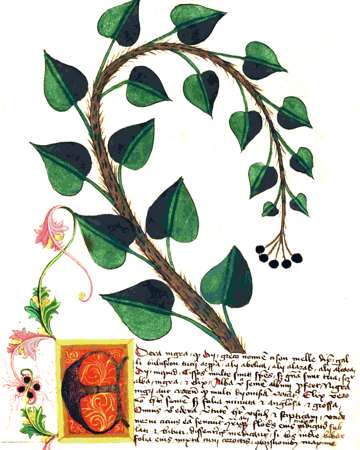
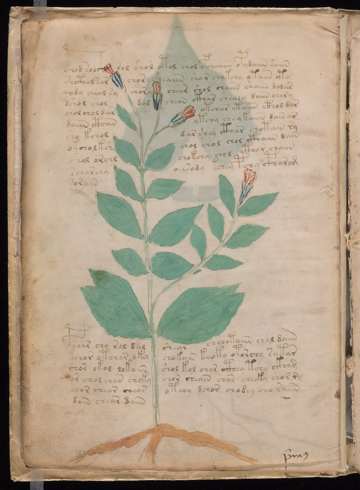
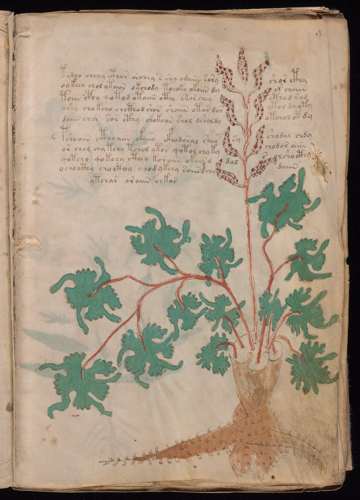
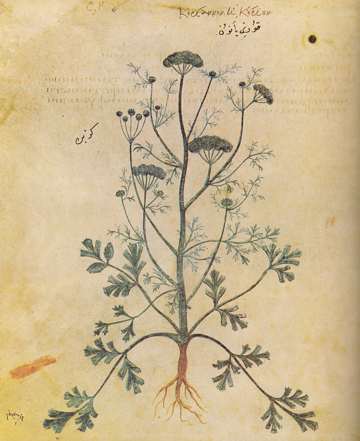
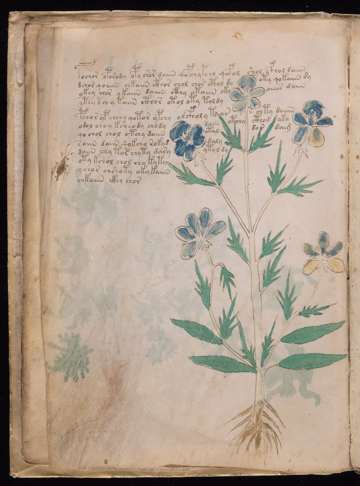
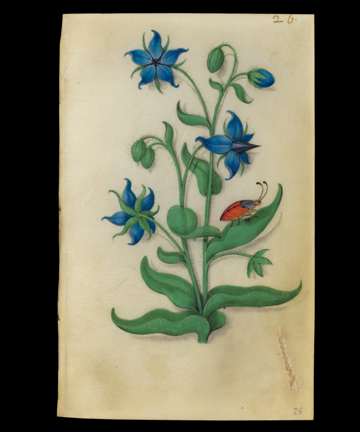
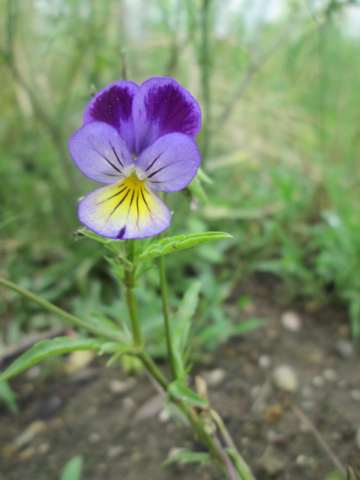
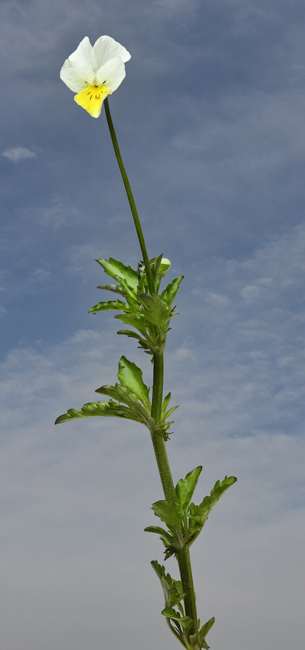
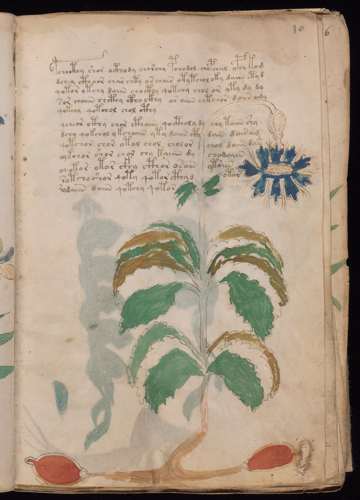
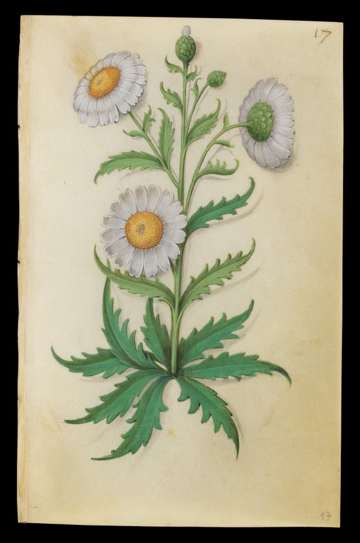
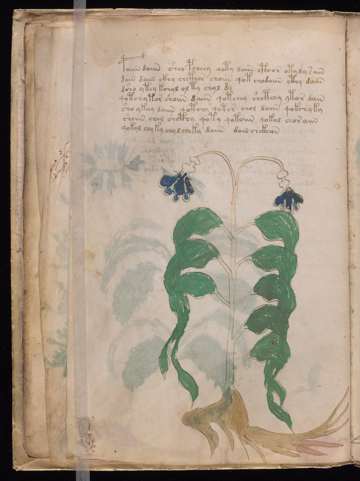
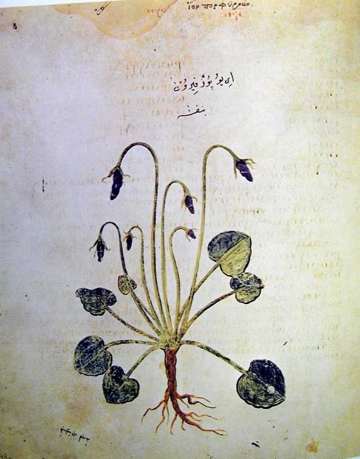
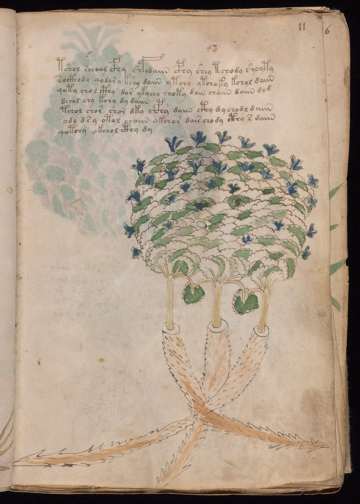
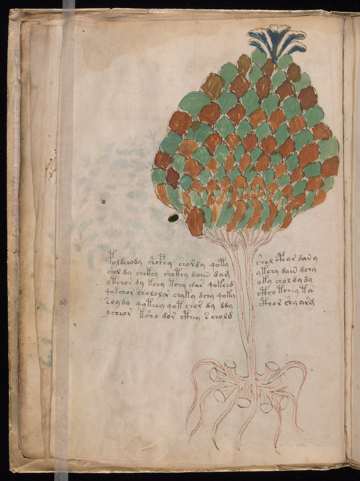
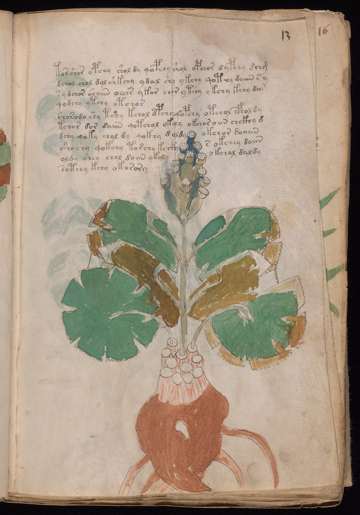
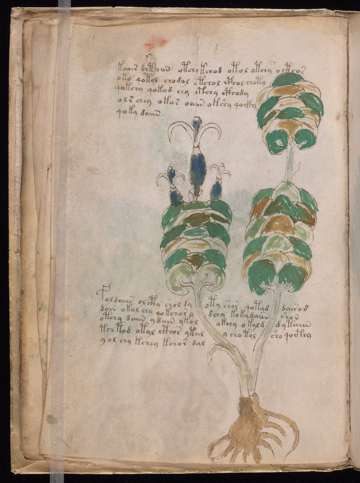
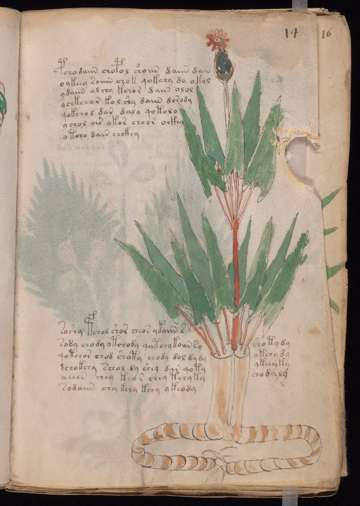
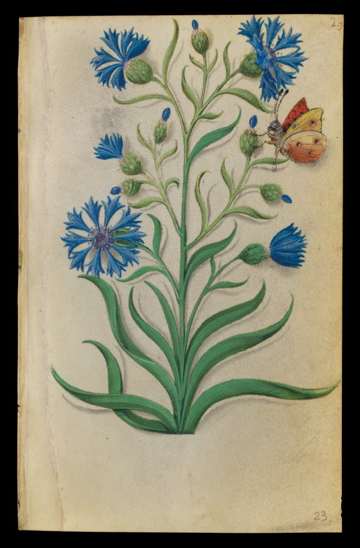
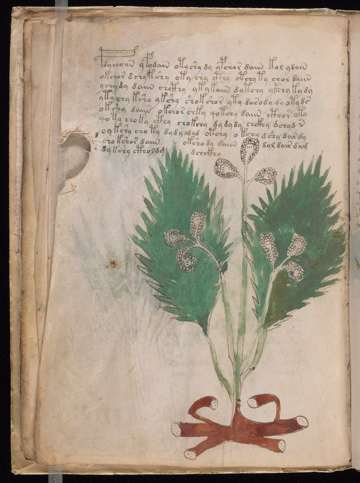
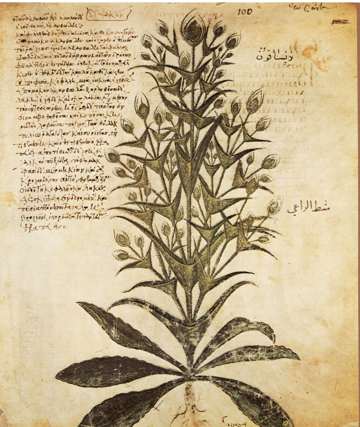
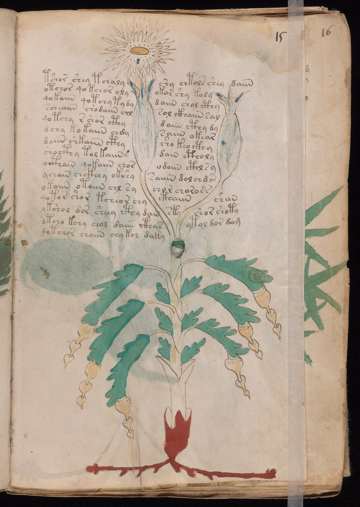
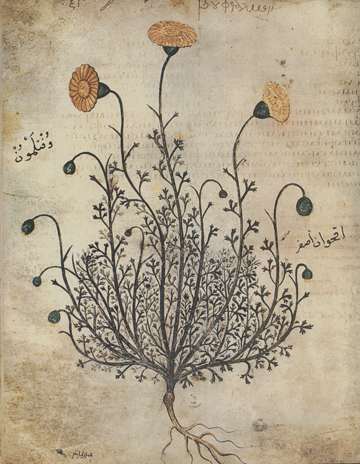
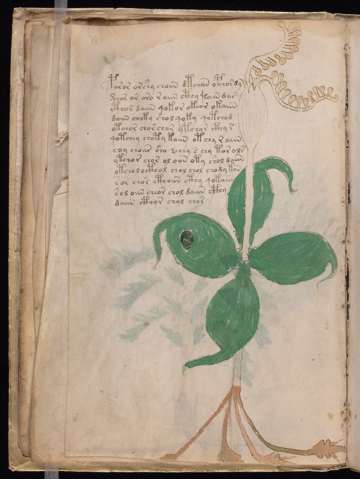
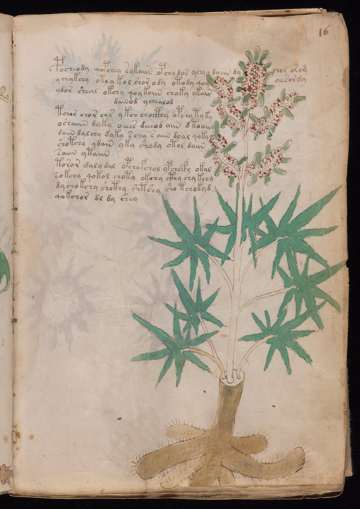
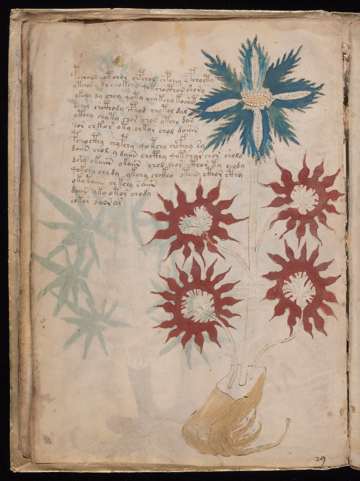
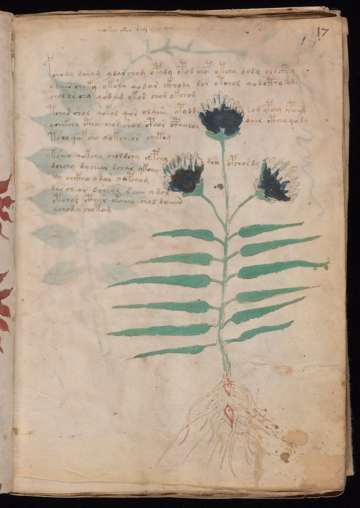
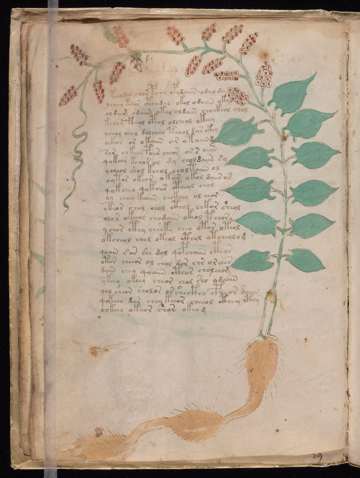
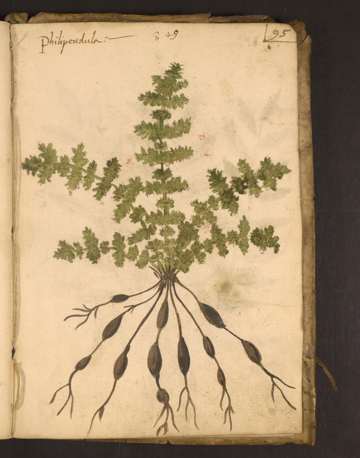
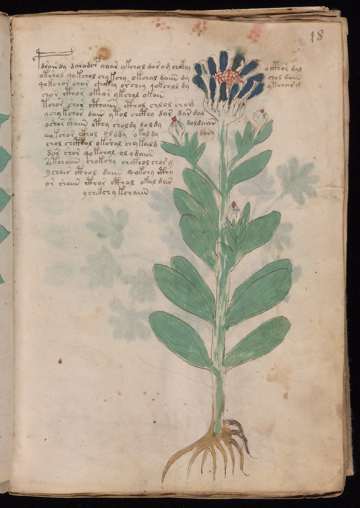
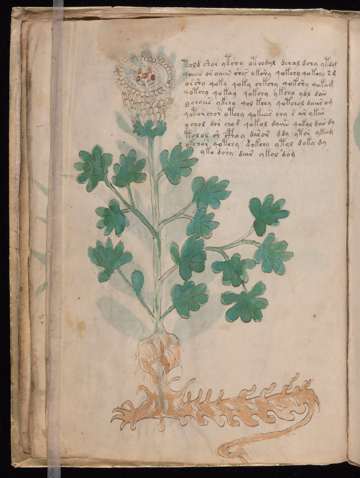
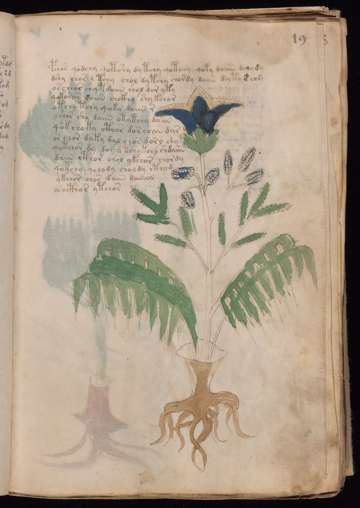
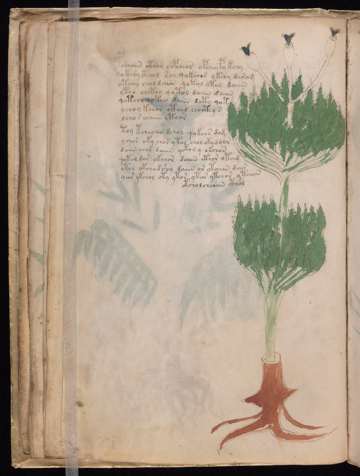
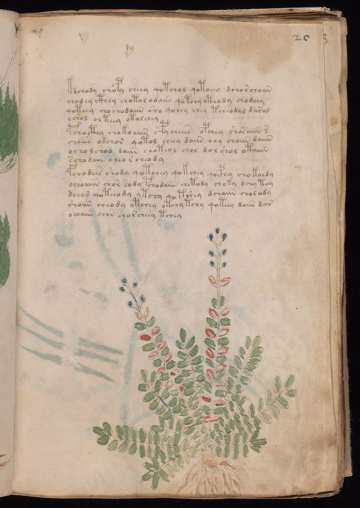
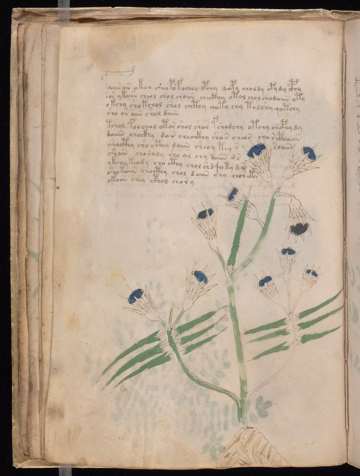
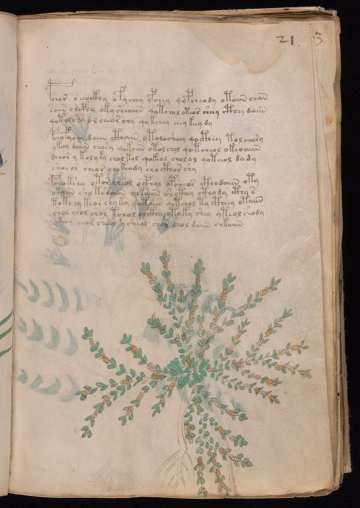
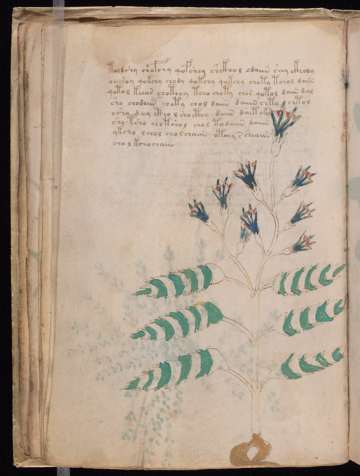
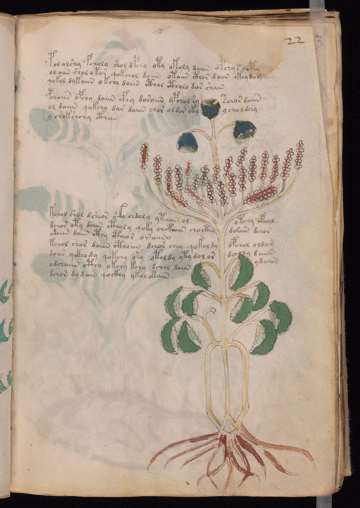
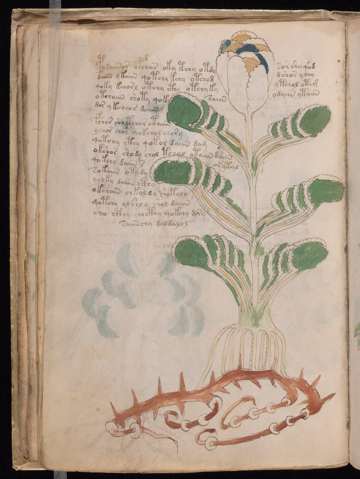
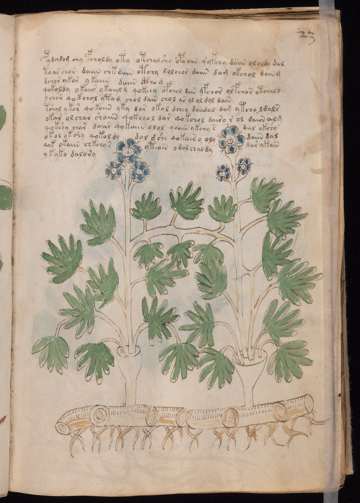
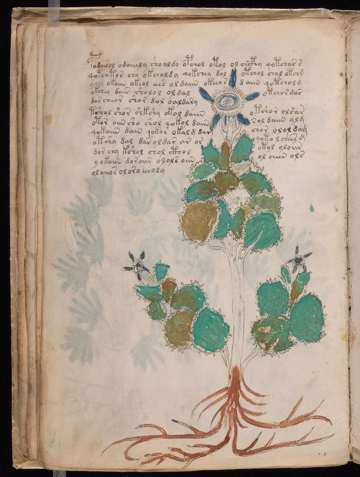
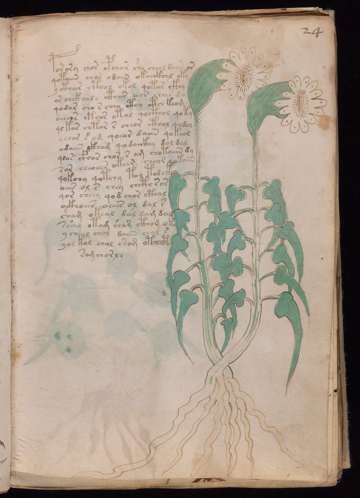
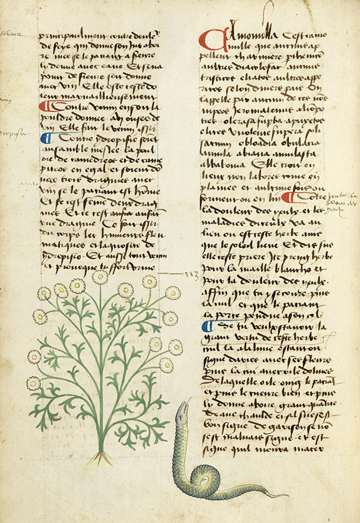
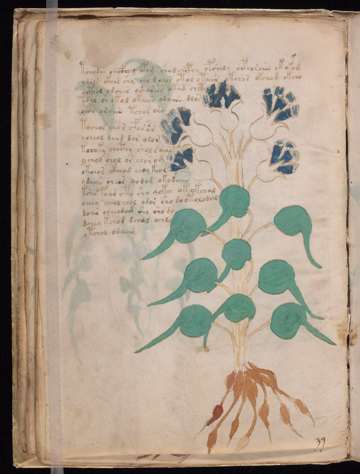
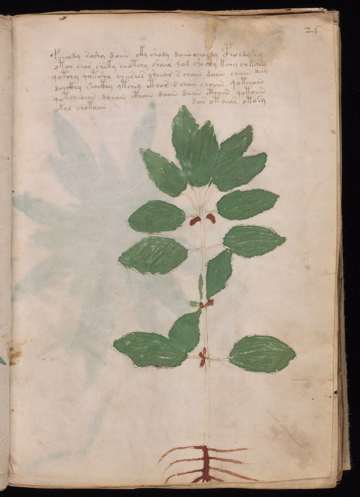
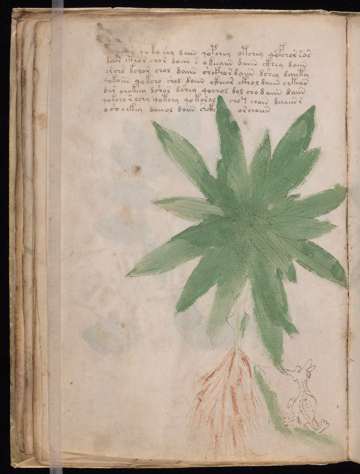
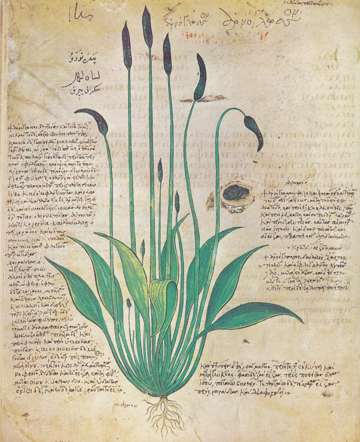
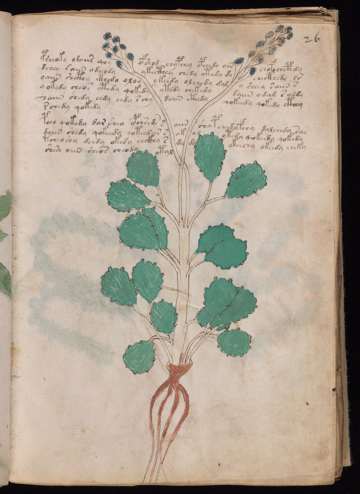
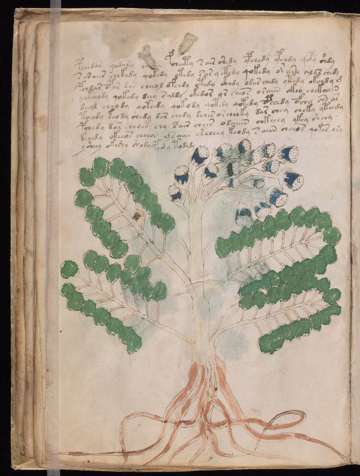
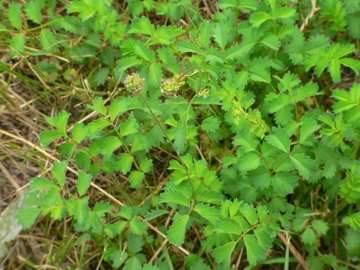
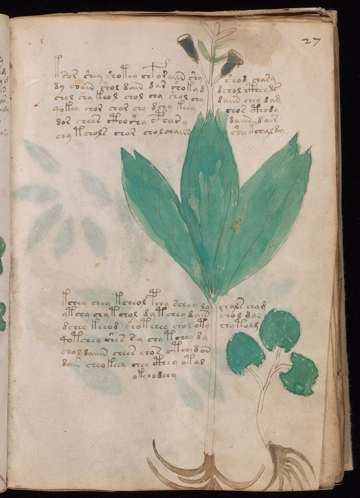
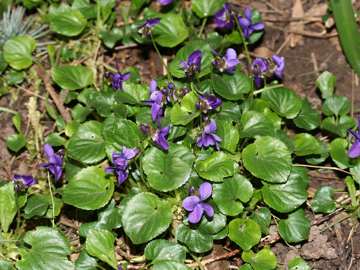
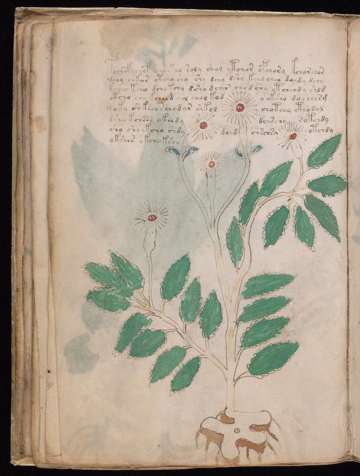
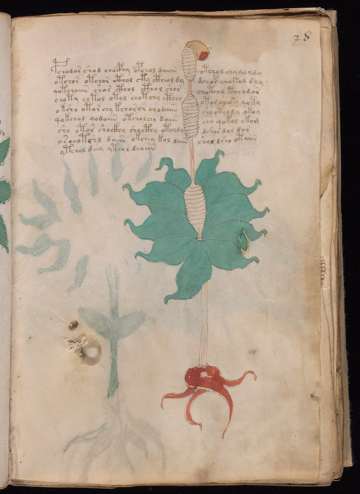
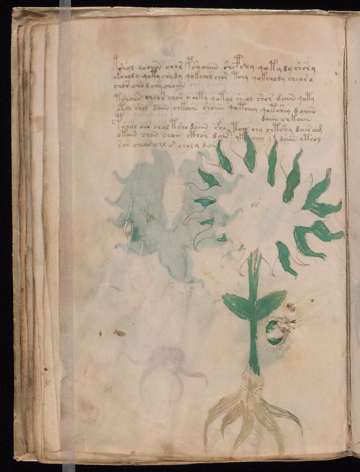
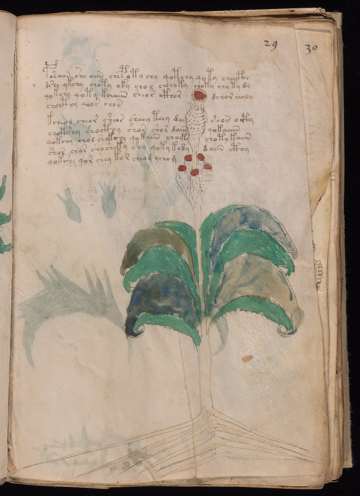
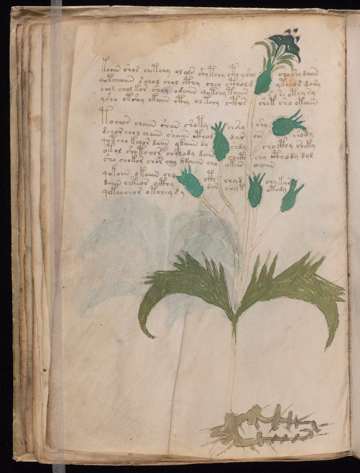
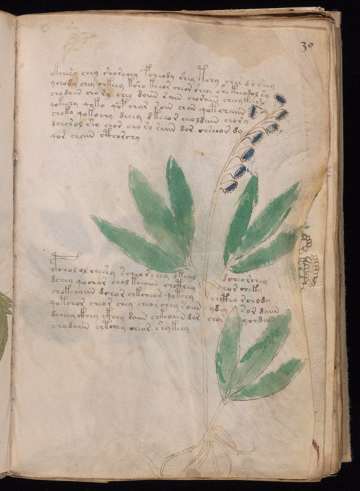
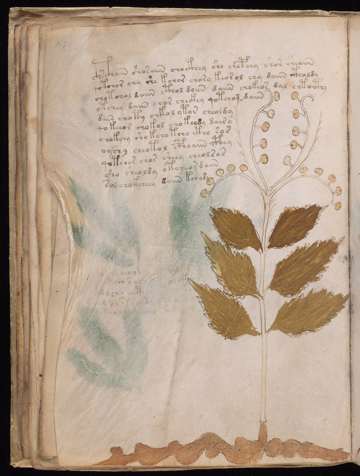
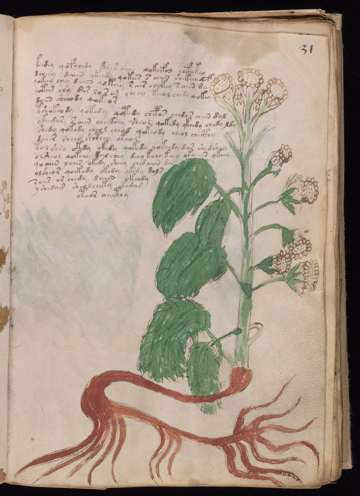
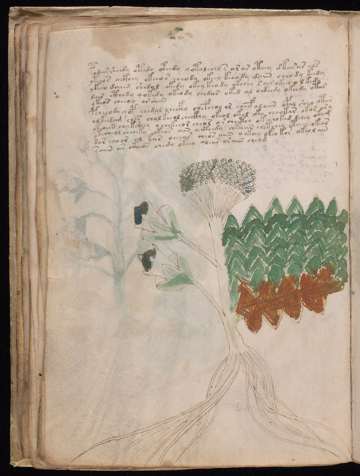
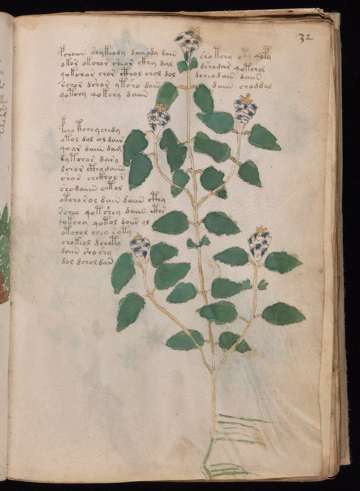
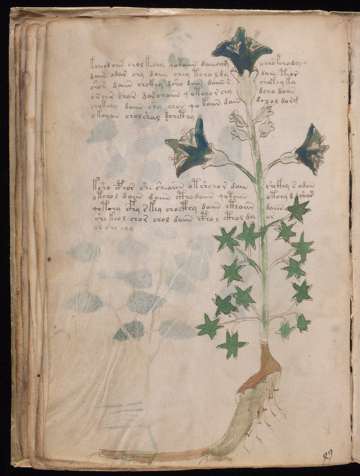
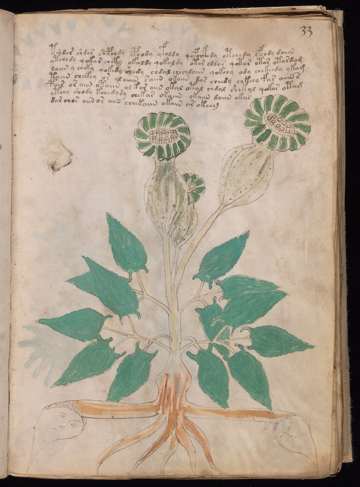
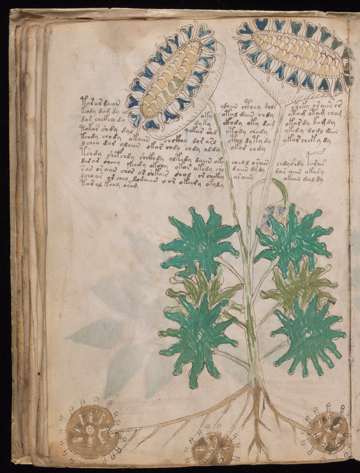
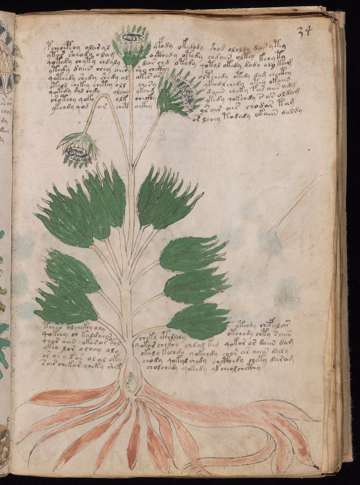
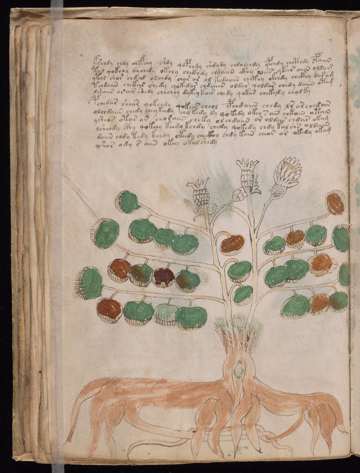
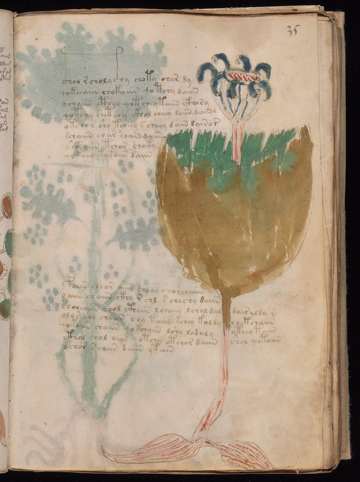
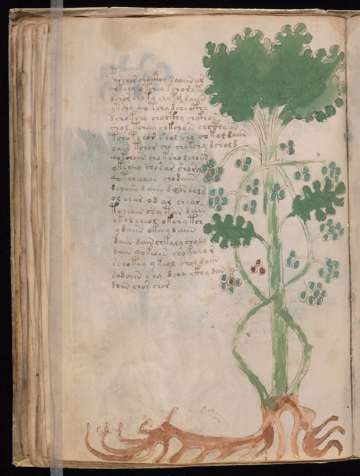
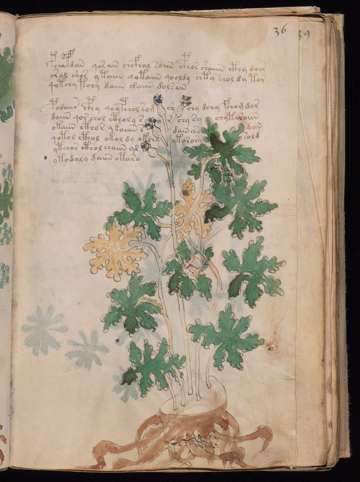
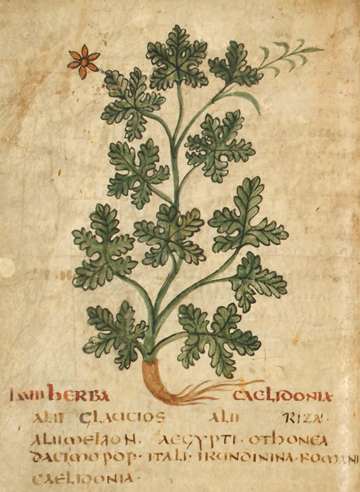
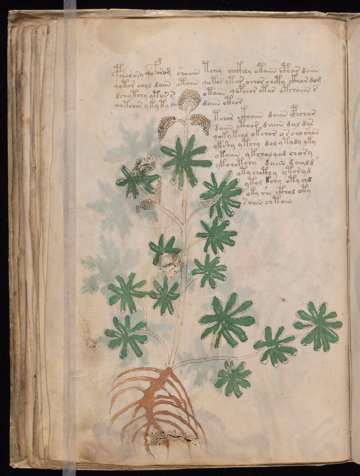
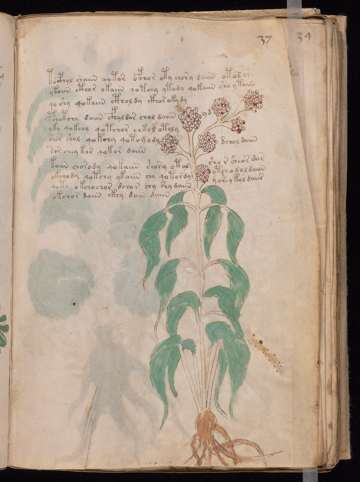
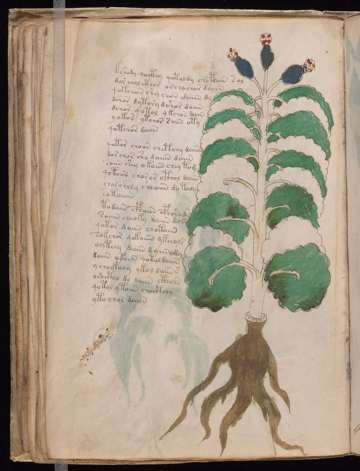
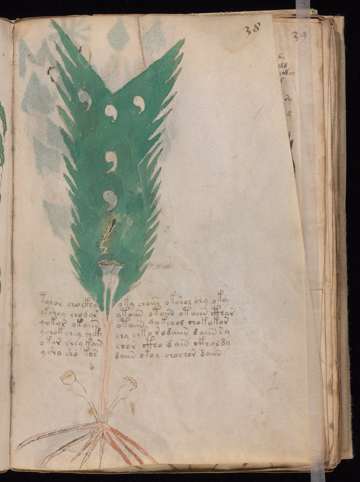
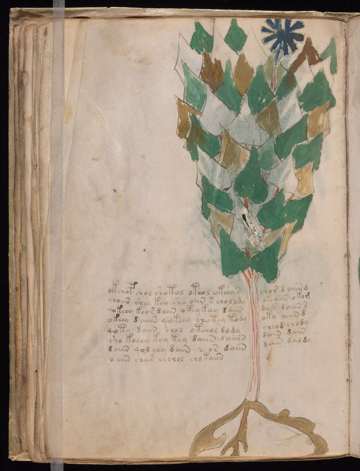
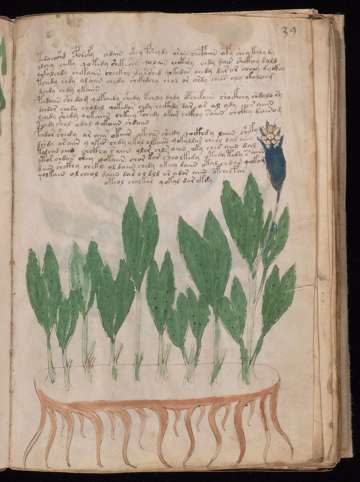
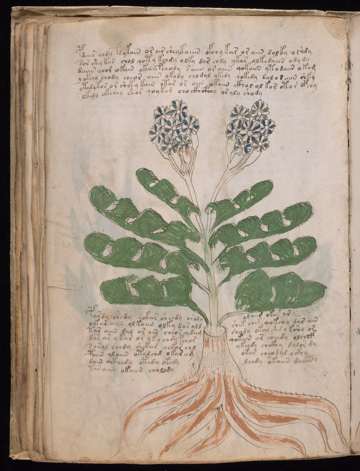
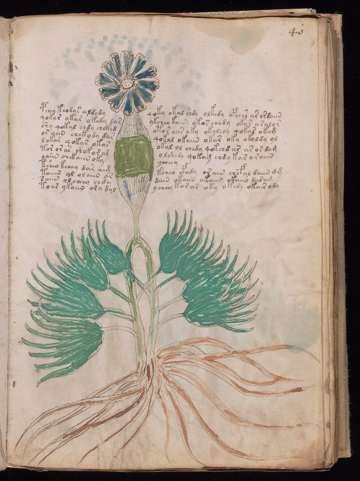
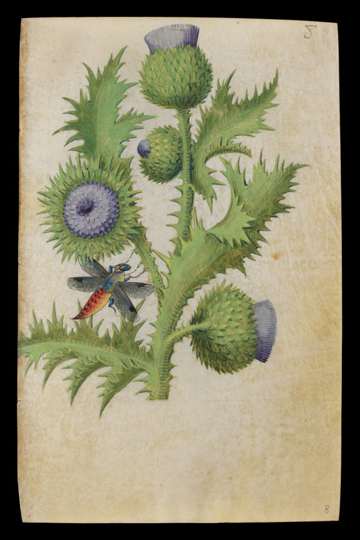
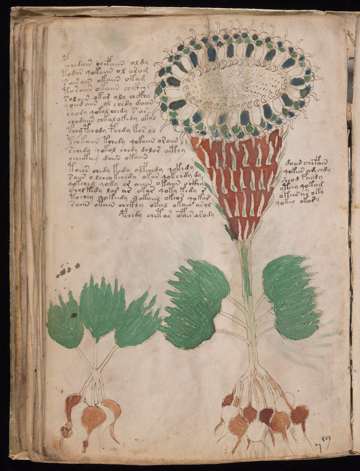
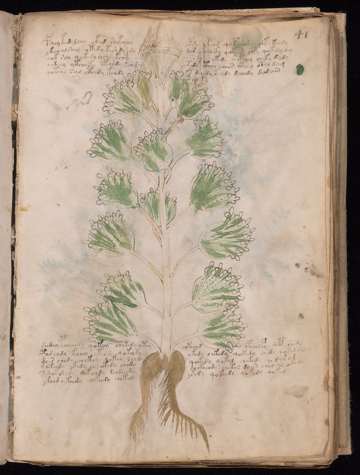
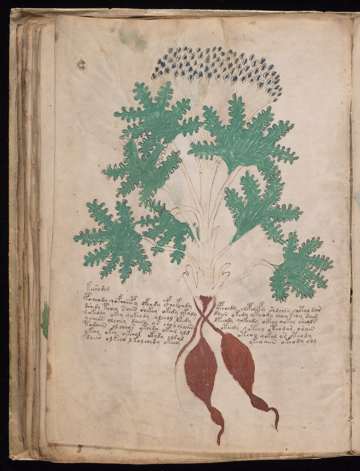
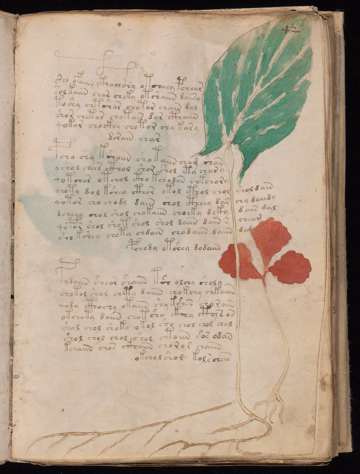
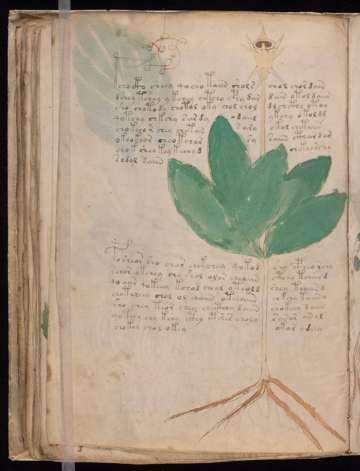
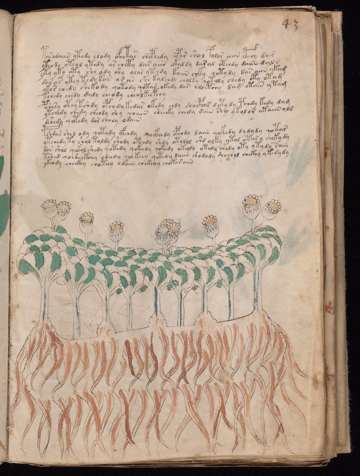
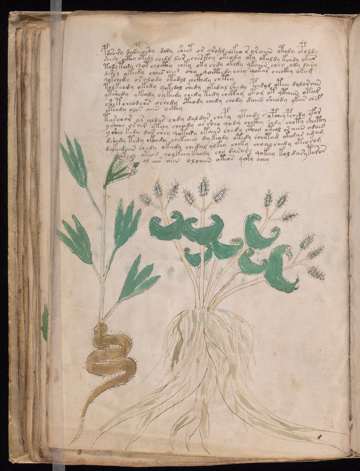
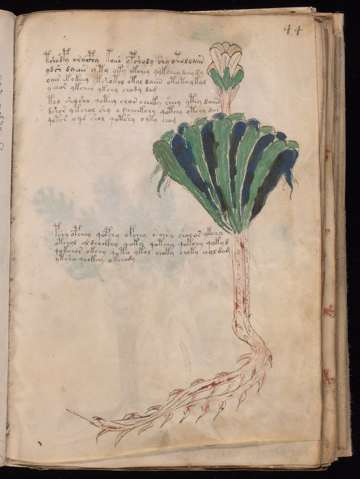
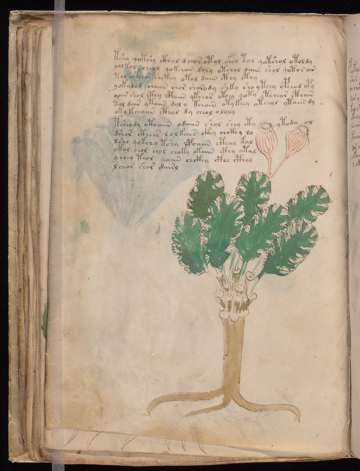
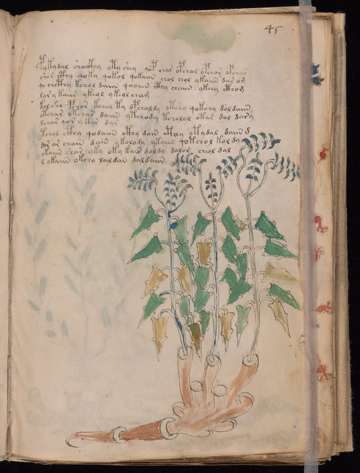
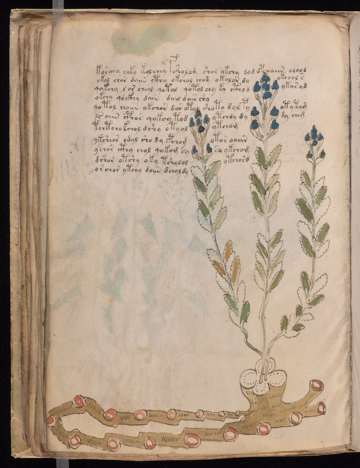
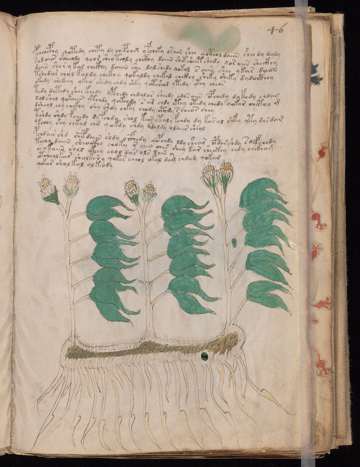
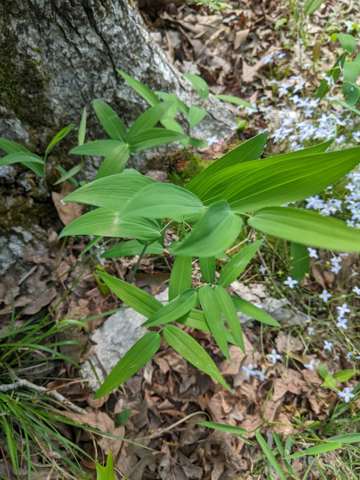
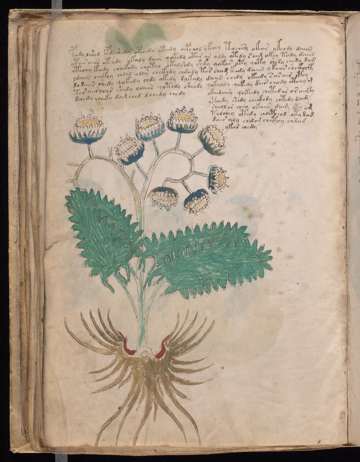
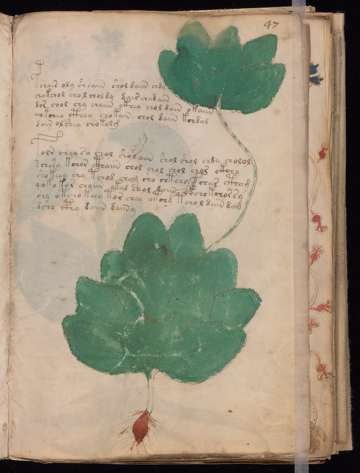
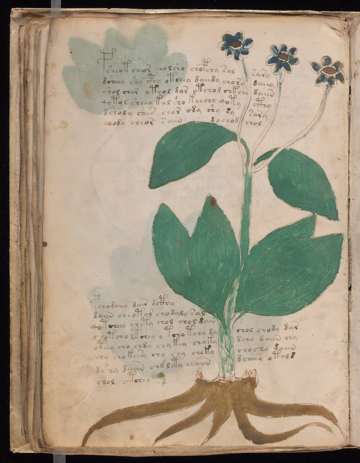
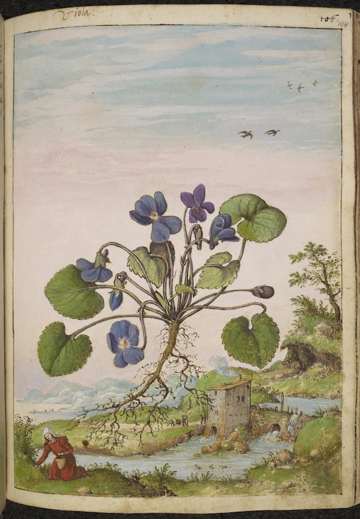
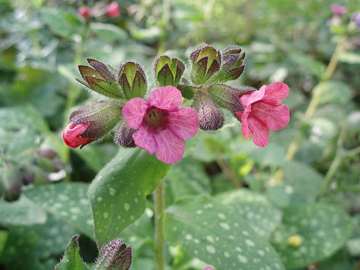
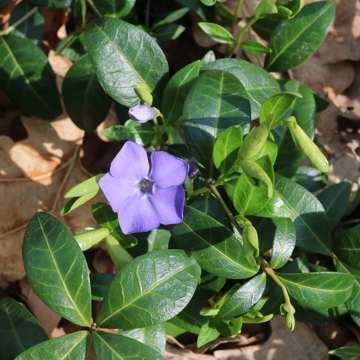
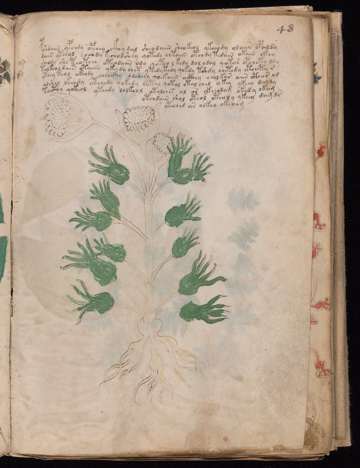
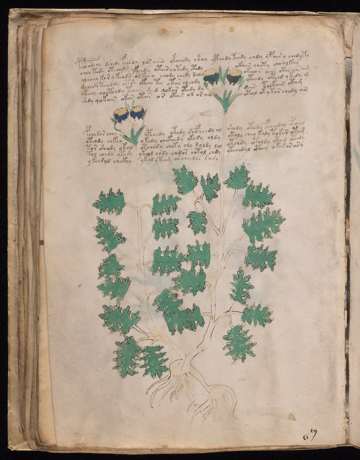
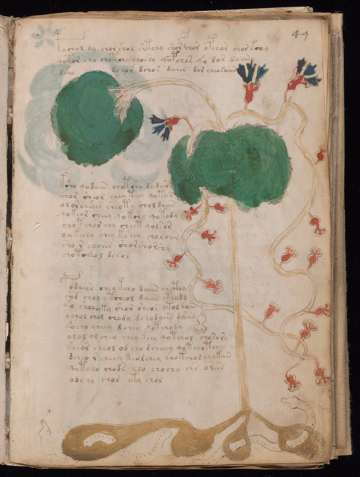
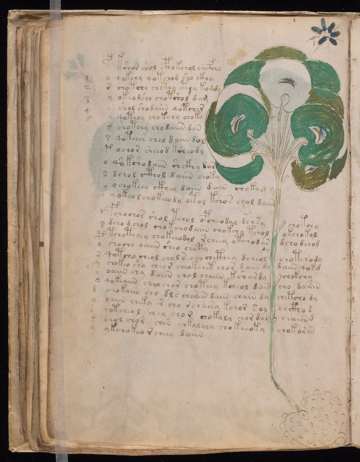
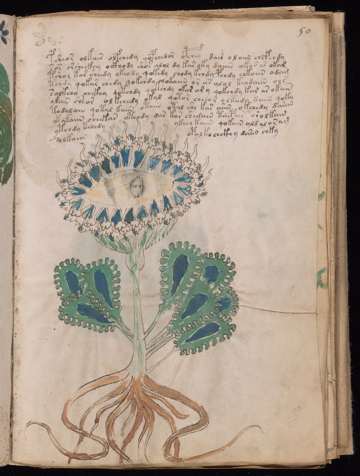
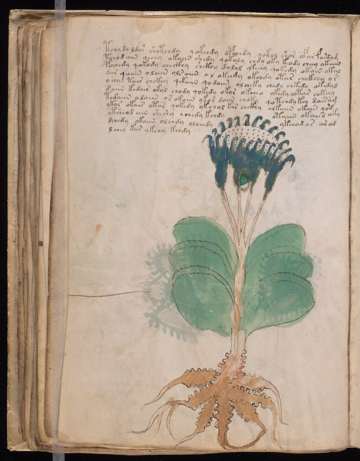
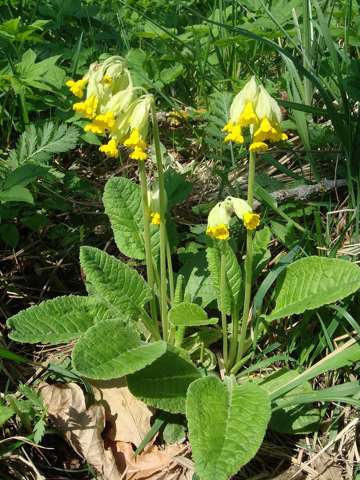
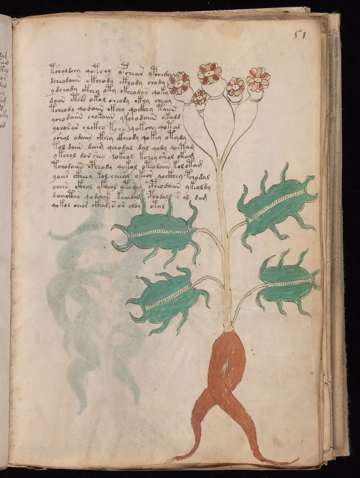
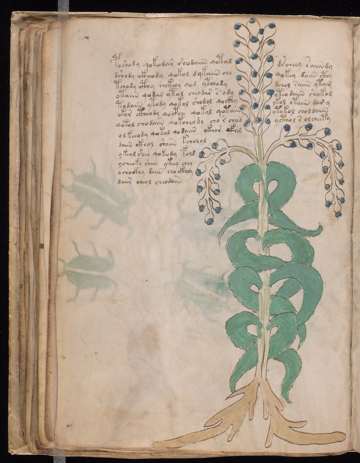
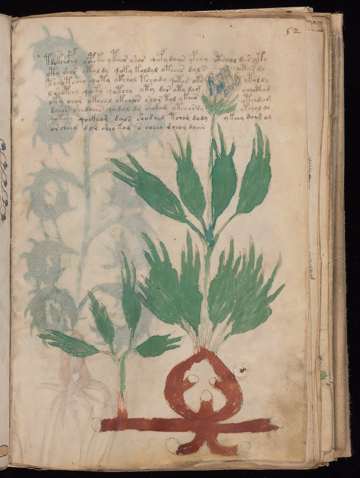
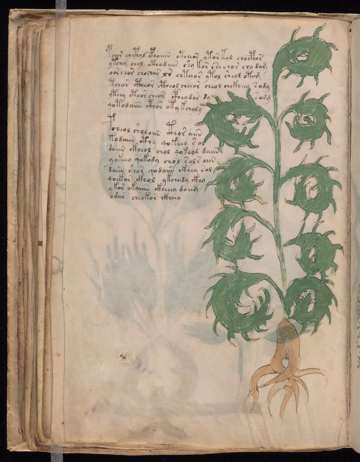
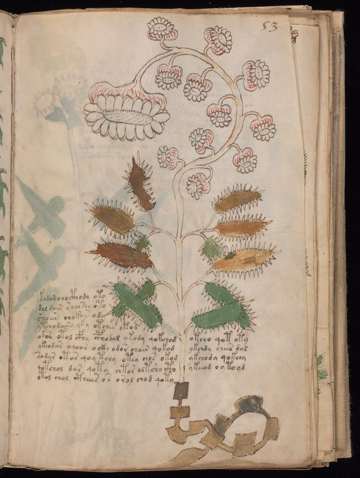
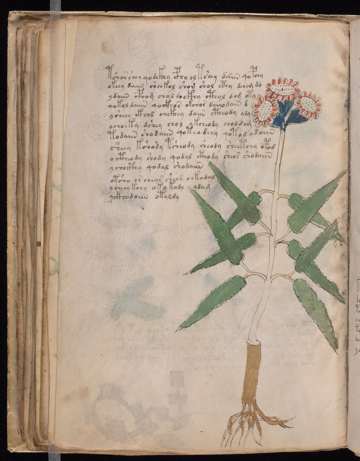
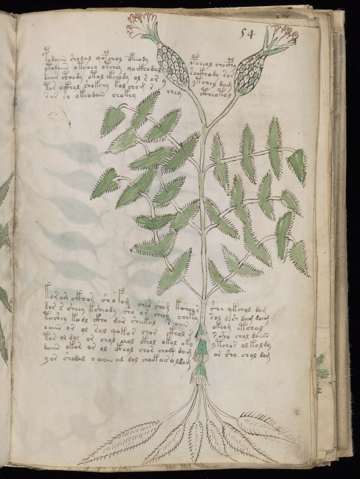
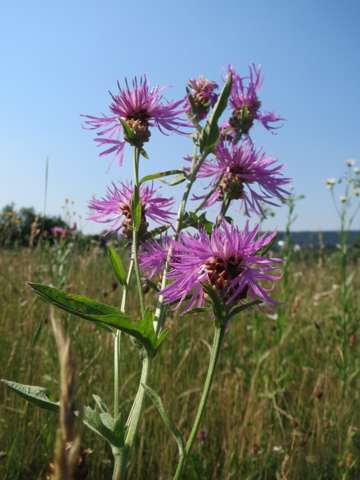
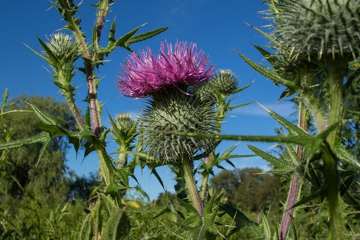
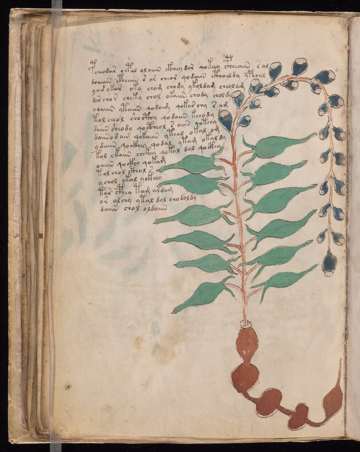
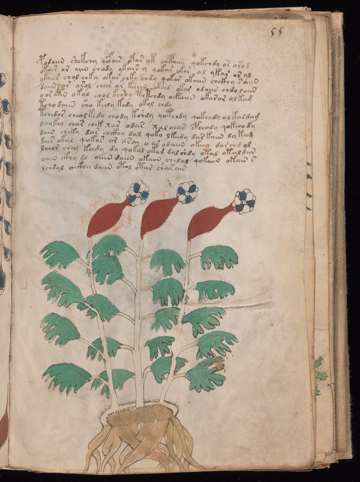
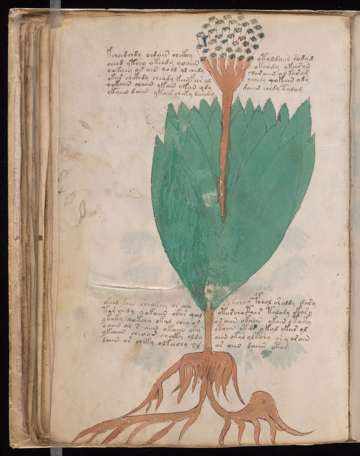
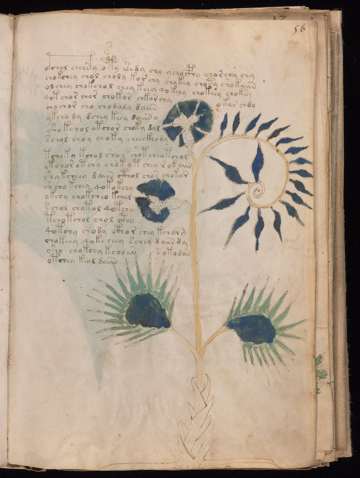
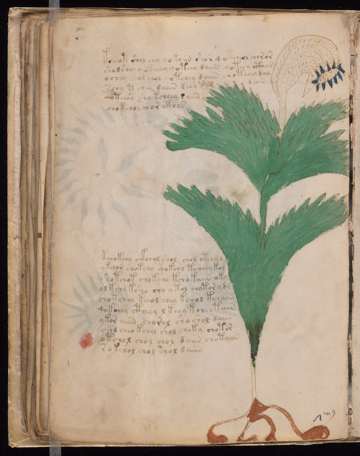
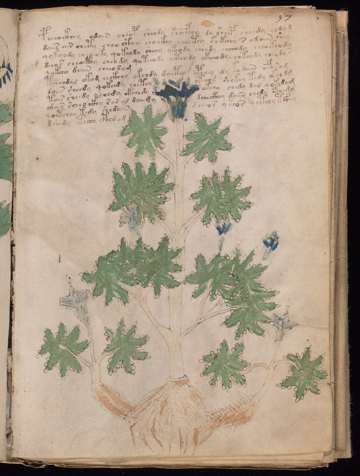
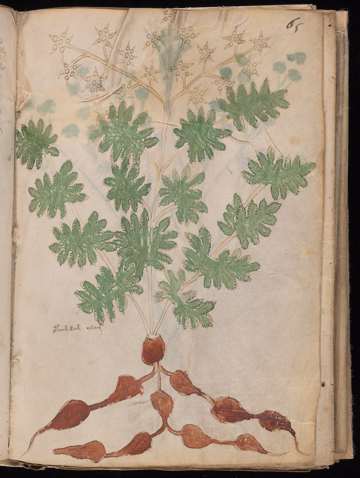
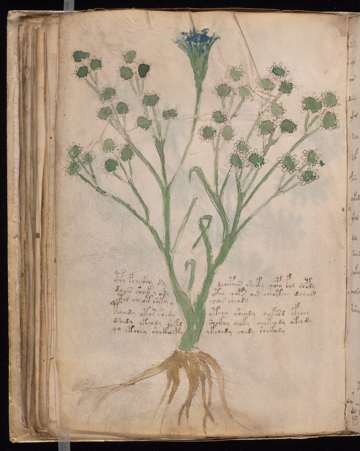
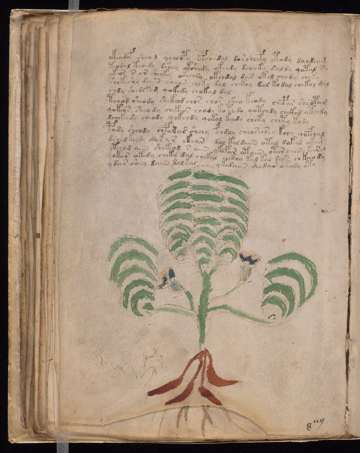
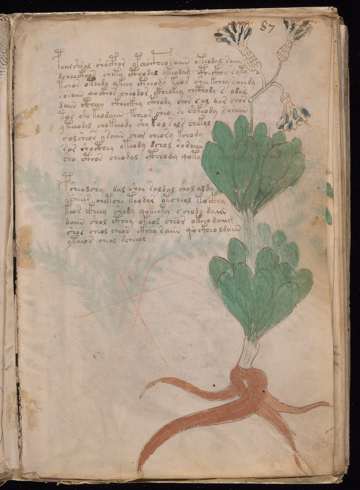
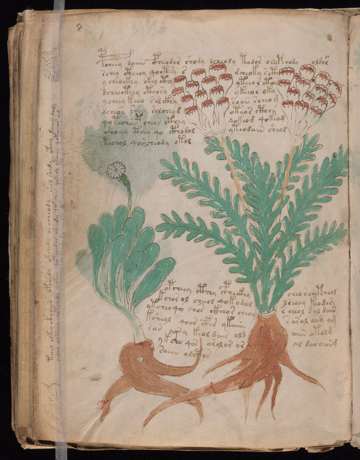
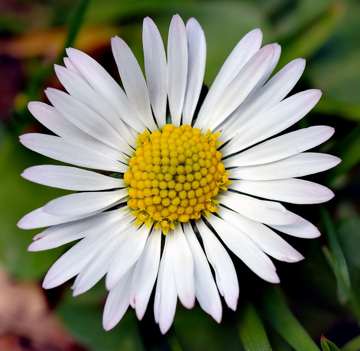
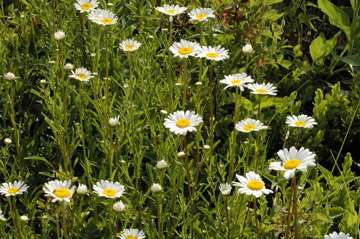
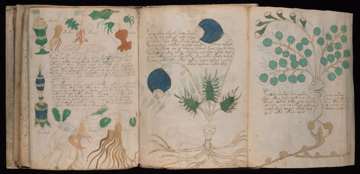
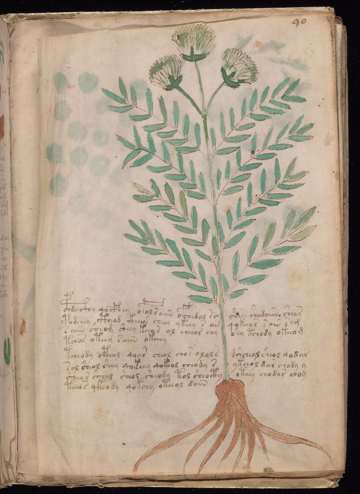
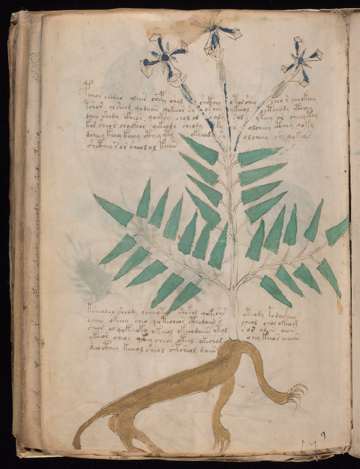
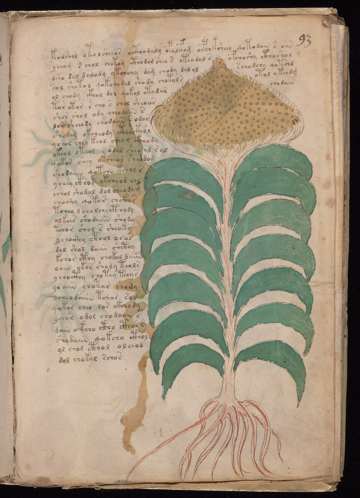
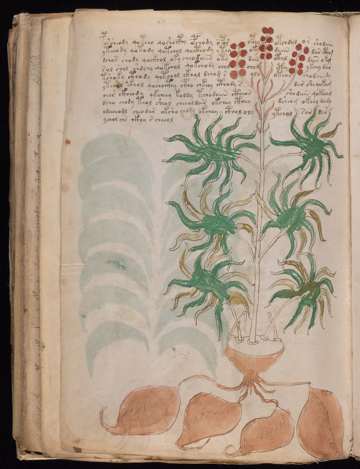
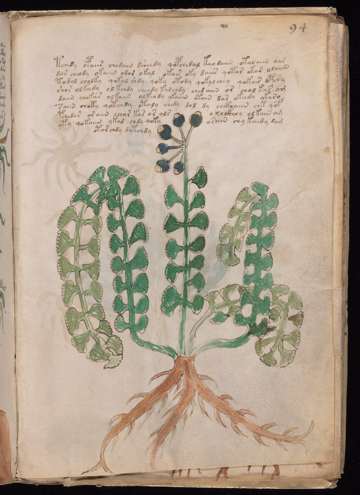
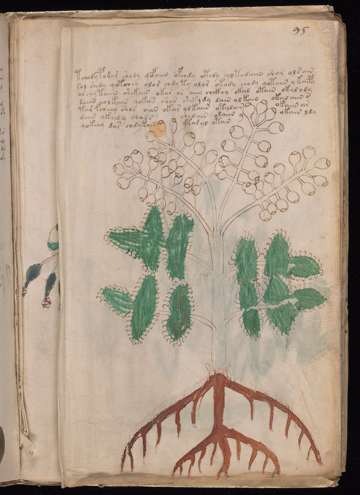
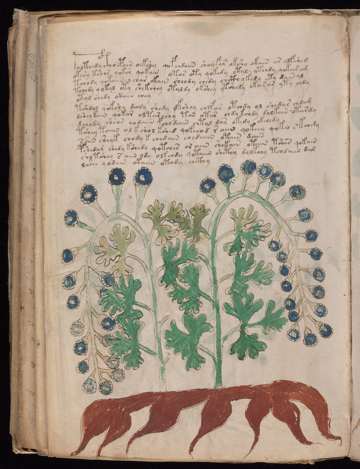
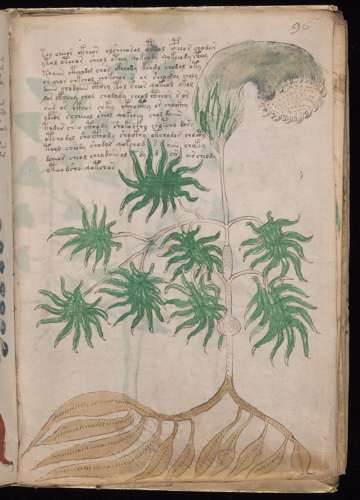
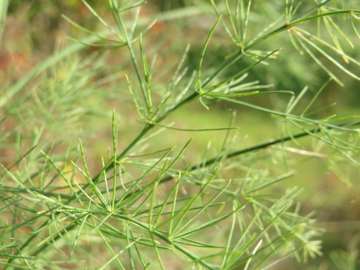
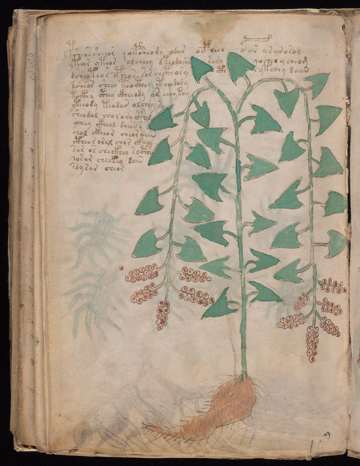

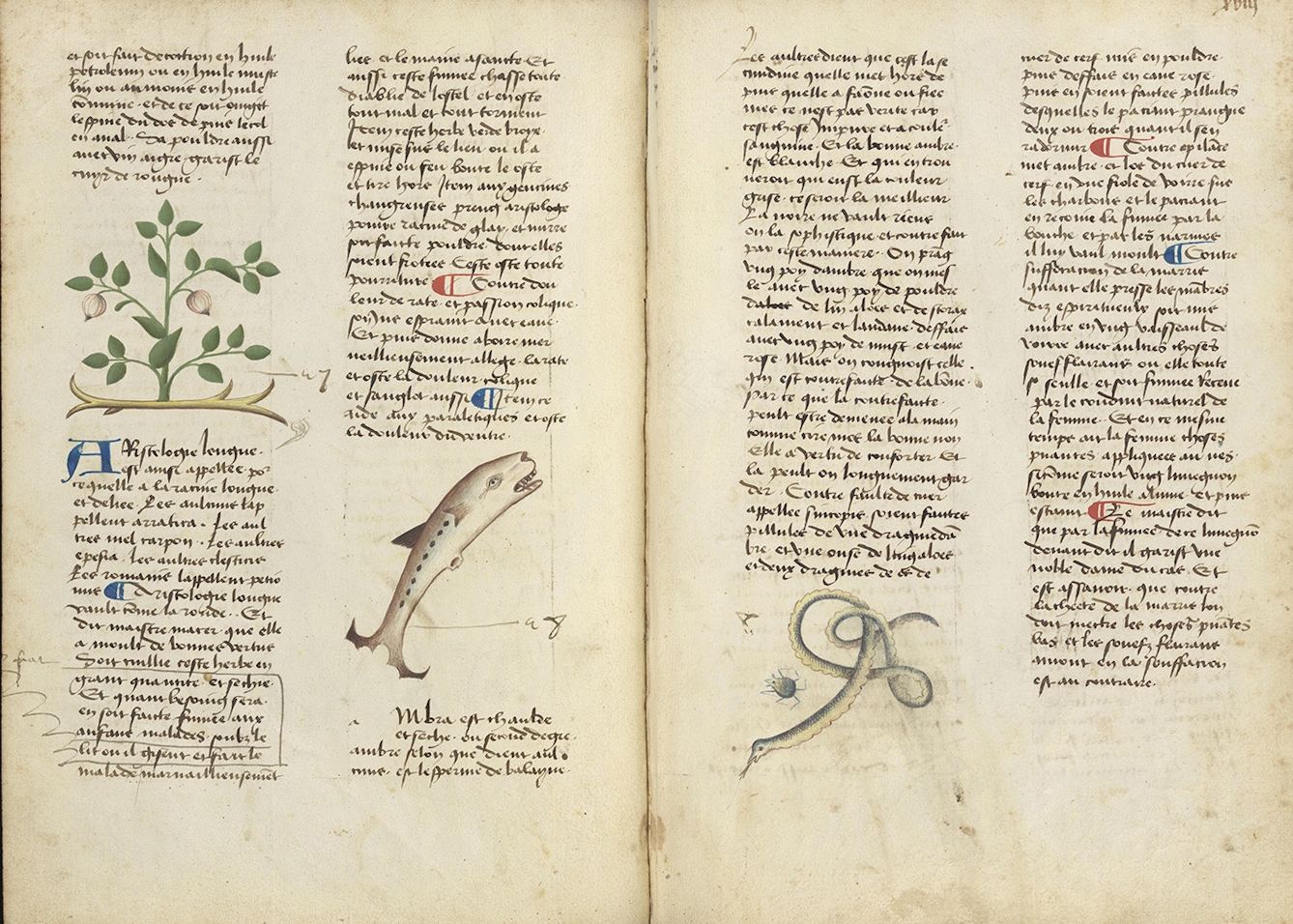

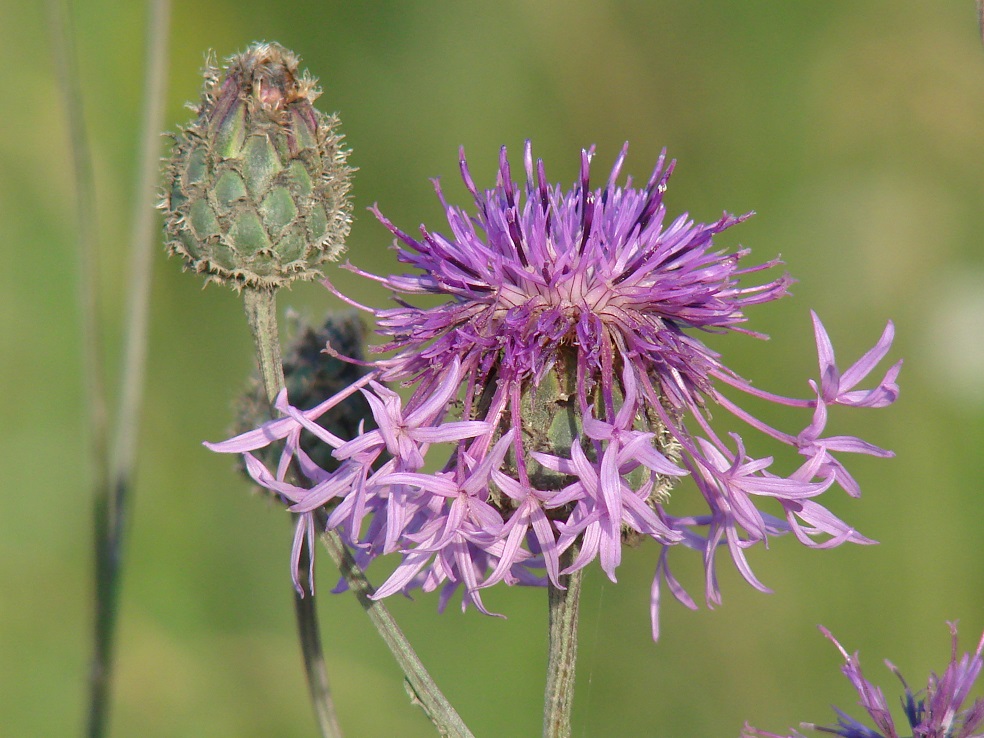
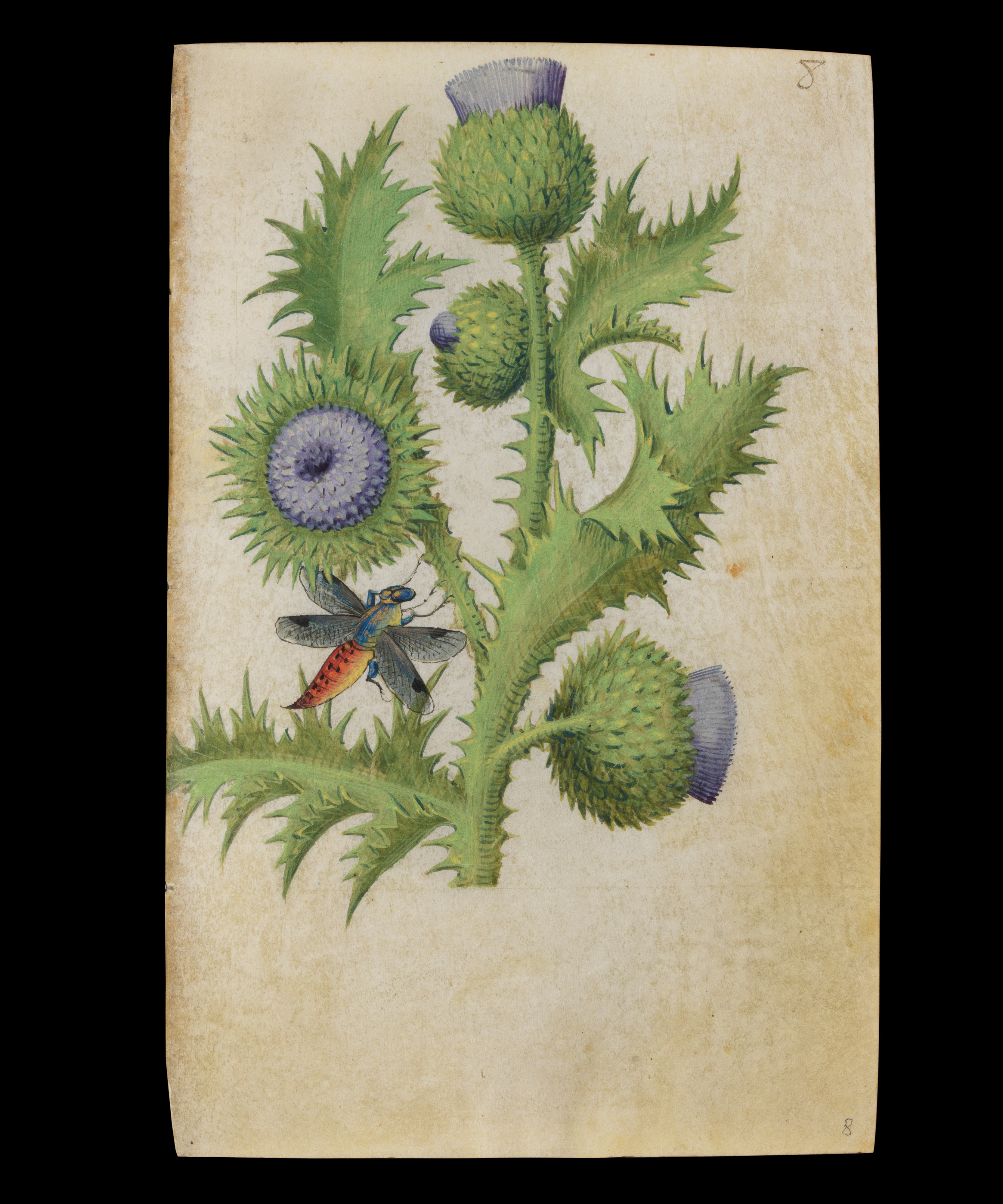


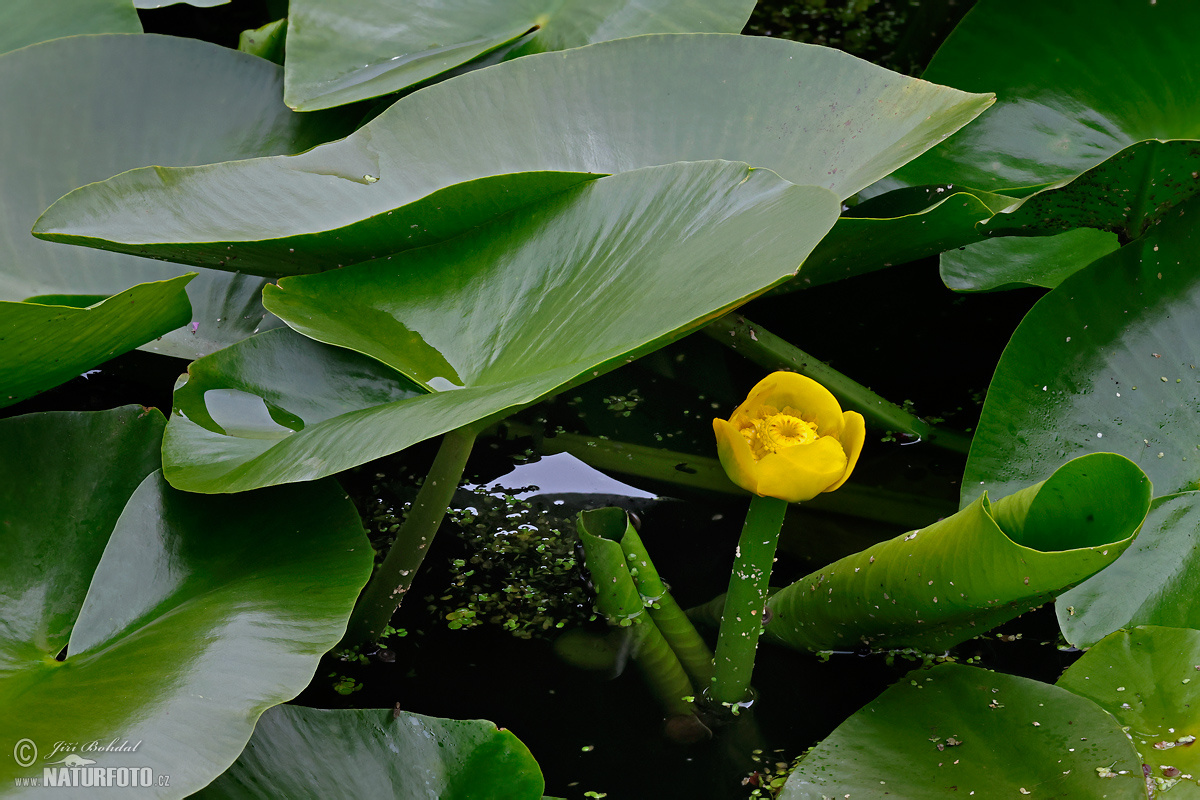


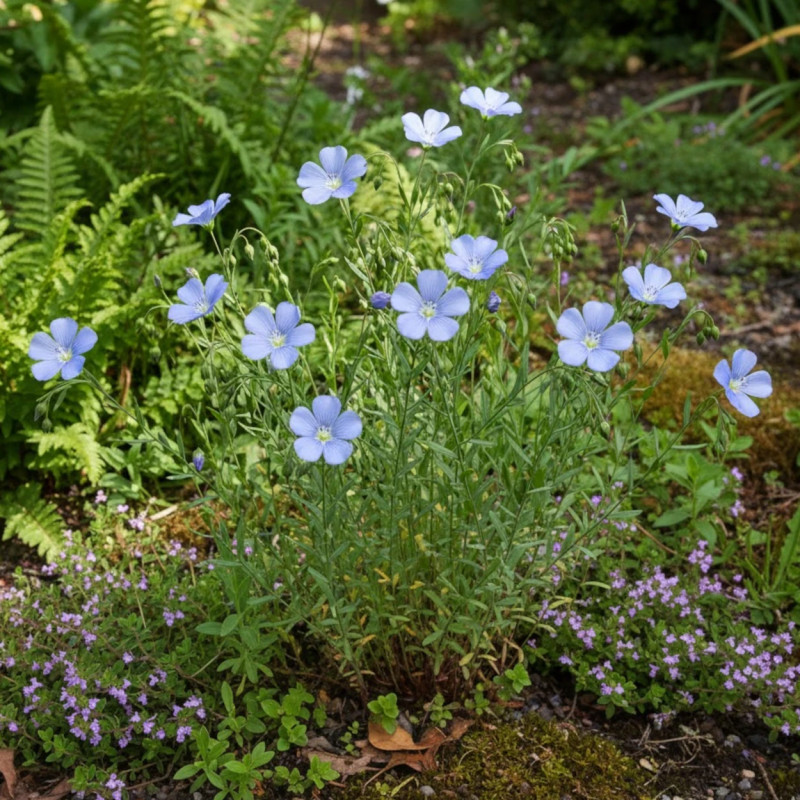


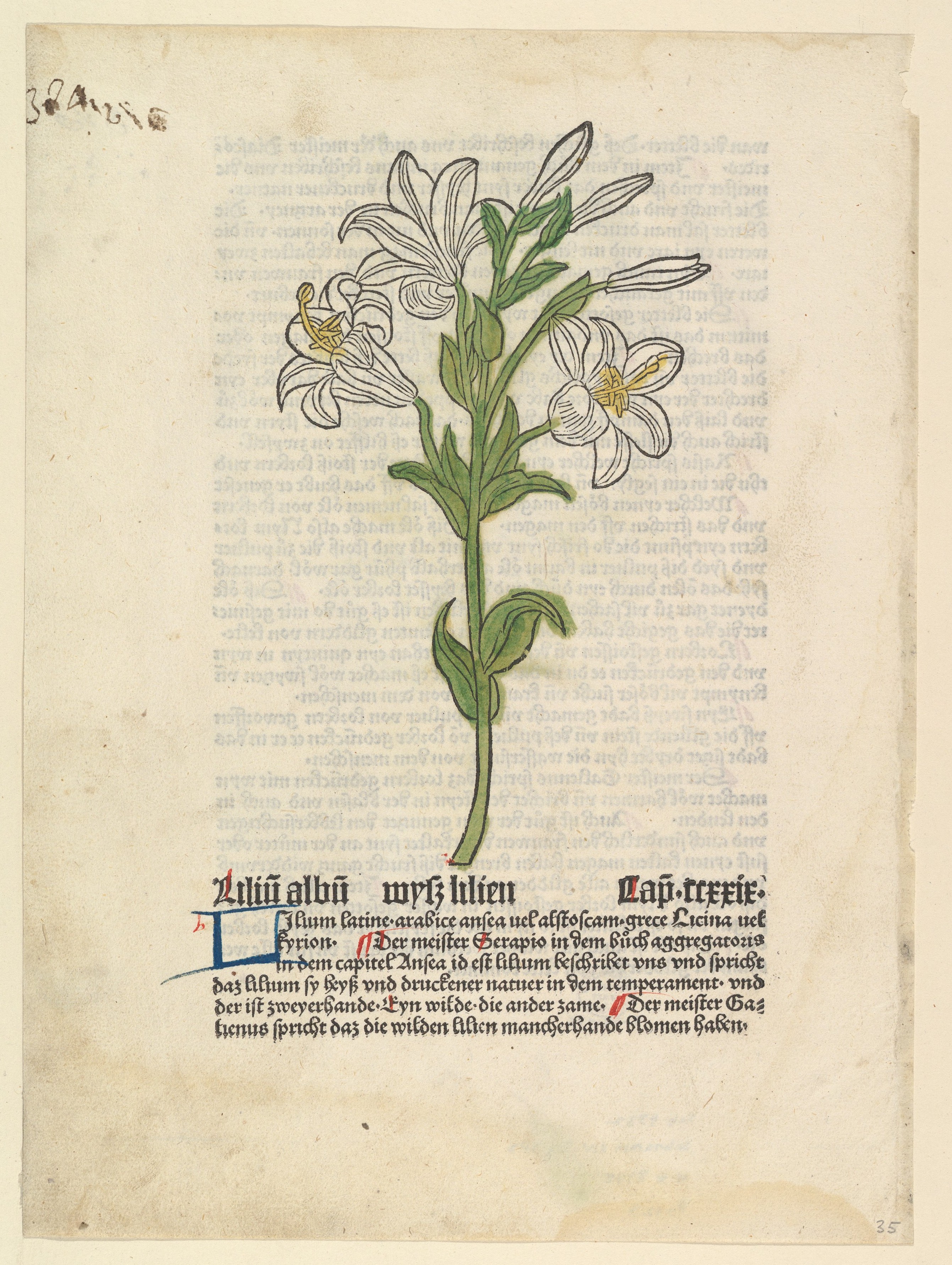
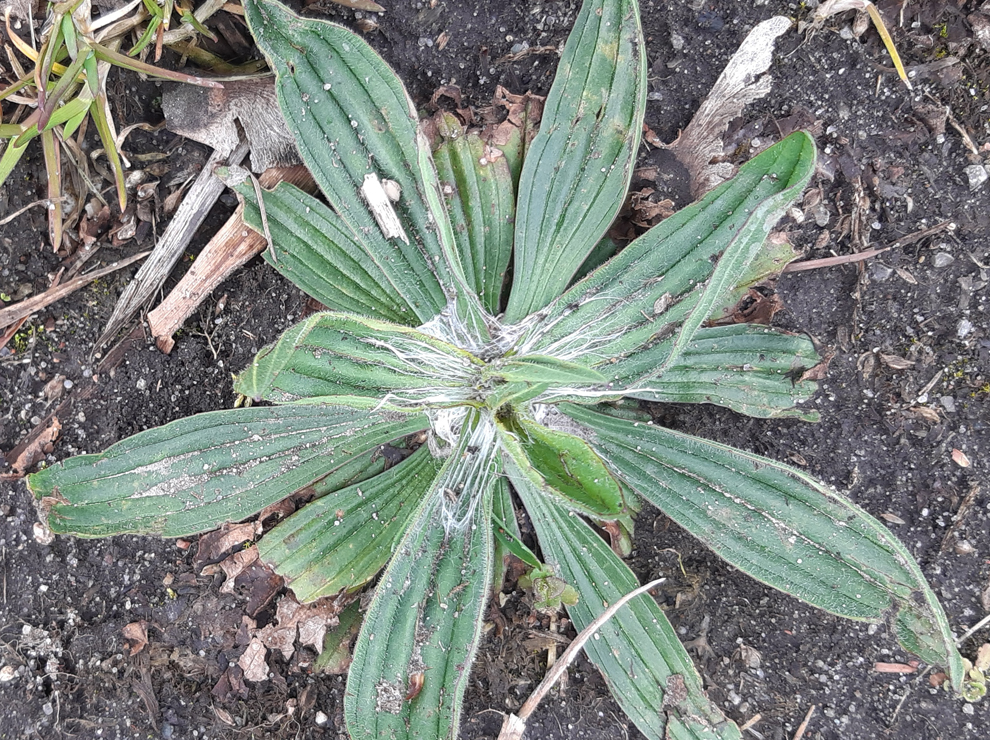


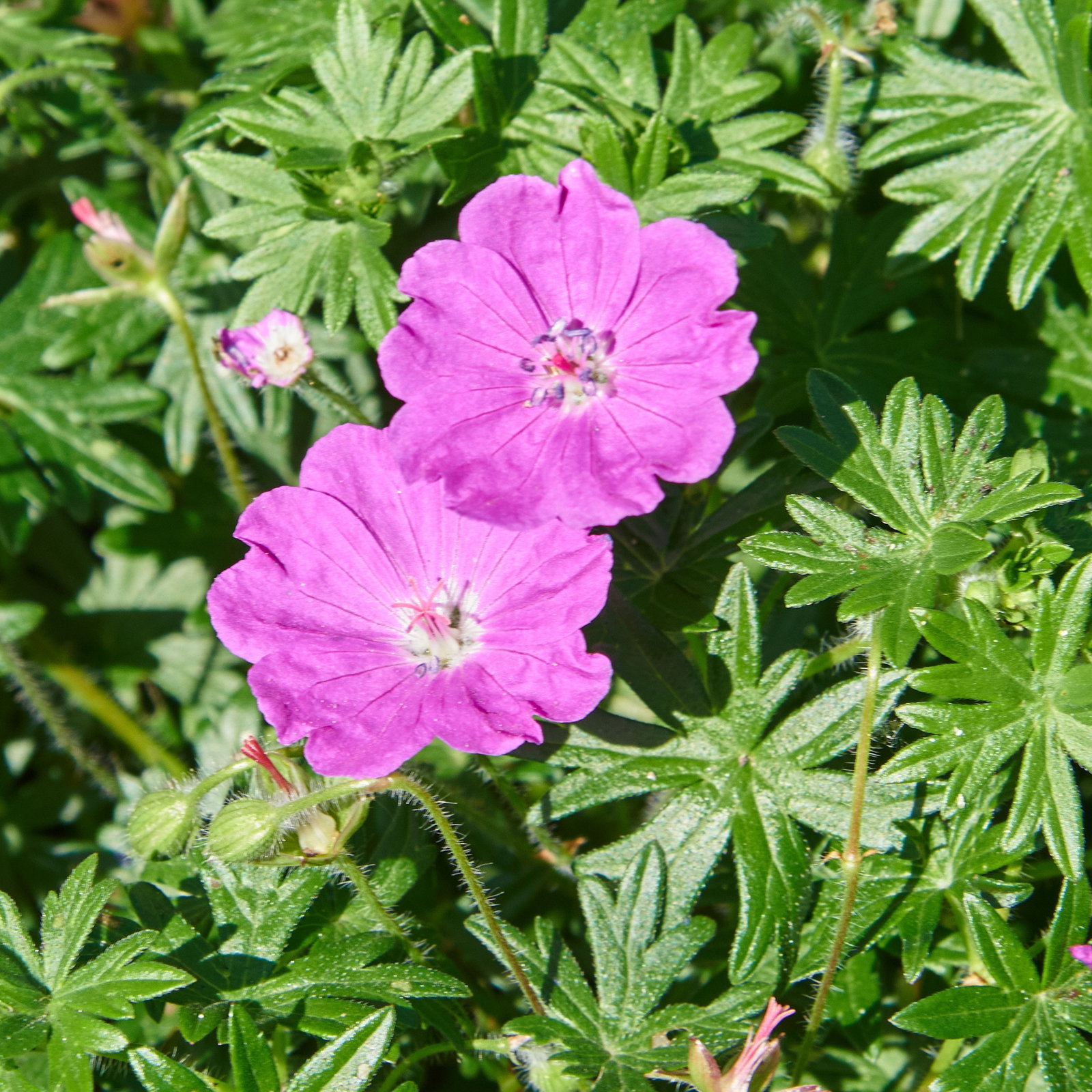

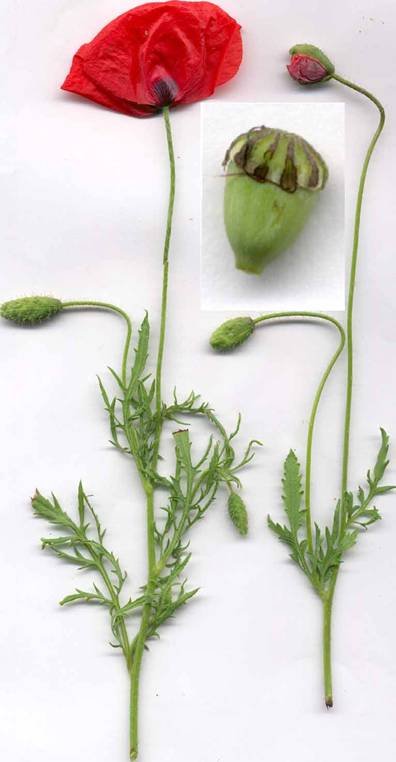
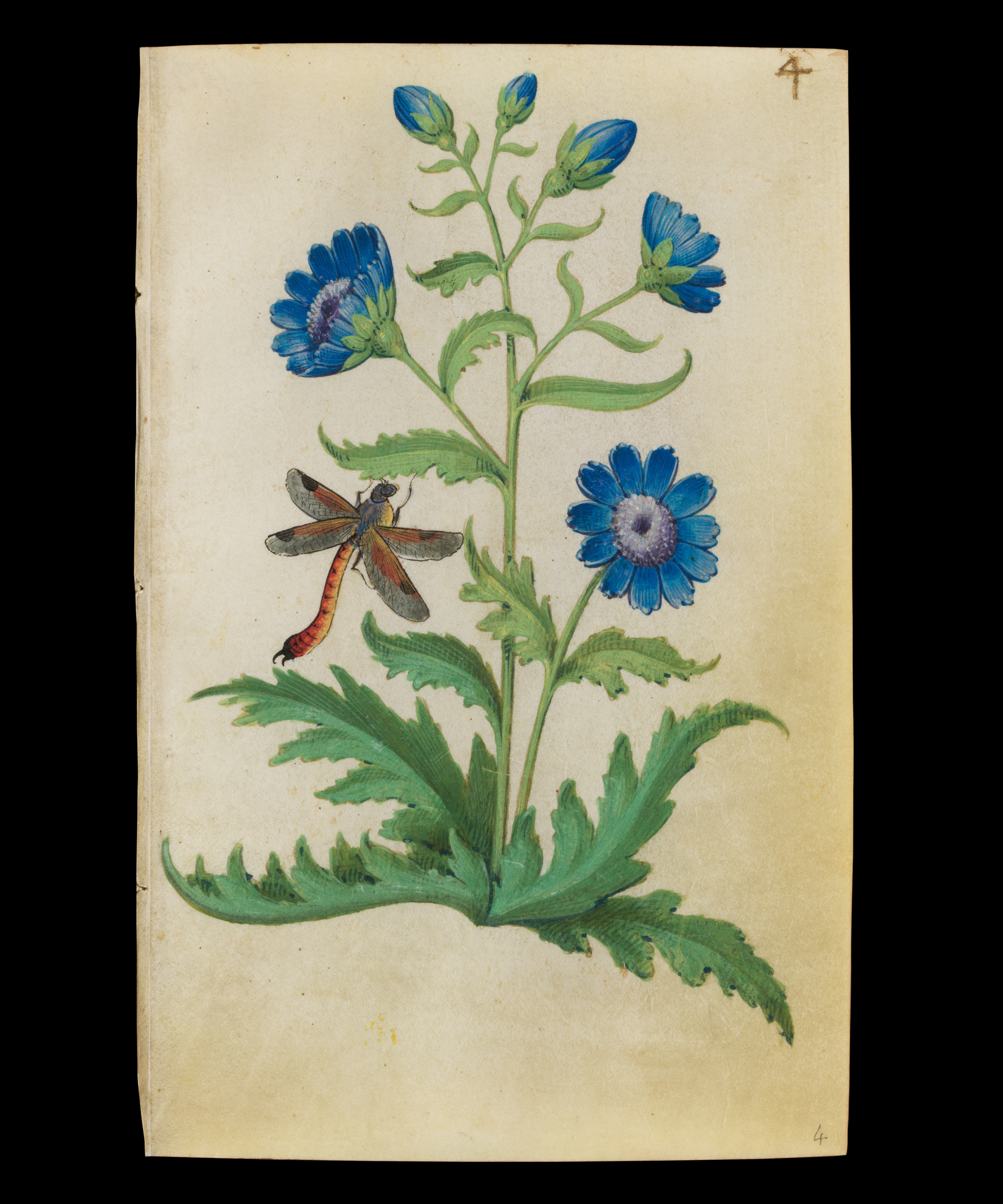
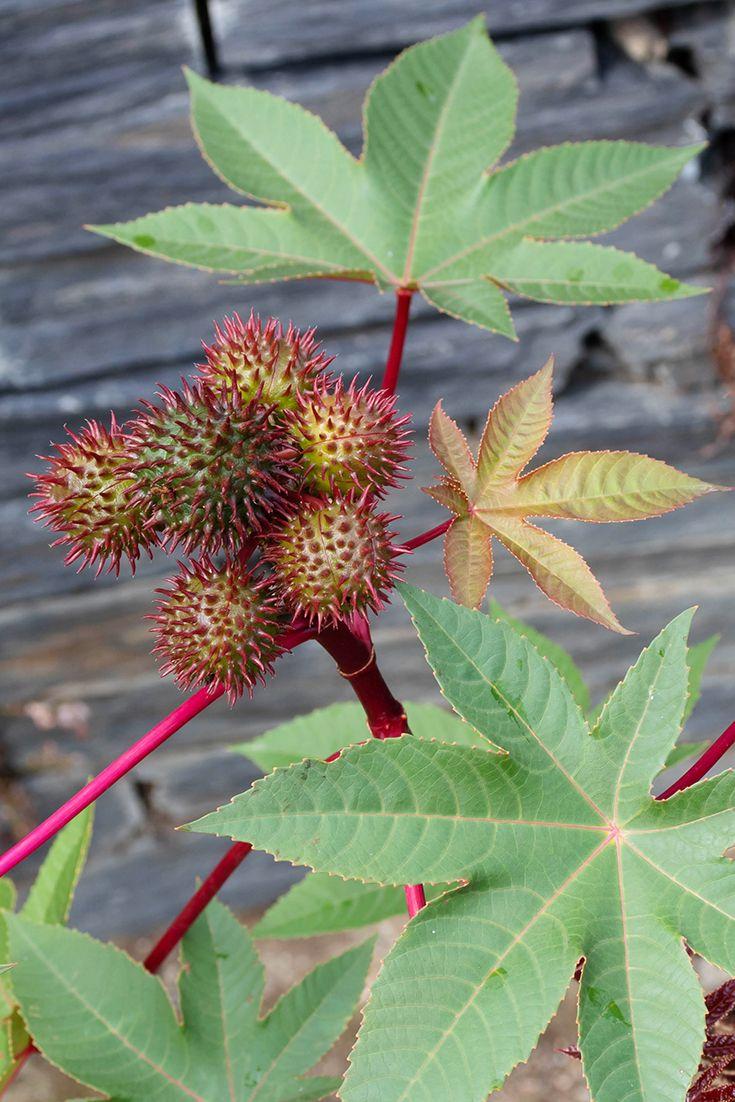
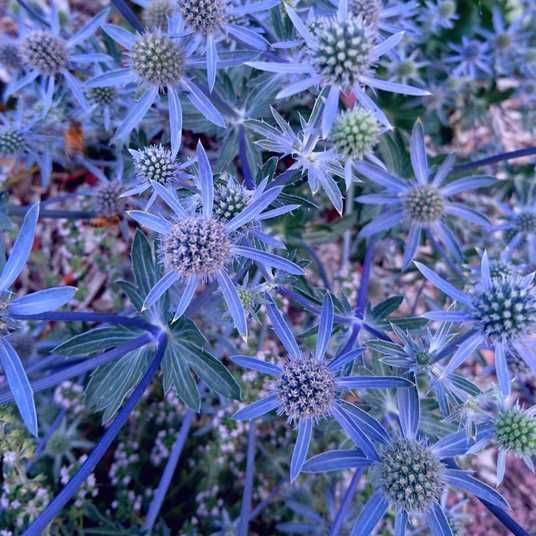

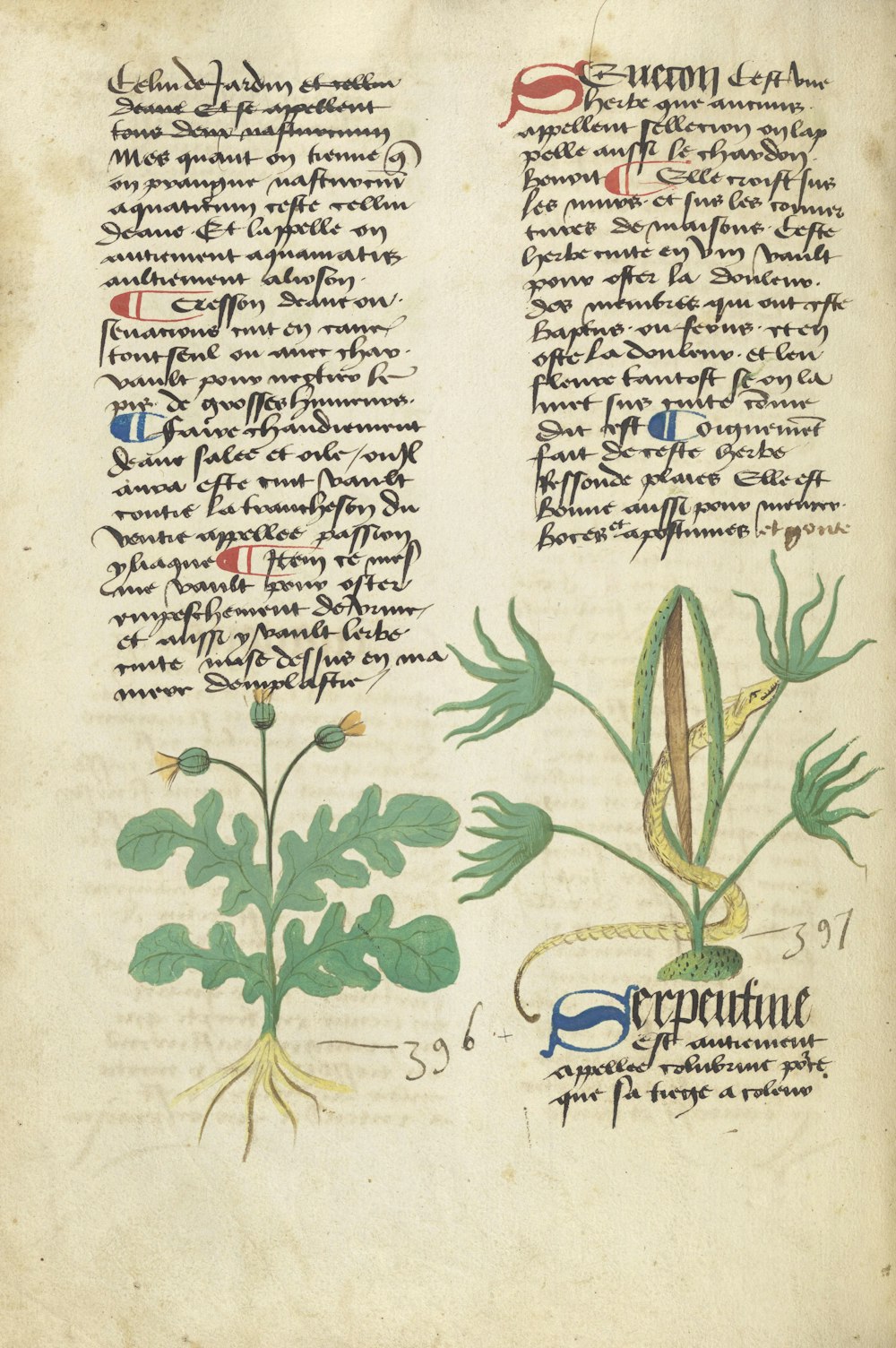


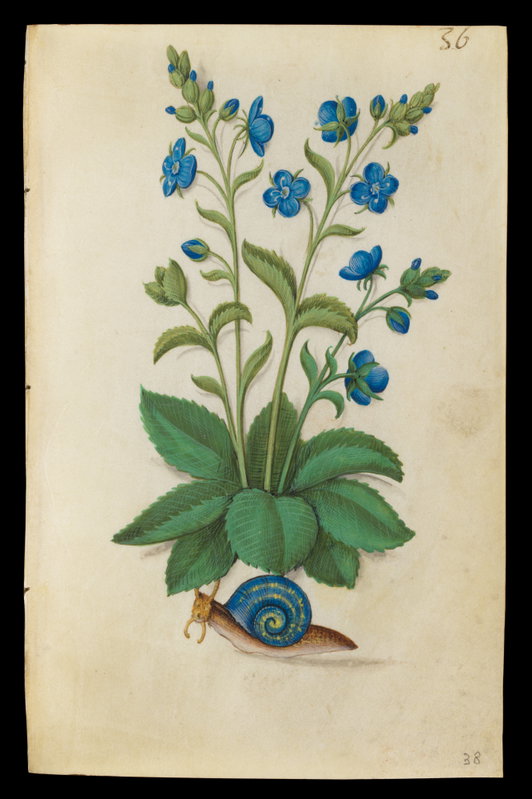

.jpg)

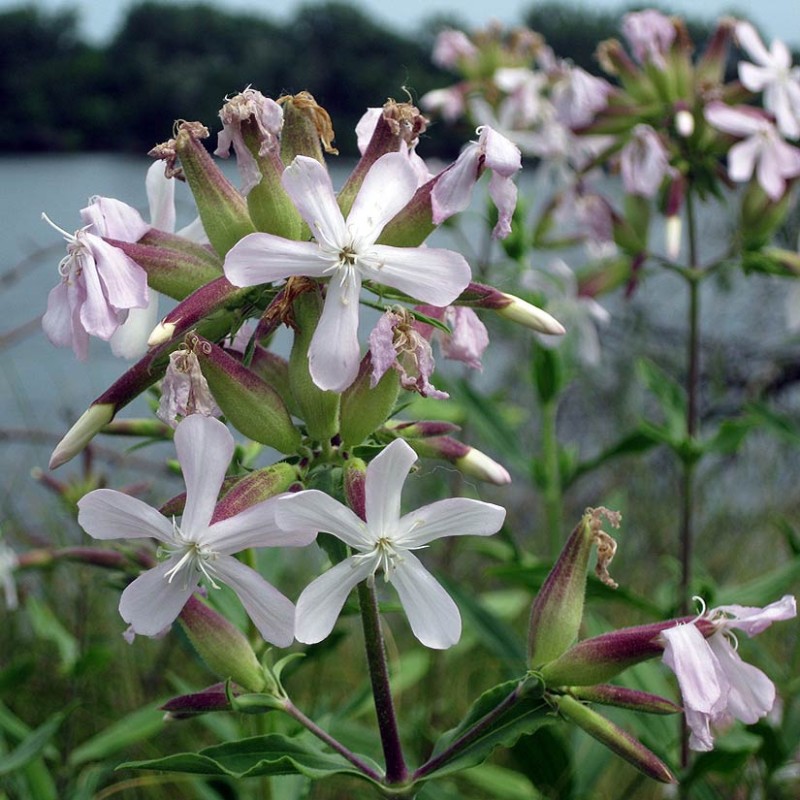
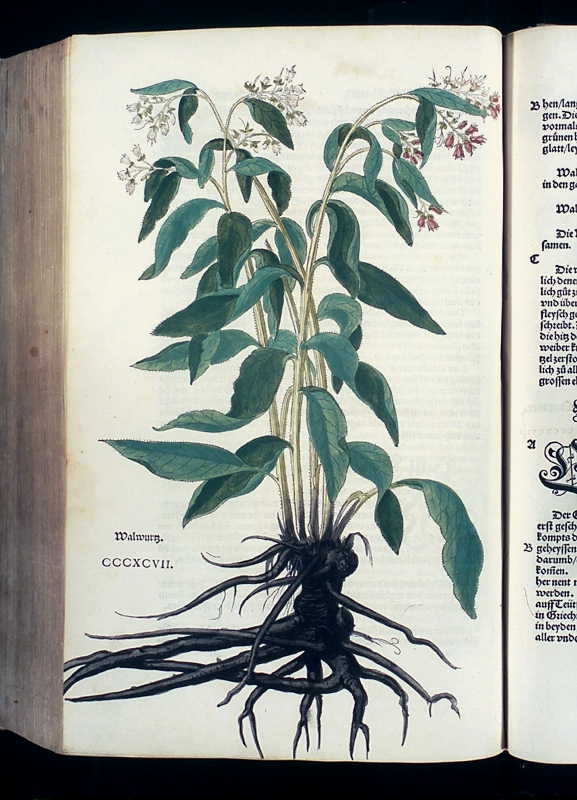


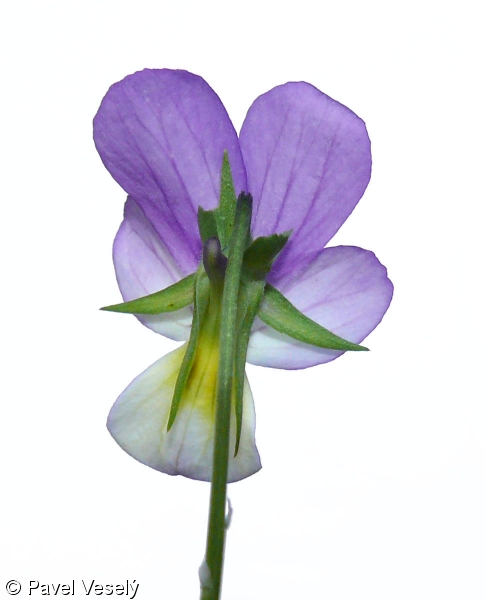
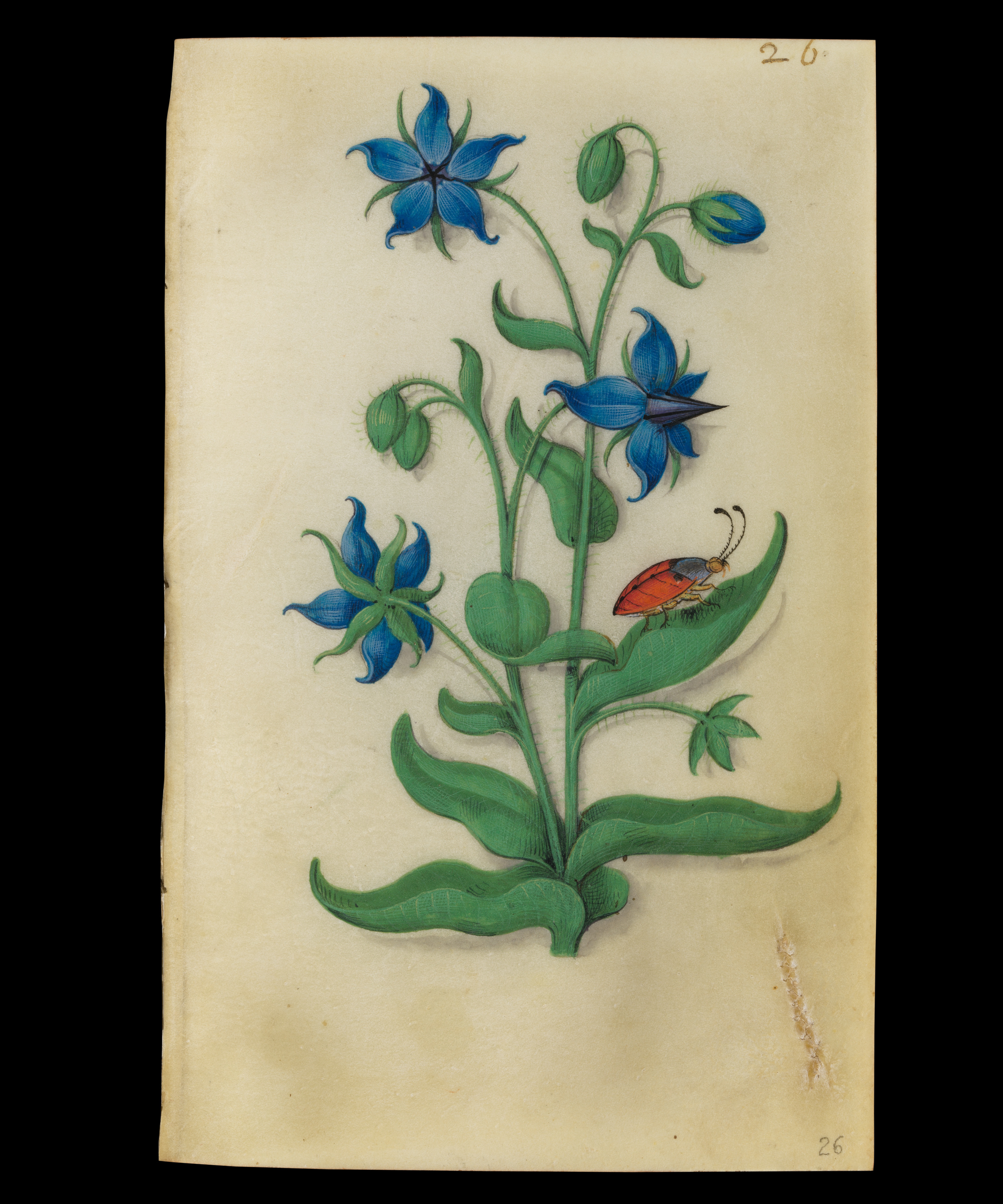


_Viola_arvensis_-_flower_and_leaves.jpg)

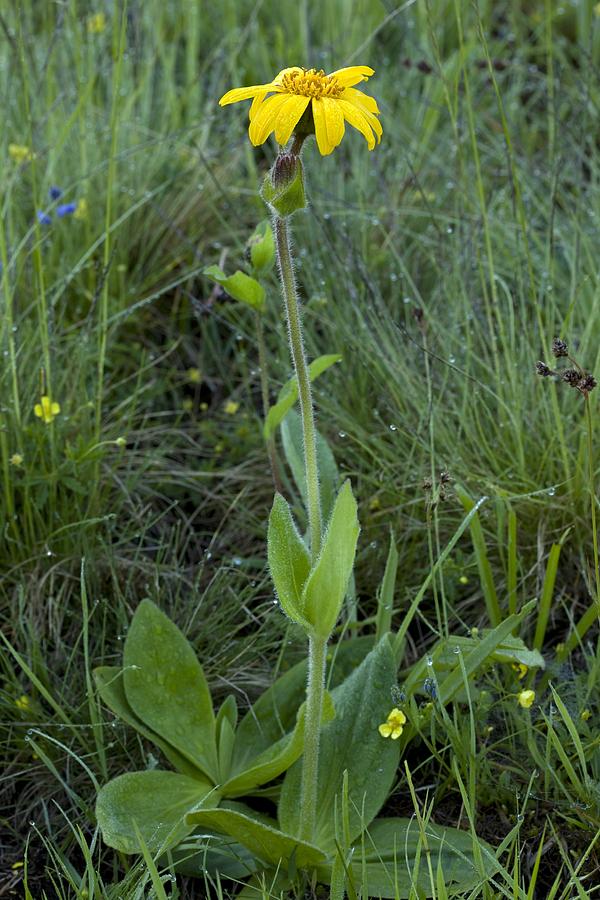

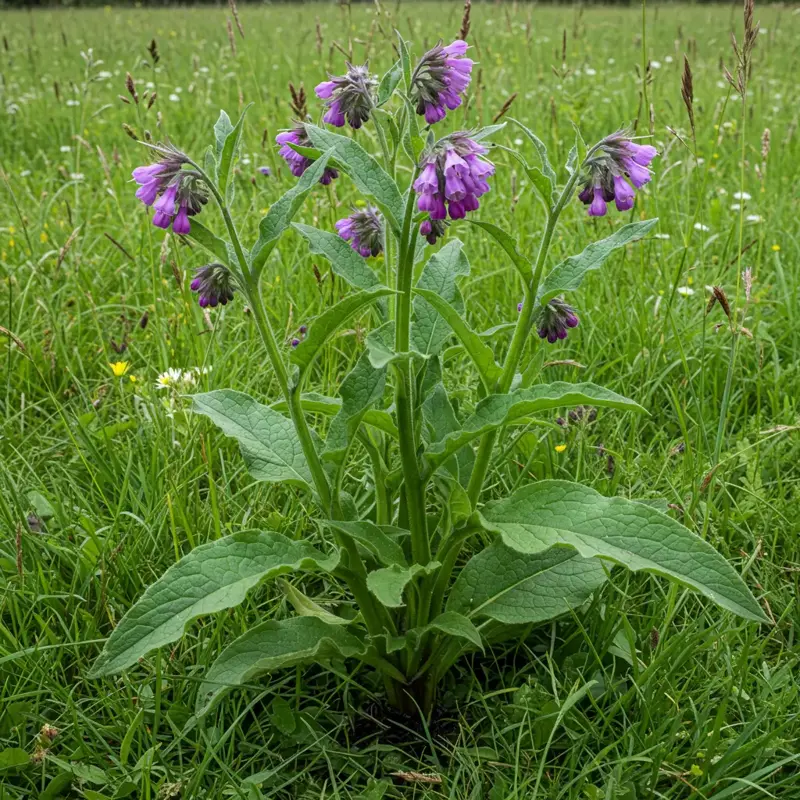


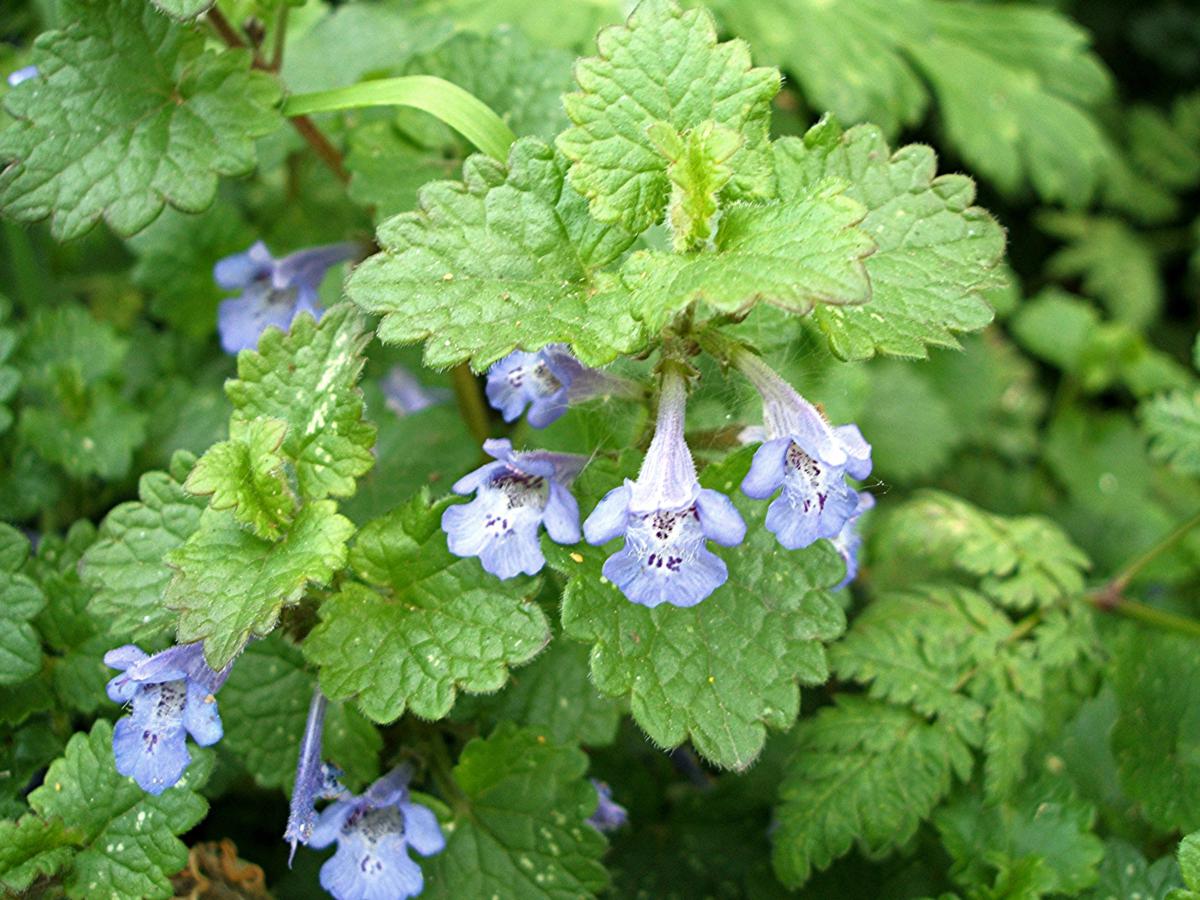

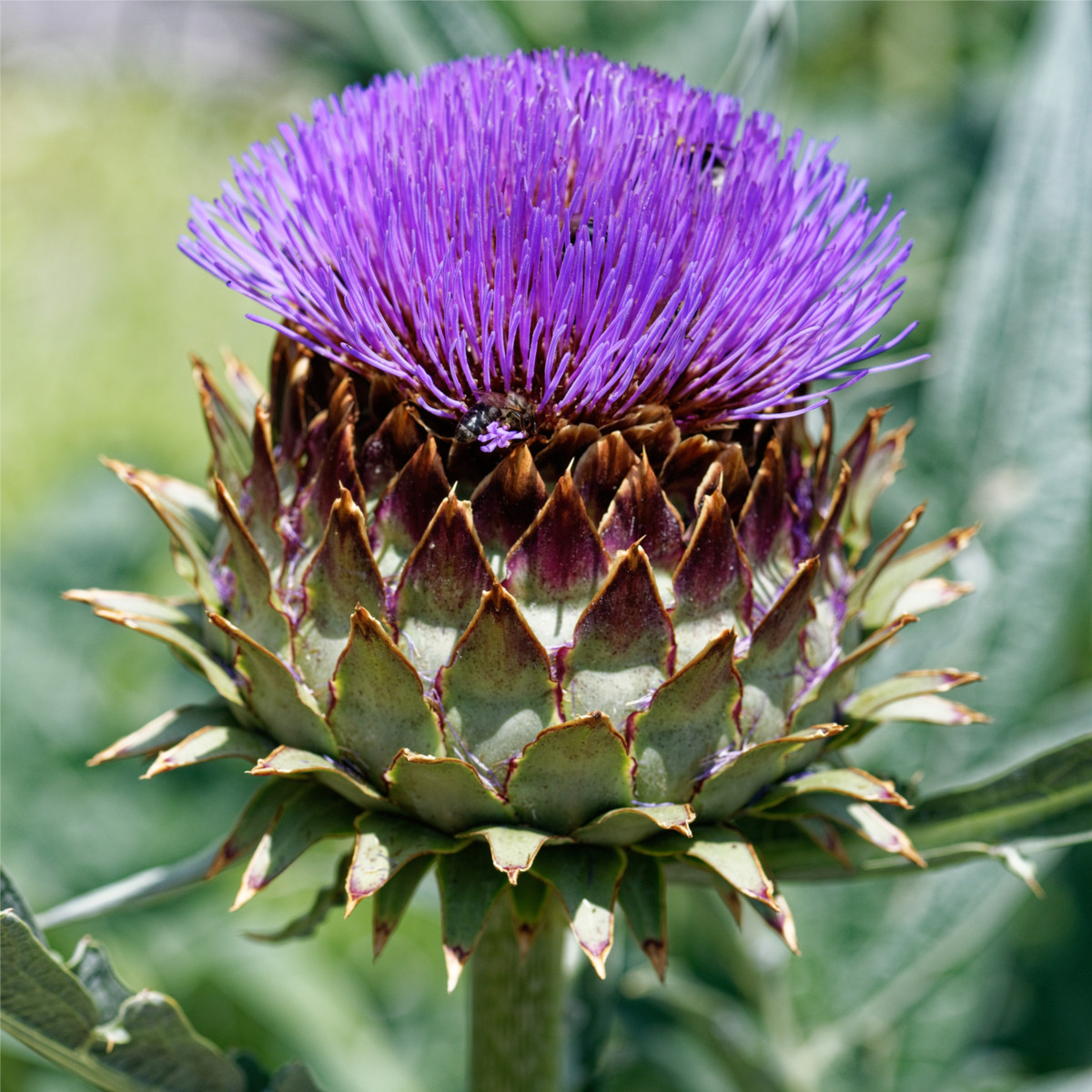


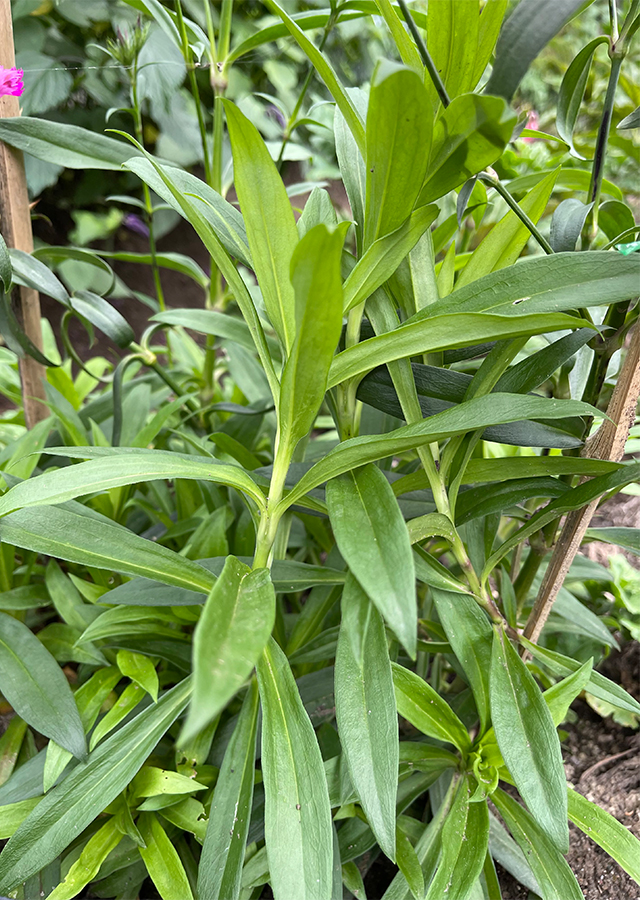

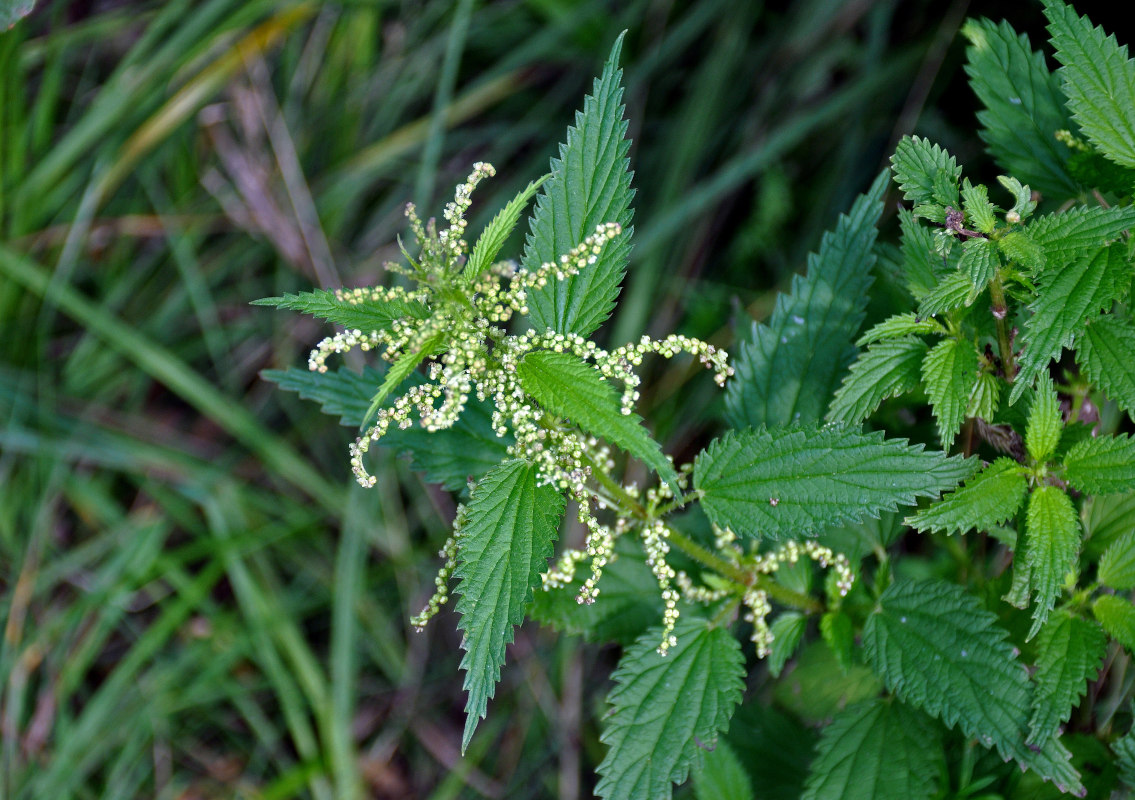
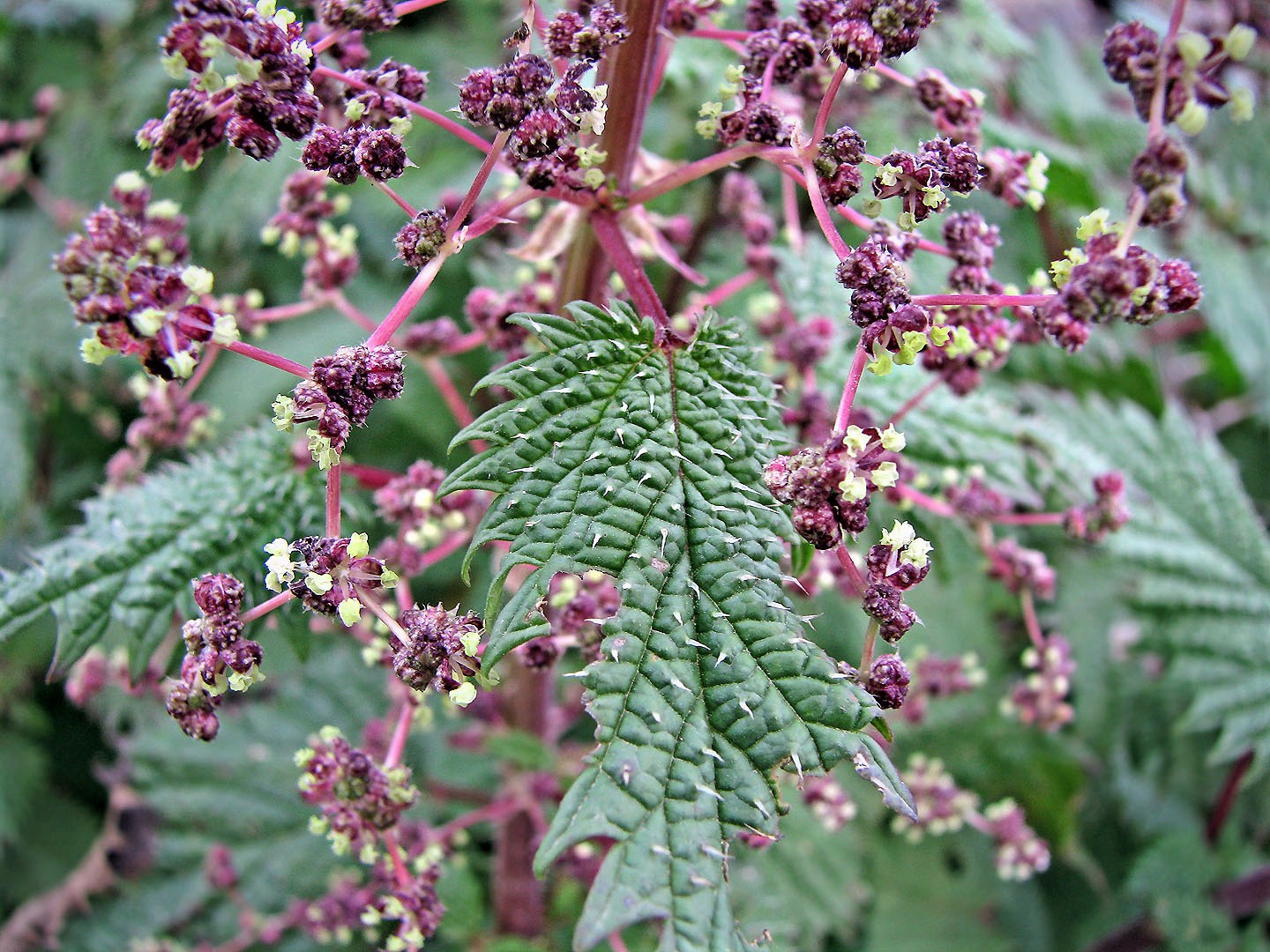
.jpg)
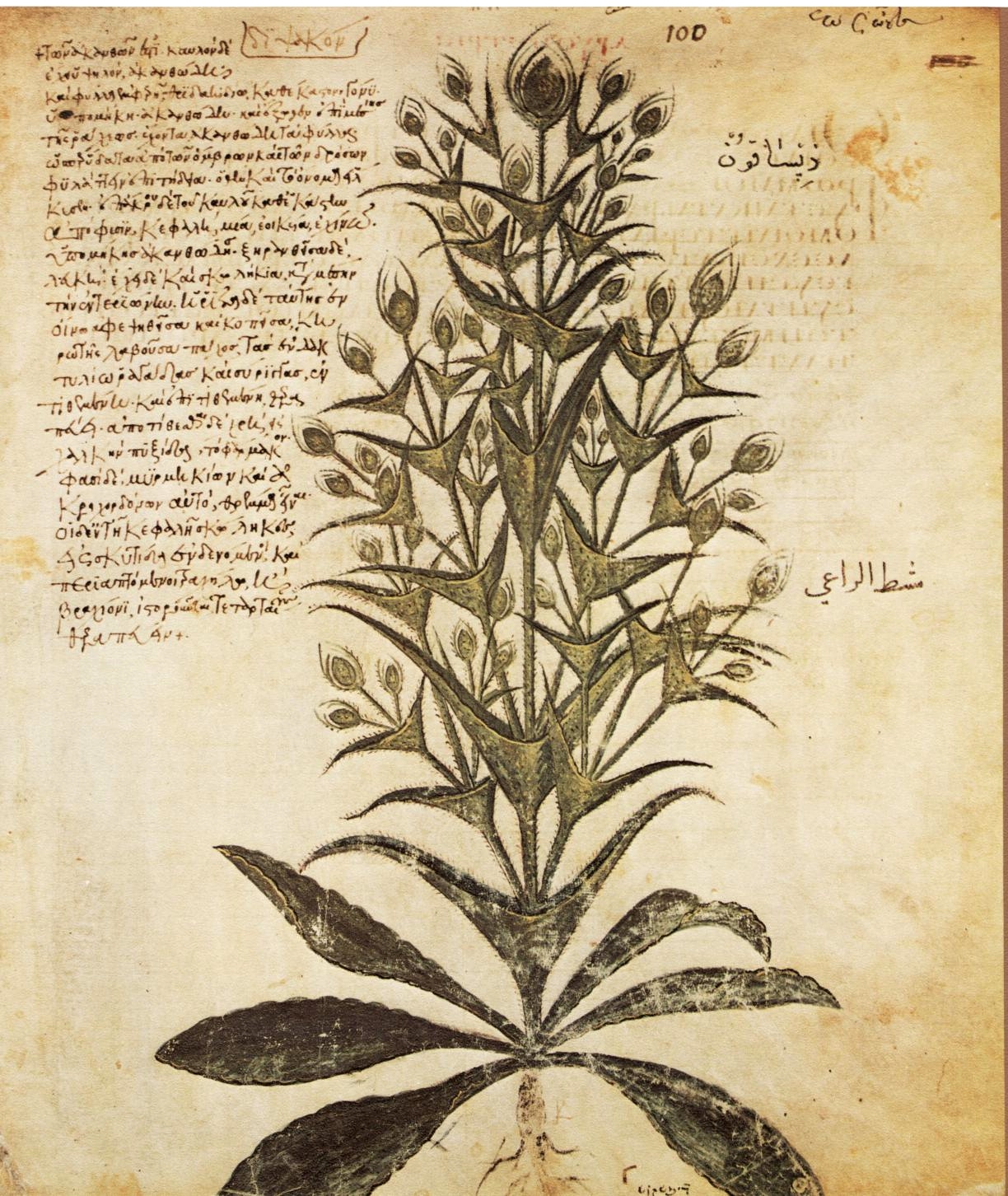
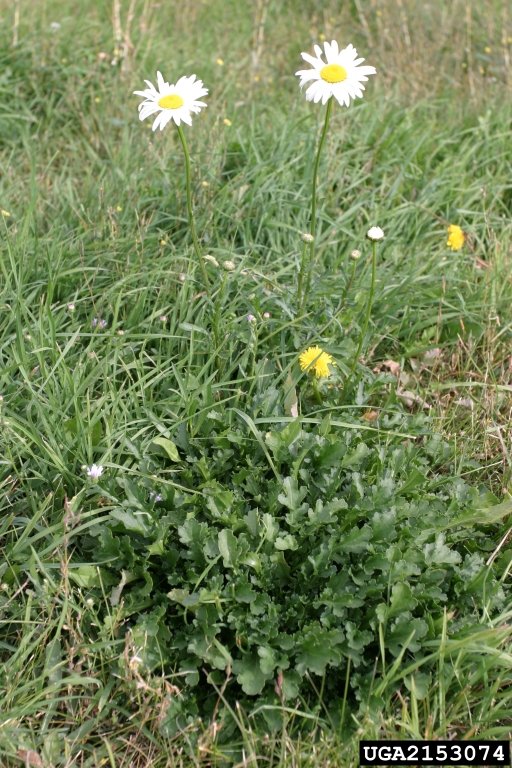


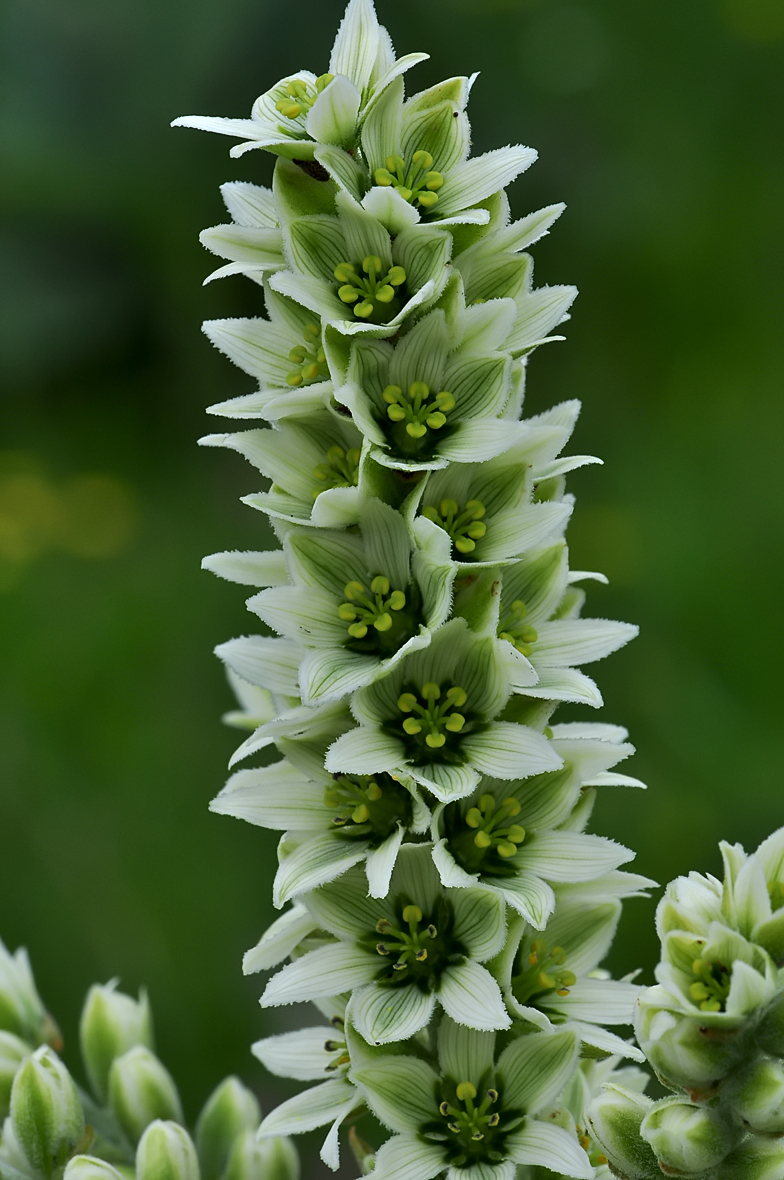

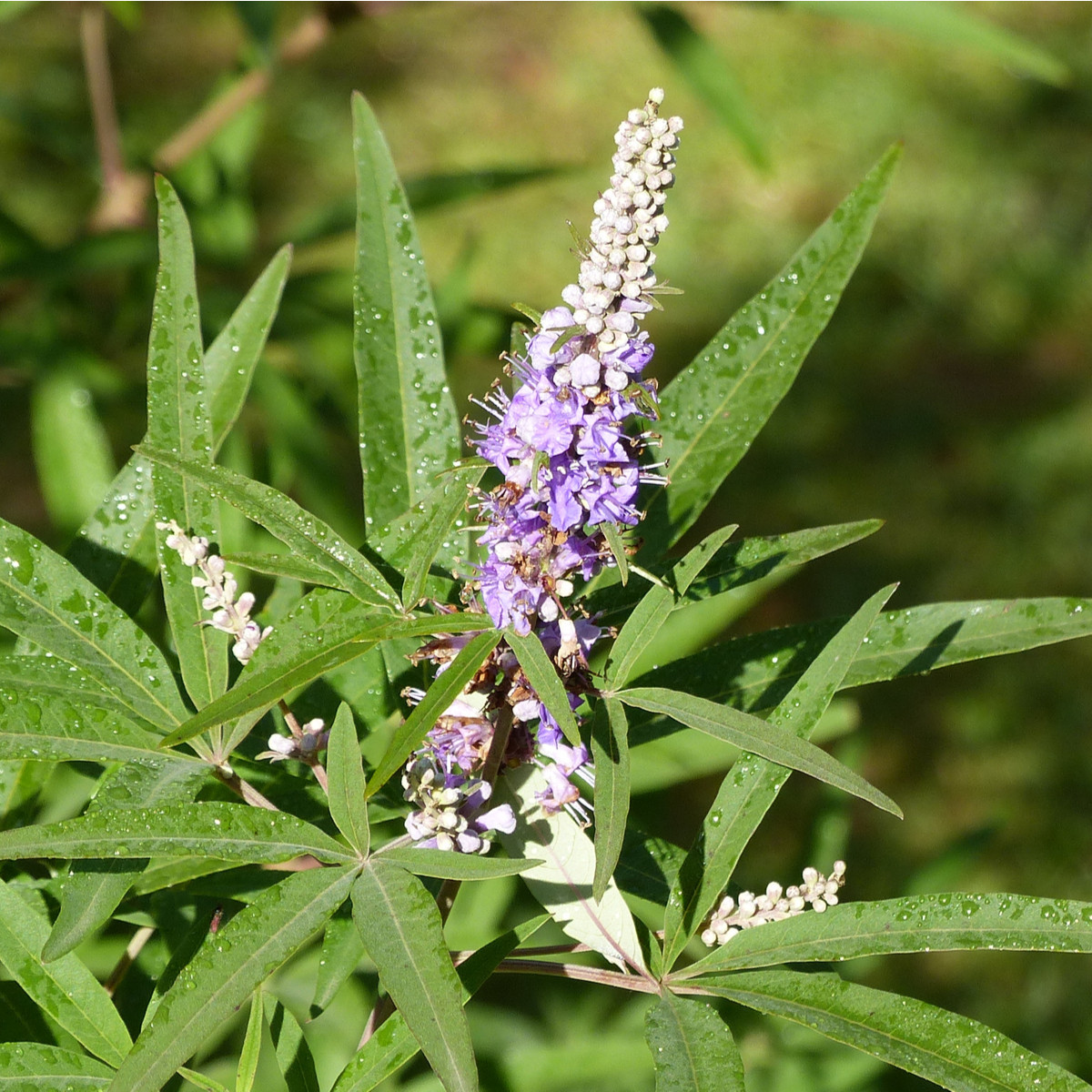

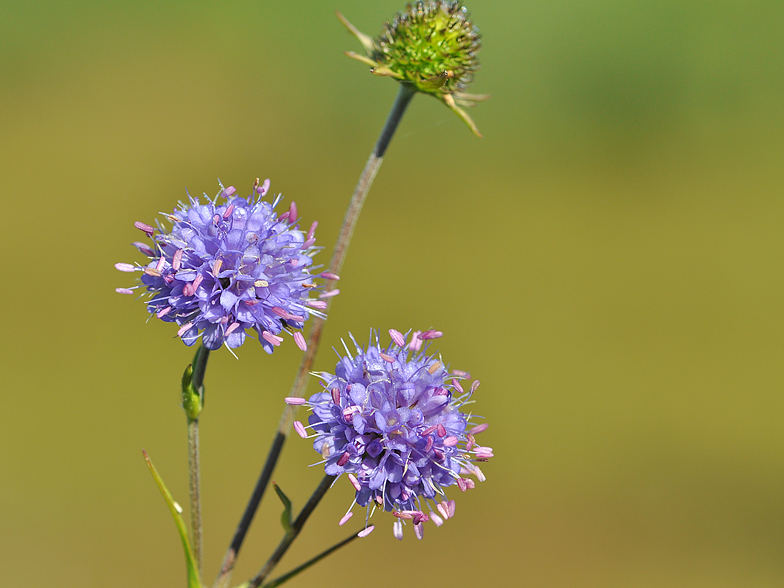
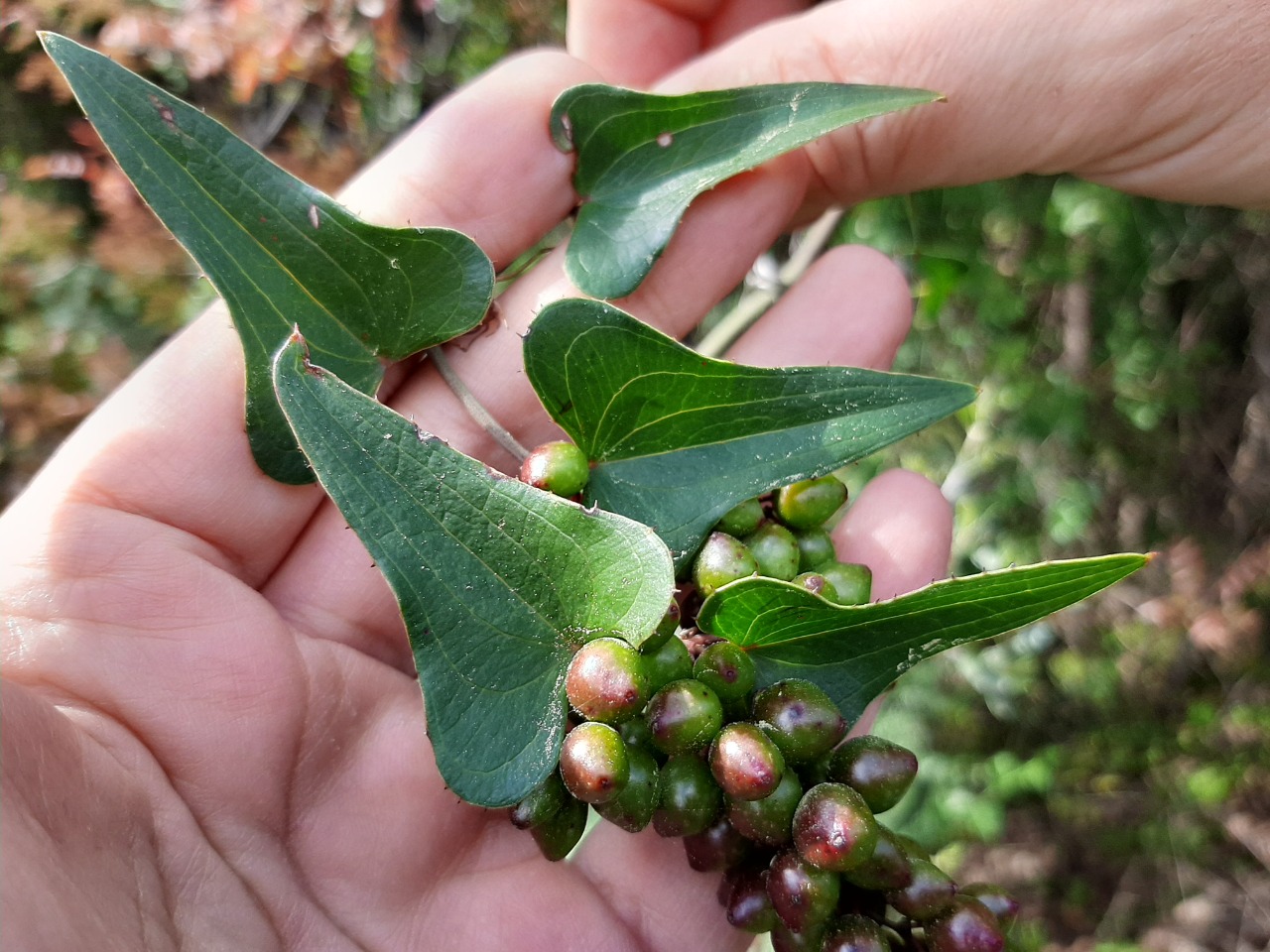
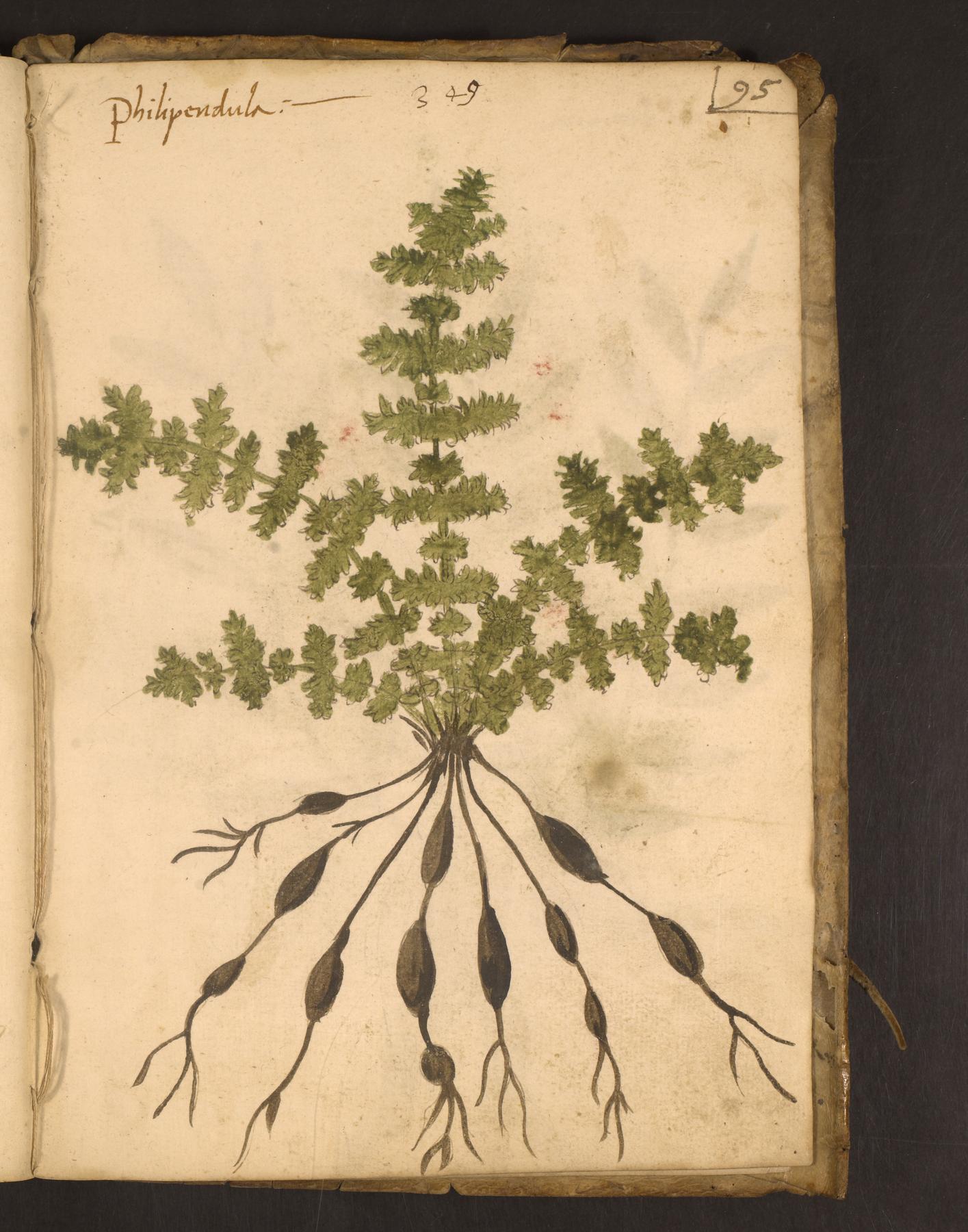
.jpg)